
Google Executive Confirms AI Search Users Submit Longer Natural Language Queries, Breaking Traditional Keyword Patterns
Google's Liz Reid disclosed on the Bloomberg Odd Lots podcast that users submitting queries through AI Mode and AI Overviews are expressing significantly longer, natural language questions that fragment into multiple keyword-level searches, according to Search Engine Journal.
 Marcus Webb··3 min read
Google Executive Confirms AI Search Users Submit Longer Natural Language Queries, Breaking Traditional Keyword Patterns
Google's Liz Reid disclosed on the Bloomberg Odd Lots podcast that users submitting queries through AI Mode and AI Overviews are expressing significantly longer, natural language questions that fragment into multiple keyword-level searches, according to Search Engine Journal.
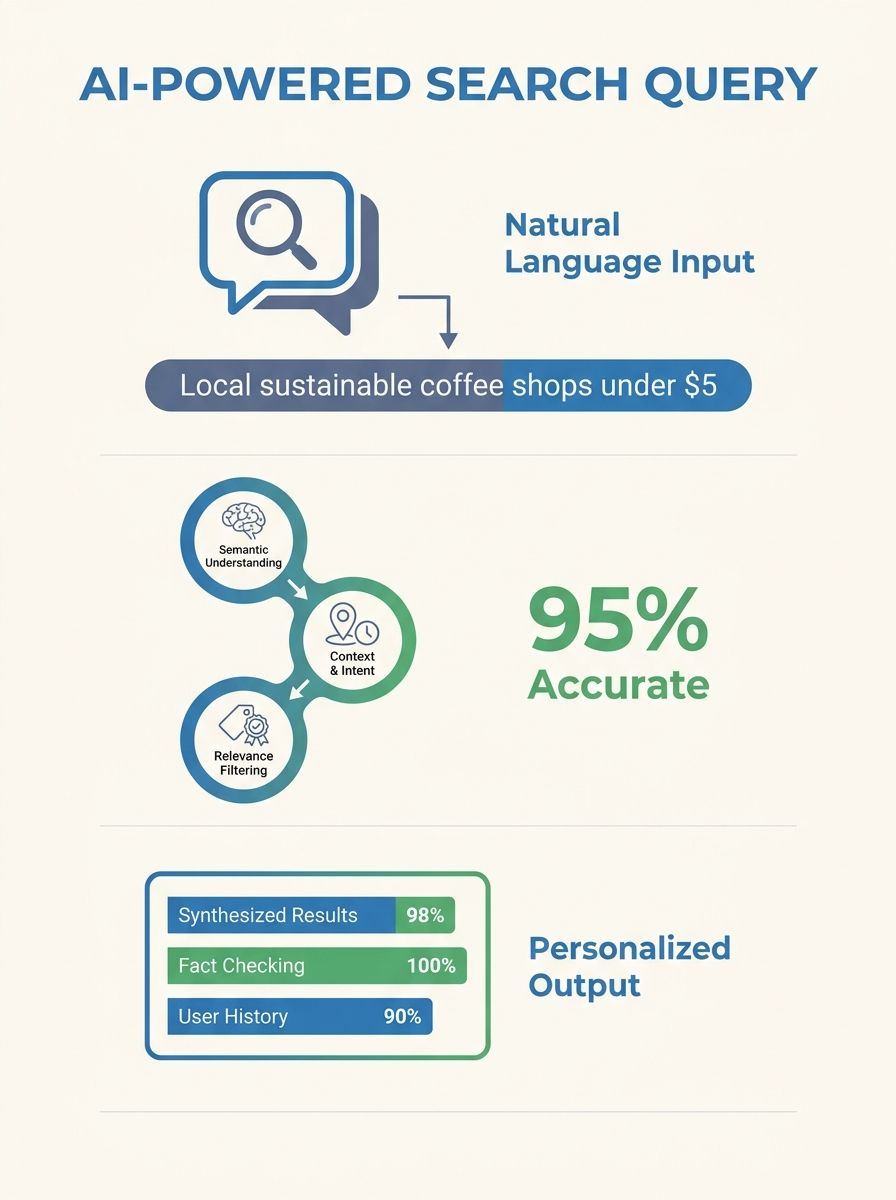
Reid, who leads Google's search division, explained that the shift represents a fundamental change from traditional keyword-based search behavior. Users who previously compressed complex information needs into short phrases like "restaurants New York" now articulate detailed multi-factor requirements directly to AI-powered search interfaces.
Traditional Keyword Compression No Longer Required
The executive provided a specific example of the behavioral change. A user's actual information need might involve finding a restaurant in a specific location for five people, with vegan options, accommodating children, and fitting a particular budget range. Under traditional search, users compressed that complexity into two or three keywords because they lacked confidence the search engine could parse detailed natural language.
"In the old world of keyword-ese, that information would be spread throughout the web," Reid said. "And so you wouldn't feel confident you could just put in the question. And now with AI Overviews and AI Mode, you can start to actually, and you see people do this, they tell you the real problem."
Query Fan-Out Maintains Classic Search Infrastructure
Reid's remarks clarified how Google processes these longer queries internally. The system breaks complex natural language questions into smaller, highly specific keyword phrases through a process called query fan-out. Those fragmented queries then route to classic search infrastructure, where Google retrieves top-ranking results for each component phrase and synthesizes an AI Overview response.
This technical detail carries implications for search optimization approaches in the AI-driven era. Rather than requiring entirely new optimization strategies for long-tail natural language queries, websites still compete on the specific keyword phrases that emerge from Google's query fragmentation process.
The shift does create new technical challenges for Google. Reid noted that diverse natural language queries create caching limitations that don't exist when millions of users submit identical keyword phrases. "If all of a sudden the queries get much more diverse, you know, it has consequences there," she said, referring to latency and infrastructure considerations.
Multiple Pages May Share AI Overview Space
Reid's explanation suggests that a single complex query may not be satisfied by any individual web page. Instead, Google's AI synthesizes information from multiple sources, each optimized for different component phrases extracted from the natural language query.
This fragmentation increases competition for visibility within AI Overviews. Multiple websites share the limited space available in AI-generated responses, which may shift optimization priorities toward factors like distinctive brand presentation, relevant imagery, and video content that command more attention within the shared response format.
The executive confirmed that Google observes "meaningfully longer queries" and "more natural language queries" among users interacting with AI-powered search features. The pattern represents users attempting to transfer the cognitive work of query formulation to the search engine rather than translating their needs into machine-friendly keyword syntax.
Reading Between the Lines
Google's official acknowledgment of query fragmentation and fan-out architecture provides rare clarity on how AI search systems process natural language input. For SEO professionals evaluating agency capabilities and optimization strategies, this confirmation suggests that traditional keyword research and page-level optimization remain foundational despite the natural language interface layer.
The practical implication is that websites still need to rank for the specific, granular keyword phrases Google extracts during query fan-out. A page optimized for "vegan restaurants downtown" remains competitive even when users submit a 40-word natural language query, provided that phrase is among the fan-out components Google fires to classic search.
However, the shared-space dynamic within AI Overviews adds a new competitive dimension. Ranking alone no longer guarantees visibility when three or four other sites occupy the same AI-generated response. This shifts some optimization focus toward brand differentiation, visual assets, and structured data that help a site claim more real estate within the synthesized answer—factors that traditional keyword ranking metrics don't fully capture.
Marcus Webb
Digital marketing consultant and agency review specialist. With 12 years in the SEO industry, Marcus has worked with agencies of all sizes and brings an insider perspective to agency evaluations and selection strategies.
Explore more topics