
Why Product SEO and Traditional Enterprise SEO Require Different Agency Skill Sets in 2026
The invoice showed $18,500 per month for "enterprise-grade SEO services." The deliverables list included keyword research, technical audits, content briefs, and product page optimization for a catalog of 40,000 SKUs.
 Marcus Webb··9 min read
Why Product SEO and Traditional Enterprise SEO Require Different Agency Skill Sets in 2026
The invoice showed $18,500 per month for "enterprise-grade SEO services." The deliverables list included keyword research, technical audits, content briefs, and product page optimization for a catalog of 40,000 SKUs. It was the exact same scope you'd find on a $3,000/month ecommerce package, with bigger fonts and a fancier PDF template. The client, a consumer electronics brand with both a DTC storefront and a sprawling corporate domain, had signed this contract fourteen months earlier. When I reviewed the engagement, organic revenue from product pages had flatlined, and the corporate domain's crawl efficiency had actually worsened. The agency was staffed entirely by content marketers. They didn't have a single data engineer or structured data specialist on the account team.
This wasn't incompetence. It was a structural mismatch between what the client needed and what the agency knew how to do. And the mismatch has gotten worse as the discipline has fractured.
When "Full-Service" Meant One Playbook at Two Price Points
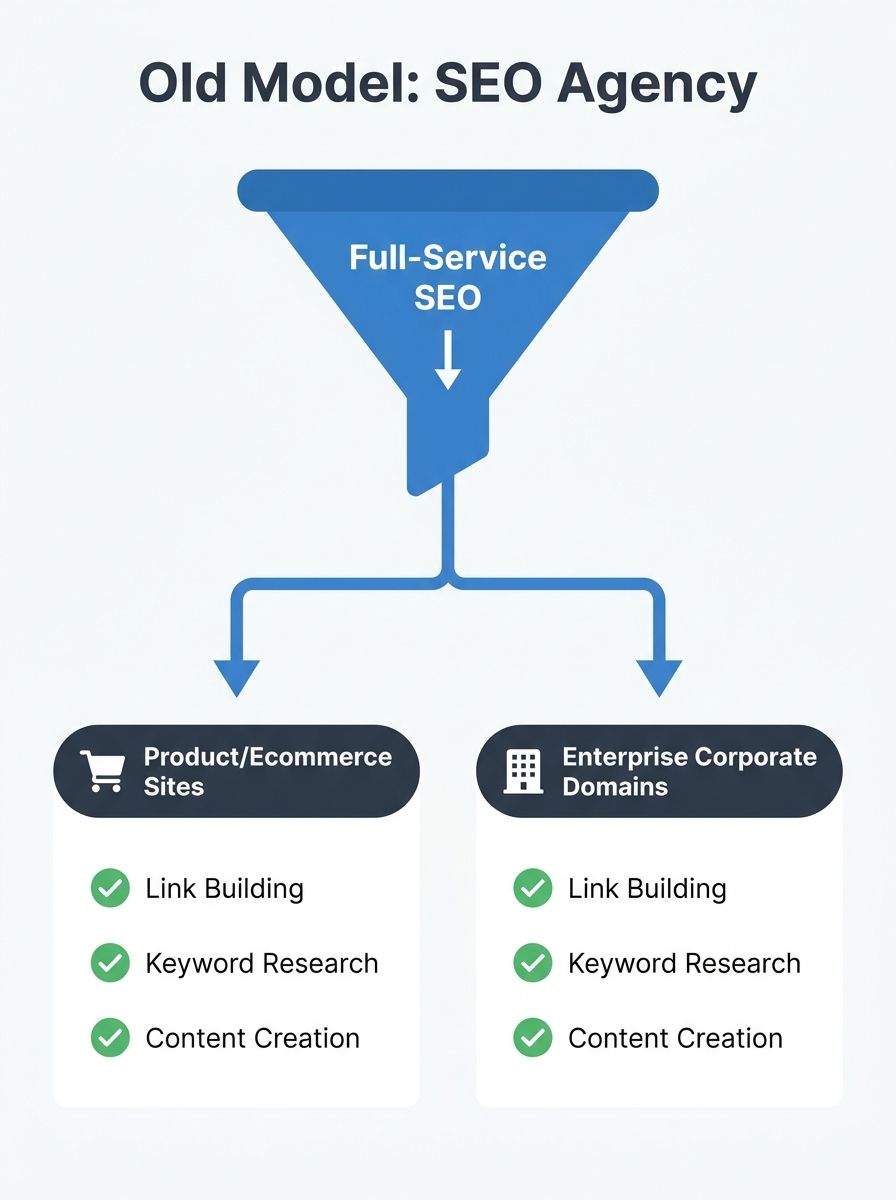
For most of the 2010s and into the early 2020s, the SEO industry drew a line between "regular SEO" and "enterprise SEO" based almost entirely on scale. Enterprise meant more pages, more keywords, more stakeholders, and a bigger monthly retainer. The underlying methodology stayed the same: keyword research, on-page optimization, link acquisition, technical audits. Agencies would pitch a $5,000/month package and a $25,000/month package, and the difference was volume of deliverables rather than a fundamentally different approach.
Product SEO specialization as a distinct discipline didn't exist in most agency org charts. If you sold physical products online, you got the same content-and-links playbook as a SaaS company or a hospital network. The assumption was that SEO was SEO, and the only variable was how many resources you threw at it.
This worked when Google's algorithm treated all content roughly the same way. A well-optimized product page and a well-optimized corporate landing page competed using the same signals: backlinks, keyword density, page speed, and domain authority. Agencies could staff generalists across both account types and produce decent results.
The Cracks Appear: Entity-Based Search Changes the Product Game
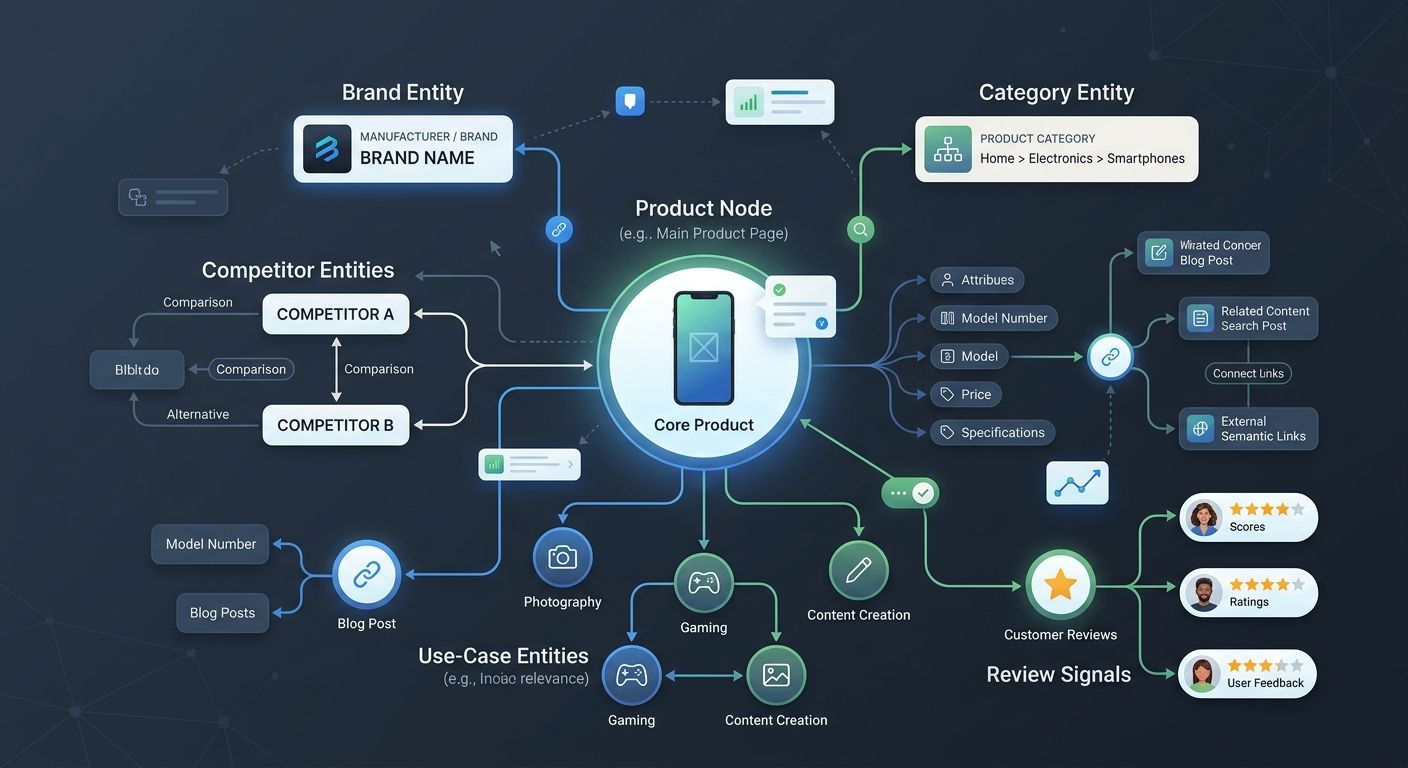
The shift started when Google's understanding of entities matured. Product pages stopped being evaluated as isolated keyword targets and began functioning as nodes in a knowledge graph. A product page for "wireless noise-canceling headphones" wasn't competing on keyword match anymore. It was competing on how well Google understood the relationships between that product, its brand, its category, its use cases, its competitors, and its review ecosystem.
Ecommerce entity optimization became a real discipline around this time. Agencies working with ecommerce brands started using entity co-occurrence analysis to understand how Google connected products to related concepts. By mapping these entities, agencies could uncover user intent that traditional keyword research missed entirely: whether a searcher wanted product recommendations, feature comparisons, or buying guidance.
This was the first major fork. Product SEO required specialists who could think in terms of entity relationships and buyer intent mapping, not just keyword volume. A content marketer who wrote blog posts about "best wireless headphones" wasn't delivering value if they couldn't connect that content to specific product entities, review schemas, and purchase-stage intent signals.
The agency skill gaps became obvious. I reviewed an engagement where a mid-tier agency was producing 8,000 words of category page content per month for a home goods retailer. Beautiful content. Well-written. But none of it used Product schema markup. None of it mapped to specific buyer intent stages. And the agency's team didn't know what entity co-occurrence meant when I asked them. They were still playing the 2019 game on a 2024 field.
Enterprise SEO Becomes an Infrastructure Problem
While product SEO was evolving toward entity-based intelligence, enterprise SEO was moving in a completely different direction. The challenge at scale stopped being "how do we optimize more pages" and became "how do we govern a system of millions of pages without breaking anything."
As Adcetera documented in their analysis of enterprise versus traditional SEO, enterprises must account for scale, stability, and risk mitigation in ways that smaller operations never face. Updates get released in phased rollouts across templates, regions, or business units. SEO timelines align with broader development sprints, meaning work gets batched and scheduled within IT or product cycles that extend turnaround times far beyond what a product-focused team would tolerate.
Hallam's research on what changes at enterprise scale puts it plainly: manual content creation cannot scale at the enterprise level. Organizations shift toward programmatic SEO, using automation and structured data to generate high volumes of pages targeting long-tail search intent. The skills required to build and maintain those systems are engineering skills, not marketing skills.
Search Engine Journal's analysis of enterprise SEO job requirements confirmed what I was already seeing in agency staffing: the ability to organize massive audits, coordinate across teams, execute on timelines, and report against goal estimates had become the core competency. Strategy and project management overtook content creation as the primary value an enterprise SEO team delivered.
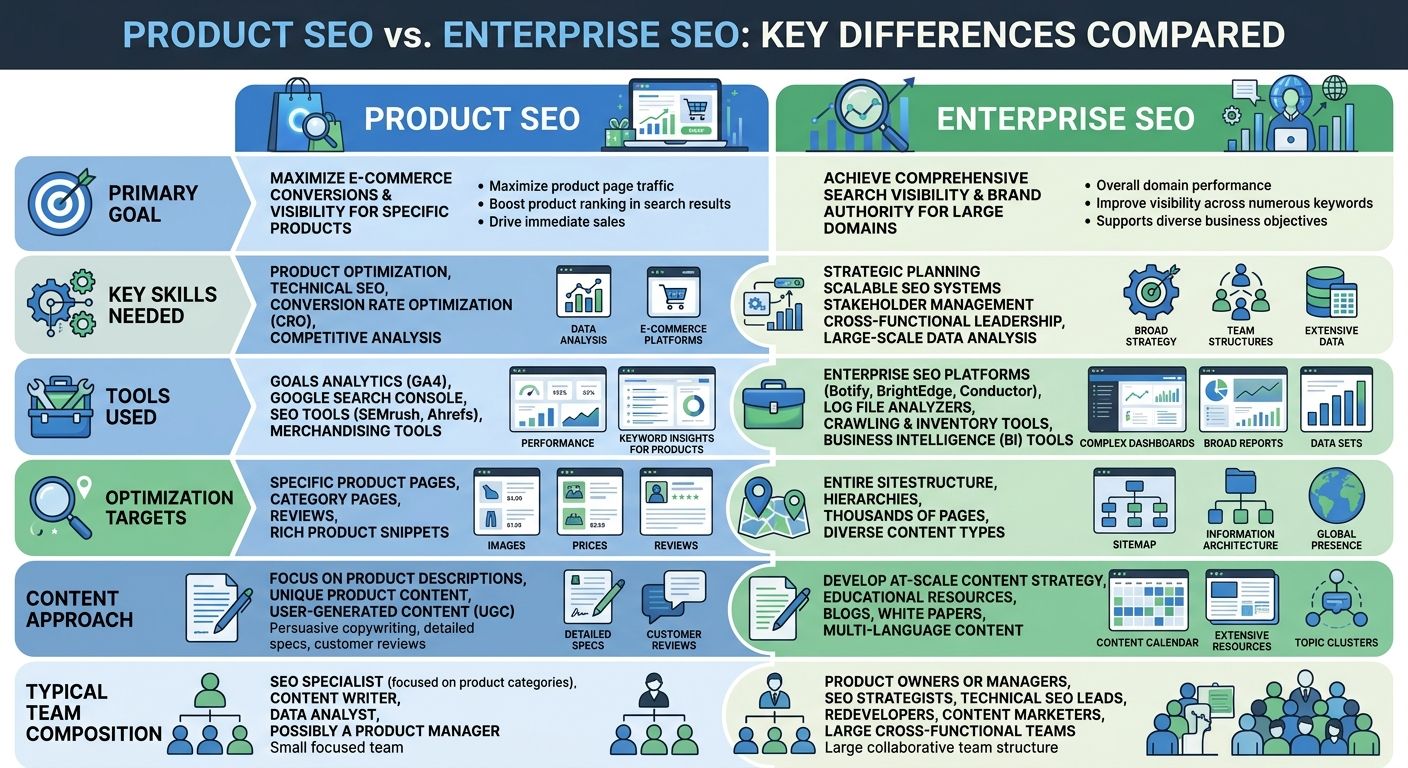
And here's where the hiring conversation gets real. If you're an enterprise brand evaluating agencies, you need people who understand crawl budget allocation, log file analysis, and cross-functional workflow management. If you're a product brand, you need people who understand buyer psychology, entity relationships, and product schema implementation. The Venn diagram overlap between those two talent profiles has been shrinking every year.
The Vertical Search Dimension Made Everything Worse
As if the entity-versus-infrastructure split wasn't enough, the rise of vertical search engines added another layer of divergence. Vertical search platforms are specialized search tools that cater to specific industries or content types. Google Shopping, Amazon's A10 algorithm, Pinterest's visual search, Kayak, Trulia: each operates with its own ranking logic and optimization requirements.
Product SEO teams now need to optimize for these enterprise SEO verticals simultaneously. A product listing that ranks well on Google might be invisible on Amazon. A fashion brand that dominates traditional search might get zero traction on Pinterest's visual discovery engine. Each vertical demands tailored strategies and platform-specific expertise.
This trend mirrors what's happening in vertical specialization across local SEO agencies, where generalist shops are losing ground to specialists who know one vertical deeply. The same fragmentation is playing out at the enterprise and product level, and it's creating real confusion for brands trying to hire.
Enterprise SEO, by contrast, rarely touches vertical search in any meaningful way. Corporate domains are optimizing for Google's primary index, internal search functionality, and increasingly, AI crawlers. The vertical dimension is almost entirely a product-side problem.
How the Pricing and Contract Structures Diverged
The talent divergence creates a pricing problem that most agencies handle poorly. I've seen three dominant patterns in how agencies price these services, and two of them are broken.
Pattern one: the blended retainer. The agency charges $15,000 to $30,000 per month and assigns a mixed team to handle both product optimization and enterprise technical work. This is the legacy model, and it consistently underdelivers on both fronts. The content strategists don't understand crawl budget. The technical SEO analysts don't understand buyer intent mapping. Everyone stays in their lane, and the client gets mediocre results across the board.
Pattern two: separate agencies for each function. The brand hires one agency for product SEO ($5,000 to $12,000/month) and another for enterprise infrastructure ($20,000 to $50,000/month). This can work, but coordination becomes a nightmare. I reviewed an engagement where the product SEO agency implemented schema changes that broke the enterprise agency's canonical tag strategy. Neither team had visibility into the other's roadmap. The situation I've documented around why enterprise SEO strategies fail at implementation frequently traces back to exactly this kind of inter-agency friction.
Pattern three: one agency with distinct practice groups. The agency maintains separate teams with different skill sets, processes, and even billing structures for product and enterprise work. This is the model that actually works, but very few agencies have built it. It requires the agency to admit that these are different disciplines requiring different hiring profiles, different tools, and different success metrics.
Contract terms also need to differ. Product SEO engagements should have shorter performance windows (90 to 120 days for initial lift) because the feedback loops are tighter. You change a product page's entity markup, and you can measure the impact within weeks. Enterprise SEO contracts need longer runways (6 to 12 months minimum) because phased rollouts across templates and regions take time to propagate through Google's index.
What Buyer Intent Mapping Actually Requires
The term "buyer intent mapping" gets thrown around in agency pitches, but the real practice demands a specific skill set that most traditional SEO teams don't possess. It's the intersection of behavioral research, conversion rate optimization, and search data analysis.
HubSpot's framework for intent-based marketing describes matching message intensity to buyer readiness. Applied to product SEO, this means every product page, category page, and supporting content piece needs to be classified by purchase stage and optimized accordingly. Informational intent pages need different content structures, different internal linking patterns, and different schema markup than transactional intent pages.
The agency team running this work needs people who can read search behavior data and extract psychological patterns from it. What does it mean when someone searches "wireless headphones Bluetooth 5.3 vs 5.4"? That's a comparison-stage query from someone who already knows what they want and is evaluating technical specifications. The content serving that query needs specificity that a generalist content writer can't provide.
This connects to why AI-driven search changes have broken traditional keyword patterns. When users submit longer, more conversational queries through AI interfaces, the buyer intent embedded in those queries becomes more nuanced. Product SEO teams need to read those signals accurately. Enterprise SEO teams, focused on infrastructure and crawl management, don't encounter this challenge in the same way.
When Agency Pilots Reveal the Gap
The fastest way to discover whether an agency actually has the right skill set is during a pilot engagement. And the pilot structure should differ depending on which type of SEO you're hiring for.
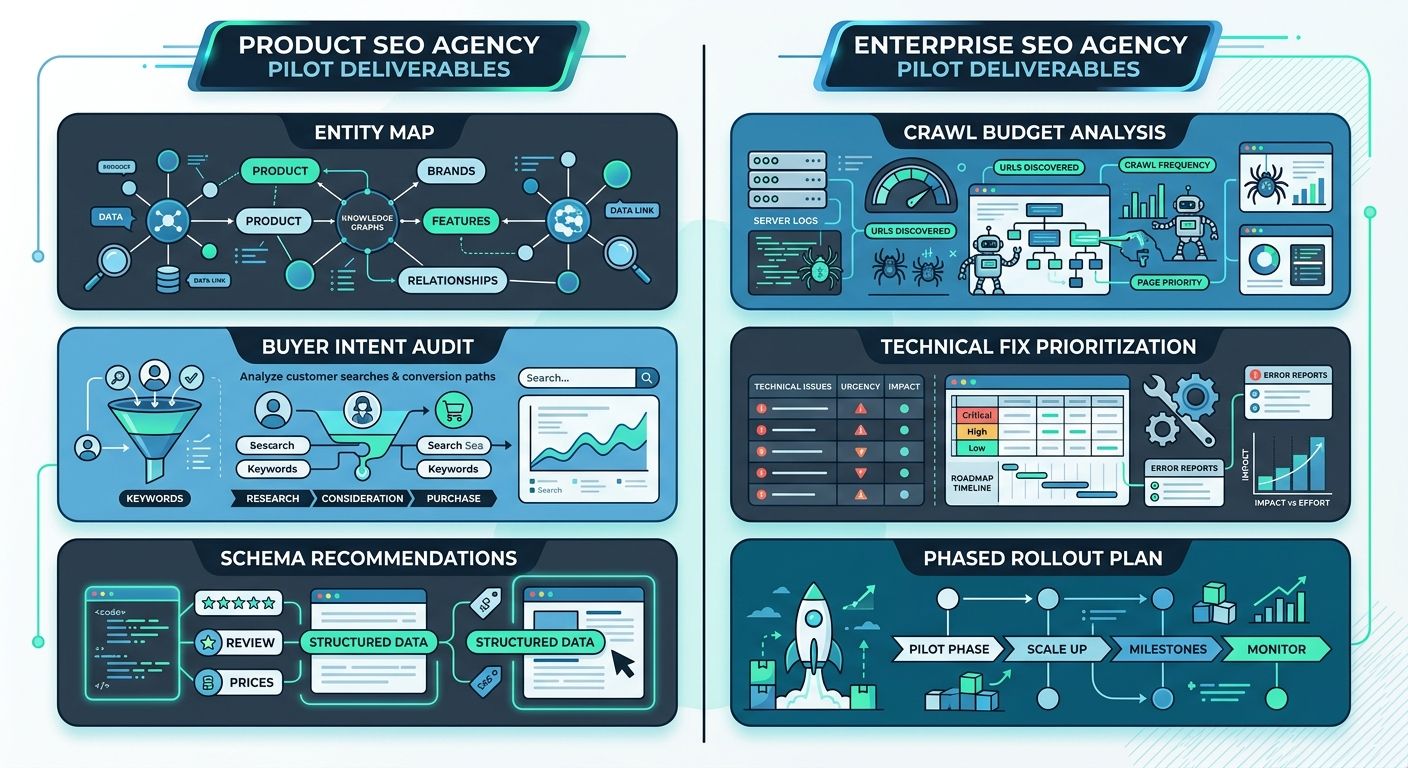
For product SEO pilots, I recommend a 60-day engagement focused on a single product category. Ask the agency to deliver three things: an entity map showing how your products relate to competitor products, branded queries, and category-level concepts; a buyer intent audit of your top 20 product pages; and schema markup recommendations with projected rich result eligibility. If the agency can't produce these three deliverables with specificity, they don't have the product SEO specialization you need.
For enterprise SEO pilots, the test is different. Give the agency access to your server logs and your crawl data. Ask them to deliver a crawl budget analysis, a priority ranking of technical fixes based on business impact, and a phased rollout plan that integrates with your existing development sprint schedule. If their recommendations don't account for how your dev team actually ships code, they're going to produce audit documents that sit in a shared drive and gather dust.
This approach aligns with what I've written about what enterprise clients should demand before signing. The pilot isn't about proving the agency can do SEO. It's about proving they can do your kind of SEO.
The State of Play
The agency skill gaps in 2026 are structural, and they're getting wider. AI-powered search is accelerating the divergence by creating entirely new optimization surfaces. Product SEO teams now need to optimize for citation in AI Overviews, ChatGPT responses, and vertical recommendation engines. Enterprise SEO teams need to manage AI crawler access, structured data pipelines, and predictive traffic models that satisfy C-suite forecasting demands.
If you're hiring an agency right now, the first question isn't "do you have enterprise experience" or "do you do ecommerce SEO." The first question is whether the agency has separated these functions internally. Ask to see the org chart. Ask which team members would work on your account and what their backgrounds are. A product SEO lead should have experience with entity modeling, conversion psychology, and product schema. An enterprise SEO lead should have experience with programmatic page generation, cross-functional project management, and crawl infrastructure.
The agencies that figured this out early have restructured into practice groups with distinct hiring pipelines, different toolkits, and separate P&L tracking. The agencies that haven't are still selling the blended retainer model and hoping their generalists can fake expertise in both directions. Your job as the buyer is to tell the difference before you sign a twelve-month contract. Look at the team, look at the deliverables list, and see whether what's being offered actually maps to the problem you need solved. The answer will save you tens of thousands of dollars and months of wasted momentum.
Marcus Webb
Digital marketing consultant and agency review specialist. With 12 years in the SEO industry, Marcus has worked with agencies of all sizes and brings an insider perspective to agency evaluations and selection strategies.
Explore more topics