
The Review-to-Ranking Pipeline: How to Audit Your Current Reviews for Hidden SEO Value
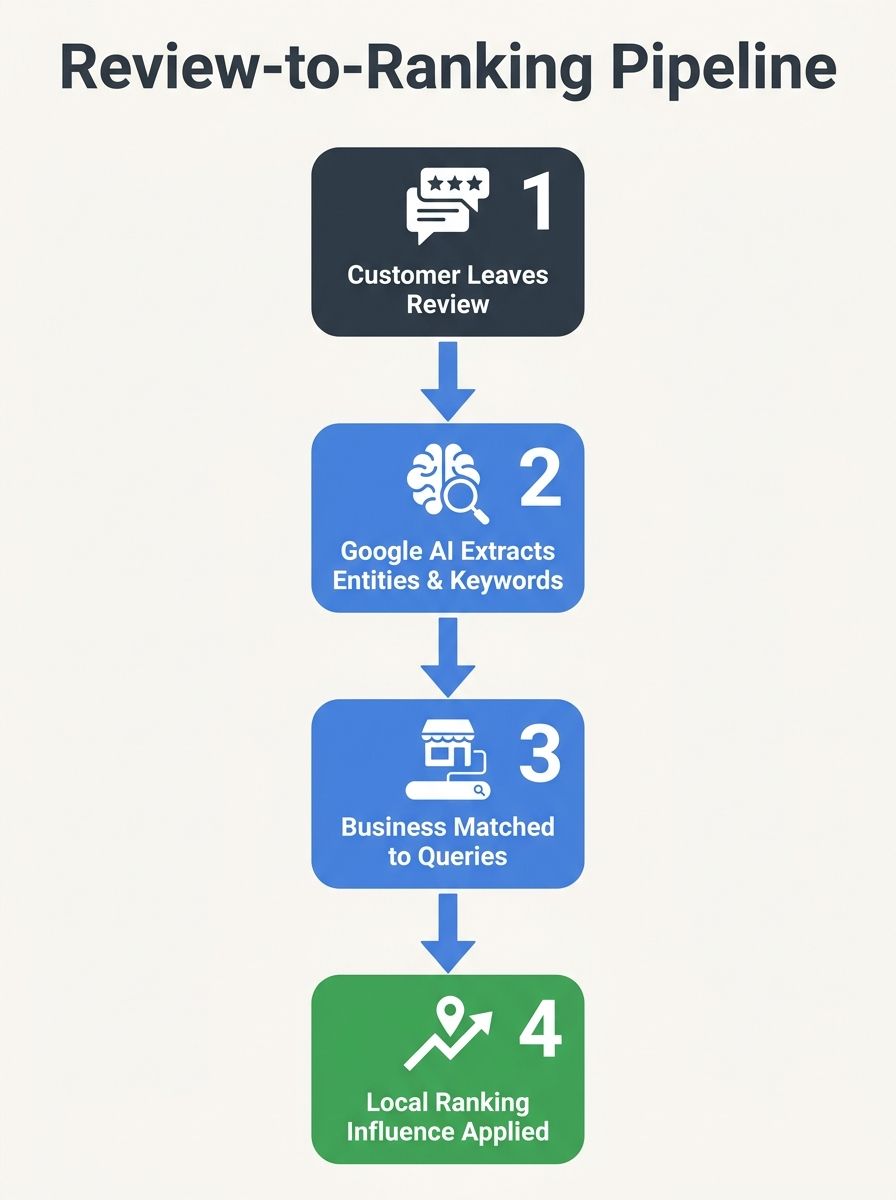
When a customer writes "fixed my burst pipe in under an hour" in a Google review, the platform's AI tags that business for queries like "emergency plumbing" and "fast service." That business owner never wrote a single line of copy targeting those terms.
 Marcus Webb··9 min read
The Review-to-Ranking Pipeline: How to Audit Your Current Reviews for Hidden SEO Value
When a customer writes "fixed my burst pipe in under an hour" in a Google review, the platform's AI tags that business for queries like "emergency plumbing" and "fast service." That business owner never wrote a single line of copy targeting those terms. The ranking signal was created entirely by a happy customer, sitting in their kitchen, tapping out a sentence on their phone.
This is the review-to-ranking pipeline, and the majority of local businesses have no idea it exists. Reviews generate a constant stream of natural language content that Google reads, categorizes, and uses to influence local search placements. Yet when I audit Google Business Profiles for clients, the review tab is almost always the last thing anyone has examined. The paid campaigns are polished. The on-page SEO is tight. The reviews sit untouched, full of dormant value.
An SEO-driven review analysis can surface keyword opportunities, schema gaps, and content patterns that traditional keyword research tools miss entirely. This article walks through the full review audit process, from extracting customer language to validating your structured data markup, so you can find and capture ranking signals that are already sitting in your review corpus.
How Google Actually Reads Your Reviews
There's a persistent myth that Google only cares about star ratings and review count. Both matter, but they're surface-level signals. The deeper mechanism involves natural language processing applied to review text itself.
Google's systems parse the full body of a review, extracting entities (service types, product names, neighborhood references), sentiment markers (positive/negative/neutral), and semantic attributes (speed, quality, price, professionalism). As Straight North's analysis explains, reviews give Google something it can't manufacture on its own: sustained, third-party confirmation that a business delivers real value.
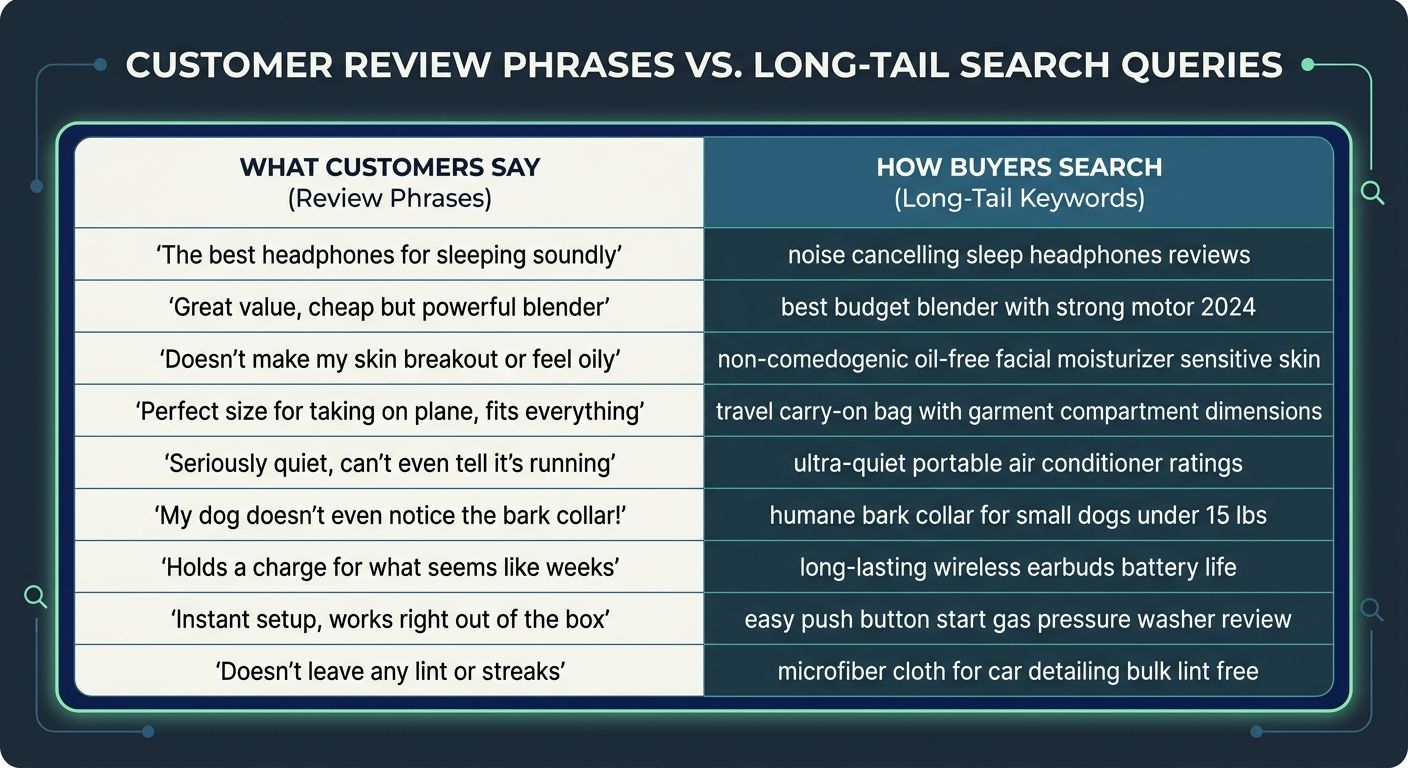
So when ten different customers mention "same-day AC repair" across your reviews, Google's confidence that you actually provide same-day AC repair goes up significantly. You don't need to stuff that phrase into your website copy. Your customers already did the work.
This has implications for how you think about local SEO review optimization. The goal of a review audit isn't to count stars. It's to understand what language your customers are generating, whether that language aligns with the queries you want to rank for, and where the gaps are.
Mining Customer Review Keywords
The richest keyword data in your business profile isn't in your Google Ads account. It's in your reviews.
I recommend starting any review audit by exporting your full review corpus. If you're working with a Google Business Profile, tools like SEOptimer can pull review data alongside your broader local audit. For businesses with reviews spread across Yelp, Facebook, and industry-specific platforms, you'll need to consolidate manually or use a scraping tool.
Once you have the raw text, the audit has three phases:
Frequency analysis. Identify which service-related terms and phrases appear most often across your reviews. A plumbing company might find "water heater installation" mentioned 40 times, while "tankless water heater" appears only twice, despite being a high-margin service they want to push. That gap between customer language and business priority is actionable intelligence.
Sentiment clustering. Group reviews by the topics customers praise or criticize. If "response time" consistently appears in 5-star reviews but "pricing" clusters in 3-star reviews, you know which attributes Google associates most positively with your brand.
Long-tail phrase extraction. Look for full natural-language phrases that mirror search queries. "Best dentist for kids who are afraid" is a real phrase I've pulled from a dental practice's reviews. No keyword tool would surface that exact query, but it matches how parents actually search. Research on keyword extraction from reviews has shown that filtering review sentences for relevance before extracting terms dramatically improves the quality of the keywords you find.
If you've already explored how to use ChatGPT for extracting SEO value from Google reviews, the manual frequency approach outlined here serves as a validation layer. Automated extraction is fast, but human review catches context that language models sometimes flatten.
Steering Reviews Without Scripting Them
A common question I get during audits: "Can we ask customers to use specific keywords?"
The short answer is yes, with guardrails. A Reddit thread in the r/localseo community puts it well: ask customers one specific question about the service and location in your follow-up so relevant words appear naturally. The distinction is between prompting and scripting. Sending a follow-up email that says "How did our team handle your roof replacement in Cedar Park?" will naturally generate customer review keywords that mention your service type and location. Sending a template that says "Please mention 'best roofing contractor in Cedar Park, TX'" will get your reviews flagged and your credibility damaged.
The best review prompts I've seen follow a simple formula: reference the specific service + reference the location + ask an open question. The customer fills in the rest with their own words, and those words become your keyword pipeline.
The Review Schema Markup Audit
Even if your reviews are packed with valuable language, Google can only display rich results if your structured data is properly implemented. Review schema markup is the technical layer that tells search engines "this content is a review, here's the rating, here's the author, here's the date."
JSON-LD is the recommended format for implementing review schema. It sits in a script tag in your HTML head, separate from your visible content, which makes it cleaner to maintain and less prone to breaking when your CMS updates. Your review schema should include AggregateRating (with reviewCount and bestRating), individual Review objects with author, datePublished, and reviewBody, and proper nesting within the parent LocalBusiness or Product schema.
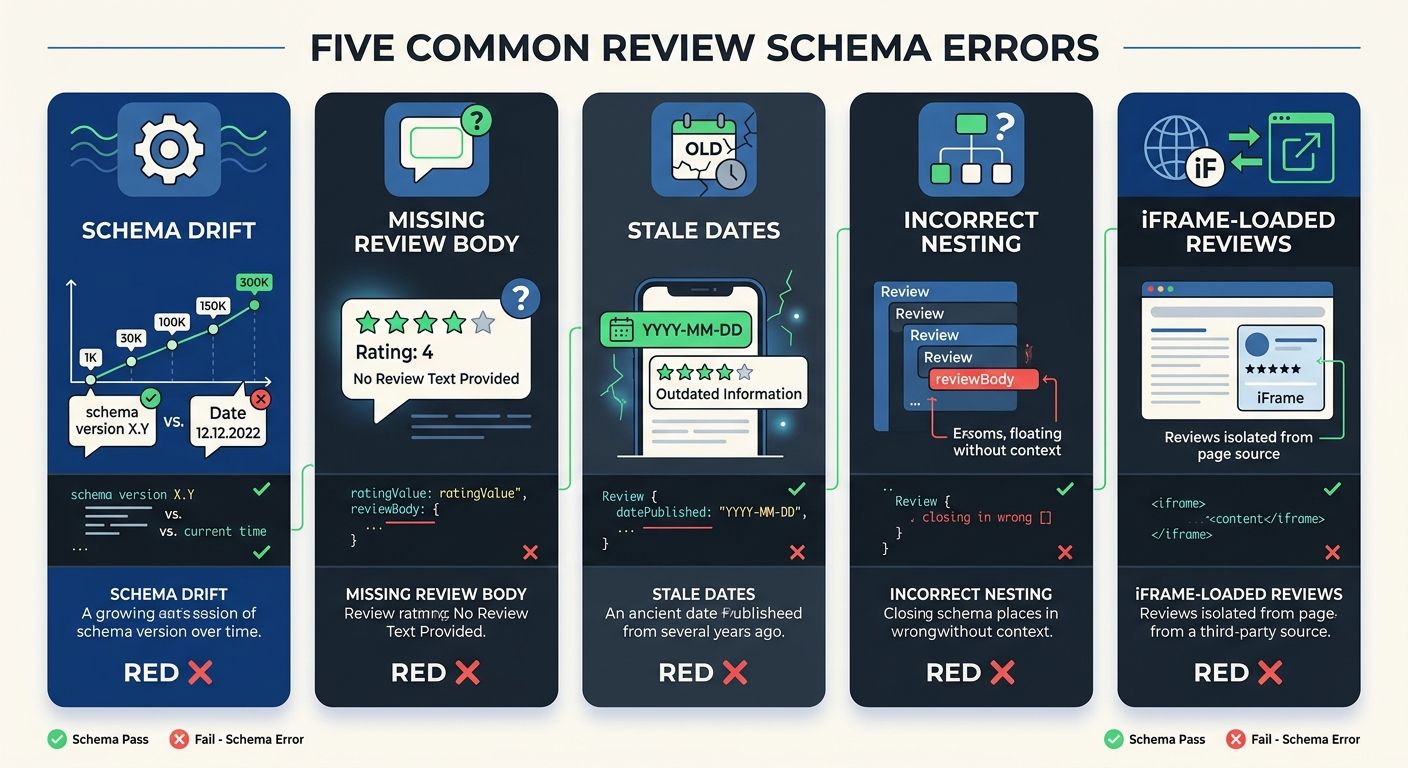
The most common issues I find during schema audits:
Schema drift. The structured data says you have 4.8 stars and 312 reviews, but your visible page content shows 4.7 stars and 298 reviews. This mismatch can trigger a manual action or simply cause Google to ignore your markup. Google's own documentation on structured data emphasizes that markup must accurately reflect on-page content.
Missing review body. Many implementations include the star rating but omit the actual review text in the reviewBody field. You're leaving keyword-rich content out of your structured data.
Stale dates. If your most recent review in the schema is from 2024, Google reads that as a dormant profile. We've covered how review velocity matters more than raw volume for local rankings, and your schema timestamps reinforce that signal.
Incorrect nesting. Reviews that aren't properly nested under the correct entity type (LocalBusiness, Product, or Organization) can be misattributed or ignored entirely.
Run your pages through Google's Rich Results Test after every template change. Schema validation is a one-time task that takes 15 minutes and prevents months of invisible ranking loss.
The Full Review Audit Checklist
Here's the process I use when running a review audit process for agency clients. It applies whether you're auditing a single-location dentist or a 50-location franchise.
Step 1: Inventory All Review Sources
List every platform where your business has reviews. Google Business Profile is the priority, but don't ignore Yelp, Facebook, Healthgrades, Avvo, G2, Trustpilot, or industry-specific directories. Each platform feeds a different part of Google's entity understanding. The Search Engine Land local SEO audit guide recommends checking your NAP (name, address, phone) consistency across these sources as part of any local audit, but you should also be checking whether your best review content is trapped on platforms where Google can't easily access it.
Step 2: Export and Analyze Review Text
Pull the full text of your reviews into a spreadsheet. Sort by star rating, then by date. Read the 5-star reviews first and highlight every phrase that contains a service name, a location reference, or a specific outcome ("saved us $3,000 on our energy bill," "finished the project two days early"). These are your customer review keywords.
Step 3: Compare Review Language to Your Target Keywords
Take your target keyword list from your SEO strategy and map it against the phrases you extracted in Step 2. Where do customers use the same language you're targeting? Where do they use different terms? The gaps in both directions matter. If customers consistently describe your service in a way that doesn't match your target keywords, either your keyword strategy needs updating or your review prompts need refining.
Step 4: Validate Schema Markup
Check every page that displays reviews. Confirm that JSON-LD review schema is present, properly nested, and matches the visible content. Test with Google's Rich Results Test. If you're on a third-party review widget, verify that the reviews are rendered in the DOM and not loaded via an iFrame that Google's crawlers can't penetrate.
Step 5: Audit Your Review Responses
Google has tested AI-generated review replies inside Google Business Profile, which signals how seriously the platform takes the response layer. While review responses aren't a confirmed direct ranking factor, they influence engagement metrics, customer trust, and the overall content density of your GBP. Respond to every review. In your responses, naturally reference the service performed and the location. A response that says "Thank you! We're glad the furnace installation in Westlake went smoothly" reinforces the same entity signals that the review itself creates.
Step 6: Benchmark Against Competitors
Pull the review counts, average ratings, and review recency for your top three local competitors. If they have more recent reviews, higher volume, or richer language in their review text, that tells you where you're losing ground. We've published a full review benchmarking scorecard that walks through this comparison in detail.
Where Reviews Meet AI Search
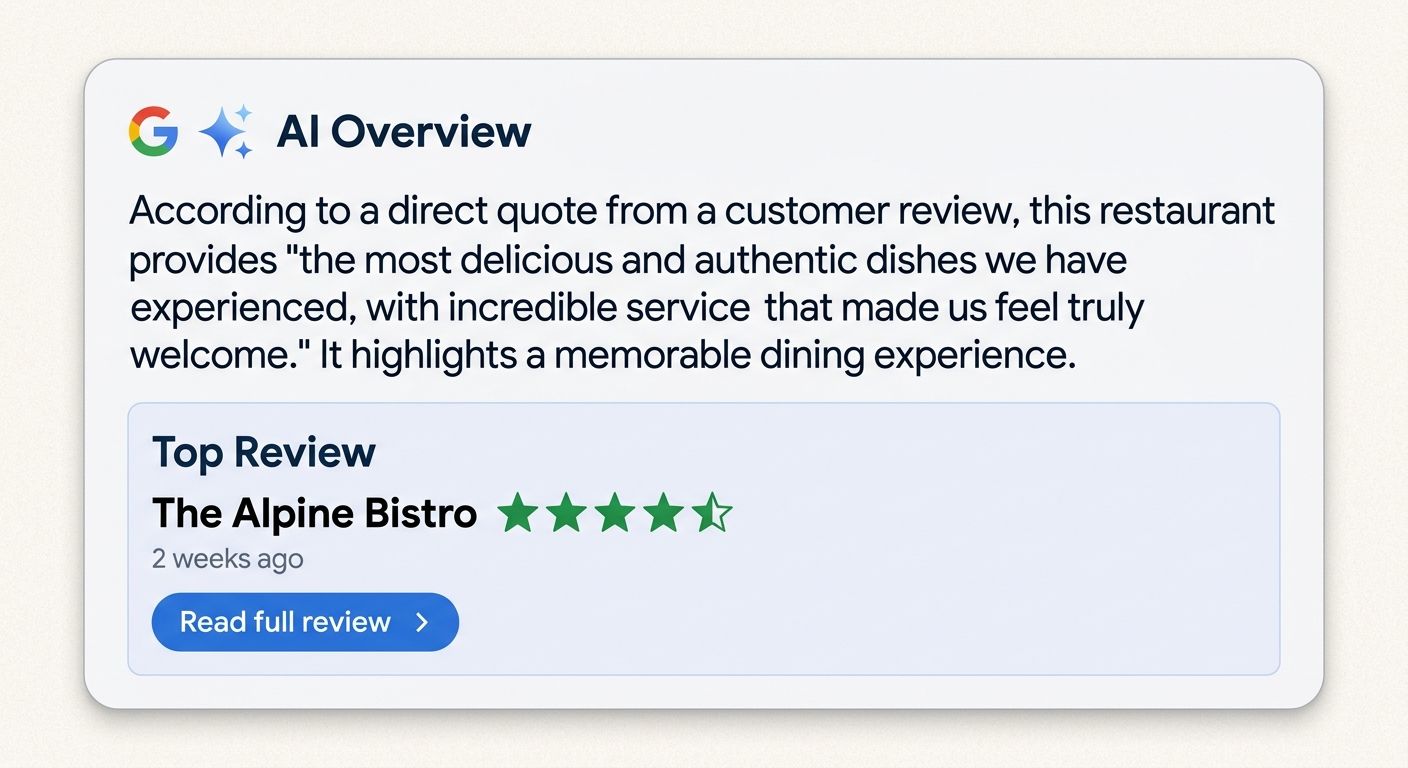
The review audit process has expanded this year because of how AI search features consume review content. Google AI Overviews appear in nearly half of all searches, and review text containing natural-language answers to common questions gets pulled into those generated responses. A review that says "We paid about $4,500 for a full kitchen backsplash installation and it took three days" is exactly the kind of specific, experience-based content that AI Overviews surface.
This aligns with what Google's quality raters look for under E-E-A-T. Marketing copy can demonstrate expertise, but it can't demonstrate experience. Only real customers can do that. If you're thinking about how reviews fit into the broader shift toward AI-driven search optimization frameworks, the connection is direct: review content is among the strongest experience signals available to any local business.
And for businesses whose GBP listings have been affected by Google's 2026 trust enforcement rules, a healthy, authentic review profile is one of the clearest trust indicators you can present during any reinstatement process.
What Still Isn't Settled
Several open questions remain in the review-to-ranking pipeline.
First, Google's weighting of review text versus review metadata (stars, date, reviewer history) is opaque. We can observe correlations between keyword-rich reviews and improved local rankings, but Google has never published the formula, and the balance likely shifts with algorithm updates.
Second, the role of review responses in ranking calculations is genuinely uncertain. Google's experiments with AI-generated replies suggest the company sees responses as important, but whether that importance translates into algorithmic weight or is purely a user-experience signal remains unclear.
Third, cross-platform review consolidation presents an unresolved problem. A business with 200 reviews on Yelp and 50 on Google may be undervalued in Google's local results despite having strong overall review presence. How much weight Google gives to off-platform reviews when constructing entity understanding varies by industry and seems to change without notice.
What is settled: your reviews contain real, measurable SEO value that most businesses never extract. The audit process described above takes a few hours for a single location and surfaces opportunities that keyword tools, rank trackers, and even your agency's monthly reports probably aren't showing you. The language your customers use is the language your potential customers search. Connecting those two datasets is the gap that a thorough review audit closes.
Marcus Webb
Digital marketing consultant and agency review specialist. With 12 years in the SEO industry, Marcus has worked with agencies of all sizes and brings an insider perspective to agency evaluations and selection strategies.
Explore more topics