
Answer Engine Optimization vs. Traditional SEO: How AI Search Engines Are Rewriting the Rules (And What Your Agency Should Do Now)
Paid click-through rates have dropped 68% on Google queries that trigger AI-generated summaries, according to tracking data compiled this spring across multiple enterprise SEO platforms.
 Marcus Webb··10 min read
Answer Engine Optimization vs. Traditional SEO: How AI Search Engines Are Rewriting the Rules (And What Your Agency Should Do Now)
Paid click-through rates have dropped 68% on Google queries that trigger AI-generated summaries, according to tracking data compiled this spring across multiple enterprise SEO platforms. At the same time, 42% of CRM software buyers now use AI search tools as part of their evaluation process, per HubSpot's January 2026 survey. These two numbers, taken together, represent the clearest evidence yet that the divide between Answer Engine Optimization and traditional SEO has moved from theoretical talking point to operational emergency for agencies and the brands they serve.
I've evaluated over 200 SEO agencies in my career, and right now roughly a third of them are pitching "AI search visibility" or "generative search optimization" as a service line. When I dig into what that actually means in their contracts, scope documents, and deliverables, the picture gets thin fast. Many agencies are repackaging their existing content optimization workflows with new terminology, charging an additional $2,000–$5,000 per month for it, and delivering essentially the same structured data audits they were already doing. The agencies that genuinely understand AEO look different in specific, measurable ways, and I'll break those down here.
The Structural Difference Between AEO and Traditional SEO
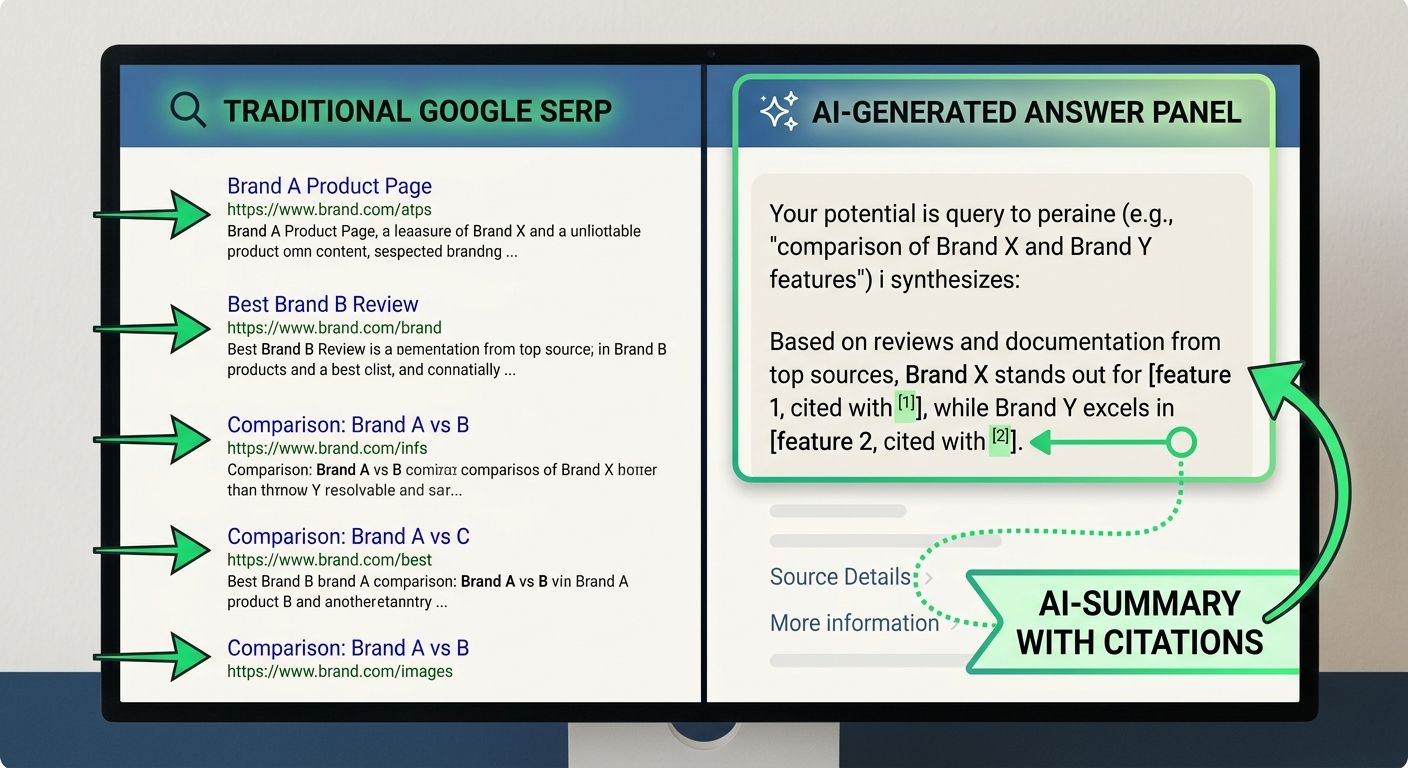
Traditional SEO optimizes for a click. You want your URL to appear high on a search engine results page so a human clicks it. Answer Engine Optimization targets a fundamentally different outcome: you want an AI system to cite your content, your brand, or your data point inside the answer it generates for the user. The user may never visit your website at all.
As Optimizely's breakdown of AEO vs. SEO explains, AEO is about "optimizing your content so that AI models can easily understand and accurately present it in their responses." That's a different design goal from ranking in the traditional sense, and it creates different content requirements, different technical specifications, and different success metrics.
The GEO vs SEO strategy debate is related but distinct. Generative Engine Optimization (GEO) is the broader umbrella term for optimizing across all generative AI interfaces. AEO specifically targets answer engines like Google's AI Mode, Perplexity, and ChatGPT's search functionality. In practice, most agencies use these terms interchangeably, which tells you something about how early the specialization is.

Here's what matters for you as someone evaluating agencies: the overlap between SEO and AEO is real. Good information architecture, clean HTML, authoritative backlinks, and E-E-A-T signals all help in both contexts. But AEO adds specific requirements that many SEO agencies haven't operationalized. AI answer engines use Retrieval-Augmented Generation (RAG), a process where the model pulls relevant external documents in real-time, synthesizes an answer, and cites the sources it drew from. If your content can't be easily retrieved, parsed, and attributed by that pipeline, you don't exist in AI search.
What AI Search Engines Actually Need From Your Content
The technical requirements for generative search optimization are more specific than most agency pitch decks acknowledge. Based on the research data available right now, here's what the AI crawl-and-cite pipeline actually looks at:
Clean, accessible HTML. 46% of ChatGPT bot visits begin in "reading mode," a plain HTML version stripped of images, CSS, JavaScript, and schema markup. If your content depends on JavaScript rendering to be readable, ChatGPT's bot likely can't parse it.
Hierarchical heading structure. Forge and Smith's GEO analysis confirms that proper formatting with hierarchical headings helps ChatGPT scan content faster and extract useful information. This isn't new advice, but the penalty for ignoring it is now steeper.
Schema markup with real depth. FAQ, HowTo, Article, and BlogPosting schema all help AI systems categorize and attribute your content programmatically. One e-commerce brand saw a 35% increase in organic traffic within eight weeks after implementing product and FAQ schema markup.
Consistent entity signals. AI evaluates site-wide coherence. Contradictory messaging, outdated references, or inconsistent terminology across your pages reduce citation likelihood. The model doesn't evaluate individual pages in isolation; it evaluates your domain's trustworthiness as a whole.
Pages that don't block bots. 63% of ChatGPT agents bounce immediately from pages due to HTTP errors, unexpected redirects, slow load times, CAPTCHAs, or bot blocking. If your technical infrastructure actively prevents AI crawlers from accessing your content, nothing else matters.
I've seen agencies bill $15,000 for an "AEO audit" that amounts to checking schema markup and running a Lighthouse report. That's a $500 task dressed up with new branding. A legitimate AEO technical audit should also include AI crawler access testing, entity consistency analysis across your domain, content structure evaluation against RAG retrieval patterns, and a review of how AI systems are currently citing (or not citing) your brand. If you're paying for a site architecture review aimed at AI crawlers, make sure the scope reflects the actual complexity.

Siteimprove's AEO Launch Signals a Maturing Market
On April 20, Siteimprove announced new AEO capabilities within its Siteimprove.ai Search platform, enabling enterprises to track AI citations, prompts, share of voice, and sentiment across answer engines in a single unified platform. This is significant because it addresses one of the biggest gaps in the AEO space: measurement.
Until now, tracking ChatGPT citations for brands has been a manual, inconsistent process. You'd either monitor brand mentions through custom scraping setups, rely on anecdotal evidence ("a client told us they found us through ChatGPT"), or use early-stage tools with limited coverage. Siteimprove's move signals that enterprise-grade measurement infrastructure is arriving, which means agencies will increasingly need to report on AI search visibility with the same rigor they apply to traditional SERP rankings.
This matters for agency evaluation specifically because it changes the accountability conversation. When I review agency retainer agreements, I look at how deliverables and KPIs are defined. An agency that's still exclusively reporting on keyword rankings, organic traffic, and backlink counts is operating on a measurement model that doesn't capture where a growing share of brand discovery actually happens. The agencies worth their retainer fees are already building AI citation tracking into their monthly reporting, even if the tooling is still evolving.
How to Evaluate Whether an Agency Can Actually Deliver on AEO
I've been building a checklist for this specific evaluation over the past several months, based on conversations with agency teams, contract reviews, and outcome analysis. If you're evaluating an agency's AEO capabilities, here's what to look for:
Ask for their AEO-specific deliverables list
An agency that genuinely does answer engine optimization work should be able to produce a deliverables list that's distinct from their traditional SEO deliverables. If they hand you the same scope document with "AEO" substituted for "SEO" in the headers, that's a red flag. Distinct deliverables should include things like: AI crawler access audits, entity consistency reviews, citation monitoring setup, and content restructuring specifically for RAG retrieval.
Check their reporting stack
Do they have tooling in place to track AI search visibility, or are they still exclusively using Ahrefs, SEMrush, and Google Search Console? Those tools are essential for traditional SEO, but they don't measure AI citation performance. Ask specifically what tools they use for monitoring generative search mentions. Acceptable answers include Siteimprove's new AEO platform, custom monitoring solutions, or partnerships with emerging AEO-specific vendors. "We're working on it" isn't acceptable at the price points most agencies charge for this work.
Look for schema depth beyond the basics
Every competent SEO agency implements basic schema markup. The AEO differentiator is whether they go deeper: nested entity relationships, consistent use of sameAs properties linking to authoritative external references, proper implementation of speakable schema for voice-oriented answer engines, and FAQ schema that directly mirrors the questions AI users are actually asking.
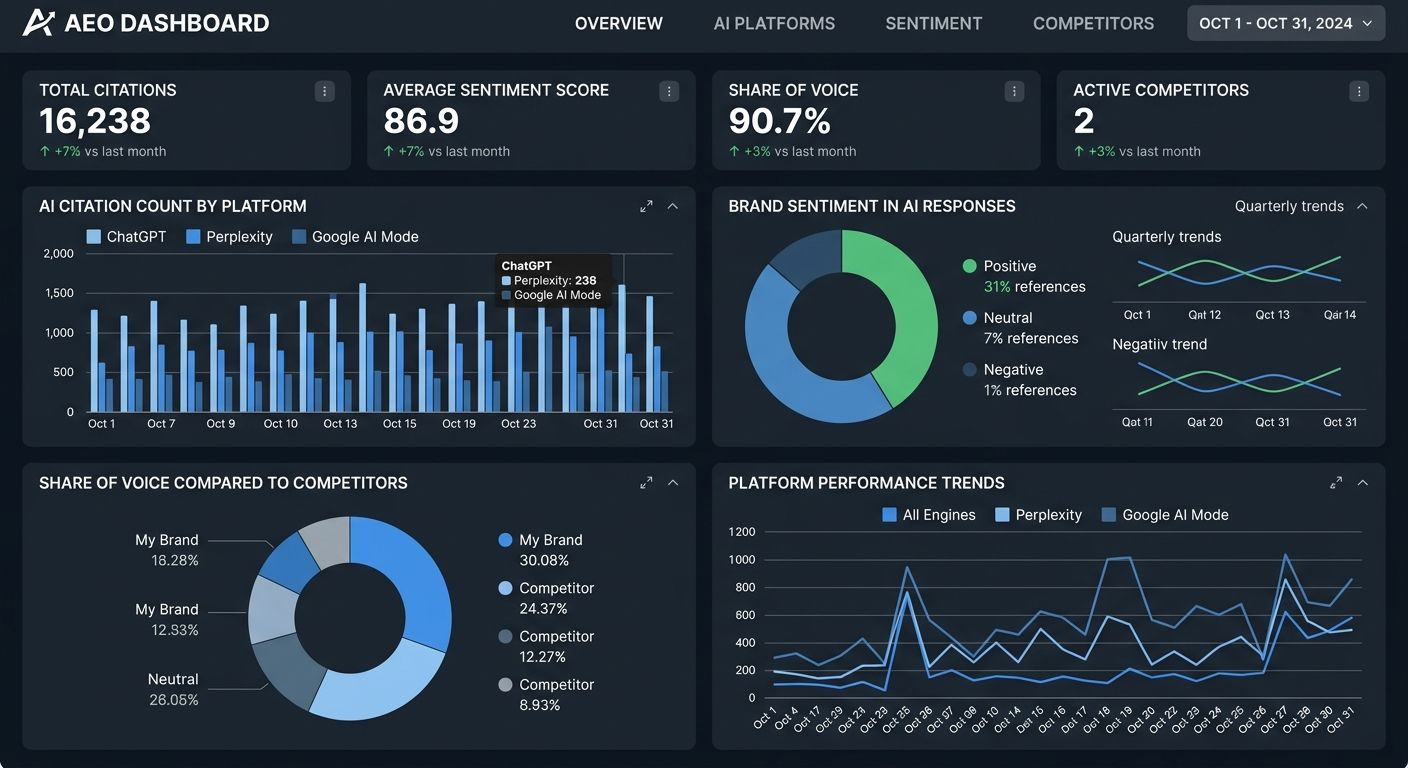
Examine their content strategy philosophy
Traditional content strategy for SEO tends to focus on keyword targeting, search volume, and topical authority through volume. AEO content strategy should emphasize concise, directly answerable content blocks within larger pieces, consistent brand terminology and entity signals across the site, and content freshness as an ongoing maintenance task rather than a one-time project. As Amsive's AEO guide notes, one in ten U.S. internet users already turns to generative AI first for online search. That number is growing, and content that isn't structured for AI retrieval is progressively invisible to this audience.
The agencies already adapting to this shift—and there are strong options among white-label SEO companies as well as boutique specialists—tend to share a common trait: they treat AEO as a genuine discipline with its own processes, not as a marketing add-on to their existing SEO packages.
Pricing and Contract Structures I'm Seeing
The market for AEO services is still finding its pricing floor and ceiling. Here's what I've observed across roughly 30 agency proposals I've reviewed that include AEO components:
Bundled with existing SEO retainers (no additional cost): A few agencies are folding basic AEO work into their standard SEO retainer, typically in the $5,000–$10,000/month range. This usually means they're adding schema depth and content restructuring to their existing workflow. The AEO-specific deliverables tend to be minimal.
Add-on AEO service ($2,000–$5,000/month): The most common pricing model right now. Agencies offer their standard SEO package plus an AEO module that includes citation monitoring, AI crawler auditing, and content optimization for answer engines. Quality varies enormously at this price point.
Dedicated AEO retainers ($8,000–$20,000/month): Emerging at the enterprise level, these are standalone engagements focused exclusively on AI search visibility. They typically include ongoing citation tracking, monthly content restructuring, technical AI crawl audits, and competitive AI share-of-voice reporting. I've only seen about a half-dozen agencies offering this as a distinct service line with staffing to match.
If you're working with an agency whose skill gaps are showing, the underlying issue often goes deeper than AEO. I've written about how AI search visibility gaps are reshaping agency skill requirements, and the competency shortfalls tend to compound. An agency that hasn't adapted its technical auditing for AI crawlers probably hasn't updated its content strategy framework either.
Why This Doesn't Replace Traditional SEO
I want to be clear about something, because the discourse around this topic tends toward false dichotomies. Traditional SEO is not dead. HubSpot's comparison of AEO and SEO puts it well: "AEO improves visibility in AI answers and voice responses, while SEO anchors visibility in SERPs and long-form content." Both create different operational requirements, content formats, and measurement challenges.
B2B buyers still consult multiple sources. Long-form content still drives organic traffic. Google's traditional SERP results still account for the majority of search interactions, even as AI Overviews expand. The agencies that overreact to AEO hype by abandoning traditional SEO fundamentals are making a mistake. The agencies that ignore AEO entirely are making a different, arguably larger mistake.
The smart play is a dual strategy, and the question for any agency relationship is whether the team you're working with can execute both effectively. That requires different analytical frameworks, different measurement tools, and often different skill sets. As we've covered in looking at how AI citations have changed SEO strategy for PR-oriented agencies, the integration of these two disciplines requires genuine cross-functional thinking, not just new slide templates.
What Still Isn't Settled
Several significant unknowns will shape how this space evolves over the next 12 months.
The measurement problem remains partially unsolved. Siteimprove's launch helps, but the ecosystem of AEO tracking tools is immature compared to traditional SEO analytics. Agencies are building reporting workflows on platforms that may look completely different by early 2027.
The economics of citation-based discovery are unclear. If a user gets their answer from an AI summary and never clicks through to your site, what's that brand impression actually worth? Traditional SEO has clear attribution paths (ranking → click → conversion). AEO attribution models are still being constructed, and nobody has a reliable formula for calculating the revenue impact of an AI citation that doesn't result in a site visit.
AI search market share is growing but still represents a minority of total search behavior. One in ten U.S. internet users turning to generative AI first is meaningful, but it also means nine out of ten are still using traditional search as their starting point. The urgency is real, but agencies or consultants telling you to pivot 50%+ of your budget to AEO right now are probably overselling the timeline.
And the competitive landscape among AI search platforms themselves is volatile. ChatGPT relies heavily on the Bing Search API (92% of the time as of late 2025), which means Bing indexing quality matters more than it has in a decade. Google's AI Mode operates on entirely different retrieval logic. Perplexity has its own crawling and citation methodology. Optimizing for all three simultaneously is expensive, and the playbook for each will continue to diverge.
If you're mid-contract with an agency right now, the most productive conversation you can have is a direct one about their AEO roadmap, their measurement capabilities, and their honest assessment of where the gaps are. I'd rather work with an agency that admits they're building these capabilities than one that claims they've had them all along. Transparency has always been the most reliable signal of whether an agency relationship will actually deliver results, and that principle holds whether we're talking about blue links or AI-generated answers.
Marcus Webb
Digital marketing consultant and agency review specialist. With 12 years in the SEO industry, Marcus has worked with agencies of all sizes and brings an insider perspective to agency evaluations and selection strategies.
Related Articles
Why Recognition Beats Rankings in 2026: How SEO Agencies Should Pivot Their Authority Strategy
The slide deck that convinced a $4M ARR fintech company to sign a 12-month agency retainer showed fourteen keyword ranking improvements, zero AI citation metrics, and no mention of entity authority anywhere in the strategy section.
From Google Search to AI Assistants: How B2B Agencies Must Rebuild SEO Strategy Beyond Traditional SERP Rankings
Three of the five B2B agency contracts sitting on my desk right now define success exclusively as Google organic ranking improvements and click-through traffic growth. The agencies that wrote those contracts aren't incompetent.

Why Enterprise SEO Agencies Are Expanding Into AI-Driven Markets: What the San Francisco Shift Reveals About 2026 Competition
SEO.co announced its physical expansion into San Francisco on May 7, targeting venture-backed startups and enterprise brands with GEO consulting, AI-driven search strategies, and technical audits designed for generative platforms.
Explore more topics