
The Local SEO Setup Audit: Why Incomplete Google Business Profiles Cost Small Businesses Thousands in Lost Visibility
Roughly 86% of impressions on Google Business Profiles come from unbranded discovery searches — "plumber near me," "emergency dentist open Sunday" — according to Birdeye's 2026 analysis of local search behavior.
 Marcus Webb··10 min read
The Local SEO Setup Audit: Why Incomplete Google Business Profiles Cost Small Businesses Thousands in Lost Visibility
Roughly 86% of impressions on Google Business Profiles come from unbranded discovery searches — "plumber near me," "emergency dentist open Sunday" — according to Birdeye's 2026 analysis of local search behavior. The mechanism that determines which three businesses appear in that coveted local pack is less mysterious than most agencies make it sound, and a staggering number of small businesses are excluded from it because of incomplete business listings that take under an hour to fix.
I've audited over 200 SEO agencies at this point in my career, and the pattern is consistent: agencies billing $1,500 to $3,000/month for local SEO work are routinely leaving foundational Google Business Profile fields blank. When I pull up the actual profile during an audit, I find missing service areas, generic business descriptions, zero Google Posts in the last 90 days, and categories that don't reflect what the business actually does. The agency reports show keyword rankings and traffic charts. The profile itself tells a different story.
This article breaks down the mechanism behind Google's local ranking decisions: the actual signals, layers, and data points that determine whether a small business shows up when someone searches with local intent. If you're evaluating an agency's local SEO work or building a local SEO setup checklist of your own, understanding this mechanism will tell you exactly where to look for the gaps.
How Google Decides Which Profiles Surface in the Local Pack
Google's local ranking algorithm evaluates three primary factors: relevance, distance, and prominence. Every local SEO fundamentals guide mentions these three. What most guides skip is how unevenly they're weighted and how profile completeness affects each one.
Relevance is determined by how well your profile matches the intent behind a search query. Google parses your business name, primary category, secondary categories, business description, services listed, product listings, and even the language used in your reviews. A profile with a single category and no services listed gives Google almost nothing to match against.
Distance is straightforward: how close the business is to the searcher or the location specified in the query. You can't optimize distance, but you can ensure your service area settings are accurate so Google doesn't restrict your visibility to an unnecessarily small radius.
Prominence is where things get interesting. Google measures prominence through a combination of review count, review score, review velocity (how frequently new reviews arrive), web references to your business, backlinks to your website, and engagement signals on the profile itself. A Birdeye report found that one additional review can generate an average of 600+ impressions, 80+ website visits, 63+ direction requests, and 16+ calls. That's the scale of impact a single data point can have within this system.
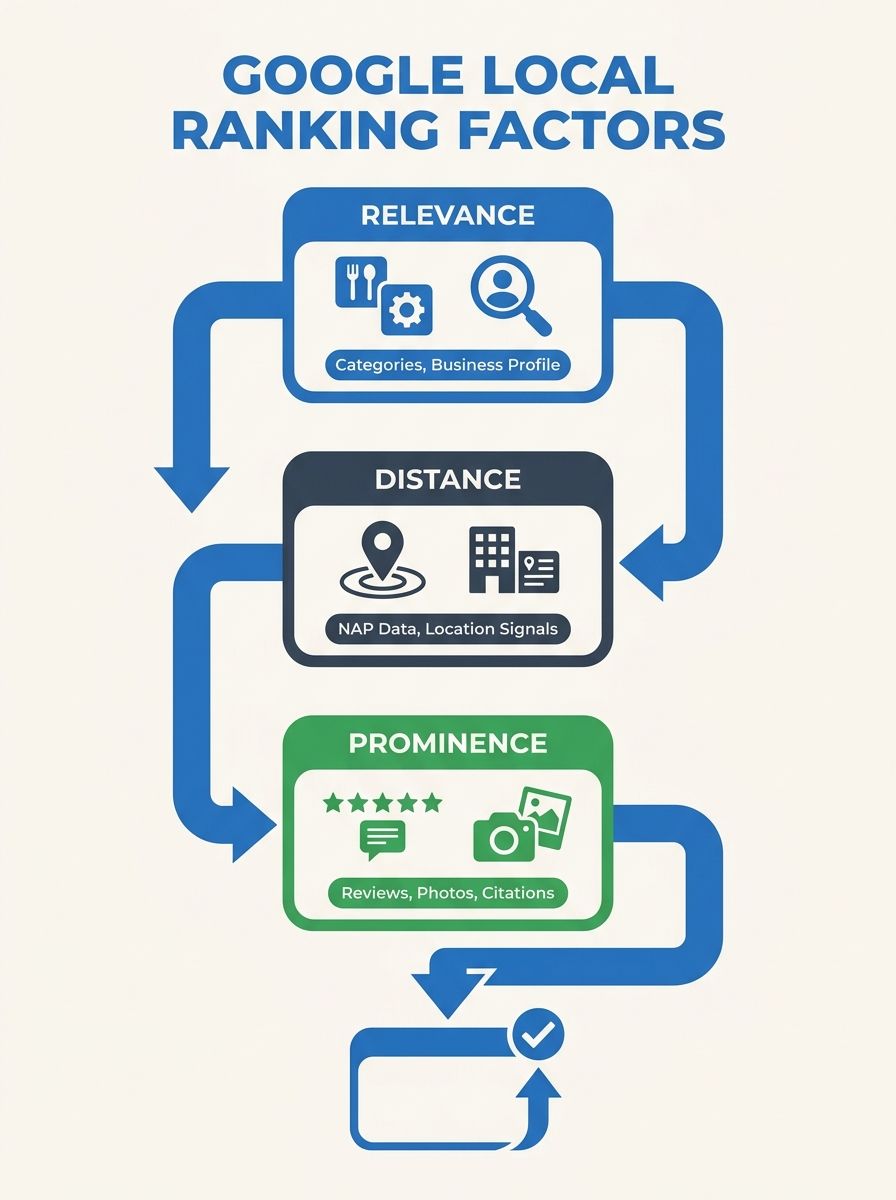
The critical insight here is that two of these three factors are directly influenced by how complete and accurate your profile is. Distance is the only one you can't change. Agencies that skip the profile setup and jump straight to link building or content creation are optimizing the wrong layer of the system.
The Profile Fields That Actually Move Rankings
When I evaluate an agency's local SEO work, the first thing I do is open the client's Google Business Profile and check every field. Not the dashboard metrics. The actual fields. Here's what I'm looking at and why each one matters within the ranking mechanism.
Primary Category is the single most impactful field on your entire profile. It directly tells Google what your business is. An HVAC company listed under "Contractor" instead of "HVAC Contractor" is competing in a broader, less relevant category. According to the Local Marketing Institute's optimization checklist, selecting the most specific primary category available is the highest-priority optimization you can make.
Secondary Categories expand your relevance to adjacent searches. A restaurant that also does catering should have both "Restaurant" and "Catering Service" listed. I regularly find profiles with zero secondary categories, even from agencies charging premium rates for local work.
Services and Products are parsed by Google to match long-tail and conversational queries. With the rise of natural language search through AI assistants, these fields have become more important than ever. A plumbing company that lists "Emergency Pipe Repair in Toronto" as a service (with location and service context together) will match more specific queries than one that lists "Plumbing Services." As one practitioner documented in their audit process, generic service descriptions like "Best service" or "We offer plumbing" signal a half-optimized profile.
Business Description gives you 750 characters to communicate what you do, where you do it, and what makes you different. Google uses this for relevance matching. Leaving it blank or stuffing it with keywords without readable context hurts both algorithmic matching and user trust.
Attributes (wheelchair accessible, women-owned, outdoor seating, etc.) feed into filtered searches and Google's AI-generated summaries. These are frequently ignored by agencies because they seem cosmetic. They aren't. Google's AI systems pull attributes into "People are asking" features and generated business summaries, making them a quiet but meaningful input to the visibility mechanism.
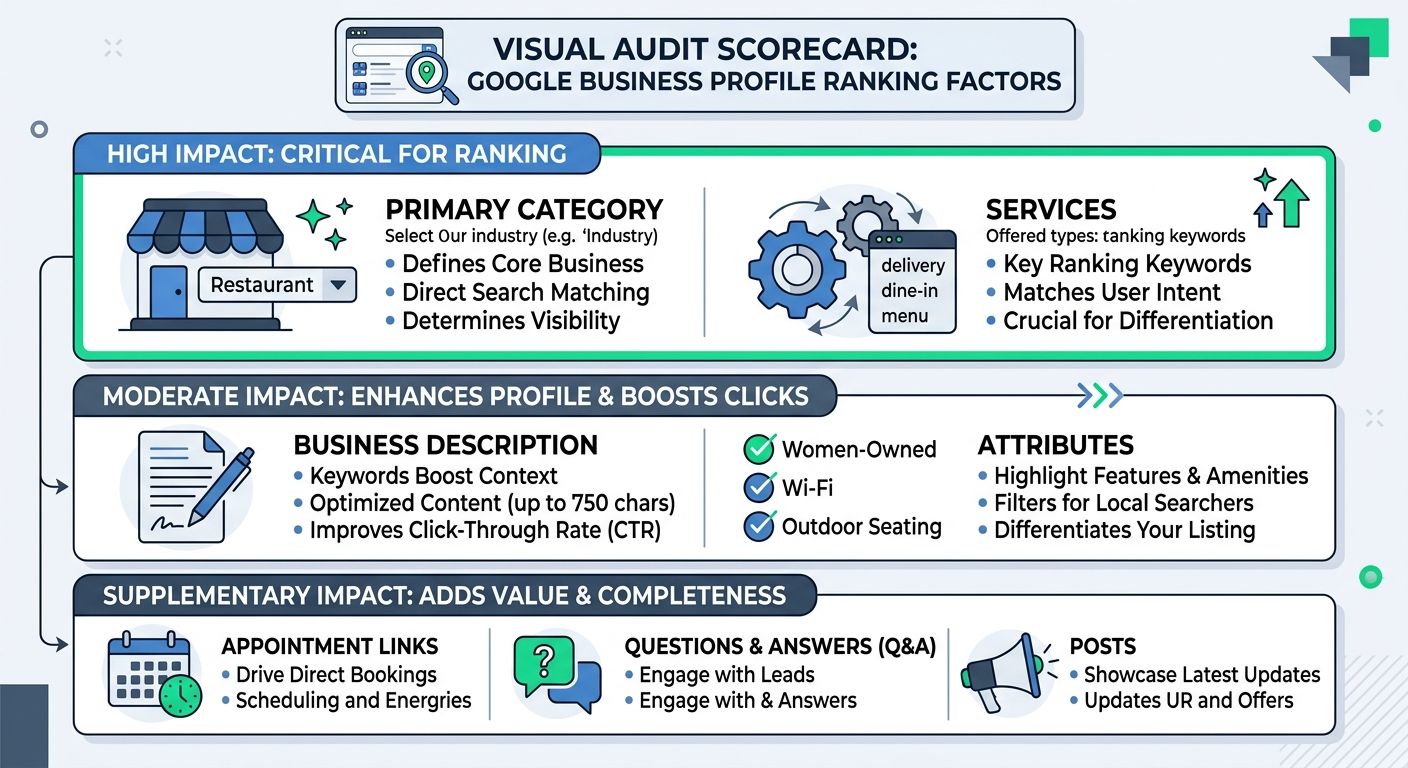
When evaluating whether your agency is doing competent Google Business Profile optimization, pull up the profile and count how many of these fields are actually filled in. If more than two high-impact fields are blank or generic, the agency hasn't completed foundational setup, regardless of what their monthly report shows.
NAP Consistency and the Trust Signal Layer
NAP stands for Name, Address, Phone number. The consistency of this information across your Google Business Profile, your website, and every directory listing where your business appears is one of the strongest trust signals in Google's local ranking system.
According to BrightLocal's research cited by Entrepreneur, nearly seven out of ten consumers (68%) would stop using a local business if they discovered incorrect information in online directories. But the impact goes beyond consumer behavior. Google cross-references your NAP data across the web to verify that your business is legitimate and that your listed information is accurate. Inconsistencies — even minor ones like "Street" vs. "St." or a missing suite number — create ambiguity in Google's entity resolution system.
One documented case showed a dental practice improving its local pack position by two to three spots simply by correcting three address variations across directories. No new content. No new links. The data cleanup alone moved the needle.
I wrote about related trust enforcement changes in the context of Google's local trust rules for Maps, and those same principles apply here. Google's verification systems are getting stricter, and data inconsistencies that were tolerable two years ago now carry real ranking penalties. If you're building a local SEO setup checklist, put NAP consistency at the top.
Photos, Posts, and the Freshness Mechanism
Google's algorithm uses freshness signals to evaluate whether a business is active and engaged. Two of the most accessible freshness signals live directly inside the Google Business Profile: photos and Google Posts.
Profiles with 15 or more photos consistently outperform those with fewer across impressions, clicks, and calls. Yet the average verified profile has fewer than one photo. That gap represents an enormous amount of untapped small business Google visibility sitting on the table, unclaimed.
Google Posts function like mini-updates: announcements, offers, events, product highlights. They expire after seven days for most post types, which means a profile without recent posts looks dormant to Google's freshness evaluation. According to TrueFuture Media's 2026 GBP checklist, businesses that win locally "don't do one big optimization" but instead perform "small, consistent maintenance," including checking for unwanted edits, replying to reviews, and publishing regular posts.
Some GBPs have shown dramatic drops in impressions after 30 days without any updates. Google's AI systems now treat profile freshness as an active signal, and a stale profile communicates disengagement to the algorithm the same way it communicates disengagement to a potential customer scrolling through results.
When I audit agency performance on local SEO accounts, I check the Google Posts history first. If the agency hasn't published a post in 60+ days on a client's profile, they're neglecting one of the cheapest and most effective optimization levers available. This is the kind of operational gap I've seen across agencies of all sizes, similar to the pattern of unimplemented recommendations where the knowledge exists but the execution never follows.
Reviews as a Ranking Input
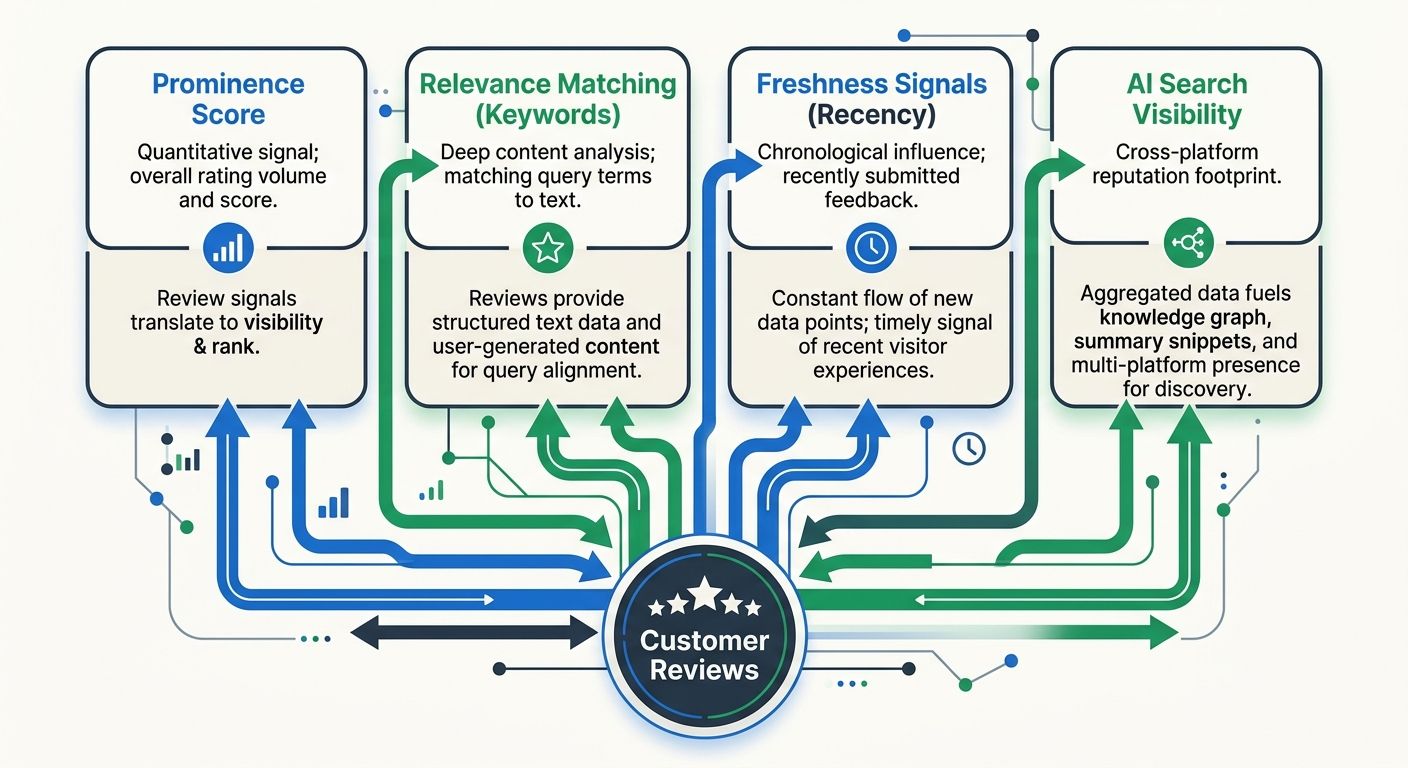
Reviews deserve their own section because they feed into multiple layers of the local ranking mechanism simultaneously. Review count affects prominence. Review content (the actual words customers use) affects relevance matching. Review recency affects freshness scoring. And review sentiment increasingly affects how Google's AI systems characterize your business in generated summaries and "People are asking" features.
The review ecosystem has shifted considerably. Review volume dropped 36.7% in 2024 under stricter moderation, with only a 0.9% recovery in 2025. That means the review landscape is more competitive and more authentic than it was even two years ago. Businesses that systematically generate post-service reviews have a compounding advantage over those that don't.
And with AI assistants like ChatGPT, Gemini, and Perplexity pulling business information from platforms beyond Google, your review presence on Yelp, Facebook, Trustpilot, and industry-specific directories now influences your visibility in AI-driven discovery channels too. I've covered the hidden SEO value embedded in your existing Google reviews in a separate deep-dive, and the core argument holds: reviews are a ranking input, not a vanity metric, and they compound over time in ways that other signals don't.
An agency that treats review generation as outside its scope is leaving one of the most powerful ranking levers untouched. When evaluating agencies for local SEO work, ask specifically about their review strategy. If they don't have one, or if they outsource it entirely to a separate reputation management vendor without coordination, the Google Business Profile optimization effort will always underperform.
The Geo-Grid Audit That Reveals True Visibility
Standard rank tracking for local SEO is misleading because local results change dramatically based on the searcher's physical location. A business might rank #1 in the local pack when searched from 0.5 miles away and disappear entirely from 3 miles out.
A geo-grid ranking scan addresses this problem directly. Tools like Local Falcon, Places Scout, and Whitespark can run a 7x7 or 9x9 grid scan around your business location, checking your ranking at dozens of geographic points for a given keyword. The result is a heat map that shows exactly where your profile is visible and where it drops off.
This matters for agency evaluation because it exposes whether an agency's reported rankings reflect actual customer-relevant visibility or a cherry-picked searcher location. I've seen agencies report #2 rankings for a client's primary keyword while the geo-grid showed the profile invisible across 60% of the target service area. If your agency isn't running geo-grid scans as part of their performance benchmarking process, you don't have an accurate picture of your local visibility.
The geo-grid scan also reveals where NAP inconsistencies, weak category selections, or low review counts are creating visibility holes in specific neighborhoods. Comparing grid results before and after specific optimizations is the clearest way to attribute ranking changes to individual profile improvements, and it keeps your agency accountable for measurable geographic gains rather than vague "ranking improvement" claims.
Where the Mechanism Breaks
Google's local ranking system is effective for straightforward service-area businesses in established categories, but it has real limitations that would be dishonest to gloss over.
Multi-location businesses face a coordination challenge that single-location businesses don't encounter. Each location needs its own profile linked to a dedicated local landing page with functional contact forms, service details, and location-specific content. Google now enforces this requirement, and businesses linking all locations back to a single corporate homepage see ranking suppression across the board. Managing this across 10, 50, or 200 locations introduces operational complexity that most local SEO agencies aren't staffed to handle, which is why pricing for multi-location local SEO typically starts at $500/location/month and climbs steeply from there.
Businesses in saturated categories (think personal injury attorneys or real estate agents in major metros) may complete every optimization on this list and still struggle to break into the local pack because the prominence gap between established competitors and newer entrants is too wide to close through profile optimization alone. In these cases, the profile work is necessary but insufficient on its own, and agencies that promise local pack rankings based solely on profile setup are overselling their capacity to deliver.
Google's own data limitations have created growing friction for businesses trying to measure local SEO performance. The removal of low-volume keyword data from GBP reports means businesses and their agencies have less visibility into which searches are actually driving profile impressions. You'll need UTM tracking, call logging, and third-party analytics to fill the gap, and many agencies aren't set up to provide this layer of reporting at standard retainer rates.
AI-driven search fragmentation is the newest challenge to the local SEO model. As AI assistants pull local business data from multiple platforms simultaneously, a perfect Google Business Profile doesn't guarantee visibility when someone asks ChatGPT or Perplexity for a local recommendation. The profile audit described in this article is necessary for Google visibility, but businesses increasingly need a multi-platform presence strategy that accounts for how AI search visibility gaps reshape discovery beyond traditional search results.
The local SEO setup audit remains the single highest-ROI activity for small businesses competing in local search. The mechanism is well-understood, the optimizations are documented and repeatable, and the results are measurable through geo-grid tracking and impression data. Where the mechanism falls short is at scale, in hyper-competitive verticals, and at the edges where Google's local system meets the emerging AI discovery ecosystem. Agencies that understand both the mechanism's power and its boundaries are the ones producing results that survive the next algorithm update.
Marcus Webb
Digital marketing consultant and agency review specialist. With 12 years in the SEO industry, Marcus has worked with agencies of all sizes and brings an insider perspective to agency evaluations and selection strategies.
Related Articles

Why Your Local SEO Rankings Plateau After Six Months — and the Five Audit Fixes That Break the Ceiling
The local SEO plateau is a signal exhaustion problem. Agencies front-load Google Business Profile optimization, citation building, and on-page local keywords in months one through three, then stop feeding Google's local algorithm fresh inputs.

Local SEO Guide Identifies Google Business Profile Optimization as Highest-ROI Tactic for Small Businesses in 2026
Success Knocks published a comprehensive local SEO strategy framework on May 21, identifying Google Business Profile optimization as the single highest return-on-investment tactic for small businesses competing in proximity-based search results, according to the analysis posted this morning. The gui
Small Local Businesses Hold Structural Search Advantage Over National Chains Through Proximity Signals
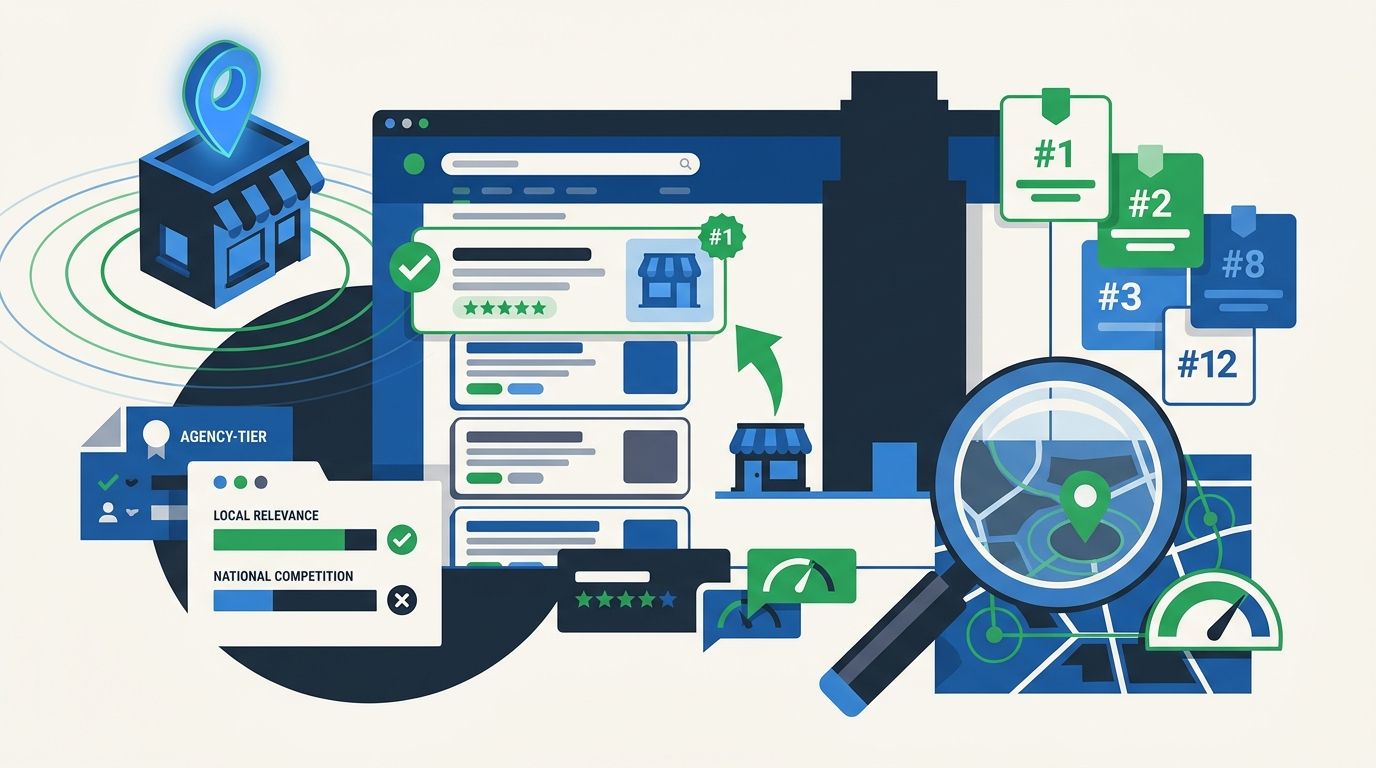
Proximity-based ranking factors give single-location businesses a structural advantage over national chains in local search results, allowing firms with complete Google Business Profile listings and recent reviews to outrank 900-branch competitors in map pack placements, according to an analysis pub
Explore more topics