
DIY SEO Tools vs. Agency Services: The Real Cost-Benefit Analysis for Mid-Market Businesses in 2026
The standard "in-house vs agency SEO" debate gives mid-market companies a false binary that leads to overspending in both directions — paying agencies $5,000–$10,000 per month for tasks a $200 tool handles, while skipping the strategic work where professional firms actually earn their fee.
 Marcus Webb··8 min read
DIY SEO Tools vs. Agency Services: The Real Cost-Benefit Analysis for Mid-Market Businesses in 2026
The standard "in-house vs agency SEO" debate gives mid-market companies a false binary that leads to overspending in both directions — paying agencies $5,000–$10,000 per month for tasks a $200 tool handles, while skipping the strategic work where professional firms actually earn their fee.
The False Binary and Why It Persists
Why does the in-house vs agency SEO question keep getting framed as an either/or decision? Because agencies benefit from selling full-service retainers, and tool vendors benefit from selling the fantasy that software replaces expertise. Neither side has an incentive to tell mid-market buyers the truth: you need both, but in very different proportions than either party suggests.
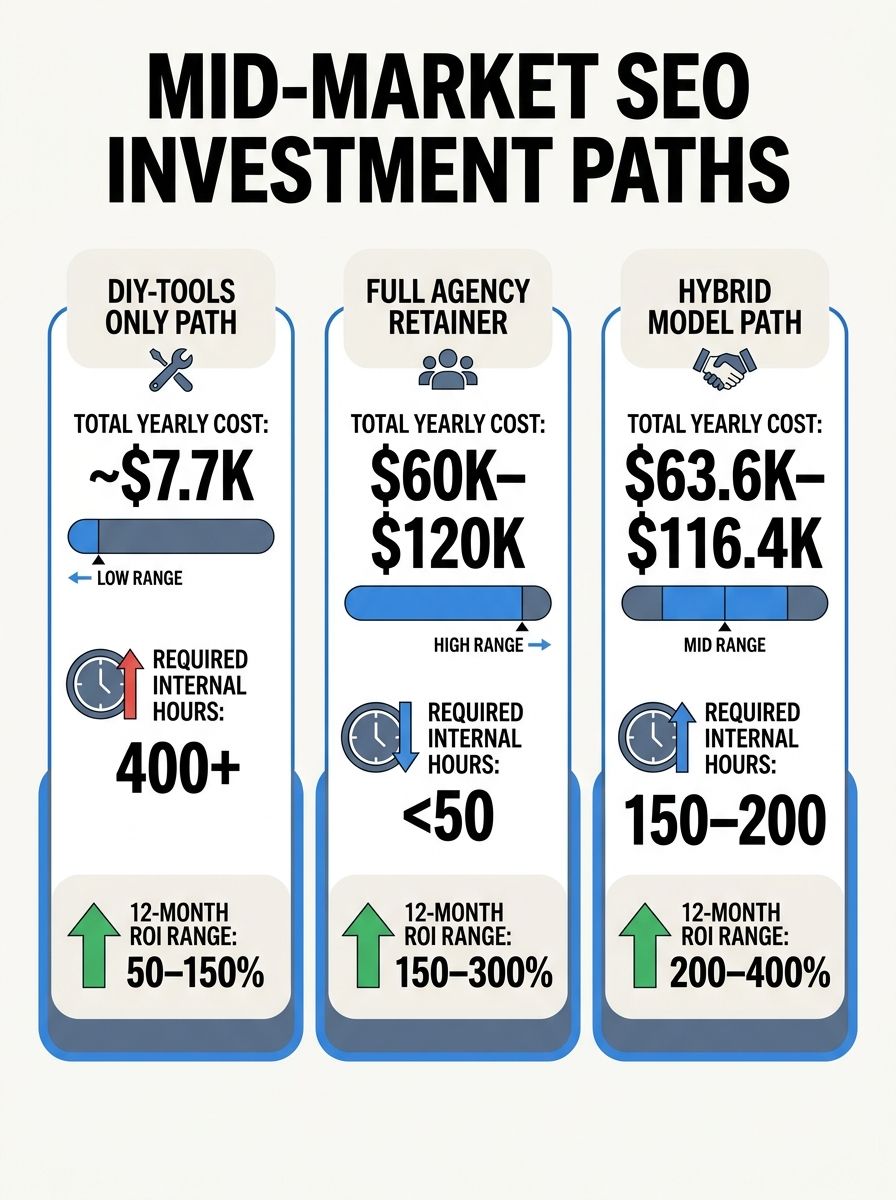
The numbers tell a clear story. According to SEO pricing data from DigitalApplied, mid-market companies invest $5,000–$10,000 per month on agency SEO retainers in 2026. That's $60,000–$120,000 annually for a service where significant portions of the deliverables — rank tracking, site audits, content gap reports — come from the same SEO automation platforms 2026 businesses can license directly for $100–$500 per month.
Building a full in-house SEO team runs $250,000 to $500,000+ annually when you factor in salaries, benefits, and operational overhead. For a company doing $10M–$50M in revenue, that's a massive fixed cost for a function that may not need three to five dedicated heads.
The mid-market SEO budget gets squeezed from both ends. Agencies upsell beyond what's needed, and the in-house path demands headcount that's hard to justify until organic traffic already drives meaningful revenue. The right answer sits in the middle, but almost nobody structures their spending that way.
Evidence One: Tool Capabilities Have Outgrown Agency Reporting Packages
The SEO tool ROI calculation has shifted dramatically. Five years ago, platforms like Ahrefs and SEMrush provided raw data that required significant interpretation. The current generation does the interpretation for you.
Clearscope, priced at $189/month for the Essential tier and $399/month for Business, automates content decay detection — flagging pages losing traffic and prescribing specific optimization actions. Surfer SEO runs $49/month for AI-driven content briefs and on-page optimization scoring. SE Ranking offers local rank tracking and competitor analysis at $103/month. Screaming Frog provides technical audits at $259/year. Moz Pro still serves as a solid mid-market option with Domain Authority benchmarking, Link Explorer, and site crawl capabilities that handle most routine audit needs.
Stack Clearscope, Surfer, SE Ranking, and Screaming Frog together and you're paying roughly $640/month — $7,680 annually. A mid-market agency retainer at the low end costs $60,000 per year. The gap is $52,320.
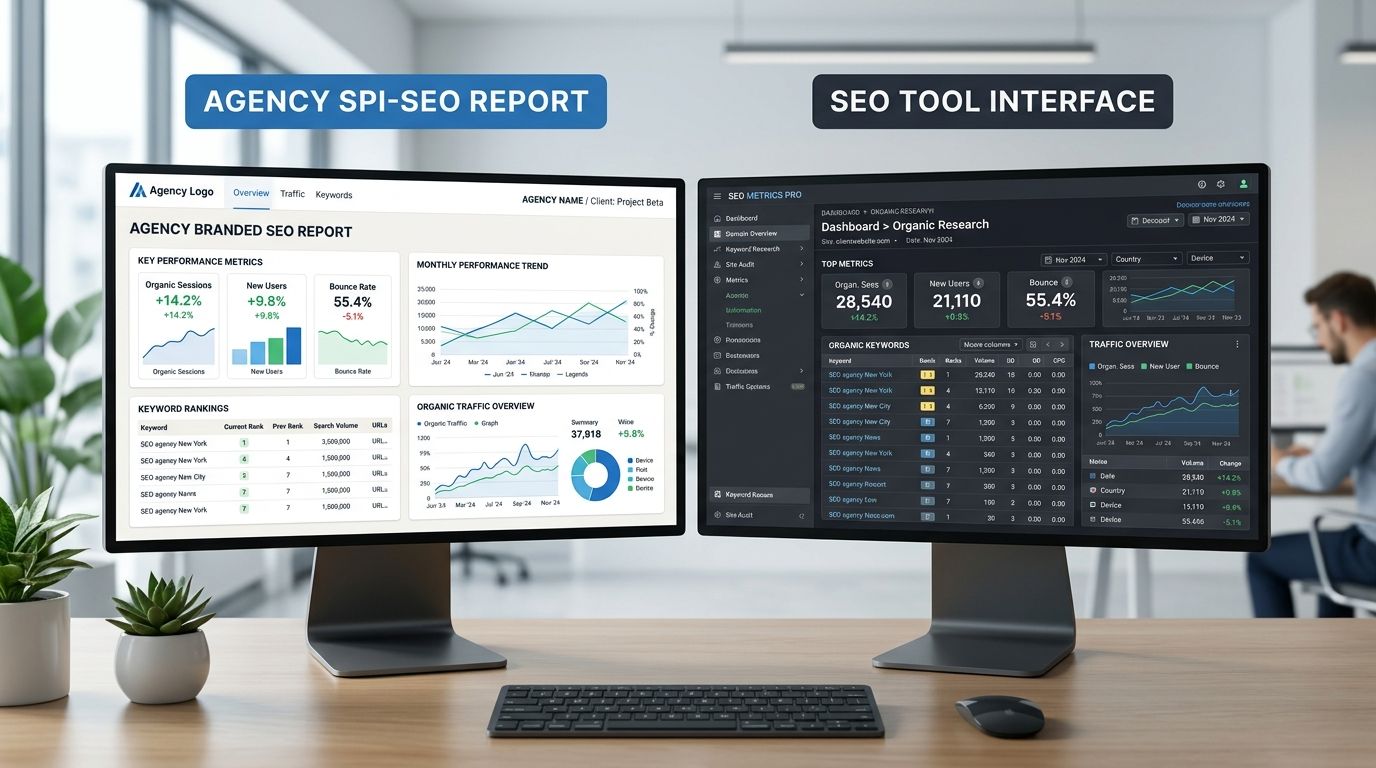
So what fills that gap in a typical agency engagement? Having reviewed agency deliverables for over 200 firms during my consulting work, I can tell you a substantial portion of what agencies charge for at the mid-market tier is tool output wrapped in branded templates. The monthly "SEO performance report" is often a Semrush or Ahrefs export reformatted into a slide deck. The "content audit" is frequently Clearscope or Surfer data with agency commentary layered on top.
If you've been evaluating SERP tracking and audit platforms for your stack, you already know the tool side of this equation is strong. The question is whether you're still paying an agency to run those same tools on your behalf.
Capability | DIY Tools (Annual Cost) | Agency Retainer (Annual Cost) | Better Value |
|---|---|---|---|
Rank tracking & reporting | $1,236 (SE Ranking) | Included in $60K–$120K retainer | DIY Tools |
Technical site audits | $259 (Screaming Frog) | Included in retainer | DIY Tools |
Content optimization scoring | $2,268–$4,788 (Clearscope) | Included in retainer | DIY Tools |
Link acquisition (15–25 quality links/mo) | No tool replaces outreach | Included in retainer | Agency |
AI search / GEO strategy | $588 (Surfer) + internal time | Included in retainer | Agency |
Technical migration support | N/A | $150–$300/hour specialist rate | Agency |
Competitive strategy & pivots | Internal time (15–25 hrs/mo) | Bi-weekly strategy calls | Depends on team |
The pattern is consistent across every agency I've evaluated. Tools win on monitoring, reporting, and content scoring. Agencies win on execution tasks that require human relationships (link building), specialized expertise (technical migrations), and strategic judgment (competitive pivots after algorithm changes that break established playbooks).
Evidence Two: The Opportunity Cost of DIY Is Worse Than the Dollar Cost
Here's where the pro-tool argument breaks down. Tools generate output. They don't generate outcomes. And the difference between those two things eats mid-market companies alive.
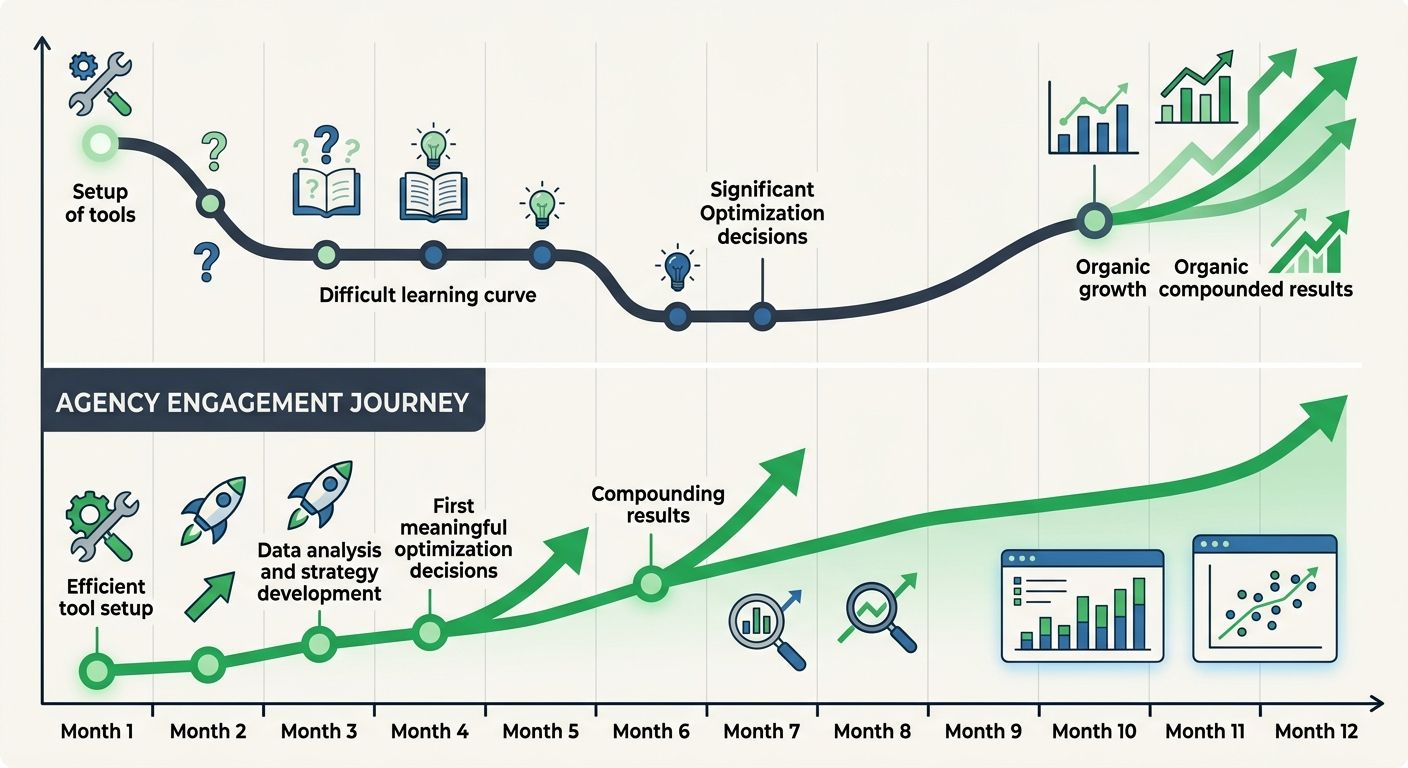
Running DIY SEO requires 10–20 hours per month minimum, and that estimate is conservative for mid-market sites with 500+ pages. The opportunity cost of that time runs $750–$1,500 per month, assuming the person doing the work has other revenue-generating responsibilities. But the real cost is the learning curve: the same source estimates 6–12 months to become proficient in SEO execution.
During those 6–12 months, a mid-market business running a pure DIY approach is making decisions based on incomplete understanding. I've watched companies burn through an entire year of "doing SEO" with tools, only to discover they'd been optimizing for keywords with zero commercial intent, or building internal links in patterns that diluted their topical authority rather than strengthening it.
AI has compressed some of this learning curve. Tools with built-in recommendations can guide a non-specialist toward better decisions. But AI has also made SEO more complex — Google's May 2026 core update reshaped ranking factors across verticals, and the rise of AI search engines means businesses now optimize for extraction by LLMs alongside traditional rankings. AI search traffic grew 527% year-over-year according to industry tracking data, and visitors from AI search convert at 4.4x the rate of traditional Google traffic. A tool can tell you your Core Web Vitals score. It can't tell you whether your content strategy aligns with how AI agents are restructuring discovery.
The hidden cost of the DIY path multiplies when something breaks. Site migrations, penalty recoveries, sudden traffic drops after algorithm updates — these events require immediate, experienced intervention. An agency with a team of specialists can deploy a structured debugging framework within 48 hours. A marketing manager with a Screaming Frog license and six months of self-taught knowledge is going to lose weeks of revenue diagnosing the problem.
AI has reduced routine SEO task costs by 20–30%, according to EvenDigit's 2026 analysis of in-house vs agency marketing. That compression benefits both approaches. Agencies deliver more output per retainer dollar. Tools automate tasks that previously required human hours. But the compression doesn't eliminate the expertise gap — it actually widens the gap between what tools can handle and what requires experienced judgment, because the easy tasks are now trivially automated while the hard tasks remain genuinely hard.
Evidence Three: Agency ROI Numbers Are Real, But Averages Hide Wide Variance
The headline figure circulating in 2026 is a 748% median ROI for agency SEO — roughly $22 returned per $1 invested. That number aggregates results across businesses of all sizes and verticals, and it's genuinely useful as a benchmark. But medians hide the spread.
In my experience evaluating agencies, the distribution looks roughly like this: about 20% of engagements deliver spectacular results (1,000%+ ROI), around 50% deliver solid positive returns (200–700% ROI), and approximately 30% deliver flat or negative returns. That bottom 30% is where mid-market companies lose real money, and it happens for predictable reasons.
The agencies in that bottom tier share characteristics I've documented across years of evaluations. They guarantee rankings — a red flag I've flagged consistently throughout my career. They charge under $2,000/month for mid-market scope, which falls below what Arc4's pricing research describes as the threshold where "real strategy, content, and link building happen." And they front-load their deliverables with tool-output reporting rather than the strategic and execution work that drives organic revenue.
For mid-market businesses comparing white-label SEO companies or evaluating agency proposals, the vetting process matters more than the in-house vs agency SEO decision itself. A well-chosen agency at $7,000/month will outperform a poorly chosen agency at $12,000/month every single time, and it will dramatically outperform a DIY approach where the company lacks internal expertise. The selection decision is where ROI gets made or lost — not the budget decision.
The SEO Capability Stack: A Framework for Splitting the Budget
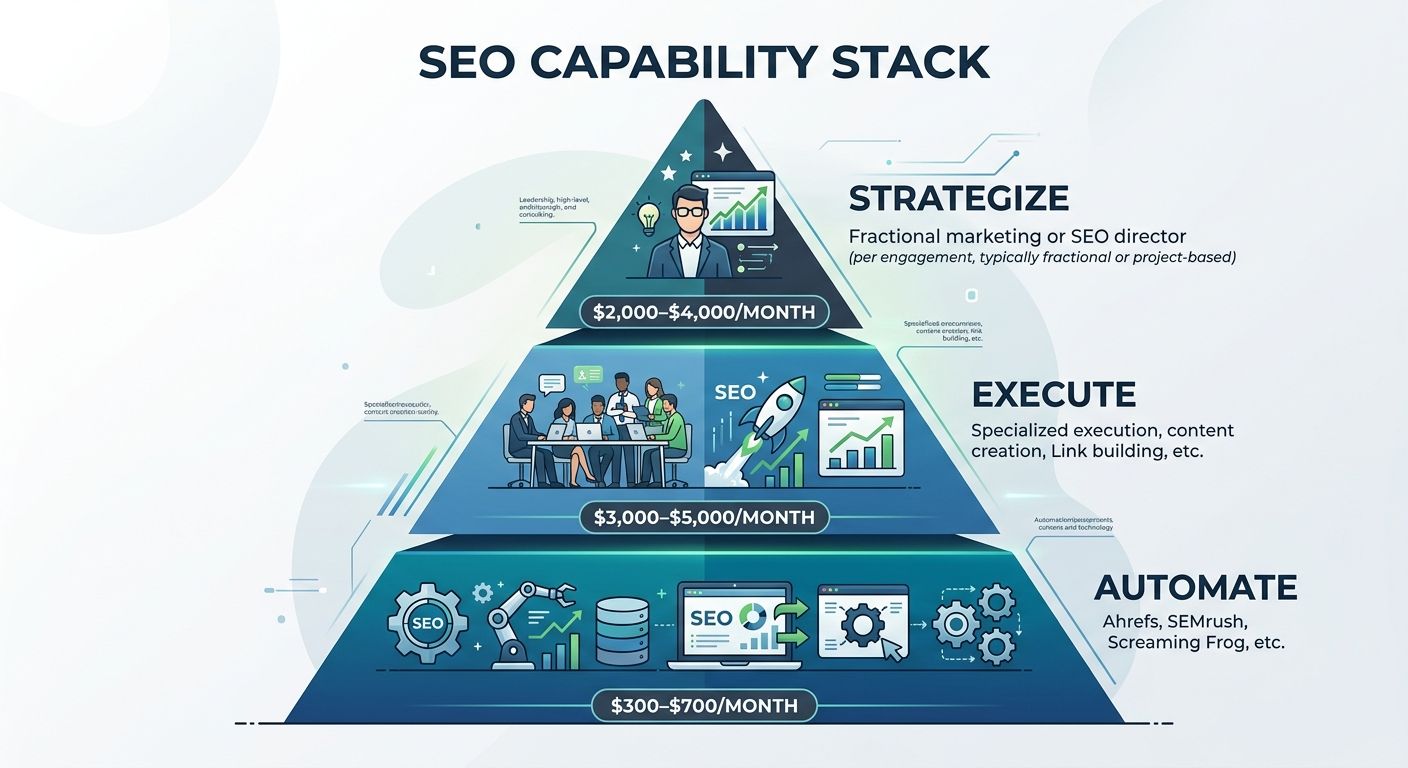
I've been using a model with clients that strips the emotion out of this decision. The SEO Capability Stack sorts every SEO activity into three buckets based on where human judgment creates value versus where it doesn't.
Bucket 1: Automate ($300–$700/month in tools). Rank tracking, technical audits, content scoring, keyword monitoring, competitor alerts. These are tasks where human judgment adds minimal value once the tool is configured correctly. License SE Ranking, Screaming Frog, and one content optimization platform. Total annual cost: $3,600–$8,400. Assign one internal person 5–8 hours per month to review output and flag issues that require human decision-making.
Bucket 2: Execute ($3,000–$5,000/month via agency or specialist). Link acquisition, content production at scale, technical implementation of audit findings, AI search optimization. These require either dedicated headcount or agency execution. For companies without a senior SEO hire, an agency scoped specifically to execution tasks delivers better per-dollar value than a single full-time generalist who splits attention across twelve responsibilities. Annual cost: $36,000–$60,000.
Bucket 3: Strategize ($2,000–$4,000/month via senior hire or fractional strategist). Competitive positioning, content architecture, algorithm response planning, and integration between SEO and broader marketing. This is the layer where most agencies struggle at the mid-market tier, because their strategists are typically spread across 15–20 accounts. A fractional SEO director engaged 10–15 hours per month often delivers more focused strategic value than an agency's account manager juggling a dozen clients. Annual cost: $24,000–$48,000.
Total hybrid model cost: $63,600–$116,400 annually. That's comparable to the upper range of a standalone agency retainer, but the allocation is dramatically different. You're spending 6–7% on tools, 50–55% on execution, and 35–40% on strategy. A typical all-agency engagement reverses those proportions — spending the majority on blended deliverables where you can't distinguish tool output from expert judgment.
Companies with strong performance dashboards can measure which layer is driving results and adjust quarterly. Those without that measurement infrastructure are flying blind, and they're the companies most likely to either overpay an underperforming agency or waste months on a DIY approach they don't have the expertise to execute well.
The Claim, Revisited
The false binary between DIY tools and agency services persists because it serves both sides of the market. Tool vendors want you to believe $500/month replaces a $7,000 retainer. Agencies want you to believe their $7,000 retainer is indivisible — that you can't unbundle the monitoring layer from the expertise layer without losing the whole thing.
Neither claim survives contact with the actual numbers. The SEO Capability Stack works because it maps spending to value creation at each tier. Tools create monitoring value at $300–$700/month. Agencies or specialists create execution value at $3,000–$5,000/month. Senior strategists create directional value at $2,000–$4,000/month. Collapsing all three into a single line item — whether that's a tool subscription or an agency retainer — guarantees you'll overspend on one layer and underspend on another.
The in-house vs agency SEO debate, as traditionally framed, asks the wrong question for mid-market companies. The useful question is narrower: for each specific SEO capability your business needs, what's the most cost-effective way to source it? Work through your capabilities one by one, match each to the right bucket, and the budget allocates itself with a clarity that the old binary never provided.
Marcus Webb
Digital marketing consultant and agency review specialist. With 12 years in the SEO industry, Marcus has worked with agencies of all sizes and brings an insider perspective to agency evaluations and selection strategies.
Related Articles
SEO Tool Stack Consolidation: Building Your 2026 Agency Tech Stack Without Bloat
Agencies carrying 5 to 7 overlapping SEO subscriptions at $300–$450 per month can consolidate to a unified platform for roughly $100, recapturing $3,600–$5,400 annually per agency.
The Complete SEO Tool Stack Audit Checklist: How to Evaluate, Consolidate, and Right-Size Your Agency's Technology Budget in 2026
Google searches that end without a click now account for 58% of all queries, and over half of Google results pages display an AI Overview — yet the median agency's SEO tool stack still concentrates its budget on tracking traditional blue-link positions.
White-Label SEO Tools vs. Full-Service Agency Ownership: Building Your Tech Stack for Margin and Client Retention in 2026
Agency tech stack ROI hinges on one architectural choice: whether you rent white-label SEO tools or own your reporting infrastructure outright.
Explore more topics