
Why Google's May 2026 Algorithm Update Is Breaking Enterprise SEO Playbooks (And How Agencies Should Respond)
SE Ranking's volatility index for the March 2026 core update showed 79.5% of top-3 positions shifting — the most disruptive reshuffle ever recorded.
 Marcus Webb··8 min read
Why Google's May 2026 Algorithm Update Is Breaking Enterprise SEO Playbooks (And How Agencies Should Respond)
SE Ranking's volatility index for the March 2026 core update showed 79.5% of top-3 positions shifting — the most disruptive reshuffle ever recorded. The May 2026 update, rolling out since May 15, compounds that disruption by tightening scrutiny on scaled AI content, re-weighting E-E-A-T signals for enterprise sites, and punishing intent mismatches that white-label SEO fulfillment teams have baked into their standard operating procedures for years.
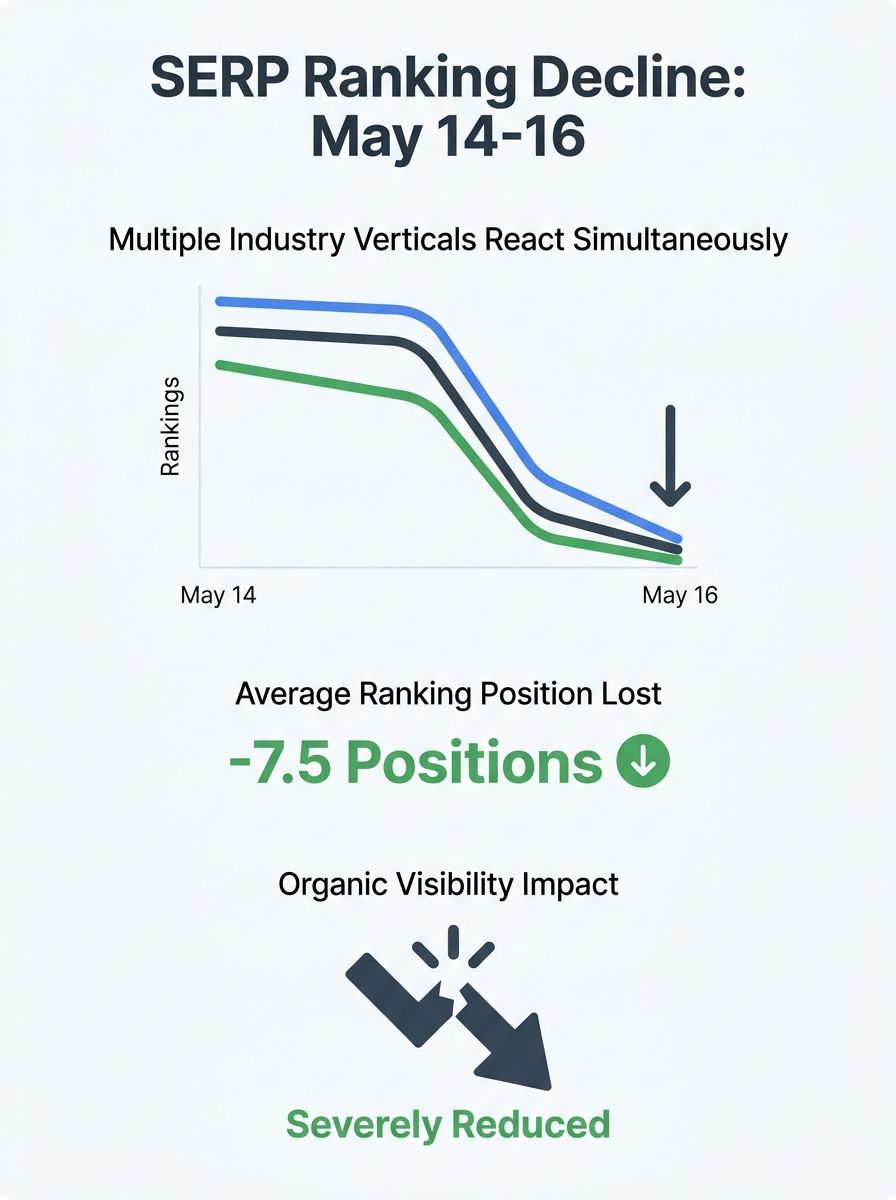
I've spent the last 72 hours fielding calls from agency partners whose enterprise client dashboards look like crime scenes. Entire content libraries that ranked comfortably through Q1 dropped 25–35% in competitive verticals overnight. The agencies asking the sharpest questions aren't the ones panicking about individual keyword positions. They're the ones realizing their entire production model, the one they've sold to reseller partners and white-label clients as a reliable system, was built on assumptions Google just invalidated. And the fix isn't a quick audit or a content refresh. It's structural.
What the May 2026 Update Recalibrated
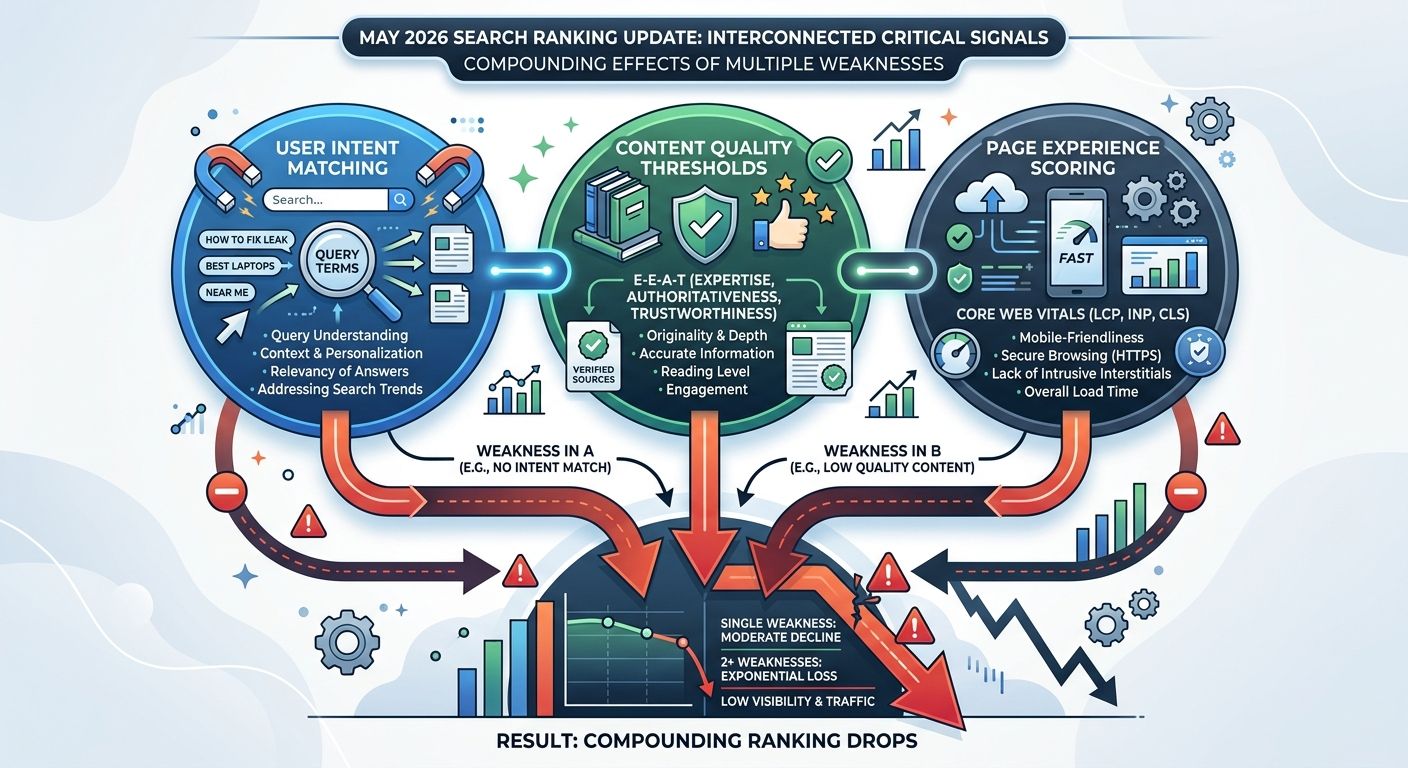
The May 2026 update targets three interconnected signals simultaneously: user intent interpretation, content quality thresholds, and page experience scoring. According to SEO Vendor's initial analysis, this update targets how Google reads user intent, content quality, and page experience all at once, which is why the impact feels so broad. Previous updates tended to isolate one signal and tighten it. This one adjusted the weights across all three in concert, creating a compounding penalty effect for sites that were marginal in two or more categories.
The quality content signals Google re-weighted cluster around three properties that the March 2026 core update had already flagged, according to Evertune's post-update analysis: demonstrated first-hand expertise, specificity of claims backed by verifiable sources, and content that better satisfies the signals Google has decided matter more. The sites losing ground aren't being punished in a punitive sense. They're being outranked by pages that score higher on the recalibrated rubric. That distinction matters because it changes how agencies should diagnose the drop. You aren't looking for a penalty. You're looking for the gap between your content and whatever Google now considers sufficient.
One critical clarification: there is no public evidence that search systems use third-party AI detection scores as a direct ranking factor. Google has been consistent on this point. The update's impact on AI-generated content comes from quality evaluation, not detection. Content produced by AI that demonstrates genuine expertise, cites real sources, and satisfies user intent can still rank. Content produced by AI at scale with minimal editorial oversight and thin subject-matter depth gets outranked because it fails quality evaluation, regardless of how it was produced. The SEO Vendor analysis noted that this May update has added a sharper layer of scrutiny toward AI-generated material specifically because so much of it fails those quality checks, not because of its origin.
The dominant ranking factors in 2026, as Search Engine Basics documented, are content quality, E-E-A-T (Experience, Expertise, Authoritativeness, and Trustworthiness), backlinks from authoritative sites, Core Web Vitals, and how well your page matches what a searcher actually wants. None of these are new. What's new is how aggressively Google is now enforcing the gap between meeting those standards and merely gesturing at them.
Why Enterprise Playbooks Cracked Under This Pressure
Enterprise SEO has operated on a specific economic model for the better part of a decade: identify high-volume keyword clusters, produce content at scale to cover those clusters, build internal linking structures to distribute authority, and measure success through aggregate organic traffic growth. White-label providers built their fulfillment packages around this exact model because it was predictable, reportable, and defensible in client QBRs. The problem is that this model optimizes for coverage and volume, and the May 2026 update explicitly devalues both when they come at the expense of depth.
The Semrush data study on AI content performance found that 72% of SEO professionals believe AI-assisted content performs as well or better than human-written content in search rankings, up from 64% in their 2024 study. That confidence drove enterprise content teams and their white-label partners to increase production velocity through 2025 and into early 2026. But that 72% figure masks a critical nuance: "AI-assisted" content that involves genuine editorial shaping, expert review, and original insight behaves very differently in search than "AI-generated" content that went through a cursory human review before publication. The May 2026 update widened the gap between those two categories dramatically.
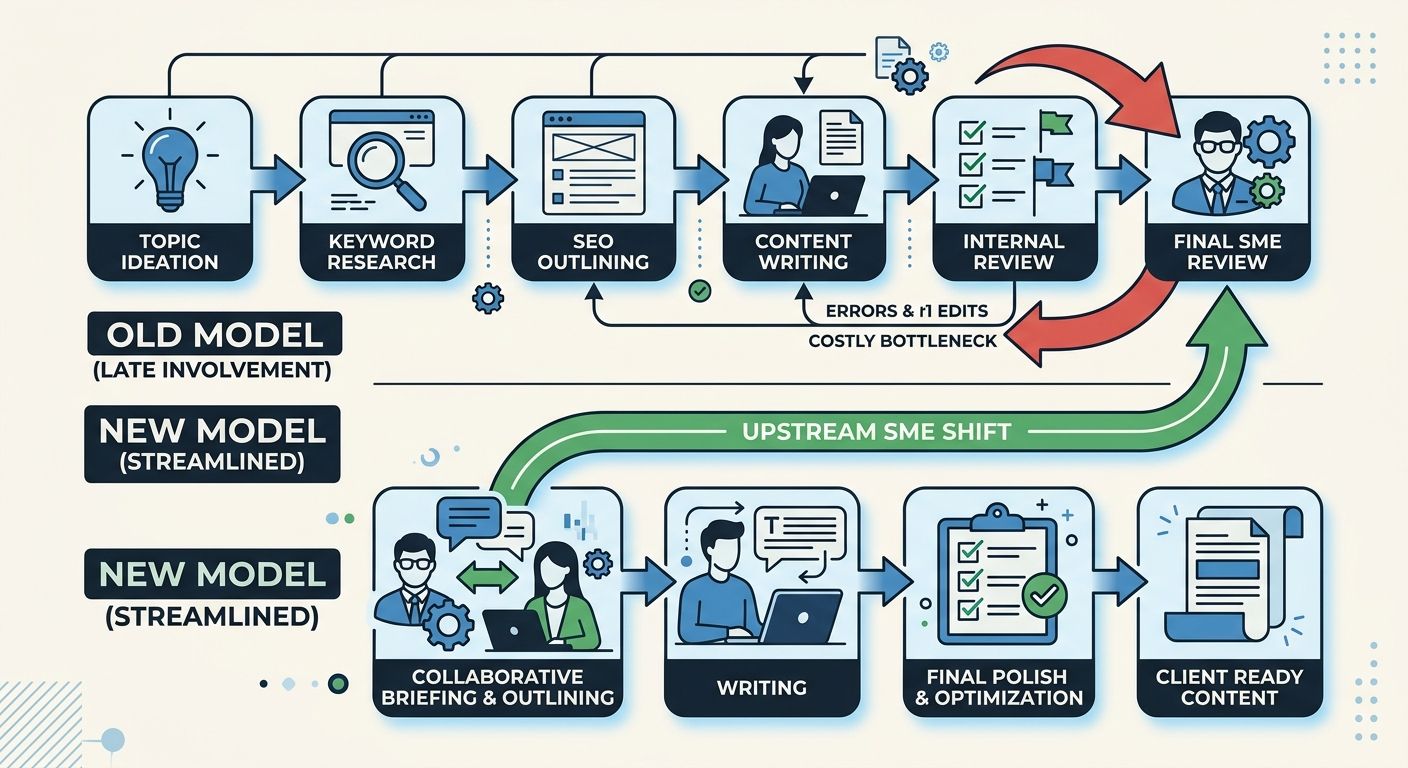
Here's where the white-label fulfillment model gets exposed. Most white-label SEO agencies price content production per deliverable: a certain number of blog posts, landing pages, or resource articles per month at a fixed cost. The economics only work if production time per piece stays low. When Google required thin content to become genuinely expert content to maintain rankings, the production cost per piece that actually performs jumped. I've seen estimates from agency operations managers suggesting a 40–60% increase in per-piece production costs to meet the new quality threshold, because you need subject-matter expert involvement at the drafting stage, not just a review pass at the end.
New data from the Fuel Online AI Index, reported just hours ago, found that 62% of enterprise brands are "technically invisible" to generative AI models. In 81% of test cases, brands that ranked well in traditional search failed to appear in AI-generated answers. This split between AI visibility and traditional SEO rankings is another crack in the enterprise playbook. Agencies optimized for one channel are losing ground in the other, and the May update's emphasis on the kind of content that AI systems extract and cite accelerates that divergence.
The IT implementation bottleneck makes this worse. Search Engine Journal's reporting from this week highlighted that backlogs don't drive growth; only implemented SEO work does. Enterprise clients typically take 3–6 months to implement technical SEO changes. That timeline was already a problem; now, with quality content signals shifting under their feet, agencies are stacking new recommendations on top of old ones that haven't been touched. I've written before about how unimplemented recommendations erode agency credibility and client relationships. This update turns that erosion into a cliff.
The White-Label Response That Actually Holds Up
The agencies I've seen respond most effectively to the Google May 2026 algorithm update impact share a common thread: they're restructuring fulfillment around what I'm calling the depth-over-coverage pivot. Instead of producing 20 pieces per month across a keyword cluster, they're producing 8–10 pieces with demonstrable E-E-A-T enterprise credentials baked in at the production level. That means named author attribution with verifiable expertise, original data or analysis that can't be replicated by a competitor's AI prompt, and specific claims tied to cited sources rather than generic summaries of a topic.
The pricing conversation matters here because white-label SEO operates on margin. If your fulfillment cost per deliverable increases by 50% but your reseller pricing stays flat, you're absorbing the hit. The agencies adapting fastest have restructured their packages to reflect the new reality: fewer deliverables per month, higher quality per deliverable, and explicit scope for subject-matter expert involvement (either sourced from the client's team or contracted through the agency's own network). Quantifi Media's analysis of this update notes that Google places an even stronger emphasis on quality, relevance, and user experience, which means agencies that try to maintain the old volume model at the old price point will produce content that Google has already decided to rank below the new threshold.
ClickRank's guide to 2026 algorithm updates offers a useful framing: updates are less about punishment and more about re-ranking content based on improved understanding. For white-label providers, this means the recovery path isn't disavowing links or fixing crawl errors. It's replacing content that was built for coverage with content built for authority. Agencies that have already started rebuilding their approach around AI-driven search visibility have a head start because the skills required to perform well in AI search and to satisfy the May 2026 update's quality thresholds overlap significantly. Both reward content that demonstrates genuine expertise, provides specific answers, and cites authoritative sources.
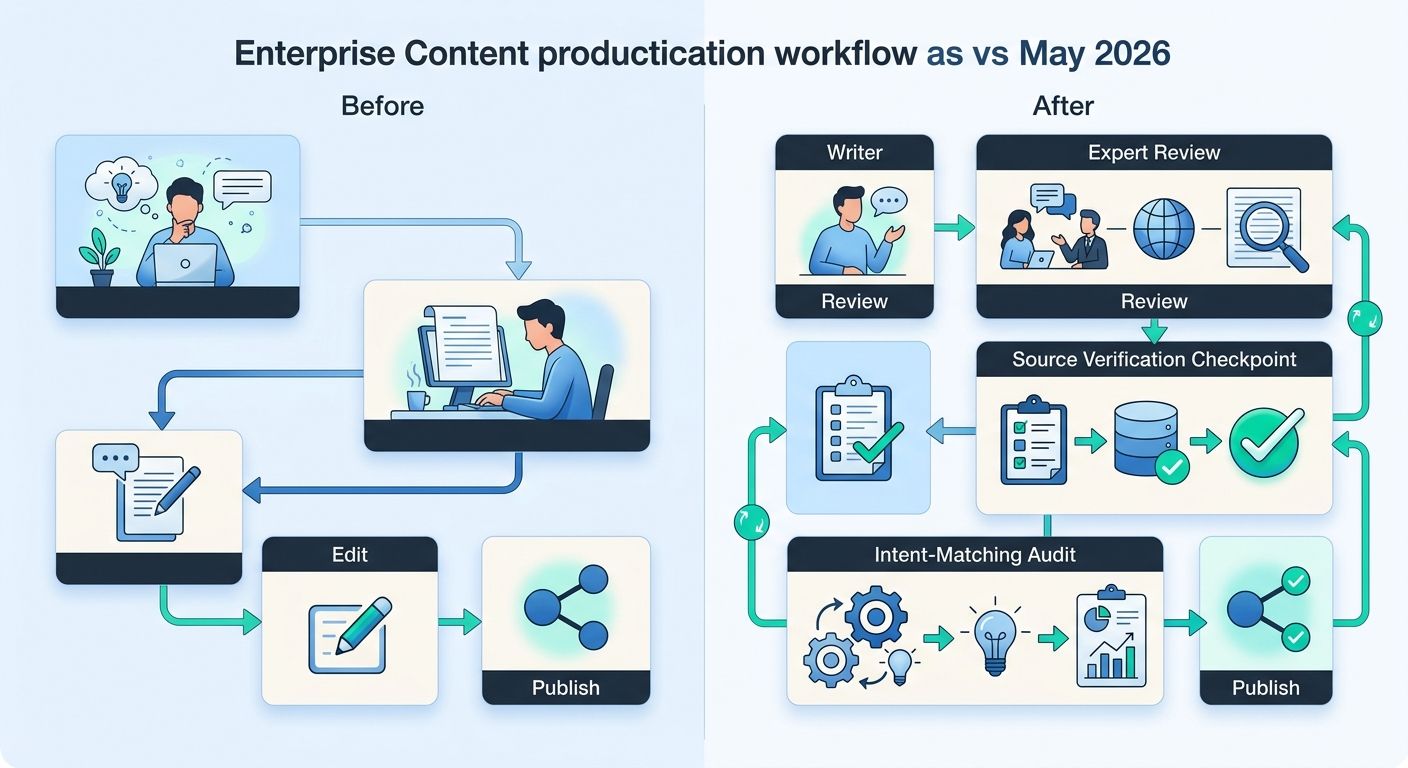
For white-label operations specifically, the operational change that matters most is moving subject-matter expertise upstream in the workflow. The old model had writers producing drafts from keyword briefs and outlines, with an editor reviewing for accuracy after the fact. The model that survives the May 2026 update has a subject-matter expert involved at the briefing stage, defining what original insight or perspective the piece will offer before a single word gets written. This is a structural change to how agencies staff, price, and schedule their fulfillment work. And it's the kind of change that takes 60–90 days to implement fully, which means agencies that started pivoting after the March 2026 core update are now the ones best positioned.
Google I/O 2026, kicking off on May 19 according to CNET, will likely provide additional context on how Google evaluates content quality in AI Overviews and traditional search. Agencies should pay close attention to any signals about how Google's official AI search guidance evolves, because the frameworks Google describes at I/O tend to telegraph what the next round of updates will prioritize.
The Part Nobody Wants to Talk About
The uncomfortable truth about the Google May 2026 algorithm update impact is that some white-label SEO models may not survive the cost restructuring this demands. An agency that built its value proposition around producing 30 blog posts per month for $3,000 can't produce 30 expert-quality blog posts per month for $3,000. The math doesn't work. And the enterprise clients buying those packages have been conditioned to evaluate agencies on output volume, not output depth. Changing that expectation means renegotiating contracts, losing some clients who only want cheap volume, and building a new sales narrative around quality content signals 2026 and beyond.
The Forbes Council piece published earlier this week framed the decision between in-house AI SEO teams and agencies as a balancing act between control, cost, expertise, and long-term vision. Enterprise clients are asking that question right now, and the agencies that can't articulate how their fulfillment process produces genuinely expert content will lose that conversation. The ones that can demonstrate a clear E-E-A-T production methodology, complete with named experts, original research processes, and verifiable source citations, have a defensible answer. But "defensible" and "easy" aren't synonyms, and the agencies best positioned for this shift are the ones that were already investing in quality infrastructure before the update forced the issue.
Recovery timelines add another layer of uncertainty. Early analysis suggests that ranking recovery from the May 2026 update won't happen until the next broad core update, potentially in June or July 2026. That's 6–10 weeks of depressed organic performance for affected enterprise clients, during which white-label agencies need to maintain client confidence while simultaneously overhauling their content production approach. I've talked to agency owners who are treating this as a temporary correction and planning to wait it out. I think they're wrong. The trajectory since the March 2026 core update, which ran from March 27 through April 8, has been consistent: every update tightens the quality threshold. Waiting for a reversion that isn't coming burns time and trust. The agencies that acknowledge the structural nature of this change, even when that acknowledgment is uncomfortable, and communicate it clearly to their clients and reseller partners are the ones that will still be operating by Q4. Whether the rest of us want to admit it or not, this update didn't break the enterprise SEO playbook. It revealed that the playbook was already outdated, and the signals were there for anyone paying attention.
Marcus Webb
Digital marketing consultant and agency review specialist. With 12 years in the SEO industry, Marcus has worked with agencies of all sizes and brings an insider perspective to agency evaluations and selection strategies.
Related Articles
Google's Expanded Ranking Pool Could Reshape Enterprise SEO Priorities: What Agencies Need to Prepare Now
The domain authority moat that enterprise sites have relied on for a decade is eroding faster than any agency retainer report will tell you.
Google's March 2024 Core Update Penalized Topic-Cluster Content Strategies Brands Spent Three Years Building
Google's March 2024 Core Update eliminated approximately 40 percent of low-quality, unoriginal content from search results, according to Search Engine Journal, targeting the exact topic-cluster content strategies that mid-size and enterprise brands spent 2021 through 2024 building at scale. Many org
AI Citations Just Changed SEO Strategy—But Most Agencies Haven't Updated Their PR Playbook Yet
The PR deliverables your white-label SEO provider sends every month are optimized for a citation ecosystem that functionally stopped existing in January 2026.
Explore more topics