
Google Marketing Live 2026 Confirms End of Traditional Search as Agency Study Shows Top-Ranked Brands Invisible to AI 69% of Time
Google announced at Marketing Live 2026 that traditional search has ended and all search on the platform now operates through AI-based systems, according to NP Digital's APAC managing director Dan Kalinski writing in Marketing-Interactive. The announcement validates what an NP Digital experiment mea
 Marcus Webb··4 min read
Google Marketing Live 2026 Confirms End of Traditional Search as Agency Study Shows Top-Ranked Brands Invisible to AI 69% of Time
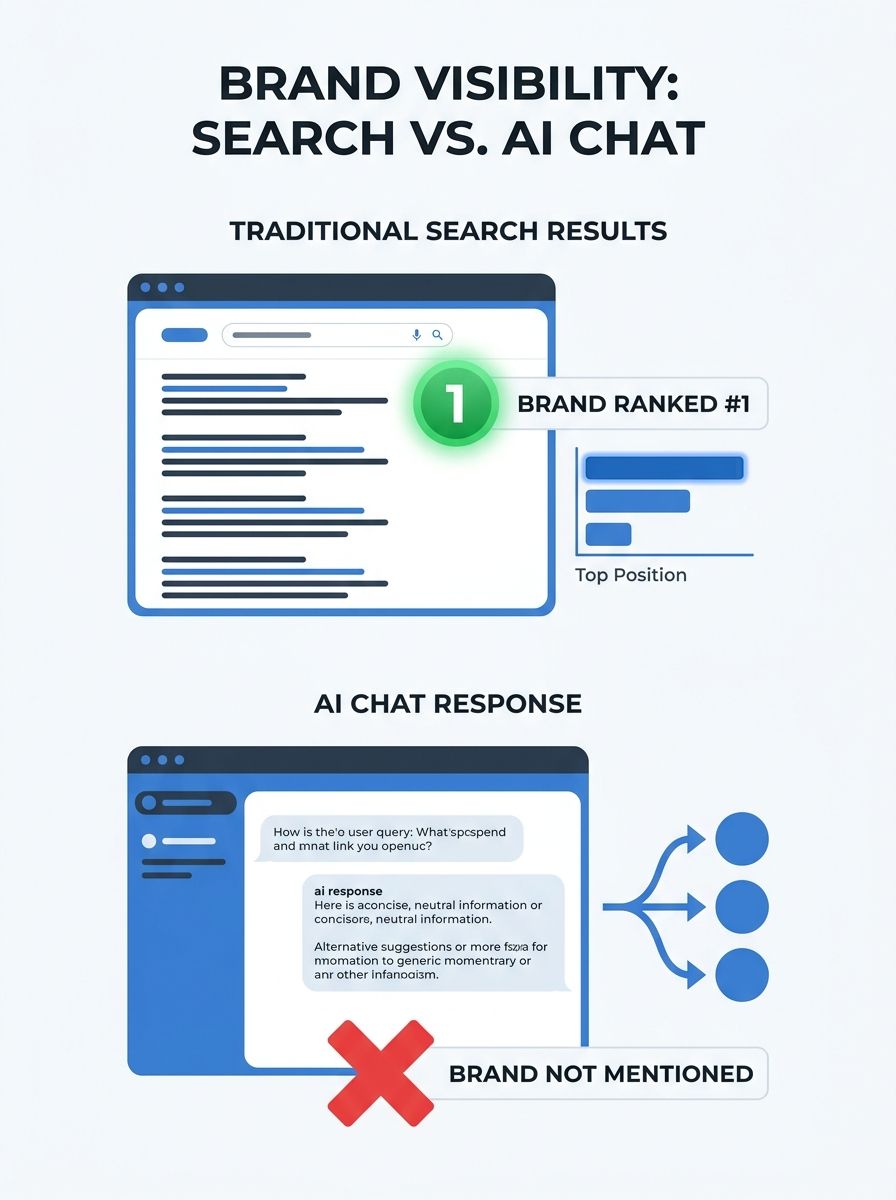
Google announced at Marketing Live 2026 that traditional search has ended and all search on the platform now operates through AI-based systems, according to NP Digital's APAC managing director Dan Kalinski writing in Marketing-Interactive. The announcement validates what an NP Digital experiment measured in March 2026: brands holding Google's top rankings appeared in AI-generated responses only 31% of the time when tested across 4,308 conversational prompts.
The visibility gap represents a structural shift in how search engines surface commercial information. NP Digital tested 100 commercial keywords across five industries in March 2026, identifying which brands ranked in the top five positions on Google. The agency then ran longer-tail, conversational variations of those keywords—4,308 prompts sourced from Ubersuggest and Answer the Public—through large language models to measure whether those same top-ranking brands received mentions in AI responses.
"The brands holding Google's top spot were only showing up in AI responses 31% of the time," Kalinski wrote. "In other words, brands that 'won' SEO, who fought for and held the top rank, are invisible to AI more than two-thirds of the time."
Purchase Journey Compression Drives Zero-Click Dominance
The behavioral shift behind Google's platform redesign stems from collapsing consumer purchase journeys. Zero-click activity already accounts for 65% of consumer searches, according to Bain & Company's "Goodbye clicks, hello AI" report cited by Kalinski. The majority of purchase decisions now form before a brand's website enters consideration.
NP Digital's own client base shows consumer journeys shrinking from 20-plus touchpoints over several weeks to a single AI conversation lasting five minutes. The shift invalidates ranking-focused measurement frameworks that track position, traffic, and click-through rate as primary KPIs. "The old measurement framework, using rankings, traffic and CTR, is assessing the wrong thing entirely," Kalinski noted.
The fundamental change in how Google operates as a search platform versus an AI agent has accelerated faster in Southeast Asia than in Western markets. Platforms including Lazada, Shopee, and Grab already trained regional consumers to expect instant, personalized answers through chat-native commerce, conditioning that now accelerates AI search adoption. Brands optimizing for keyword rankings rather than AI mention frequency are falling behind competitors who have pivoted to what Kalinski described as "outcomes-first measurement."
30-Day Adaptation Framework Prioritizes AI Visibility Audits
NP Digital outlined a four-step adaptation sequence agencies can execute within 30 days. The first step involves auditing brand visibility across ChatGPT, Perplexity, Gemini, and other AI platforms by searching brand names and category terms directly in those systems. "Think of this as your new share-of-voice audit," Kalinski wrote.
Measurement strategy forms the second adaptation layer. Agencies should stop reporting rankings and traffic as primary KPIs and instead track brand mentions in AI outputs, citation frequency, and share of AI recommendations by category. Review volume and quality now outweigh keyword density—AI agents surface brands based on third-party citations and review signals rather than on-page copy optimization.
Content structure requires the third shift. Websites should adopt encyclopedic formats over promotional copy because AI overviews disproportionately extract from content containing facts, comparisons, and statistics. Brands whose content resembles sales pitches get overlooked more frequently by large language models, according to Kalinski's analysis.
The fourth requirement involves cross-channel messaging consistency. AI agents cross-reference signals from Google, YouTube, Reddit, review platforms, and social media. Inconsistent messaging across those touchpoints creates conflicting signals that reduce AI recommendation probability. "A confused AI won't recommend you," Kalinski wrote.
Google's classification of AI Overview manipulation as search spam creates guardrails around aggressive optimization tactics, while the platform's May 2026 core update and search redesign established the technical infrastructure supporting AI-first search.
What Happens Next
The agency data quantifying traditional SEO's diminished effectiveness gives business owners and CMOs a decision framework for 2026 budget allocation. Companies still measuring SEO success through rankings and traffic are optimizing for visibility that doesn't translate to AI-generated recommendations—where 65% of consumer search activity now occurs. The 31% AI mention rate for top-ranking brands means that winning traditional search placements delivers less than one-third of the brand exposure those positions historically provided.
For marketing managers evaluating SEO agencies, the NP Digital framework provides specific audit criteria. Ask prospective agencies how they measure AI visibility, what tools they use to track brand mentions across ChatGPT and Perplexity, and whether they report citation frequency alongside traditional ranking metrics. Agencies still leading with keyword-density optimization and ranking reports as primary deliverables haven't adapted to the structural change Google confirmed at Marketing Live 2026.
The 30-day adaptation timeline Kalinski outlined is achievable because the required shifts are audit-based rather than content-production-dependent. Running brand and category searches across AI platforms, reconfiguring measurement dashboards, and auditing cross-channel messaging consistency are diagnostic tasks agencies can execute within a monthly sprint. The competitive advantage accrues to companies that complete these audits before Q3 2026 budget planning locks in 2027 SEO strategies optimized for a search paradigm Google has formally retired.
Marcus Webb
Digital marketing consultant and agency review specialist. With 12 years in the SEO industry, Marcus has worked with agencies of all sizes and brings an insider perspective to agency evaluations and selection strategies.
Related Articles
Google Launches May 2026 Core Update During I/O Week as Search Box Gets AI-Powered Redesign
Google began rolling out its May 2026 core update on May 21, the second core update this year and the fourth confirmed ranking update of 2026, according to the Google Search Status Dashboard. The rollout coincides with Google I/O announcements including the largest Search box redesign in over 25 yea
Ranking #1 on Google Now Delivers 58% Fewer Clicks Than It Used To, Gravitate Analysis Finds
A first-position Google ranking now delivers 58% fewer clicks than the same ranking delivered before AI Overviews began appearing in search results, according to an analysis released July 9, 2026 by Gravitate, a Vancouver-based digital marketing agency.
AI Search Platforms Layer Atop Google Rather Than Replace It, Similarweb Tracking Shows
Ninety-five percent of ChatGPT's 494 million users also used Google during the March-May 2026 tracking period, according to Similarweb's "2026 Generative AI Landscape" report released July 24.
Explore more topics