
Google Classifies AI Overview Manipulation as Search Spam, Targets "Recommendation Poisoning" Tactics
Manipulation tactics designed to influence Google's AI Overview and AI Mode results are now formally classified as spam violations under Google's updated search spam policy, effective May 17, 2026, according to Times of India. The policy update explicitly names "recommendation poisoning"—a technique
 Marcus Webb··4 min read
Google Classifies AI Overview Manipulation as Search Spam, Targets "Recommendation Poisoning" Tactics
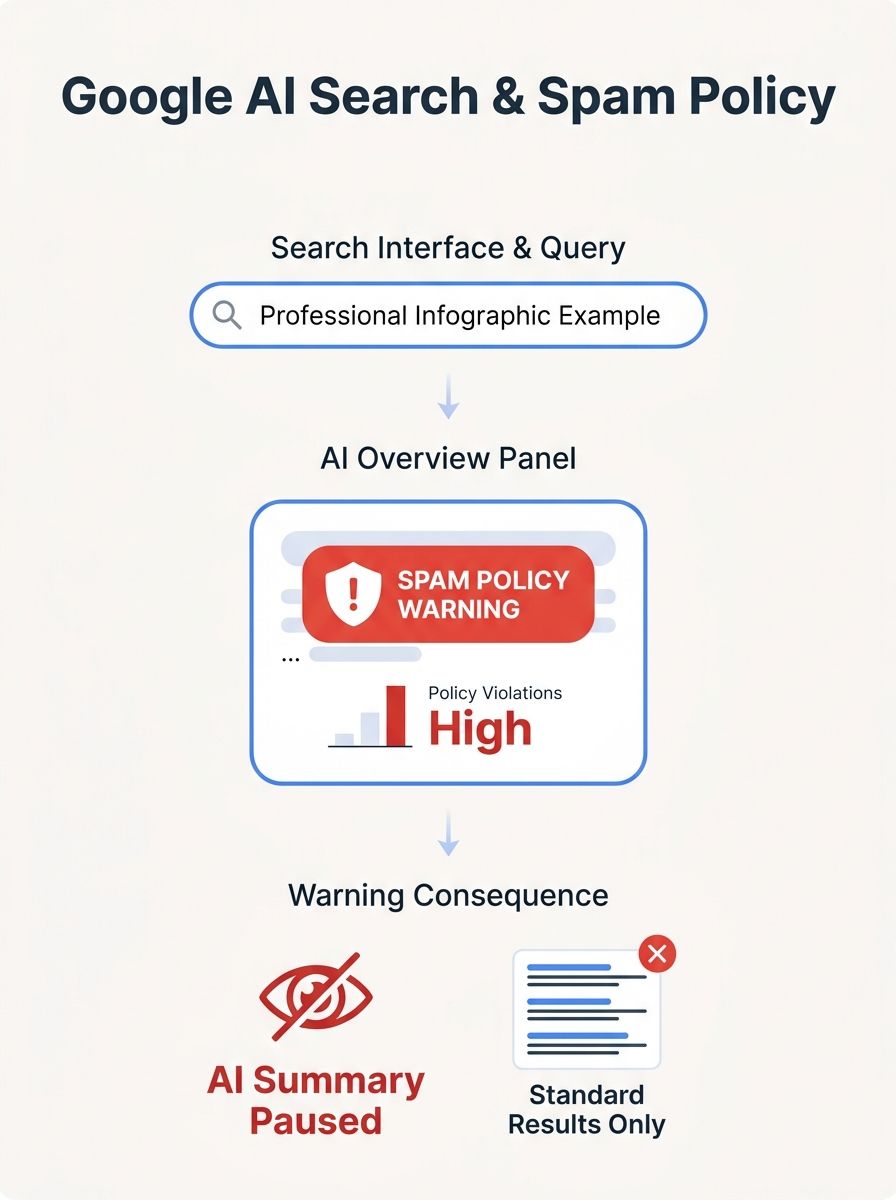
Manipulation tactics designed to influence Google's AI Overview and AI Mode results are now formally classified as spam violations under Google's updated search spam policy, effective May 17, 2026, according to Times of India. The policy update explicitly names "recommendation poisoning"—a technique where publishers embed hidden instructions in website code to manipulate large language model responses—as a prohibited practice subject to ranking penalties or complete removal from search results.
Policy Language Expands Spam Definition
Google's updated spam policy documentation now reads: "In the context of Google Search, spam refers to techniques used to deceive users or manipulate our Search systems into featuring content prominently, such as attempting to manipulate Search systems into ranking content highly or attempting to manipulate generative AI responses in Google Search," according to the official policy text published May 17. The expanded definition represents the first time Google has explicitly addressed manipulation of AI-generated search features in its core spam guidelines, first reported by Search Engine Land.
The policy applies to all web search results, including content from Google's own properties. Sites violating the guidelines may rank lower or disappear entirely from results. Google indicated it detects policy violations through both automated systems and human review that can trigger manual actions.
"Recommendation Poisoning" Technique Explained
"Recommendation poisoning" works by hiding specific phrases and instructions within a website's HTML code, metadata, or hidden page elements designed to trick large language models into identifying that domain as an authoritative source on particular topics, the Times of India report explained. The technique exploits how AI systems parse and weight content when generating summaries and recommendations shown in AI Overviews and AI Mode.
The practice emerged alongside the rapid growth of the Generative Engine Optimization (GEO) industry, where marketers and SEO practitioners developed tactics specifically targeting AI-powered search features rather than traditional algorithmic ranking factors. Google's policy update directly responds to this industry's expansion, which accelerated following the widespread rollout of AI Overviews in 2025 and early 2026.
As covered in Google's recent documentation updates, the search engine has taken an increasingly firm stance against practices that attempt to game AI-generated results through technical manipulation rather than content quality improvements.
Detection and Enforcement Mechanisms
Google stated it uses "scalable and automated solutions" to identify spam practices, with user reports supplementing its spam detection systems. The company indicated it "may act against any type of spam practices we detect," leaving enforcement scope broader than the specific examples named in the policy documentation.
The updated guidelines do not specify exact penalties for recommendation poisoning violations, maintaining Google's historical approach of not disclosing precise enforcement mechanisms. Sites found violating the policy face potential ranking suppression or complete de-indexing, consistent with penalties applied to other spam policy violations.
Manual actions triggered by human review teams can result when automated systems flag suspicious patterns consistent with AI manipulation attempts. Google has not disclosed what volume of sites have already been penalized under the new classification.
Industry Response and Adaptation
The policy update arrives as AI-powered search features represent a growing share of total search interactions, with AI Overviews now appearing on a significant percentage of queries. The GEO industry has developed multiple tactics beyond recommendation poisoning, including quotation insertion strategies and statistic placement techniques designed to increase citation probability in AI-generated responses.
Google's documentation distinguishes between legitimate optimization practices—improving content quality, structure, and relevance—and manipulative techniques designed to deceive AI systems about content authority or topic expertise. The company has consistently stated that traditional SEO best practices remain valid for AI-powered search features, as detailed in its official AI search guidance.
The policy update does not address all GEO tactics equally. Practices focused on improving content structure, adding properly attributed statistics, or enhancing factual accuracy fall outside the spam classification, while hidden text, invisible instructions, or deceptive markup targeting LLM parsing clearly violate the updated guidelines.
Services Implications
SEO agencies must immediately audit client sites for any tactics that could be construed as recommendation poisoning, particularly hidden text elements, invisible instructions in structured data, or metadata designed exclusively to influence AI parsing rather than serve user needs. The May 17 policy update creates liability for agencies that previously recommended or implemented GEO tactics focused on manipulating AI responses through technical deception rather than content improvement.
The enforcement risk is highest for agencies that adopted early GEO frameworks emphasizing hidden prompt injection, invisible instruction sets, or markup patterns designed to trick large language models. Agencies should review any AI-optimization work completed in 2025 or early 2026 against the new spam definition, prioritizing removal of tactics that fall within the "recommendation poisoning" classification before manual actions or algorithmic penalties take effect.
For agencies evaluating new AI search visibility strategies, the policy update reinforces that sustainable optimization approaches must focus on legitimate content quality signals—properly attributed statistics, well-structured answers, authoritative quotations—rather than technical manipulation. The boundary between acceptable optimization and spam now explicitly includes AI-powered features, closing a gray area that some practitioners exploited during the 2025 AI Overview rollout period.
Marcus Webb
Digital marketing consultant and agency review specialist. With 12 years in the SEO industry, Marcus has worked with agencies of all sizes and brings an insider perspective to agency evaluations and selection strategies.
Related Articles
Google Updates Search Spam Policy to Classify AI Manipulation as Violation, Targets "Recommendation Poisoning" Tactics
Google updated its search spam policy on May 17, 2026, explicitly classifying attempts to manipulate AI-powered search features—including AI Overviews and AI Mode—as spam violations, according to Search Engine Land. The policy revision directly targets "recommendation poisoning," a technique where m

Google's June 2026 Spam Update Targets AI Citation Manipulation as Violation of Core Search Policies
Google's June 2026 spam update, which began rolling out on June 24, explicitly treats efforts to manipulate AI-generated search responses—including buying citations or altering AI Overviews—as violations of the company's spam policies, according to Search Engine Journal. The update expands Google's

Google Launches June 2026 Spam Update Targeting Low-Quality Content Across All Languages
Google deployed a global spam-focused algorithm update on June 24, 2026, designed to reduce the visibility of websites violating the company's spam policies, according to an announcement from Advait Technology Labs. The June 2026 Spam Update applies across all languages and regions and is expected t
Explore more topics