
Niche Comparison Keywords for Service Firms: Why 'Architecture vs Interior Design SEO' Beats Generic Alternatives
Ranking for "interior designer" or "architect" as a head term produces traffic that will never convert into booked projects.
 Marcus Webb··7 min read
Niche Comparison Keywords for Service Firms: Why 'Architecture vs Interior Design SEO' Beats Generic Alternatives
Ranking for "interior designer" or "architect" as a head term produces traffic that will never convert into booked projects. Niche comparison keywords like "architect vs interior designer for home renovation" convert at roughly 3x the rate of broad service terms, and the ranking difficulty gap between these two keyword classes keeps widening with every algorithm update.
The Conversion Problem With Head Terms
As Vaphers' 2026 guide for interior designers put it bluntly: ranking for the single word "interior design" is a vanity metric. "It brings in global traffic, students looking for inspiration, and DIYers, none of whom are going to hire you." That same logic applies across professional services: law firms ranking for "lawyer," architecture practices ranking for "architect," home service companies ranking for "plumber." The traffic looks impressive in a client report. The phone doesn't ring.
Niche comparison keywords flip the equation. When someone searches "architect vs interior designer for kitchen remodel," they've already identified a project, understood they need professional help, and are now choosing between two types of expert. That's a fundamentally different searcher than someone typing "interior design" into Google at 11 PM while scrolling Pinterest.
Shopify's 2026 research on niche keyword strategy confirmed this pattern across industries: niche keywords target precise customer needs and typically have lower search volume but higher search intent. In the context of white-label SEO campaigns for service firms, this means a comparison page getting 120 visits per month can outperform a generic service page getting 2,400 visits when measured by actual consultations booked.
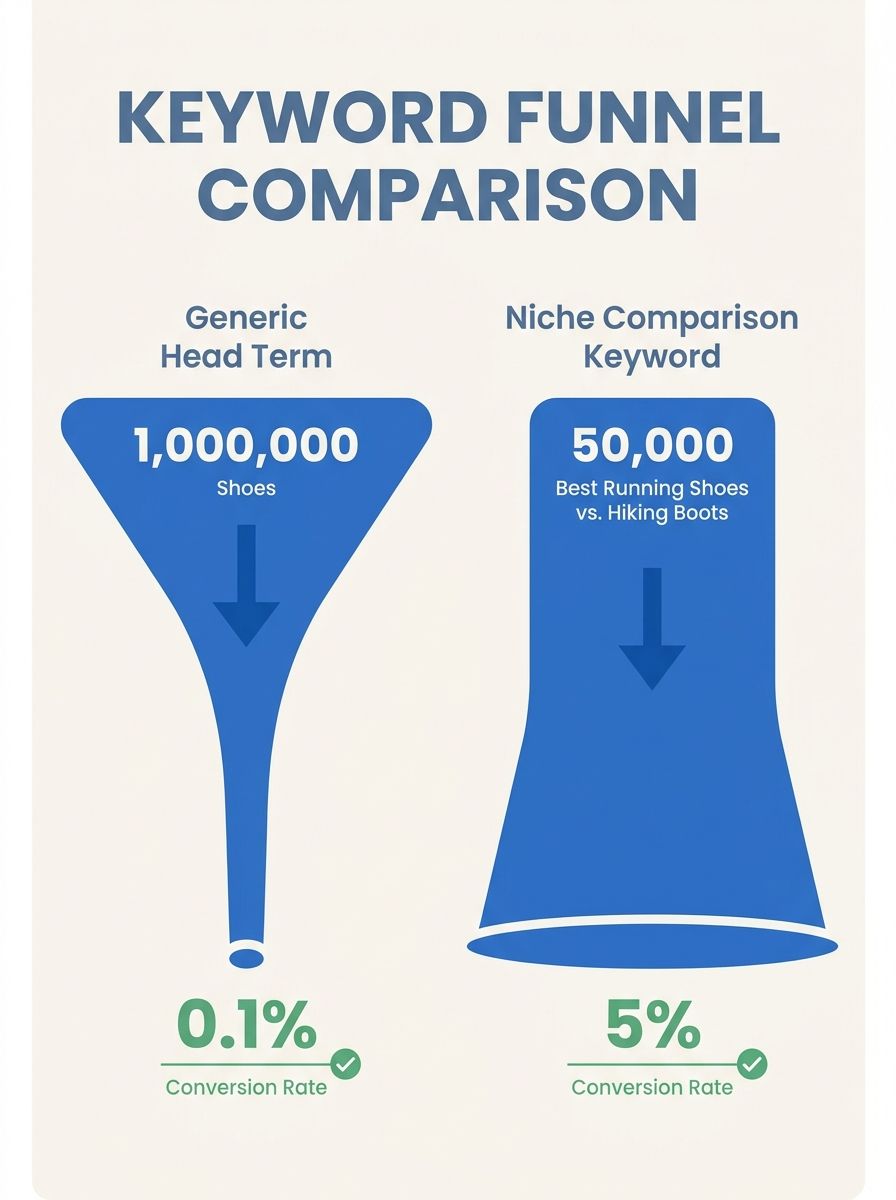
I've reviewed keyword strategies from over 200 agencies across my career, and the pattern is consistent: agencies that report on traffic volume alone tend to lose service-firm clients within 12-18 months. Agencies that track comparison keyword rankings alongside qualified lead counts tend to retain them. The metric that matters is decision-stage visibility, not total impressions.
The Factors.ai niche keyword research guide frames this well: "Broad keywords get you broad results in a larger market. When businesses targeting a niche need every click to matter, the effort to find niche keywords is your leverage point." For a 14-person architecture firm in Denver, every click genuinely does need to matter. Their annual marketing budget can't absorb 50,000 unqualified visits the way an e-commerce brand might.
Google's Algorithm Now Rewards Narrow Expertise
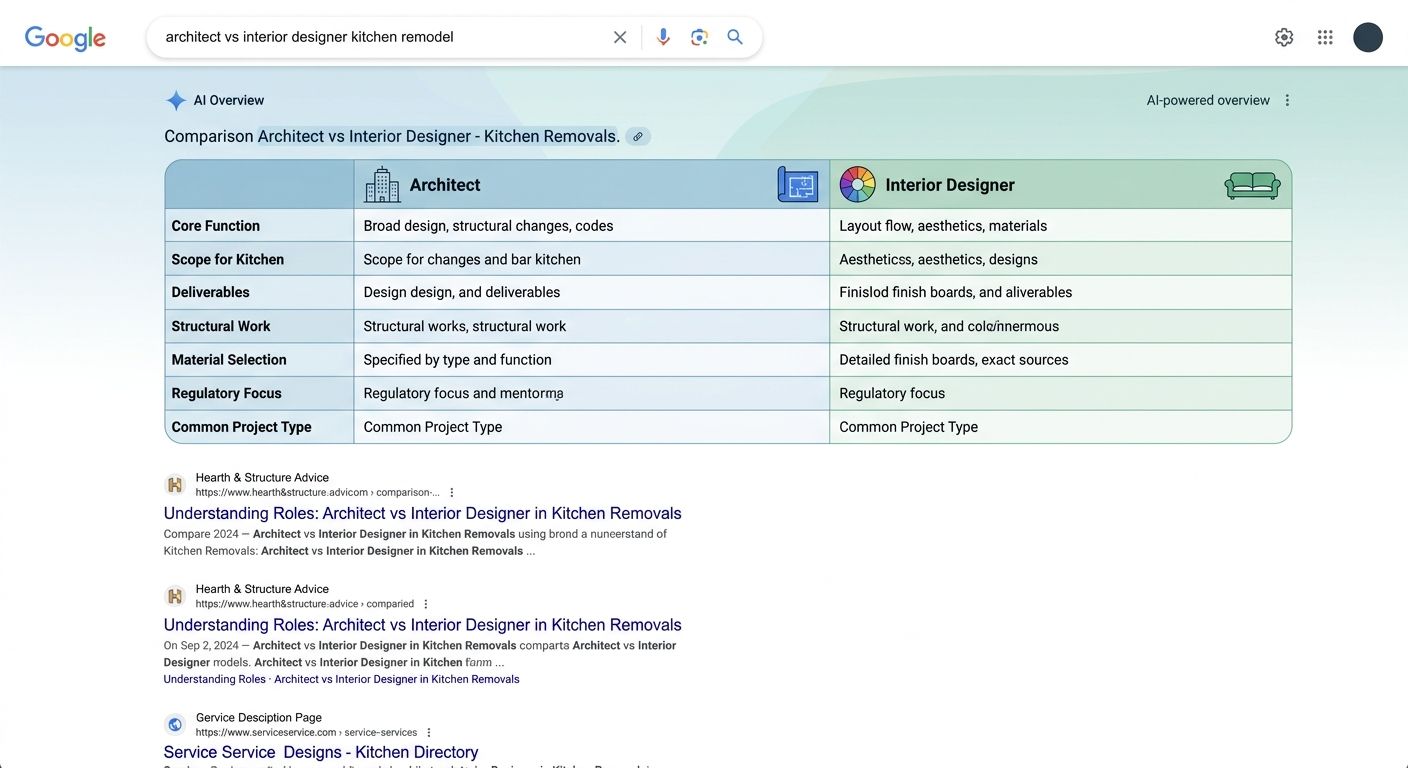
The shift toward niche comparison keywords isn't only a conversion-rate argument. Google's ranking systems have moved decisively toward rewarding topical depth over domain authority breadth. BrightEdge's 2026 analysis found that AI Overviews now trigger on approximately 48% of all tracked queries, representing a 58% year-over-year increase. Content that answers specific comparison questions with structured, clear responses gets preferentially cited in those AI Overviews.
This means a well-built comparison page titled "Architect vs Interior Designer: Who Handles Structural Changes?" has a real shot at appearing in the AI Overview for that query cluster, while a generic "Our Architecture Services" page competes against thousands of identical pages with no structural advantage.
Architecture firm local keywords perform especially well in this environment. When you combine a comparison query with a geographic modifier, you create a long-tail comparison query with three ranking advantages simultaneously: low competition, high commercial intent, and local relevance. A query like "architect vs interior designer for ADU in Portland" has perhaps 40-80 searches per month, but the searcher is almost certainly within 90 days of hiring someone.
Tina Flint, writing for her design-industry SEO practice, demonstrated this with direct keyword comparison data: using Google Search, she compared the search frequency of "interior designer," "architect," and "stager" and found that the geographic and related-term data revealed where real client demand concentrated. The answer wasn't in the head terms. It was in the intersections between them, where people needed help understanding which professional to call.
If your white-label team is still building keyword strategies around 10-15 high-volume head terms per client, you're optimizing for a version of Google that stopped existing around 2023. The agencies seeing the strongest results for service-firm clients in 2026 are building pages around 40-60 specific comparison and long-tail queries, each targeting a distinct decision point in the client's hiring process. We've covered this broader principle in our breakdown of long-tail comparison keywords as a missed opportunity in competitive markets.
MarketKeep's analysis of architecture firm keywords supports this directly: the firms that rank well target keywords based on user intent, location, and service type rather than chasing volume. LPagery's 2026 architect keyword guide confirmed that building content around specific, long-tail queries establishes your firm as a trusted authority in ways that ranking for "architect" alone never will.
How White-Label Teams Can Build Comparison Keyword Programs
The vertical-specific SEO optimization required for comparison keyword strategies is where white-label teams have a genuine structural advantage. A service-firm client rarely has the internal content expertise to produce comparison pages that satisfy E-E-A-T requirements. An agency with a systematic framework can build these across multiple clients in the same vertical without duplicating content.
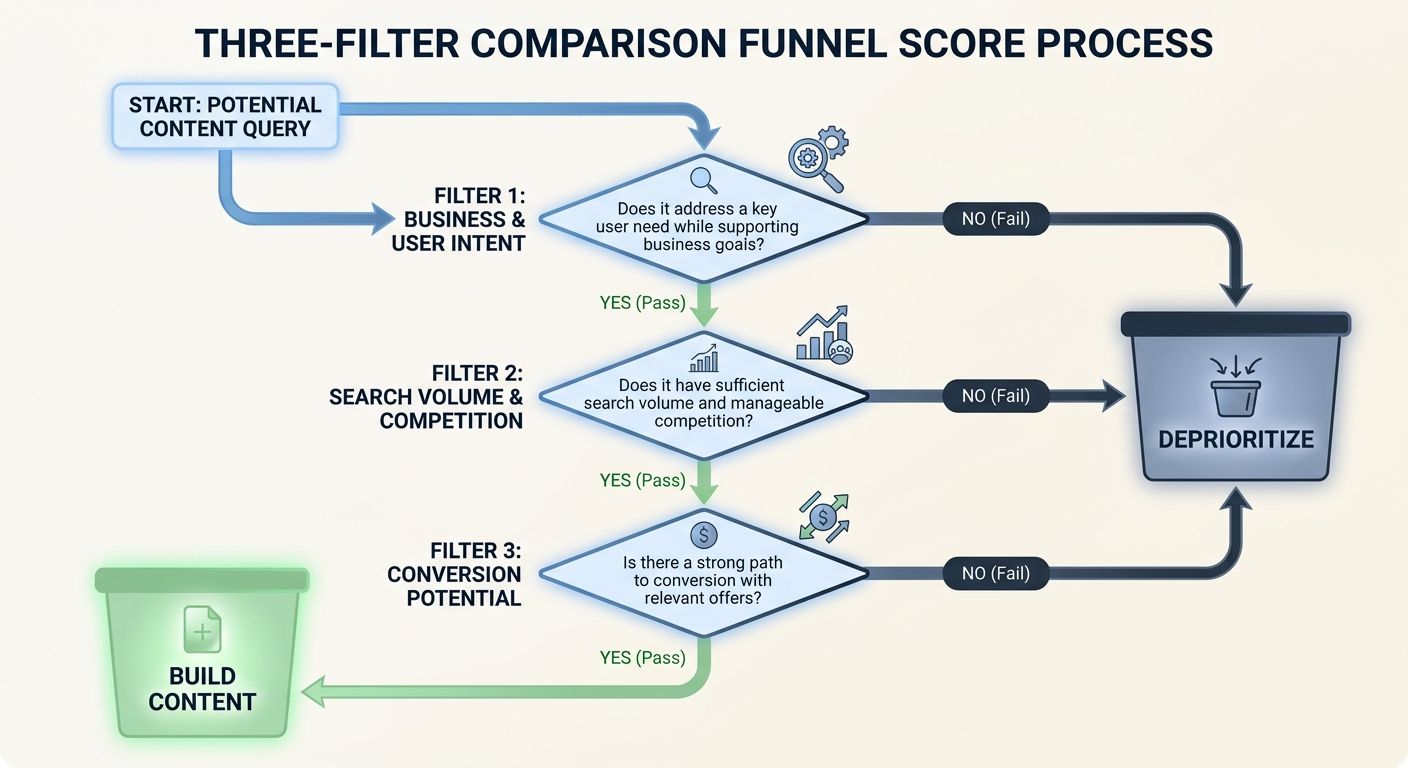
I propose evaluating every potential niche comparison keyword against what I call the Comparison Funnel Score: three filters that separate high-value comparison queries from noise.
Filter 1: Decision proximity. Is the searcher actively choosing between two services, or are they researching out of curiosity? "Architect vs interior designer" alone is often informational. "Architect vs interior designer for home addition" is almost always commercial. The preposition "for" followed by a project type is the clearest signal of hiring intent.
Filter 2: Service overlap. Do the two compared services genuinely compete for the same project type in the client's market? "Architect vs general contractor" maps to real client confusion. "Architect vs graphic designer" doesn't. The comparison needs to reflect an actual decision a prospect faces, or the content will attract the wrong audience.
Filter 3: Local defensibility. Can you rank for this query in the client's geographic market within 4-8 months? For most mid-sized service firms, the answer is yes. Fewer than 40% of mid-sized architecture firms have fully optimized Google Business Profiles, which means the local competition for niche comparison terms is thin. GBP optimization alone can shift local visibility within 6-8 weeks when paired with consistent reviews and accurate service categories. Our audit of why incomplete Google Business Profiles cost small businesses visibility covers the technical details.
Filter | What to Evaluate | Green Signal | Red Signal |
|---|---|---|---|
Decision Proximity | Does the query include a project type or use case? | "architect vs designer for loft conversion" | "architect vs designer" (bare comparison) |
Service Overlap | Do both services genuinely compete for this client? | "architect vs structural engineer for extension" | "architect vs landscape designer for office build" |
Local Defensibility | Is competitor saturation low in the target metro? | Fewer than 5 dedicated comparison pages in SERPs | 10+ established comparison pages with high DA |
When building this for white-label clients, the content production workflow matters as much as the keyword research. Each comparison page needs:
A 30-40 word direct answer immediately after the H1, structured for AI Overview extraction
A comparison table covering at least 3 attributes (project scope, typical cost range, timeline, licensing requirements)
At least one case study or real-world scenario from the client's portfolio
Local modifiers in the URL structure, H2s, and body copy
SEO.London's guide for architecture keywords emphasizes this local integration: firms should use neighborhood-specific terminology and vernacular architecture styles unique to their area. A comparison page for a San Francisco architect should reference ADUs, seismic retrofitting, and Victorian restoration. A comparison page for a Phoenix architect should reference desert-modern design, energy-efficient construction, and HOA compliance. The specificity signals expertise to both Google and the prospect.
This same framework scales across verticals. The comparison keyword model that works for architecture firms works equally well for law firm SEO companies building content around "litigation attorney vs mediator" queries, for home services SEO agencies targeting "plumber vs HVAC technician for gas line work," and for real estate SEO companies building pages around "buyer's agent vs dual agent." The underlying principle is identical: capture the decision, not the category.
The Thesis, Pressure-Tested
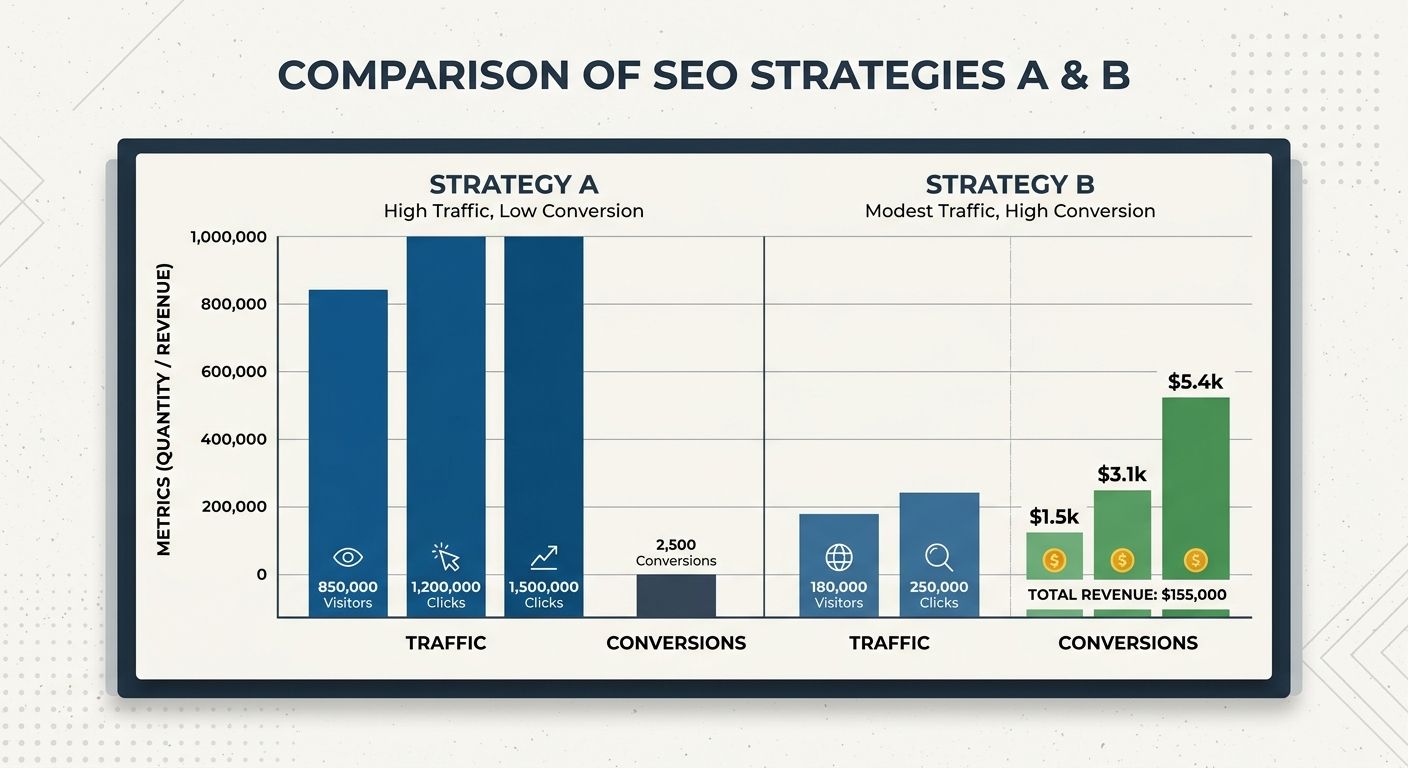
The obvious counterargument is volume. A client paying $3,000-$5,000 per month for SEO expects to see impressive traffic numbers, and niche comparison keywords will never deliver the kind of charts that make quarterly reviews feel exciting. An "architect vs interior designer for kitchen remodel" page might attract 80-150 visits per month. The client's competitor ranking #4 for "architect" can point to 6,000 monthly visits.
This is where white-label teams need to educate their reseller partners on reporting frameworks that track decision-stage metrics rather than vanity traffic. The architecture firm SEO strategy that produces 200 monthly visits across 12 comparison pages, generating 8-10 consultation requests, is objectively outperforming the strategy that produces 4,000 monthly visits to a generic homepage with 2 contact form submissions.
The niche-specific audit approach we've outlined for architecture and design firms reinforces this: generic 100-point SEO checklists miss the vertical-specific opportunities that drive real business results. Comparison keywords are the most consistently overlooked category in those generic audits.
And the ranking timeline data supports the approach. Firms in underserved comparison-keyword markets often see ranking movement within 90 days. Even in moderately competitive metros, 4-8 months is typical for a well-structured comparison page to reach page one. For a service firm that's been spending 18 months trying to crack the top 20 for a head term, that timeline represents a dramatic acceleration.
The conventional SEO playbook for service firms still defaults to targeting 10 high-volume keywords, building generic service pages, and hoping domain authority accumulates fast enough to compete. That playbook made sense in 2019. The service firm SEO strategy that works now starts with the decisions prospects actually make, builds content that directly addresses those decisions, and measures success by the quality of leads rather than the size of the traffic graph. Niche comparison keywords are the clearest expression of that shift, and the agencies building systematic comparison content programs are the ones keeping their clients past year one.
Marcus Webb
Digital marketing consultant and agency review specialist. With 12 years in the SEO industry, Marcus has worked with agencies of all sizes and brings an insider perspective to agency evaluations and selection strategies.
Related Articles

Long-Tail Comparison Keywords: The Untapped SEO Strategy Agencies Miss in Competitive Markets
Every keyword strategy deck I review from agencies pitching white-label partnerships follows the same template: 30 to 50 head terms with keyword difficulty scores above 60, a smattering of branded queries, and zero deliberate targeting of comparison phrases.
6 Ways SEO Agencies Misread Keyword Intent Data — and the Client Campaigns That Suffer for It
Keyword intent misalignment kills more SEO agency-client relationships than bad backlinks, thin content, and missed deadlines combined.

How Law Firms Are Rebuilding Rankings in the Dual-Search Era: AI Overviews vs. Traditional Google Results Strategy
The dual-search strategy that SEO agencies are packaging for law firms contains a structural contradiction.
Explore more topics