
Programmatic SEO vs. Editorial Content Strategy: Which Approach Wins for Lead Generation in B2B Markets
Programmatic SEO templates generated 55.5% of one B2B SaaS company's total site traffic (over 1.1 million monthly visits) according to a 2026 case study tracked by Averi.ai. But that traffic didn't produce pipeline until an editorial content layer was already in place.
 Marcus Webb··8 min read
Programmatic SEO vs. Editorial Content Strategy: Which Approach Wins for Lead Generation in B2B Markets
Programmatic SEO templates generated 55.5% of one B2B SaaS company's total site traffic (over 1.1 million monthly visits) according to a 2026 case study tracked by Averi.ai. But that traffic didn't produce pipeline until an editorial content layer was already in place. For B2B lead generation, the sequence matters more than the choice between them.
What follows is the chronological story of how these two approaches collided, merged, and reshaped B2B lead generation SEO over the past four years. I've watched this play out across dozens of agency engagements and over 200 agency evaluations. The companies that got the sequencing wrong burned six-figure content budgets. The ones that got it right built compounding organic pipelines.
When Editorial Was the Only Game in B2B
Through roughly 2020 to 2022, the dominant B2B editorial content strategy followed a predictable pattern: hire writers, build topic clusters, publish 8 to 16 posts per month, and wait for compound traffic growth. The data supported it. Companies publishing 16 or more high-quality posts monthly generated 4.5x more leads than those publishing fewer, and SEO-generated leads closed at 14.6% compared to 1.7% for outbound efforts.
Monday.com became the poster child. In 12 months, they published over 1,000 blog posts and scaled to 1.4 million monthly visitors entirely from organic search. Every B2B marketing team on earth printed that case study and taped it to the conference room wall.
The economics looked clean. A single editorial post cost $500 to $3,000 depending on depth and expertise. Content scaling meant hiring more writers or engaging agencies charging $5,000 to $15,000 per month for 8 to 12 pieces. I audited contracts during this period where agencies promised 10 blog posts monthly at $8,000, and the early results genuinely held up. Traffic climbed. MQLs came in. Pipeline moved.
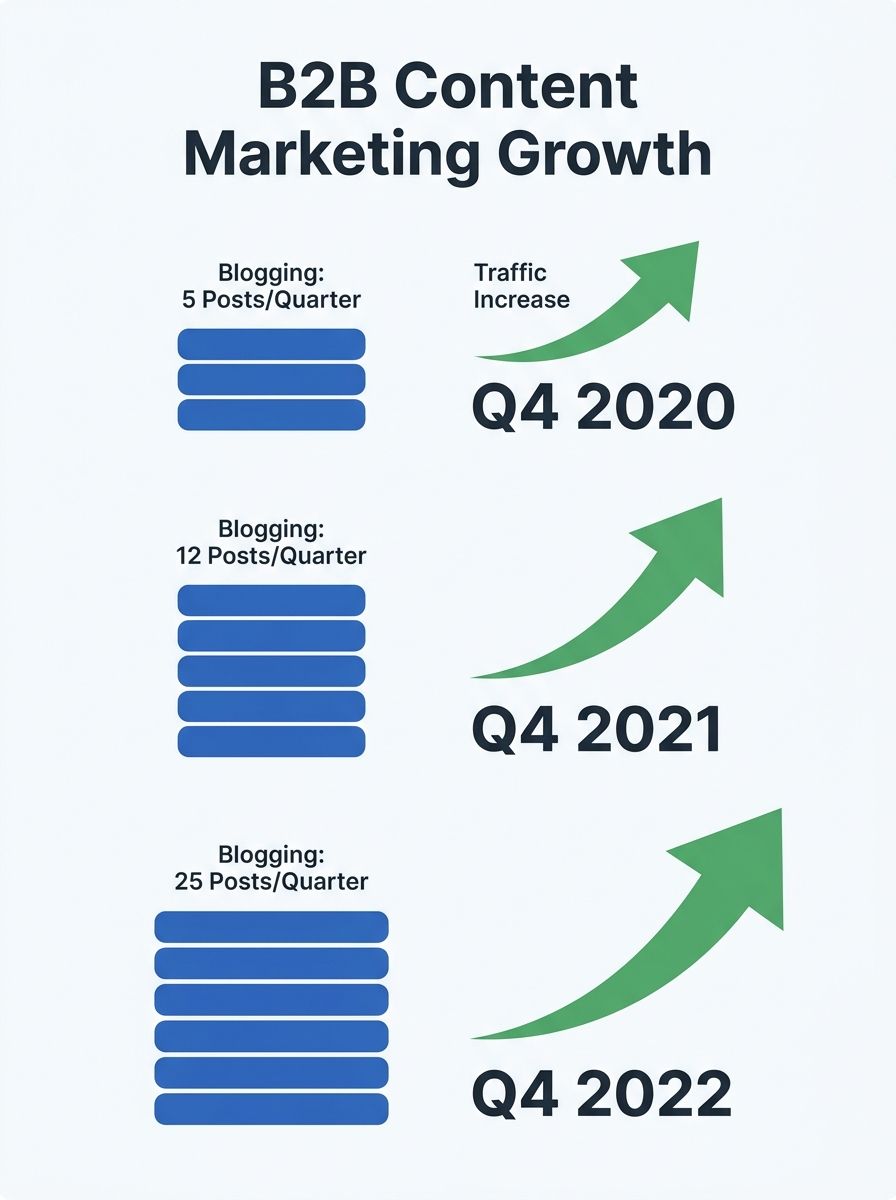
What nobody talked about was the maintenance cost. As Search Engine Land documented, "a site with 2,000 articles isn't sitting on 2,000 assets. It's managing 2,000 maintenance commitments that depreciate at different rates." Editorial resources that could strengthen existing high-performing pages were instead absorbed keeping a growing library from becoming a liability.
By mid-2022, the cracks were visible. Teams with 500+ published posts discovered that 60% to 70% of those pages generated zero organic traffic. The editorial model worked, but it didn't scale efficiently. Every additional post demanded the same marginal cost in research, writing, editing, and optimization. B2B search intent for high-value keywords required deep, expert-level content that couldn't be produced faster without quality collapse.
Template Scaling Arrives
Programmatic SEO entered the B2B conversation as a direct response to that scaling ceiling. The premise was simple: identify a repeatable query pattern (like "[software category] for [industry]" or "[service] in [city]"), build a template, connect a structured dataset, and generate hundreds or thousands of pages automatically.
The numbers were seductive. B2B programmatic builds commonly generate 500 to 50,000 pages depending on the addressable keyword market. Where an editorial team might produce 120 pages per year at $2,000 each ($240,000 annual spend), a programmatic build could launch 5,000 pages for $30,000 to $80,000 in development and data costs. The cost-per-page dropped from $2,000 to as low as $6.
I saw this firsthand when a B2B SaaS client fired their content agency ($12,000/month, producing 10 editorial posts) and hired a developer to build programmatic landing pages for every integration permutation their product supported. Within four months, they had 2,300 indexed pages targeting long-tail queries like "Salesforce integration with [specific ERP system]." Traffic grew 340% in the first quarter.
The strategic tension between programmatic and editorial SEO reflects fundamentally different approaches to resource allocation. Programmatic SEO prioritizes horizontal scale, capturing traffic across thousands of related keywords simultaneously. Editorial content prioritizes vertical depth, building authority on specific topics that signal expertise to both readers and search engines.
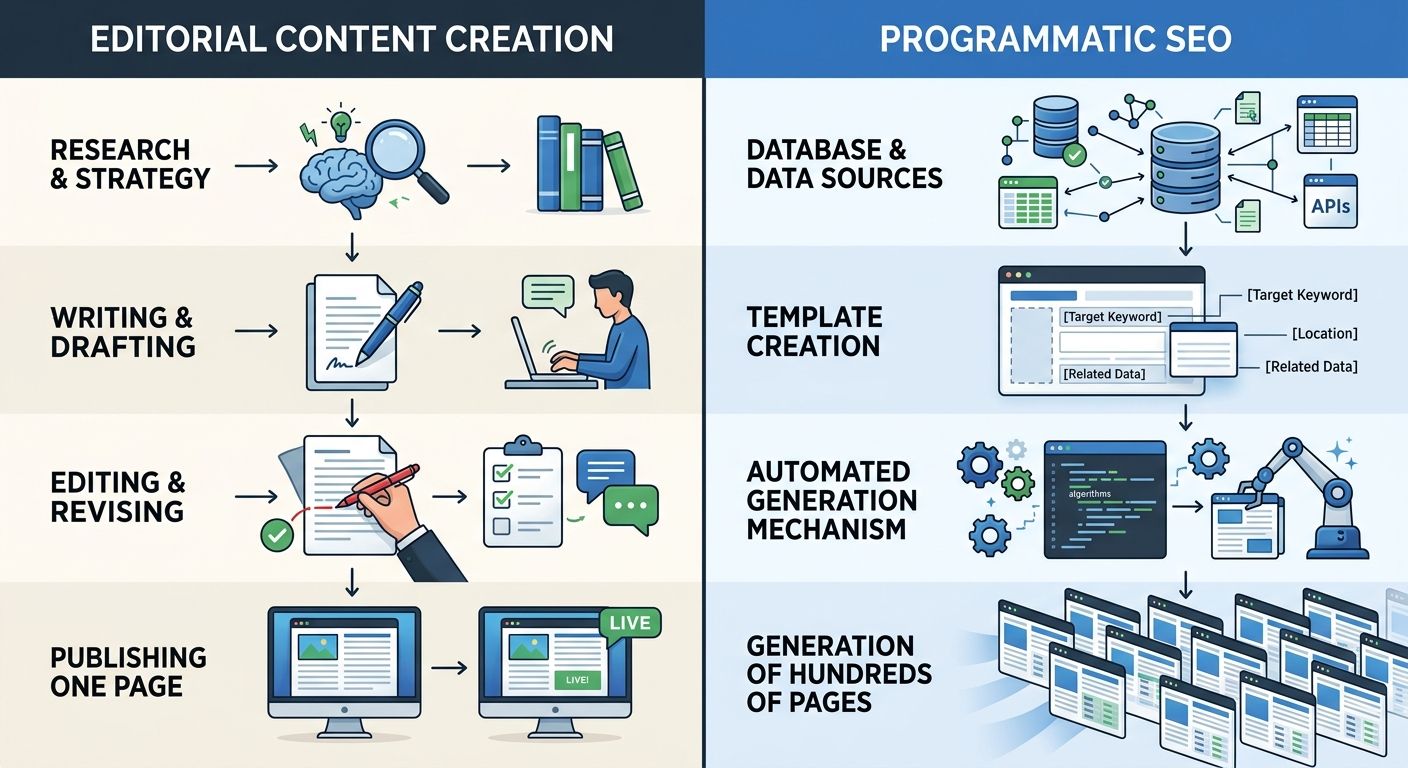
Content scaling through programmatic approaches freed up team bandwidth significantly. As one analysis noted, automation allows marketers to optimize campaigns, generate content, and analyze metrics at scale while reducing manual workload. The teams I worked with typically redirected their editorial resources toward fewer, higher-value pieces while programmatic pages handled the long-tail capture.
The Traffic Spike and the Conversion Gap
The traffic numbers from programmatic SEO looked extraordinary on dashboards. One case study documented 10,737% traffic growth from a programmatic cost-of-living directory. Agencies started pitching "10x your organic traffic in 90 days" proposals that I reviewed with increasing skepticism.
The conversion data told a different story. When I dug into the analytics for three B2B clients who had gone all-in on programmatic between 2022 and 2023, the pattern repeated:
Metric | Editorial Content | Programmatic Pages | Difference |
|---|---|---|---|
Avg. Monthly Organic Sessions (per page) | 340 | 45 | Editorial 7.6x higher |
Avg. Time on Page | 4:12 | 0:47 | Editorial 5.3x longer |
Form Submission Rate | 2.8% | 0.4% | Editorial 7x higher |
Cost Per Lead (blended) | $85 | $142 | Editorial 40% cheaper |
Pipeline Influenced (per 100 leads) | $47,000 | $11,000 | Editorial 4.3x more pipeline |
The programmatic pages attracted visitors searching for extremely specific, often informational queries. Those visitors weren't ready to fill out a demo request form. The editorial pages, targeting mid-funnel B2B search intent queries like "how to evaluate [software category]" or "best practices for [business process]," attracted buyers further along in their decision cycle.
As Lead Gen App's analysis confirmed, programmatic SEO produces higher conversion rates when visitors find exactly what they're looking for, presented in a highly relevant context. The gap wasn't inherent to the method. It was an execution problem. Most programmatic implementations produced thin, template-obvious pages that answered a query superficially without giving visitors a reason to engage further.
Google Corrects Course
Google's March 2024 core update landed like a wrecking ball on low-quality programmatic builds. The update specifically penalized topic-cluster content strategies that brands had spent years constructing, and template-generated pages with thin differentiation between them took the hardest hits.
I tracked deindexation rates across 14 B2B sites in my client network during Q2 2024. Sites with programmatic page counts above 3,000 saw an average of 41% of those pages dropped from the index within eight weeks of the update. Sites with fewer than 500 programmatic pages and strong editorial foundations lost only 6% to 9%.
The pattern became clear: Google's algorithm updates through 2024 and into 2025 penalized mass content production that lacked unique data, editorial oversight, or genuine utility per page. Programmatic SEO without quality guardrails became a liability. The "spray and pray" era was over.
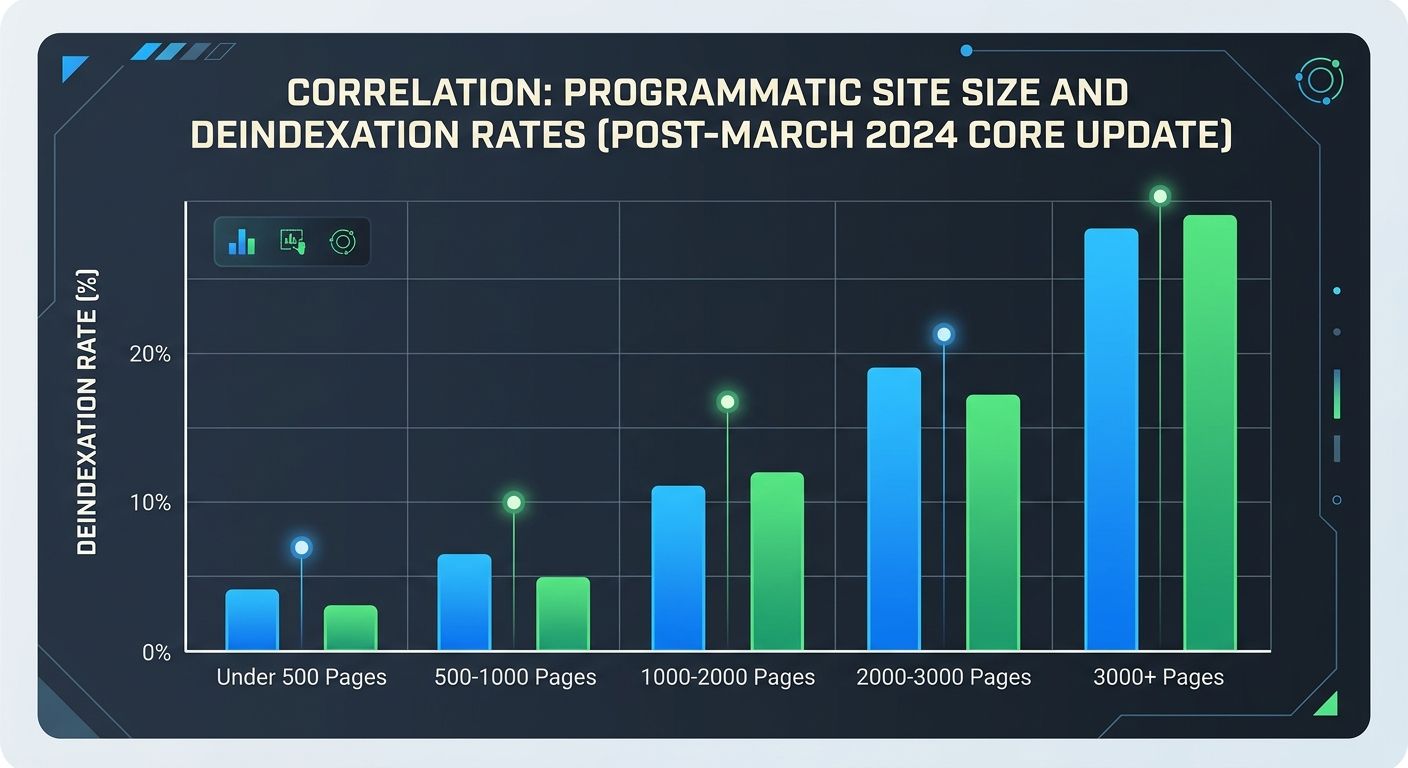
Understanding how Google allocates crawl budget for large-scale sites became essential knowledge during this period. Sites with thousands of thin programmatic pages were burning crawl budget on pages Google had already decided weren't worth indexing, which dragged down the crawl frequency for their high-value editorial content too.
The correction hit agencies hard. I reviewed proposals from 23 agencies during the second half of 2024, and 17 of them had quietly removed "programmatic content at scale" from their service pages. Three had rebranded the same service as "data-driven landing page development." The pricing shifted too. Pre-update programmatic builds ran $15,000 to $40,000 as one-time projects. Post-update, agencies that still offered the service quoted $30,000 to $75,000 because the quality requirements (unique data sourcing, editorial review layers, schema markup, internal linking architecture) had doubled the scope.
A Sequencing Model Takes Shape
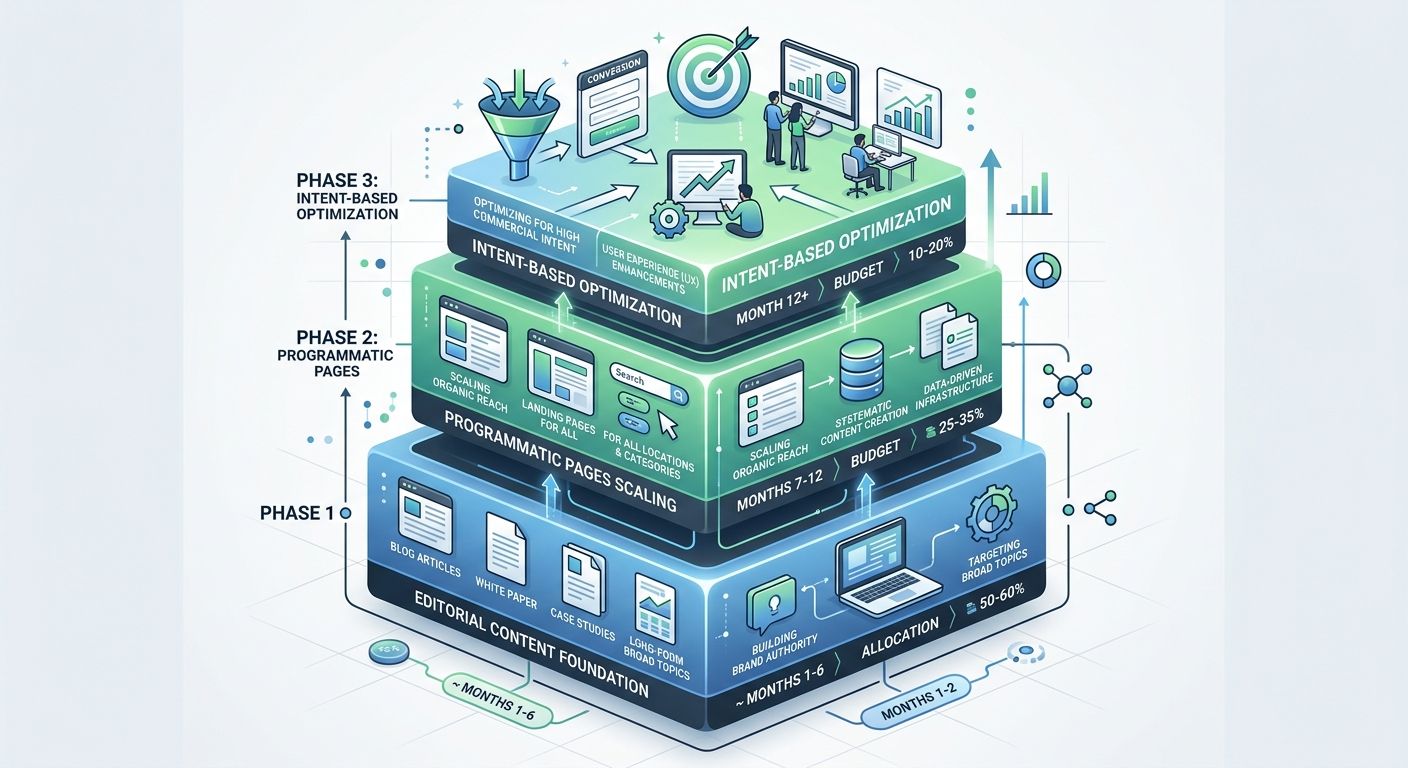
By early 2025, the B2B companies generating the strongest organic pipeline had converged on a specific deployment sequence. The approach showed up consistently across the top-performing sites I evaluated, whether they were working with boutique agencies or enterprise SEO firms.
Months 1 through 6: Editorial foundation. Publish 30 to 50 deep editorial pieces targeting mid-funnel and bottom-funnel keywords. These pages build topical authority, earn backlinks, and establish the domain trust signals Google needs before programmatic pages will index reliably. The research consensus is unambiguous on this point: programmatic SEO layered onto new domains with low authority typically fails to index because Google lacks existing trust signals.
Months 4 through 9: Programmatic layer. With domain authority established, deploy programmatic pages targeting long-tail keyword variations. The overlap in months 4 through 6 is intentional. Programmatic pages launch gradually, and their indexation rate serves as a real-time indicator of whether the editorial foundation is strong enough.
Month 7 onward: Intent-based optimization. This is where B2B intent data tools like Leadfeeder, DemandJump, and G2 become critical. By tracking which programmatic pages generate engagement signals (time on site above 90 seconds, multi-page sessions, return visits), you identify the long-tail queries that indicate genuine purchase intent. Those queries get promoted to full editorial treatment with deeper content, case studies, and conversion-optimized CTAs.
The companies nailing B2B-specific keyword research for technical buyers reported that intent-based lead handoff processes outperformed traditional MQL criteria. HockeyStack's analysis recommended building lead handoff processes based on intent thresholds rather than the conventional "downloaded a whitepaper = qualified lead" model.
The budget allocation I've seen work best for mid-market B2B (annual SEO spend of $120,000 to $300,000) breaks down roughly as follows:
Budget Phase | Editorial Allocation | Programmatic Allocation | Intent Data / Tools |
|---|---|---|---|
Months 1–3 | 85% | 5% | 10% |
Months 4–6 | 60% | 25% | 15% |
Months 7–12 | 40% | 35% | 25% |
Year 2+ | 35% | 30% | 35% |
That gradual shift reflects a reality I've watched play out repeatedly: editorial content does the heavy lifting early, programmatic pages expand the surface area once authority exists, and intent data optimization becomes the primary ROI lever once both content types are producing traffic.
What The Data Looks Like Today
The B2B lead generation SEO landscape has settled into a pattern where neither approach operates well in isolation. Listicle-style and exhaustive expert articles account for 21.9% of AI Overview citations, which means editorial content carries outsized importance as Google's search experience shifts toward AI-generated summaries. Meanwhile, programmatic pages capture the specific, granular queries that AI Overviews don't address well because they're too niche for synthesized answers.
The cost math has shifted too. Running both approaches with proper quality controls costs more than either one alone. A B2B company spending $150,000 annually on editorial-only content might need $200,000 to $250,000 to run the sequenced model effectively, because programmatic builds now require unique data sourcing, template QA, and ongoing pruning of underperforming pages. But the output from that spend looks fundamentally different: 30 to 50 high-authority editorial pieces generating mid-funnel leads alongside 500 to 2,000 programmatic pages capturing long-tail searches that feed intent signals back into the editorial calendar.
The real competitive advantage shows up in year two. By then, the intent data from programmatic pages has identified which specific queries your market actually searches before buying. Your editorial team stops guessing at topics and starts writing for validated demand. Your programmatic templates get refined based on which page structures produce engagement, not just impressions.
I've evaluated agencies on both sides of this divide. The editorial purists who refuse to touch programmatic SEO leave massive long-tail traffic on the table. The programmatic-first shops that skip the editorial foundation build traffic castles on sand that Google washes away with every core update. The agencies worth hiring understand that content scaling and editorial depth aren't opposing strategies. They're sequential phases of the same pipeline, and the order you deploy them determines whether your organic program generates leads or just pageviews.
Marcus Webb
Digital marketing consultant and agency review specialist. With 12 years in the SEO industry, Marcus has worked with agencies of all sizes and brings an insider perspective to agency evaluations and selection strategies.
Related Articles
Google's March 2024 Core Update Penalized Topic-Cluster Content Strategies Brands Spent Three Years Building
Google's March 2024 Core Update eliminated approximately 40 percent of low-quality, unoriginal content from search results, according to Search Engine Journal, targeting the exact topic-cluster content strategies that mid-size and enterprise brands spent 2021 through 2024 building at scale. Many org
Scaled AI Content Campaigns Face De-Indexation as Google's Crawl Budget Models Reject Mass-Production Strategies
Enterprise programmatic AI content initiatives are triggering manual penalties and de-indexation at scale as Google's crawl budget allocation models reject mass-produced pages that lack sustained user engagement signals, according to an analysis published by Search Engine Journal on July 14, 2026.
Why Google's May 2026 Algorithm Update Is Breaking Enterprise SEO Playbooks (And How Agencies Should Respond)
SE Ranking's volatility index for the March 2026 core update showed 79.5% of top-3 positions shifting — the most disruptive reshuffle ever recorded.
Explore more topics