
Boutique SEO Agency vs. Enterprise SEO Firm: Which Model Delivers Better ROI for Mid-Market Companies in 2026
Mid-market companies ($10M–$500M revenue) get squeezed in SEO vendor selection because they're too big for freelancers and too small to justify $25,000 monthly retainers.
 Marcus Webb··8 min read
Boutique SEO Agency vs. Enterprise SEO Firm: Which Model Delivers Better ROI for Mid-Market Companies
Mid-market companies ($10M–$500M revenue) get squeezed in SEO vendor selection because they're too big for freelancers and too small to justify $25,000 monthly retainers. Boutique agencies, enterprise firms, and a growing hybrid category each promise better ROI, but the math changes based on site complexity, internal team size, and how you define "return."
What Boutique Agencies Actually Deliver
Boutique SEO agencies run teams of 5–25 people. The person who sells you the contract is often the same person managing your account. That direct access to senior strategists is the single biggest advantage the model offers mid-market buyers.
Retainers at boutique firms typically start around $2,000 per month, with most mid-market engagements landing between $3,000 and $7,000. For that spend, you're getting a named strategist who knows your vertical. You're not getting a rotating cast of junior analysts reading from a shared playbook.
Onely's 2026 review of technical SEO agencies highlights SmartClick as an example worth studying. The review describes SmartClick as a firm that "emphasizes direct, hands-on consulting from senior practitioners rather than layered account management structures," according to Onely's technical agency ranking. That phrasing captures the core boutique pitch: fewer layers between you and the person doing the work.
The tradeoffs are real, though. Boutique firms have a smaller bench. If your site needs a JavaScript rendering specialist, a local SEO strategist for 40 locations, AND a content team producing 20 pieces per month, a 12-person shop will struggle. They'll either subcontract (adding cost and reducing quality control) or prioritize one workstream while the others stall.
I've evaluated over 200 agencies across my career, and the pattern holds. Boutique agencies excel when three conditions are true: your URL count is under 10,000, your organic goals map to a single domain and language, and your internal team can handle content production with strategic guidance rather than full execution.
Quality content from agencies runs $500–$2,000 per piece, while strategic link building requires $1,000–$5,000 monthly for effective campaigns. At boutique rates, those line items eat a significant share of your total retainer. You need to decide whether content, links, or technical work gets the largest slice — because all three at full throttle won't fit a $5,000 budget.
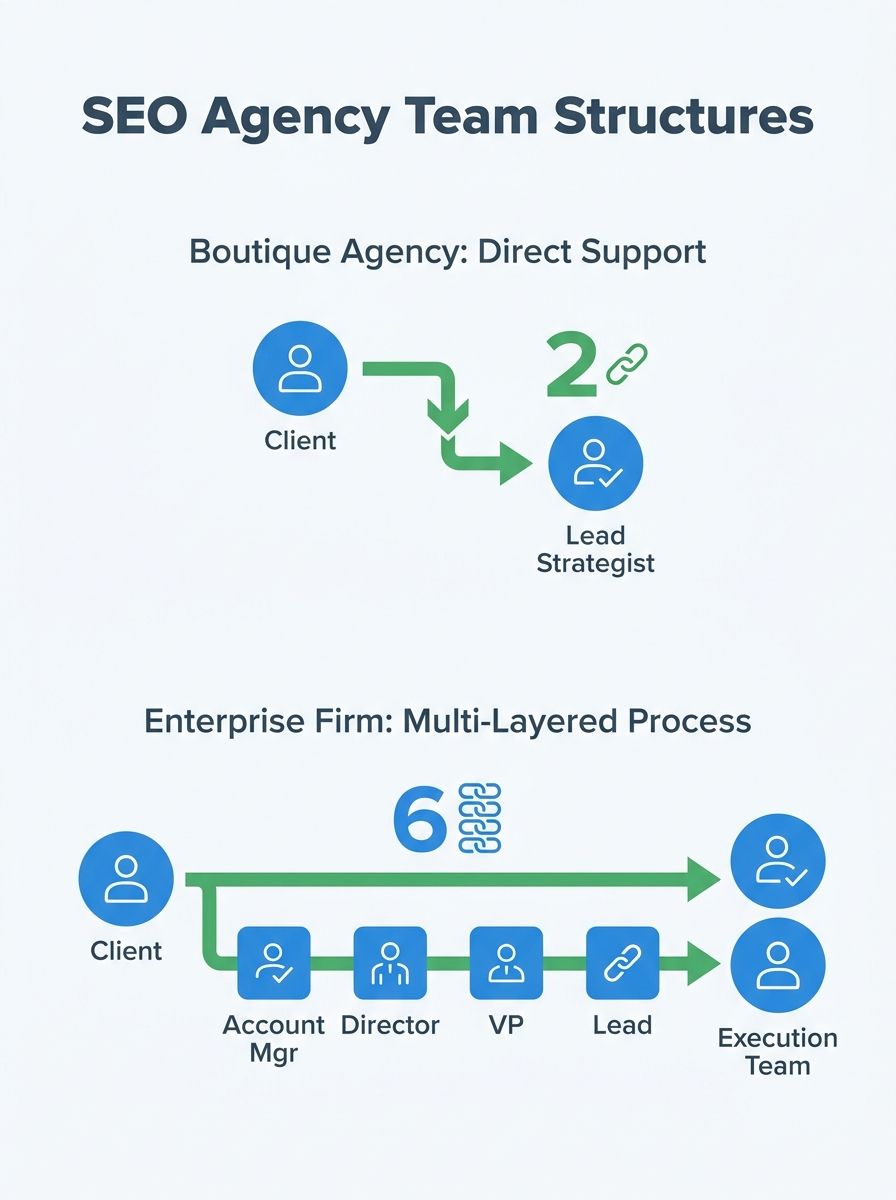
And boutique agencies move fast. Algorithm shifts like the May 2026 core update demand rapid pivots. A smaller team with fewer approval layers can push changes within days. Enterprise firms often take weeks to route the same decision through their internal process.
Where Enterprise Firms Earn Their Premium
Enterprise SEO firms charge $10,000–$30,000+ per month, employ hundreds of specialists, and bring infrastructure boutique shops can't replicate. The question for mid-market buyers is whether your problems actually require that infrastructure.
SEO Brand's enterprise metrics guide states it clearly: enterprise SEO involves "scale, multi-domain tracking, multiple stakeholders, and complex attribution models." If your company operates across three domains, two languages, and 200 location pages, you need that complexity managed as a system rather than a series of ad hoc fixes.
Searchbloom, named by Forbes Advisor as a top pick for mid-market, describes its approach as "aligning SEO with paid media performance and providing attribution models that connect organic visibility to business outcomes," per the firm's own positioning. That integration between organic and paid channels is hard for a boutique team to pull off without dedicated CRO and analytics specialists on staff.
Enterprise firms also bring standardized methodologies. For mid-market companies managing crawl budget across large e-commerce catalogs, those standardized processes for log-file analysis and indexation audits close gaps that smaller teams miss. A boutique generalist might overlook a crawl efficiency problem that an enterprise firm's automated monitoring flags on day one.
But here's where I get skeptical. The enterprise model layers account managers, project coordinators, and junior analysts between you and the senior strategists. You're paying $15,000 per month, and the person actually touching your Search Console data might be 18 months out of college. I've seen this play out at three of the top 10 U.S. agencies.
The vetting guide published by UFO Rocks warns that enterprise agencies designed for multinational corporations often carry "heavy processes" that slow down execution for companies that don't need global coordination. A $75M manufacturer with one domain and one language is paying for infrastructure built to manage Unilever's 400+ brand sites.

The enterprise model measures success differently, too. Roketto's analysis of enterprise SEO argues that CLV — customer lifetime value — should replace raw traffic or keyword rankings as the primary performance metric. That's a smarter approach to benchmarking organic performance, but it requires the agency to integrate with your CRM and sales pipeline. If your Salesforce data is clean and attribution is solid, this works. If your CRM is a mess, you're paying enterprise rates for reporting that can't deliver enterprise-level insight.
Hybrid Agencies Are Filling the Gap
The third option has gained real traction: mid-sized agencies (25–80 people) that pair boutique-style account management with enterprise-grade tooling. The industry average annual churn rate sits at 38%, driven heavily by small businesses spending under $500 per month on agencies that can't deliver results at that price point. Hybrid agencies target the $5,000–$12,000 monthly range, aiming at the sweet spot where mid-market companies get enough senior attention and enough bench depth to handle complex projects.
The average agency retainer across the entire industry runs approximately $3,209 per month. Hybrid firms price above this average because they invest in proprietary dashboards, automated regression testing for Core Web Vitals, and dedicated specialist roles that a five-person boutique can't maintain. They're also building out AI search readiness — a growing concern as AI Overviews now appear on an estimated 15–30% of commercial queries.
Silverback Strategies, a full-service agency that straddles the hybrid line, describes its philosophy this way: "We show our work, explain our strategies, and prove the ROI behind them," per the firm's 2026 agency ranking profile. That emphasis on transparency is exactly what mid-market CFOs want — board-defensible metrics tied to revenue, not vanity traffic numbers.
The risk with hybrid agencies is verification. Some firms brand themselves as hybrid but operate as overstaffed boutiques without real process discipline. Others are former enterprise divisions that spun off and inherited bureaucratic habits. Before signing, audit their link building methodology and ask for three client references in your revenue range. Not your industry — your revenue range. A $50M manufacturer and a $50M SaaS company share more operational DNA than two manufacturers at $10M and $500M.
71% of SEO professionals report that AI-era results take longer to show measurable returns, with a typical breakeven horizon of 6–12 months. Hybrid agencies need to communicate this timeline honestly. Overpromising quick wins erodes trust faster than any algorithm update.
Pricing, Staffing, and Deliverables Compared
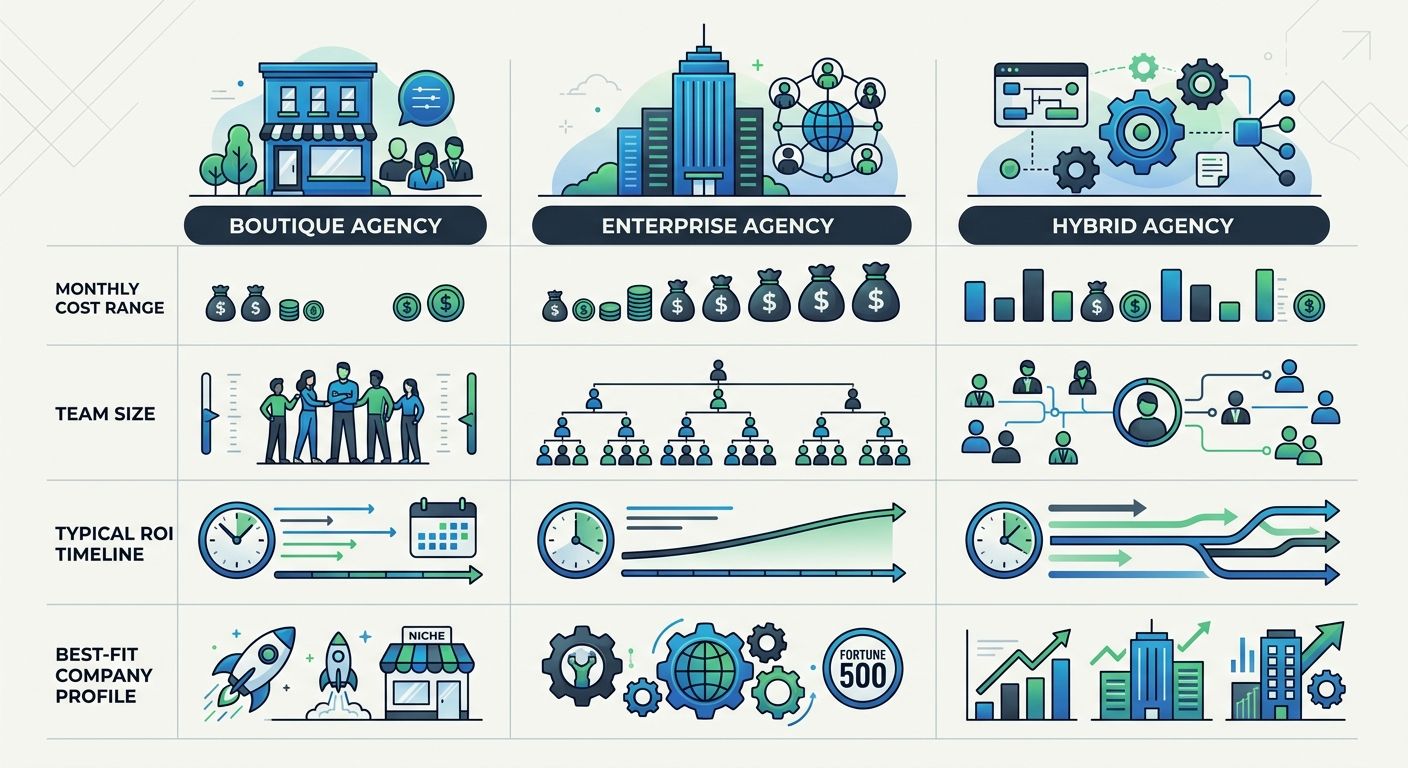
The numbers tell a clearer story than any pitch deck. Here's how the three models stack up across the dimensions that matter most to mid-market buyers weighing their real cost-benefit analysis:
Dimension | Boutique Agency | Enterprise Firm | Hybrid Agency |
|---|---|---|---|
Monthly retainer | $2,000–$7,000 | $10,000–$30,000+ | $5,000–$12,000 |
Team size on your account | 2–4 people | 5–12 people | 3–6 people |
Senior strategist access | Direct (weekly calls) | Limited (quarterly reviews) | Regular (biweekly calls) |
URL capacity sweet spot | Under 10,000 | 100,000+ | 10,000–100,000 |
Content production | Strategy + guidance | Full execution at scale | Strategy + partial execution |
Link building budget (additional) | $1,000–$3,000/mo | $3,000–$10,000/mo | $2,000–$5,000/mo |
Typical contract length | 6 months | 12–24 months | 6–12 months |
Multi-domain/multi-language support | Limited | Strong | Moderate |
AI search optimization | Varies by firm | Usually integrated | Growing capability |
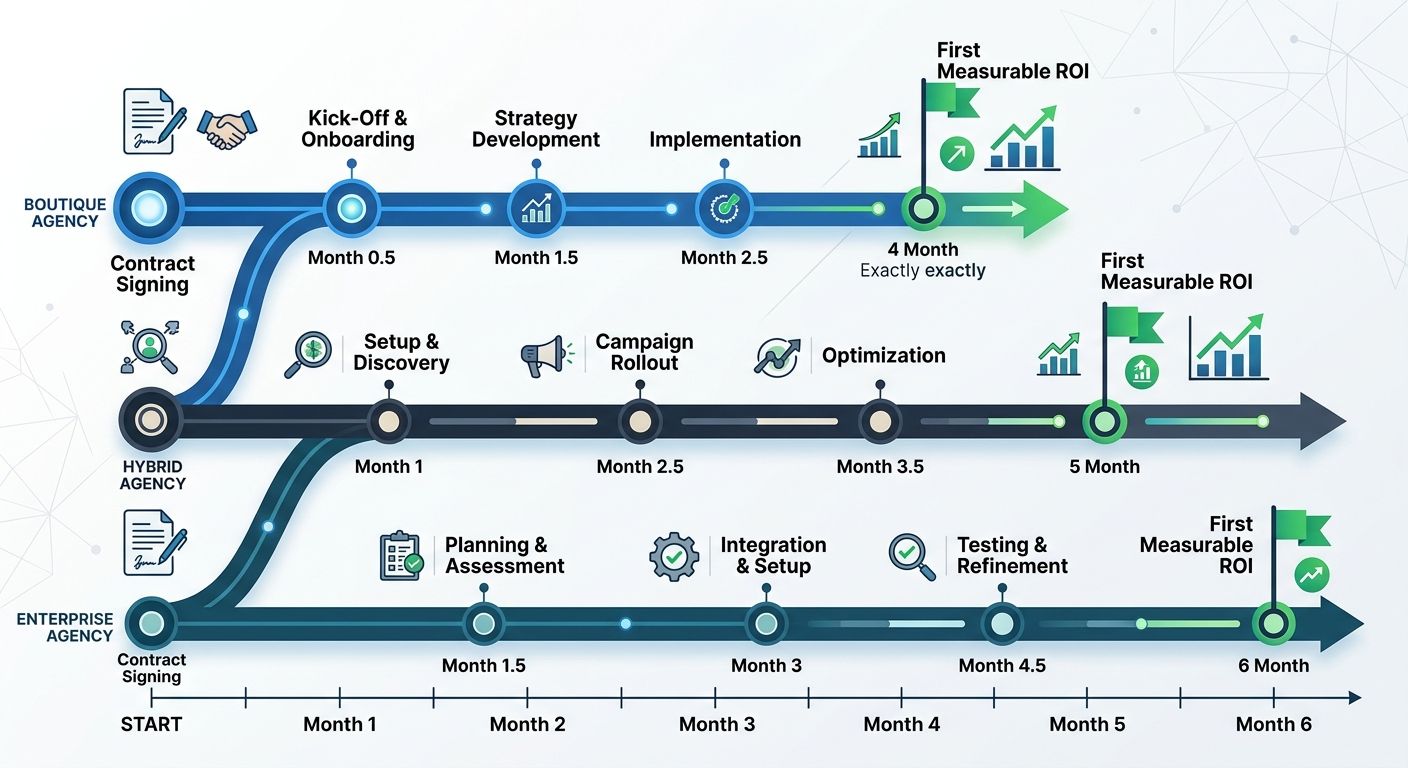
Time to measurable ROI | 4–8 months | 6–12 months | 5–9 months |
SEO pricing in 2026 depends heavily on business size, competition level, and scope. Some agencies quote $500 per month while others charge $10,000 — and that range alone tells you how much the industry resists standardization. The table above reflects what mid-market companies with $10M–$500M revenue should expect to pay for agencies that actually staff their accounts at appropriate levels.
Organic leads close at a 14.6% rate compared to 1.7% for outbound channels. That stat makes the ROI math favorable for any agency model if execution is competent. The real question is how much of your retainer goes to actual execution versus account management overhead. At boutique agencies, roughly 70–80% of your spend touches deliverables. At enterprise firms, that ratio can drop to 40–60% once you account for the coordination layers.
Who Should Pick Which
The honest answer depends on three variables: your site's technical complexity, your internal team's capacity, and your willingness to manage the agency relationship closely.
Pick a boutique SEO agency if your company operates a single domain under 10,000 URLs, has at least one internal marketer who can execute on strategic recommendations, and values speed over scale. Your mid-market SEO strategy will center on a focused set of high-value keywords and content rather than broad coverage. Budget $3,000–$7,000 monthly and expect measurable results within 4–8 months.
Pick an enterprise SEO firm if you're managing multiple domains, multiple languages, or hundreds of location pages. Your site architecture demands automated monitoring, and your C-suite requires attribution models tied to pipeline revenue and CLV. Budget $10,000–$25,000 monthly and build in a 6–12 month runway before evaluating ROI. Your enterprise SEO firm comparison should weight process documentation and team continuity over impressive case studies from unrelated verticals.
Pick a hybrid agency if you've outgrown freelancers and boutique capacity but can't justify enterprise-tier spend. You want a named senior strategist paired with specialist support for technical audits, content strategy, and link building. Budget $5,000–$12,000 monthly. The agency model ROI here depends entirely on confirming that the "hybrid" label reflects actual staffing depth and not just marketing copy.
Across all three models, SEO vendor selection comes down to a principle I've applied across 200+ evaluations: ask who will do the work, confirm they've done similar work before at your scale, and verify that reporting ties to revenue instead of rankings. The label on the agency matters far less than the match between your actual problems and the people assigned to solve them. If you're building a dashboard both sides trust, you'll see through the positioning quickly enough.
Marcus Webb
Digital marketing consultant and agency review specialist. With 12 years in the SEO industry, Marcus has worked with agencies of all sizes and brings an insider perspective to agency evaluations and selection strategies.
Related Articles

DIY SEO Tools vs. Agency Services: The Real Cost-Benefit Analysis for Mid-Market Businesses in 2026
The standard "in-house vs agency SEO" debate gives mid-market companies a false binary that leads to overspending in both directions — paying agencies $5,000–$10,000 per month for tasks a $200 tool handles, while skipping the strategic work where professional firms actually earn their fee.

How AI-Generated Content Is Exposing Your Agency's Real Competitive Advantage (And Why Client Reviews Prove It)
AI-generated content has commoditized the deliverables most SEO agencies sell. Graphite's research confirms that more articles published online are now AI-produced than human-written, collapsing the value of content volume as a differentiator.

Why Enterprise SEO Agencies Are Expanding Into AI-Driven Markets: What the San Francisco Shift Reveals About 2026 Competition
SEO.co announced its physical expansion into San Francisco on May 7, targeting venture-backed startups and enterprise brands with GEO consulting, AI-driven search strategies, and technical audits designed for generative platforms.
Explore more topics