
Google Confirms May 2026 Core Update Complete After 12-Day Rollout Marked by Multi-Phase Volatility
Google confirmed completion of its May 2026 core update on June 2 via the Search Status Dashboard, ending a 12-day rollout that began May 21 at 8:40 AM PDT and concluded June 2 at 5:40 AM PDT, according to Search Engine Journal. The update duration—11 days and 21 hours—nearly matched the March 2026
 Marcus Webb··4 min read
Google Confirms May 2026 Core Update Complete After 12-Day Rollout Marked by Multi-Phase Volatility
Google confirmed completion of its May 2026 core update on June 2 via the Search Status Dashboard, ending a 12-day rollout that began May 21 at 8:40 AM PDT and concluded June 2 at 5:40 AM PDT, according to Search Engine Journal. The update duration—11 days and 21 hours—nearly matched the March 2026 core update, which finished in 12 days. SEO practitioners reported elevated volatility across multiple phases of the rollout, with movement patterns differing significantly from the March update's relatively subdued impact.
Practitioners Report Multi-Phase Movement Across Verticals
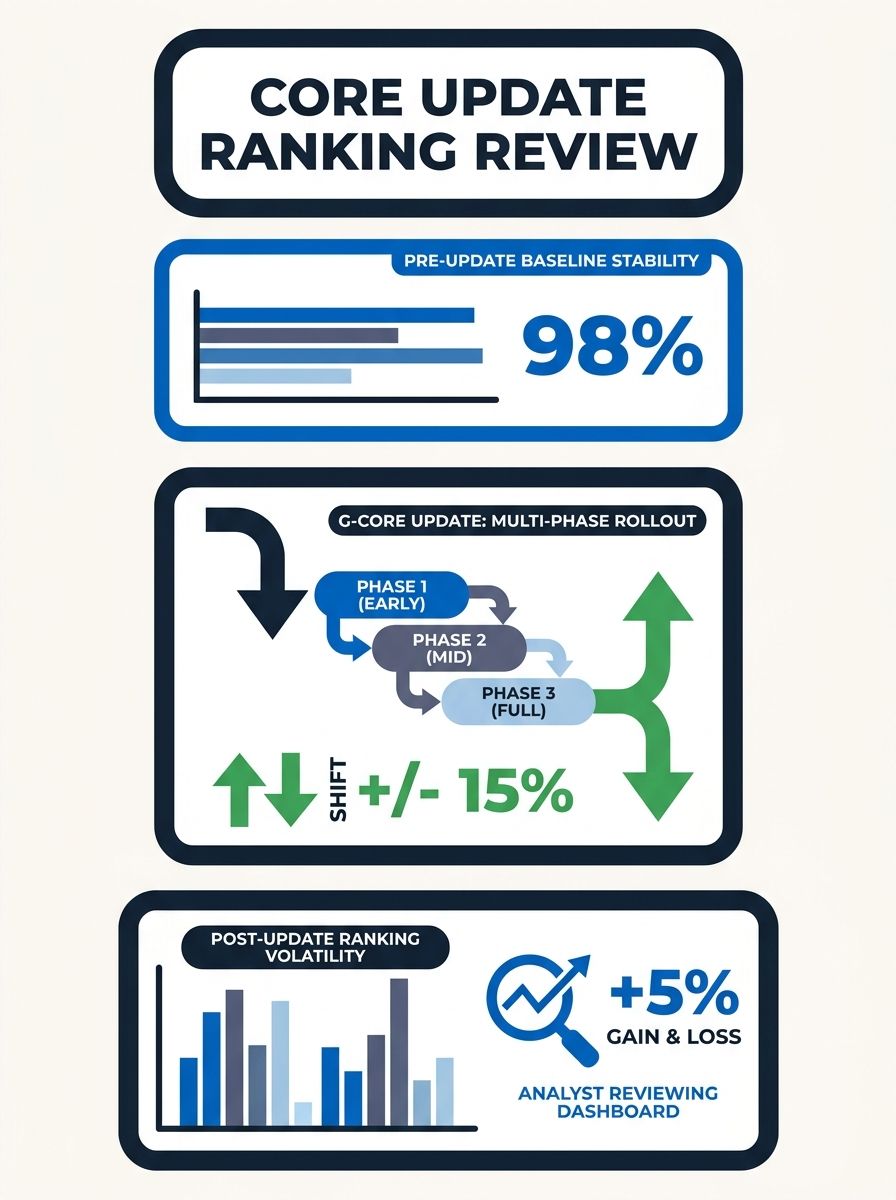
SEO consultants documented ranking shifts at several distinct points during the rollout rather than concentrated movement at launch or completion. Glenn Gabe, SEO consultant at G-Squared Interactive, reported impact "across verticals and countries" by the first weekend and later stated on X that "the May 2026 core update has been powerful so far… much more like a typical core update. March was meh, but May is big," according to the report.
Lily Ray, VP of SEO Strategy and Research at Amsive, observed weekend surges, writing on X that "a handful of sites started seeing big surges over the weekend with the core update." Third-party SERP tracking tools showed elevated volatility at multiple intervals during the 12-day window, not just at the traditional launch and completion markers.
Marie Haynes, founder of Marie Haynes Consulting Inc., connected the update's May 21 launch timing to Google's I/O announcements the same day, when the company introduced Gemini 3.5 Flash as the model powering AI Search features. The overlap raised questions among practitioners about whether ranking changes reflected core algorithm adjustments, AI-powered search integration, or both mechanisms operating simultaneously.
Clean Comparison Data Not Available Until June 9
Google's official core update documentation recommends waiting at least one full week after completion before analyzing Search Console data, then comparing that week against the week before the rollout began. That guidance places the earliest reliable comparison window around June 9, seven days after the June 2 completion timestamp.
Sites that experienced ranking shifts on May 24 may require different diagnostic approaches than sites that moved on June 2, given the multi-phase volatility pattern. Single-day ranking comparisons during the rollout period carry higher risk of misattribution, according to the report. The recommended analysis approach focuses on patterns across pages, queries, countries, devices, and search types rather than isolated day-over-day movements.
The May update follows a six-week gap after the March 2026 core update completed April 8. Google has published four confirmed search-related updates on the Search Status Dashboard in 2026: the February Discover core update (22 days, February 5–27), the March spam update (under 20 hours, March 24–25), the March core update (12 days, March 27–April 8), and the May core update. The December 2025 core update ran 18 days.
Marketing managers evaluating SEO agency performance during this period should account for the extended analysis window when reviewing May traffic data. Agencies presenting interim reports before June 9 may be working with incomplete or misleading signals, particularly for clients whose ranking shifts occurred at different phases of the rollout.
Volatility Pattern Differs From March Update Baseline
Practitioners characterized the May update as "more noticeable" than the March update, which multiple sources described as subdued relative to historical core update patterns. The March update, covered when Google launched the May 2026 core update during I/O week, served as a comparative baseline for May's elevated movement.
The distinction matters for agencies building transparent SEO reporting dashboards that contextualize ranking fluctuations for clients. A client who saw minimal March impact but significant May shifts requires explanation grounded in the difference between the two updates' volatility profiles, not generic core update messaging.
Google's core update frequency in 2026 has maintained the rough cadence established in 2024–2025, with updates spaced five to eight weeks apart. The company has not published advance notice of upcoming core updates, making the Search Status Dashboard the authoritative confirmation channel.
The Takeaway
CMOs and marketing managers evaluating agency performance in June should postpone definitive core update impact assessments until after June 9, when Search Console data reflects a full week post-completion compared against pre-rollout baselines. Agencies presenting "final" May core update analysis before that window are working with incomplete data, particularly given the multi-phase volatility pattern that produced ranking shifts across the entire 12-day rollout rather than concentrated movement at launch.
The distinction between the March and May updates—practitioners repeatedly described March as "meh" while characterizing May as "powerful" and "big"—signals that not all core updates carry equivalent impact despite similar durations. Agencies managing client expectations should reference the specific update in question rather than defaulting to generalized core update messaging, especially when building recovery or optimization strategies in response to ranking losses.
The six-week gap between the April 8 completion of the March update and the May 21 launch of the May update suggests Google may maintain a roughly monthly to bimonthly core update cadence through 2026, though the company has not confirmed future scheduling. Marketing leaders budgeting for SEO agency services should assume quarterly volatility windows require ongoing analysis rather than one-time response efforts.
Marcus Webb
Digital marketing consultant and agency review specialist. With 12 years in the SEO industry, Marcus has worked with agencies of all sizes and brings an insider perspective to agency evaluations and selection strategies.
Related Articles

Google's August 2026 Core Algorithm Update Shifts Rankings for 45% of Tracked Sites
Google's August 2026 core algorithm update caused ranking shifts for 45% of tracked websites while rewarding Core Web Vitals compliance with traffic gains between 12% and 28% and penalizing scaled AI content, according to SEO Vendor's recovery framework published August 8.

Google Launches May 2026 Core Update During I/O Week as Search Box Gets AI-Powered Redesign
Google began rolling out its May 2026 core update on May 21, the second core update this year and the fourth confirmed ranking update of 2026, according to the Google Search Status Dashboard. The rollout coincides with Google I/O announcements including the largest Search box redesign in over 25 yea

QUASA Reports 50,000-Position Ranking Gain Following Google's Largest Core Update in 25 Years
QUASA reported a 50,000-position gain in Majestic's global website ranking and entry into the Top 150,000 sites worldwide following Google's May 2026 Core Update, which ran from May 21 to June 2 and triggered the largest search result volatility in more than 25 years, according to the company's inte
Explore more topics