
How AI-Generated Content Is Exposing Your Agency's Real Competitive Advantage (And Why Client Reviews Prove It)
AI-generated content has commoditized the deliverables most SEO agencies sell. Graphite's research confirms that more articles published online are now AI-produced than human-written, collapsing the value of content volume as a differentiator.
 Marcus Webb··8 min read
How AI-Generated Content Is Exposing Your Agency's Real Competitive Advantage (And Why Client Reviews Prove It)
AI-generated content has commoditized the deliverables most SEO agencies sell. Graphite's research confirms that more articles published online are now AI-produced than human-written, collapsing the value of content volume as a differentiator. The agencies gaining ground are those whose competitive advantage through expertise shows up in verified client reviews, the one asset that AI can produce words around but cannot manufacture.
Three distinct agency models are now competing for your retainer. Each handles AI-generated content differently, each makes different promises, and each has a fundamentally different relationship with client reviews. I've evaluated over 200 agencies across my career, and the split between these three archetypes has never been sharper than it is right now. Let me walk you through the tradeoffs.
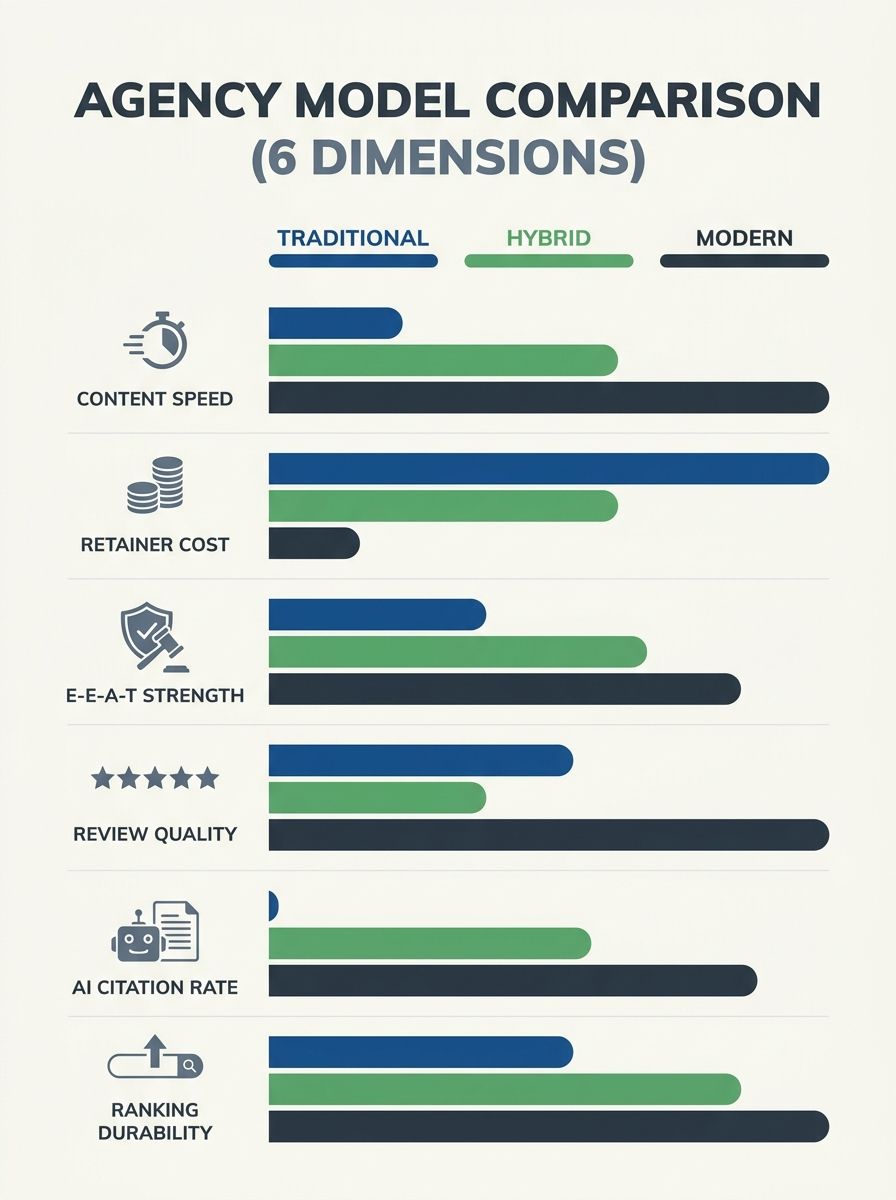
Factor | Volume-First AI Agency | Human-Only Specialist | Hybrid with Social Proof |
|---|---|---|---|
Content speed | 50-100+ posts/month | 4-12 posts/month | 12-30 posts/month |
Typical monthly retainer | $1,500-$4,000 | $5,000-$15,000 | $3,500-$8,000 |
E-E-A-T signal strength | Low | High | Medium-High |
Client review depth | Generic/vague | Detailed but scarce | Specific and verifiable |
AI search citation rate | Low (content excluded) | Medium (limited volume) | High (authority + cadence) |
Long-term ranking durability | 3-6 months before decay | 12-24 months | 12-18 months |
The Volume-First AI Agency: Speed Without Substance
Agencies that have gone all-in on AI content production can publish 50 to 100+ blog posts per month at retainers between $1,500 and $4,000. The pitch is compelling: more indexed pages, faster keyword coverage, lower per-article cost. And for about 3 to 6 months, the results look real. Rankings appear. Traffic ticks up. Monthly reports glow green.
Then the decay begins. Human-edited content consistently performs better for long-term rankings because it adds real insights and stronger E-E-A-T signals — experience, expertise, authority, and trust — according to discussions among practitioners tracking 2026 ranking data. Graphite's study used GPT-4o to generate 6,009 articles across commerce, finance, consumer, and B2B enterprise topics, and the sheer volume of AI output flooding every niche means your content has to fight an increasingly crowded field of nearly identical material.
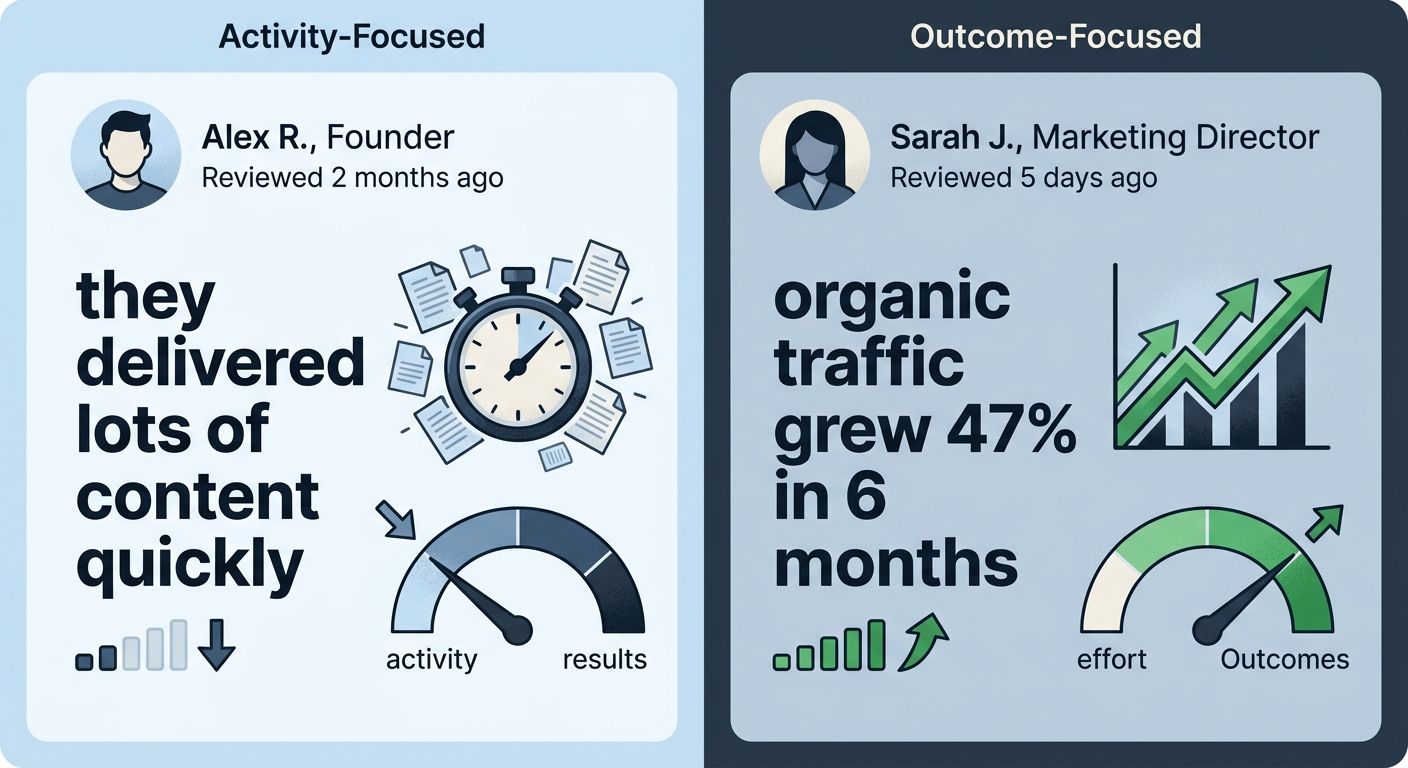
The client reviews for volume-first agencies tell their own story. When I audit these firms, the testimonials almost always follow a pattern: vague praise about "fast turnaround" and "lots of content delivered," but very few mentions of traffic growth, lead quality, or revenue impact. You'll see "they published 40 articles in our first month" but almost never "they increased qualified leads by 22%." That gap between activity metrics and outcome metrics is the tell.
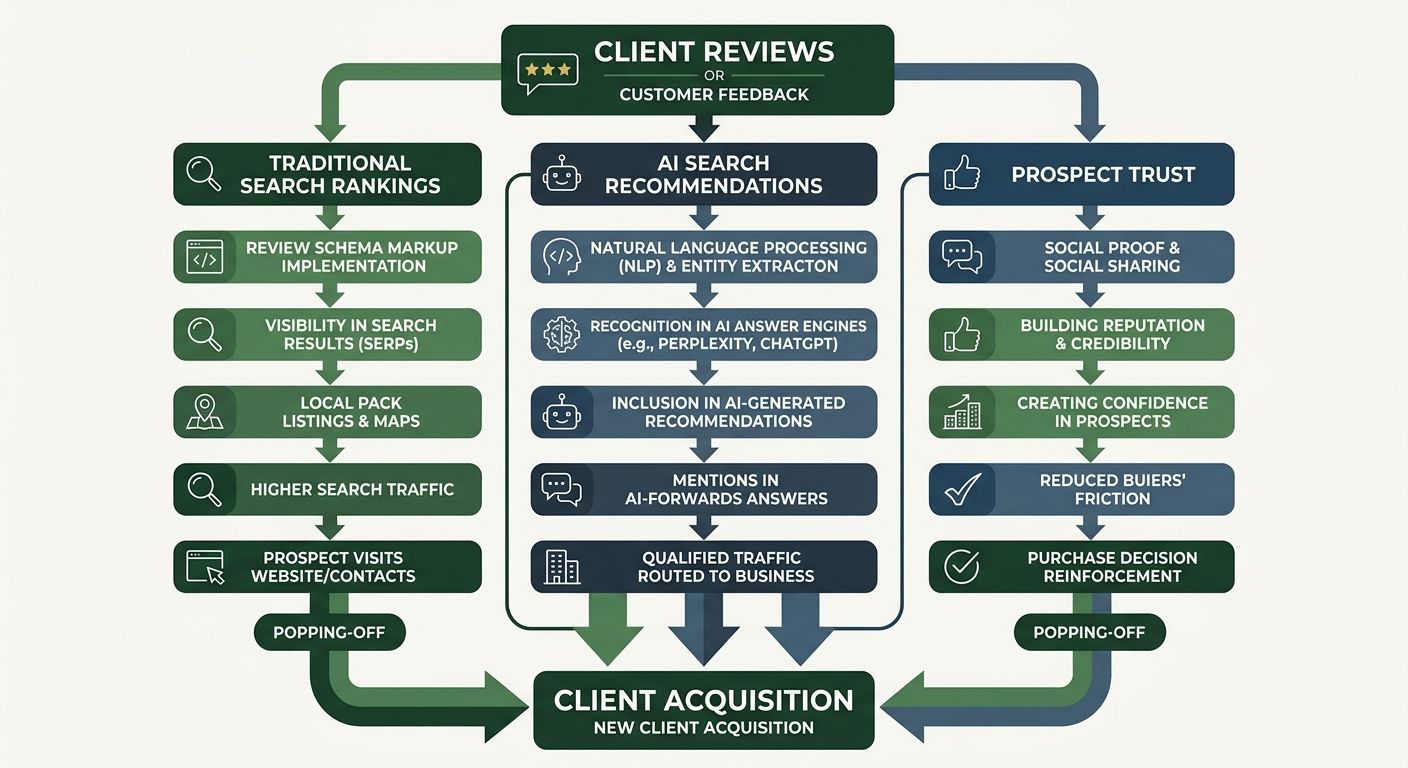
And here's where the AI search visibility problem compounds things. ChatGPT references reviews in 58% of its responses, while Perplexity does so 100% of the time. AI models are acting as quality filters, frequently excluding brands with average ratings below 4.0 from recommendations. If your agency's reviews are thin and activity-focused rather than outcome-focused, the AI systems that are increasingly driving discovery won't surface you — or the clients you serve — in their answers. Agencies built on volume are producing content that's already becoming invisible to the systems that matter most, and search traffic from traditional results has already dropped 25% as AI Overviews absorb clicks.
The California Management Review published research noting that "generative AI challenges traditional sources of competitive advantage" and that companies must rethink their business strategies to find new ways to differentiate. Agencies that built their entire model around producing words faster are watching that advantage dissolve in real time.
The Human-Only Specialist: Premium Positioning, Limited Reach
At the opposite end sits the agency that markets itself as entirely AI-free. These firms charge $5,000 to $15,000 per month, employ experienced writers with industry-specific backgrounds, and produce 4 to 12 deeply researched articles monthly. The work is genuinely good. Subject-matter expertise comes through in the writing. E-E-A-T signals are strong because real humans with real credentials stand behind every piece.
The competitive advantage through expertise is authentic here. As Intero Digital's analysis put it, deep content strategy "requires deep knowledge of your brand, audience, and industry — something AI just doesn't possess." When every paragraph reflects genuine practitioner knowledge, Google's systems can detect and reward that signal. And client reviews for these agencies tend to be specific and enthusiastic. Testimonials reference concrete outcomes: one client review noted that their agency "crafted a visually appealing site aligned with my vision and implemented an effective SEO strategy, significantly boosting organic traffic."
But this model has a serious constraint: velocity. Organizations producing 12 or more optimized content pieces monthly achieved 200x faster visibility gains than those producing fewer, according to recent AI search research. A specialist agency producing 8 articles per month can't compete on coverage breadth, and AI systems require approximately 250 unique mentions to form a definitive understanding of a brand. At 8 pieces monthly, building that citation mass takes years rather than months.
The pricing also creates a client retention challenge. At $10,000+ per month, expectations are extreme. If rankings don't materialize within 6 months, clients churn — and they churn angry. I've seen specialist agencies with incredible work quality but 40%+ annual client turnover because the gap between monthly cost and visible results creates unbearable pressure. The agencies struggling with accountability gaps in their retainer structures often fall into this category, where excellent work goes unrecognized because the delivery cadence doesn't match client expectations.
The reviews these agencies collect are strong but sparse. A firm with 15 detailed, specific reviews loses to a firm with 85 reviews averaging 4.6 stars when AI systems are calculating recommendation confidence. Fewer data points means lower statistical confidence for the algorithms deciding which agencies to recommend.

The Hybrid Agency Anchored by Verified Social Proof
The third model combines AI-assisted content production with human editorial oversight and, critically, makes verified client reviews the centerpiece of its SEO agency social proof strategy. Monthly retainers typically run $3,500 to $8,000. Content output lands between 12 and 30 pieces per month. Every article gets human review, fact-checking, and brand-voice editing. And the agency invests serious effort into collecting, displaying, and promoting detailed client testimonials.
Why does this model work? Because as First Movers' strategic guide explains, many competitive advantages come from "combining off-the-shelf AI tools with your proprietary data and domain expertise — not building custom models from scratch." The hybrid agency uses AI for research, drafting, and scaling, then layers human expertise on top for differentiation. The result is content that carries enough E-E-A-T signal to rank well while maintaining the publication cadence needed for AI search visibility.
But the real differentiator is what happens outside the content itself. Fast Company reported that the information environment has been flooded with what researchers call "slopaganda" — mass-produced, low-quality content that overwhelms and manipulates. In that environment, client reviews become the credibility anchor that content alone can't provide. When a prospect reads 30 detailed client reviews describing specific percentage gains in organic traffic, specific improvements in lead quality, and specific examples of agency communication, that social proof cuts through the noise of 10,000 blog posts making the same promises.
The verification piece matters enormously. According to research on client review credibility verification, 80% of consumers have read a fake review, and the tell-tale signs include scene-setting language, pronoun overuse, and "customer jacking." Hybrid agencies that invest in verified reviews on platforms like Google Business Profile, Clutch, and G2 create an asset that competitors can't replicate with AI tools. You can generate 50 blog posts with GPT-4o in an afternoon. You can't generate 50 verified client reviews from real businesses with real outcomes.
The review verification process that separates strong agencies from suspicious ones involves checking the date, frequency, and diversity of the reviews, plus analyzing reviewer profiles and evaluating consistency of feedback across platforms. When you're vetting agencies for potential red flags, the review profile is often the single most reliable signal of actual performance.
How Social Proof Feeds AI Search Visibility
The connection between client reviews and AI-generated content differentiation runs deeper than brand credibility. AI search systems extract and cite reviews directly. With $750 billion in US revenue projected to funnel through AI-powered search channels by 2028, and 50% of consumers already using AI-powered search, an agency's review profile directly determines whether it gets recommended in AI-generated answers.
Organizations applying structured data and content optimization saw a 44.3% improvement in crawl-to-refer ratios, leading to 28% annual pageview growth when combined with consistent content practices. Agencies that build SEO into their technical workflows and pair that technical foundation with strong review schema markup see compounding returns across both traditional search and AI discovery. Some firms implementing full optimization frameworks reported a 920% average lift in AI-driven traffic within 100 days.
The implication for agency selection is clear: the agency that can show you 50+ verified client reviews with specific outcome data, while also producing 15-25 quality-controlled content pieces monthly, is the one positioned to win in both the current search environment and the AI-driven one coming next.
The Honest Answer
The right agency model depends on three variables: your industry's E-E-A-T sensitivity, your monthly budget, and your timeline.
If you're in a low-E-E-A-T niche (general e-commerce, non-regulated products) and need quick traffic at $2,000-$4,000 per month, a volume-first AI agency can produce short-term results. Go in knowing that rankings will likely decay after 6 months and that the content won't differentiate your brand in AI search recommendations. Treat it as a tactical sprint, not a long-term investment. And scrutinize their reviews carefully — if every testimonial references output quantity without mentioning business results, you're paying for activity rather than outcomes.
If you're in YMYL (Your Money, Your Life) verticals like healthcare, legal, or finance where E-E-A-T requirements are strict, and you have $8,000+ per month to invest, a human-only specialist agency is defensible. The premium buys genuine expertise signals that AI content can't replicate, and Google's systems reward that signal heavily in regulated industries. But push your agency to collect and publish more reviews. An outstanding agency with 8 reviews on Clutch is leaving its strongest sales asset on the table.
For everyone else — mid-market B2B companies, professional services firms, local businesses with regional ambitions, agencies looking to unify their content and SEO strategy across channels — the hybrid model anchored by verified social proof offers the best risk-adjusted return. You get enough content velocity to build AI citation mass, enough human oversight to maintain E-E-A-T integrity, and a review portfolio that serves as both a trust signal for prospects and a ranking signal for AI systems.
I've watched the agency landscape fragment over the past 18 months as AI content tools became broadly available. The agencies that are winning new business aren't the ones with the flashiest AI capabilities or the longest client lists. They're the ones whose reviews consistently describe specific, verifiable outcomes delivered by people who clearly understood their client's industry. That combination of proof and expertise is the competitive advantage that AI-generated content has made visible by stripping away everything else.
Marcus Webb
Digital marketing consultant and agency review specialist. With 12 years in the SEO industry, Marcus has worked with agencies of all sizes and brings an insider perspective to agency evaluations and selection strategies.
Related Articles
Boutique SEO Agency vs. Enterprise SEO Firm: Which Model Delivers Better ROI for Mid-Market Companies in 2026
Mid-market companies ($10M–$500M revenue) get squeezed in SEO vendor selection because they're too big for freelancers and too small to justify $25,000 monthly retainers.

Why Recognition Beats Rankings in 2026: How SEO Agencies Should Pivot Their Authority Strategy
The slide deck that convinced a $4M ARR fintech company to sign a 12-month agency retainer showed fourteen keyword ranking improvements, zero AI citation metrics, and no mention of entity authority anywhere in the strategy section.

How Law Firms Are Rebuilding Rankings in the Dual-Search Era: AI Overviews vs. Traditional Google Results Strategy
The dual-search strategy that SEO agencies are packaging for law firms contains a structural contradiction.
Explore more topics