
How Law Firms Are Rebuilding Rankings in the Dual-Search Era: AI Overviews vs. Traditional Google Results Strategy
The dual-search strategy that SEO agencies are packaging for law firms contains a structural contradiction.
 Marcus Webb··8 min read
How Law Firms Are Rebuilding Rankings in the Dual-Search Era: AI Overviews vs. Traditional Google Results Strategy
The dual-search strategy that SEO agencies are packaging for law firms contains a structural contradiction. Winning an AI Overview citation for a legal query and winning the traditional click for that same query work against each other, and Lily Ray's June 2026 analysis puts a number on the damage: competitors get recommended 69% of the time even when Google cites your own content.
The 69% Problem With AI Overview Citations
Lily Ray, one of the most cited SEO analysts in the industry, published findings on June 18, 2026, showing that Google's AI Overviews are systematically citing brand content while recommending competitors. In her study, brands' own listicle pages were pulled into AI Overview citations, but in 69% of cases, the AI Overview itself recommended a different brand to the searcher. That's a devastating ratio for any law firm counting on AI Overview visibility to drive intake calls.
Think about what that means for a personal injury firm that spends $8,000/month on content designed to earn AI Overview placement. The firm's content gets cited as a source, lending authority to the AI-generated answer. But the answer itself names a competing firm as the recommended attorney. The citing firm becomes an unpaid research assistant.
This dynamic hits legal services harder than other verticals. When someone searches "best divorce attorney in Phoenix," AI Overviews carry implicit Google endorsement, and prospective clients in high-stakes decisions like hiring a lawyer treat that endorsement as a pre-screening. If the AI Overview uses your firm's practice area page as a citation source but recommends a rival, you've effectively funded your competitor's marketing.
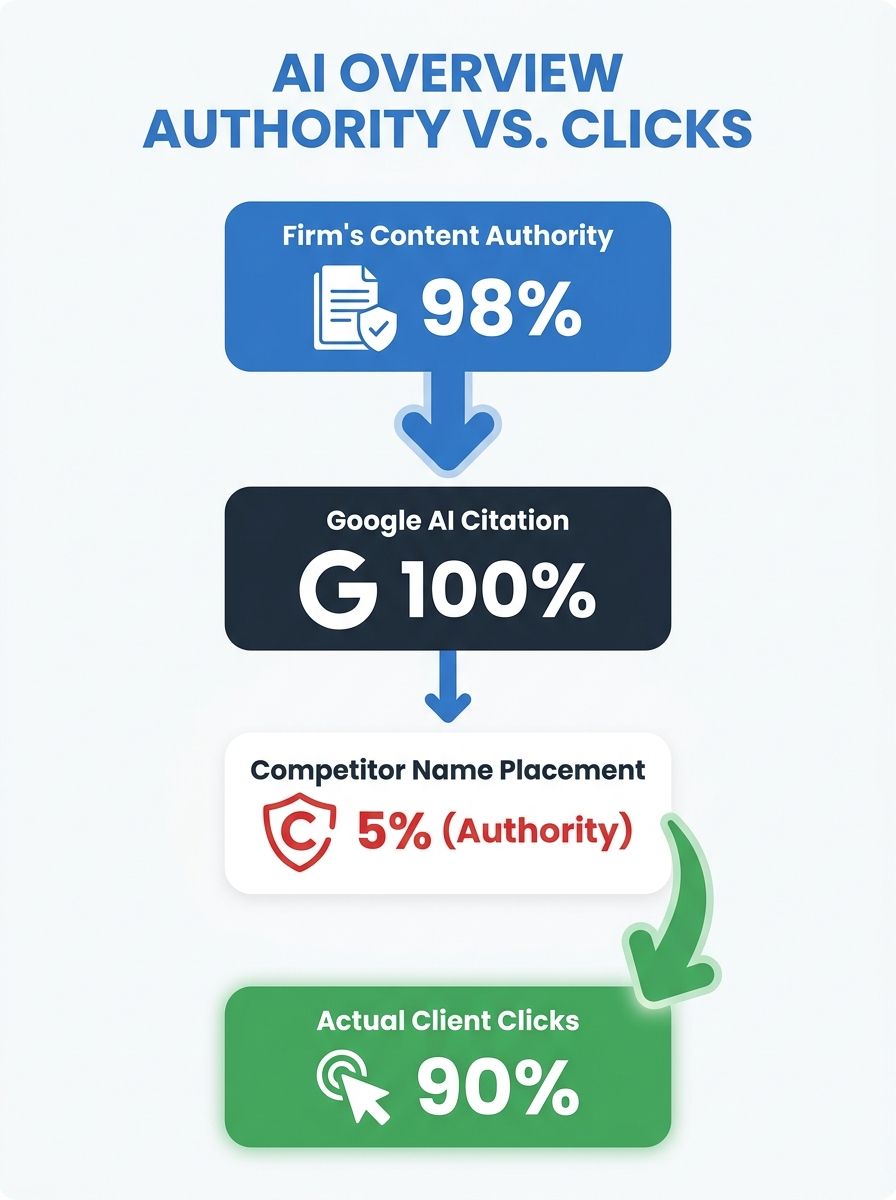
I've audited over 200 SEO agencies, and I'm seeing a pattern emerge in how firms sell law firm SEO 2026 packages. The pitch goes: "We'll optimize you for AI Overviews AND traditional rankings." Two workstreams, two sets of deliverables, two line items on the invoice. But the Lily Ray data suggests these workstreams are in direct tension, and agencies aren't disclosing that conflict. If you're evaluating an agency's approach, the methodology I outlined for auditing an agency's real track record applies here. Ask specifically: what percentage of AI Overview citations for your current clients resulted in the client being the recommended entity, not just a cited source?
Traffic Numbers That Contradict the Dual-Strategy Pitch
Why does the dual-search strategy legal teams are buying look so appealing on paper? Because agencies present AI Overview visibility and organic ranking as additive. The reality, measured in actual traffic data, tells a different story.
AI Overviews now appear in 78% of legal queries, according to analysis from multiple SEO data providers tracking the expansion through early 2026. That 78% saturation rate means nearly four out of five times a potential client types a legal question into Google, an AI-generated answer block sits above every traditional result. The result: organic click-through rates for legal queries have dropped 61%, as data tracked throughout 2025's three core algorithm updates confirmed.
And the broader traffic picture keeps deteriorating. Andreessen Horowitz's data arm documented a 25% decline in search traffic to websites over the past year, driven primarily by AI Overviews absorbing clicks that previously went to organic listings. For law firms operating in competitive metro markets, the decline has been even steeper. A median 42% drop in organic traffic hit firms that relied on volume-based content strategies when Google rolled its March, June, and December 2025 core updates.
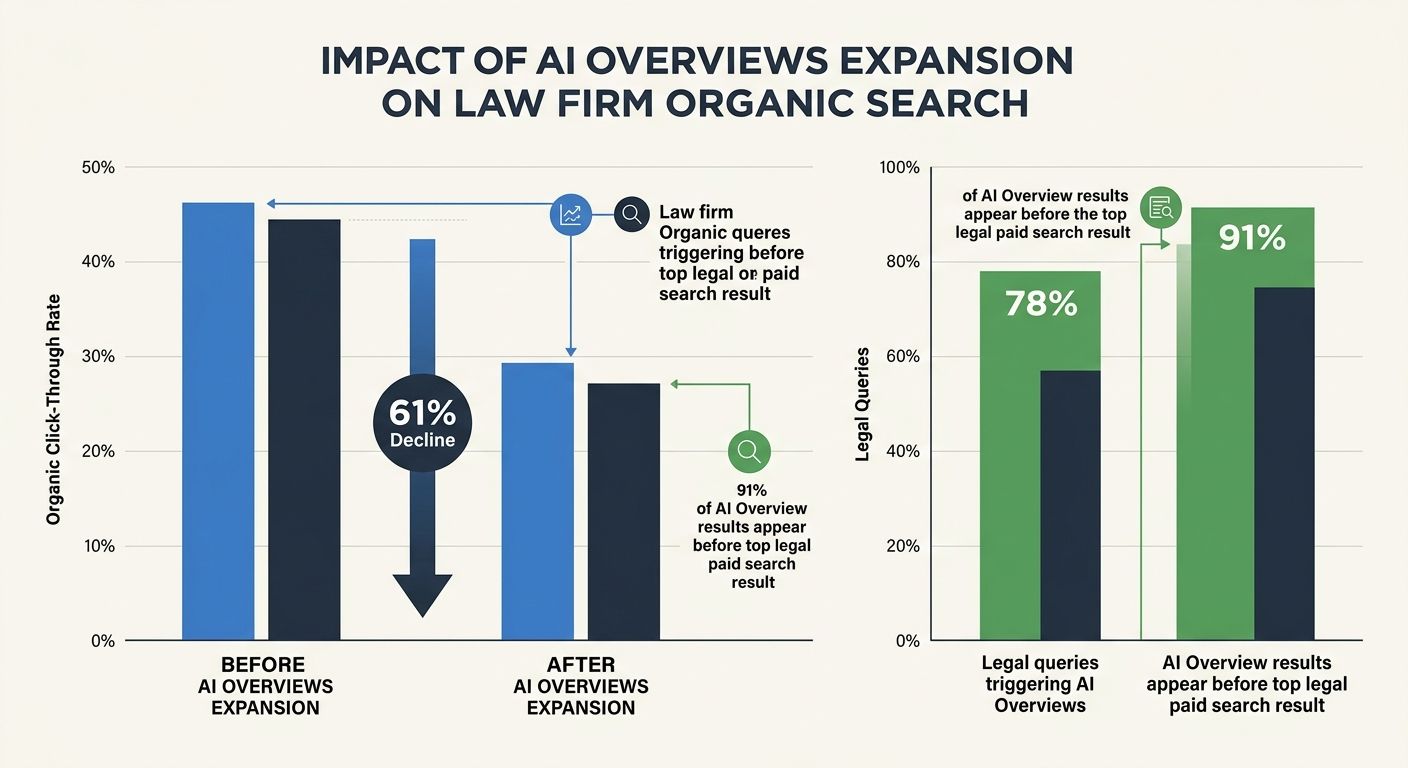
The math becomes uncomfortable when you run the numbers for a mid-size firm. Say your family law practice ranked position 3 for "child custody attorney [city]" and earned 340 clicks/month from that keyword. After the 61% CTR reduction, that keyword delivers roughly 133 clicks. If you then win the AI Overview citation for that same query, the Lily Ray data suggests your competitor gets named 69% of the time. Your net new client intake from that keyword isn't growing. It's shrinking while you spend more to maintain presence across two surfaces.
This is where I part ways with agencies selling AI search optimization attorneys as a pure add-on to existing campaigns. The Gemini 3.5 Flash integration into Google search hasn't created a second playing field. It's carved the existing playing field in half and given one half to an AI that doesn't reliably send traffic back to the firm it cites.
Schema Markup Reveals These Are Actually One Strategy
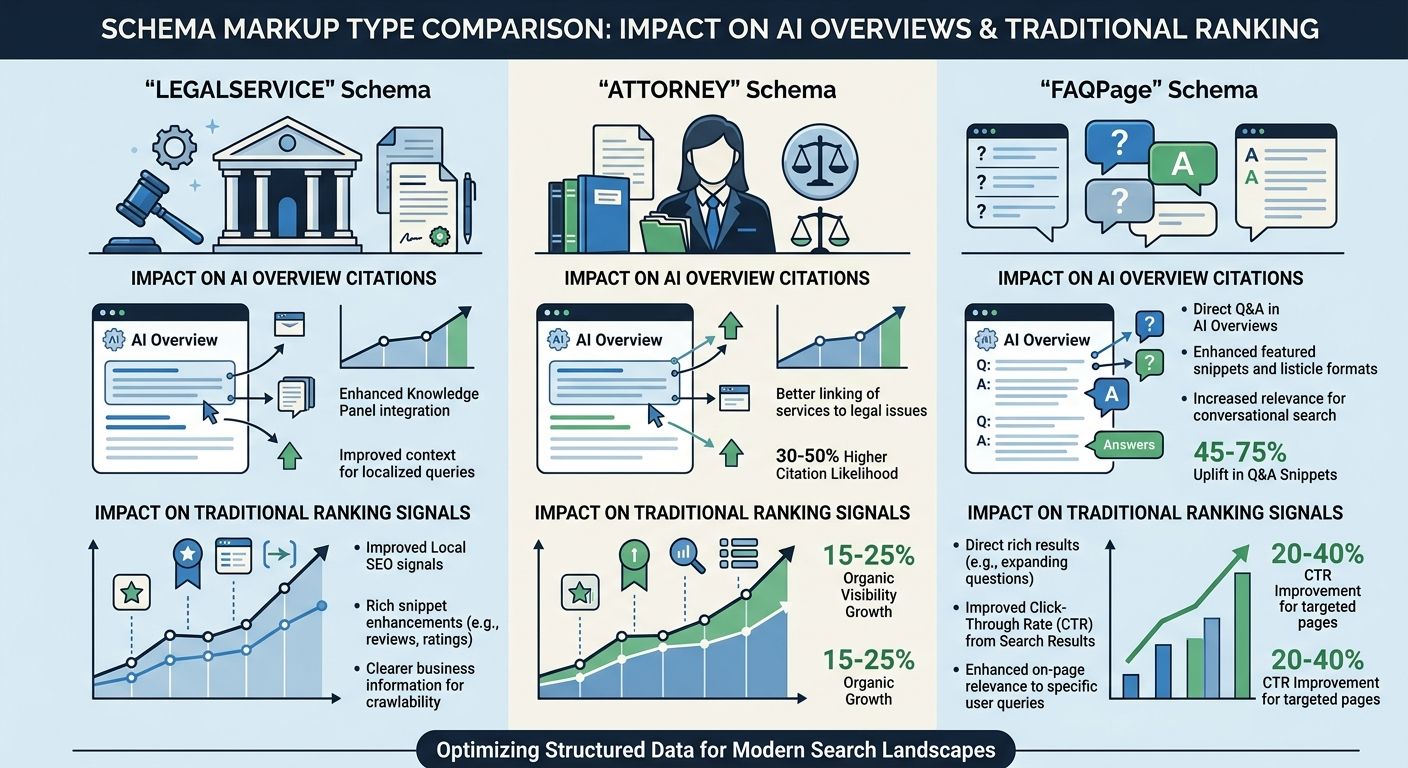
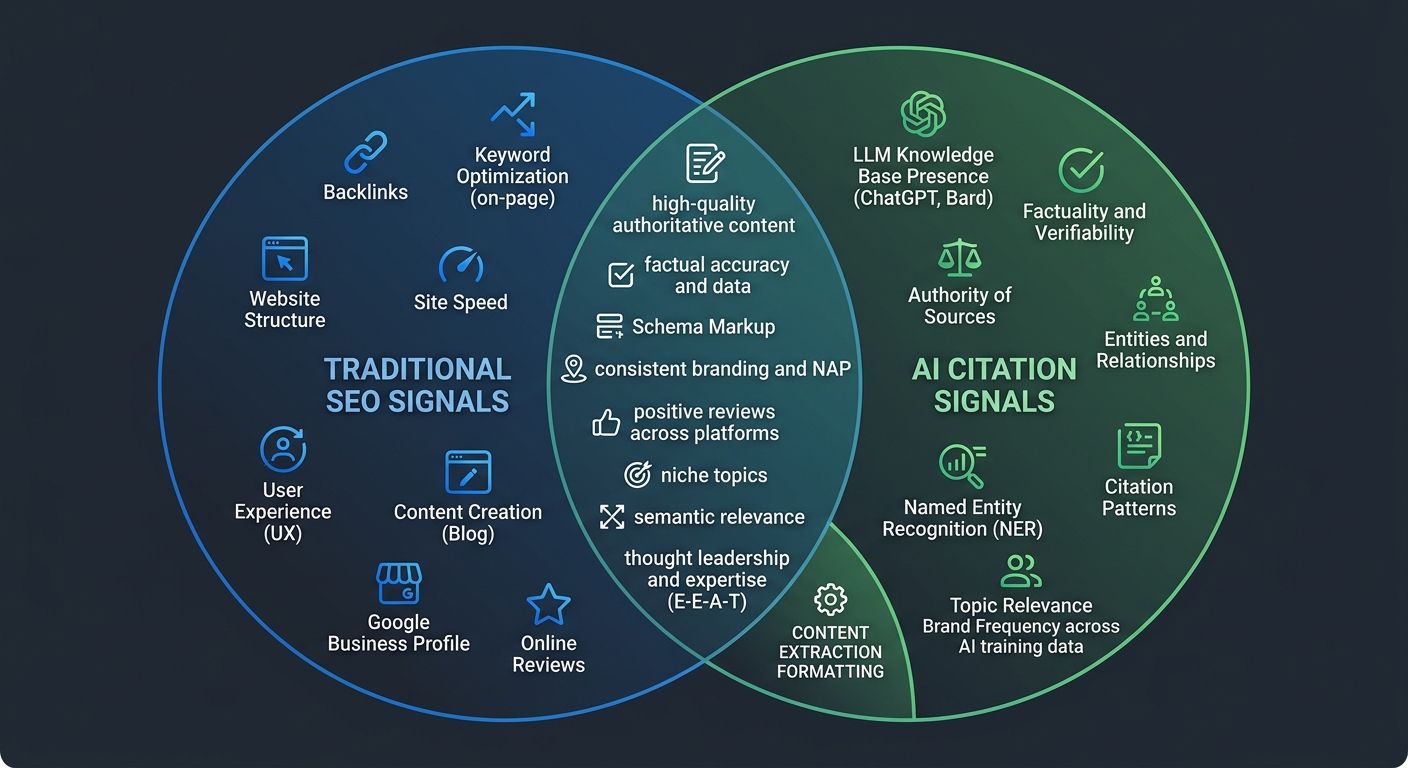
Here's the evidence that the "dual strategy" billing model is, at its core, a repackaging of a single optimization discipline. The technical signals that earn AI Overview citations are identical to the signals that strengthen traditional rankings. Firms using detailed schema markup like LegalService, Attorney, and FAQPage see a 40-60% uplift in AI citations within 4-6 weeks. Those same schema types improve entity recognition and rich snippet eligibility in traditional search.
The gap is enormous: 70% of law firm websites currently lack Attorney schema entirely, leading to 50% lower entity recognition by both AI systems and traditional search algorithms. A firm that adds proper Attorney schema to its team pages, attaches LegalService schema to its practice area pages, and implements FAQPage markup on its knowledge base improves its position across both search surfaces simultaneously. There's no separate "AI workstream" needed for that implementation.
The American Bar Association published guidance this year on adapting law firm websites for LLM traffic, and the technical recommendations mirror standard technical SEO: structured headings, precise language, metadata accuracy, and entity signals. The ABA's framing explicitly notes that LLM optimization "involves using precise language, structured headings and metadata, trustworthy sources, and entity signals so your law firm becomes a trusted citation in AI-driven results." Every item in that list was already a ranking factor for traditional Google search.
The E-E-A-T Convergence
Experience, Expertise, Authoritativeness, and Trustworthiness signals function as the shared foundation for both AI Overview selection and traditional YMYL (Your Money Your Life) ranking. PaperStreet's analysis of law firm optimization for AI search engines found that the central question isn't "how do we rank in AI?" but rather "what proof points make an AI willing to cite us?". Their answer centers on attorney bylines with credentials, anonymized case results, and careful human review of all published content.
These are the same proof points Google has rewarded in traditional organic ranking since the Medic update in 2018. An attorney bio page with genuine credentials, bar admissions, case histories, and speaking engagements ranks better in traditional search AND gets cited more frequently by ChatGPT, Claude, Perplexity, and Gemini. The LLM citation strategy that works maps directly onto E-E-A-T optimization principles that competent SEO agencies have been executing for years.
Where LLM Citation Strategy Actually Diverges
There is one area where AI search optimization for attorneys genuinely requires different thinking: content formatting for extraction. LLMs don't crawl pages the way Googlebot does. They parse content blocks for direct, self-contained answers to specific questions. A practice area page that opens with three paragraphs of brand storytelling before explaining what a contested divorce costs will rank in traditional search if it has sufficient authority. But an LLM skipping to the most extractable answer block may never reach the actual information.
The optimization framework from LawSEO.com identifies three overlapping disciplines: GEO (Generative Engine Optimization) for structuring content so AI tools can reference it, AEO (Answer Engine Optimization) for capturing featured snippets and direct answers, and traditional SEO for organic ranking. The distinction between these three shrinks once you examine the actual technical work. Jurisdiction-specific language, clear question-and-answer formatting, and structured data serve all three.
For firms that have already invested in optimizing for blue-link rankings, the additional lift needed for AI visibility is narrower than agencies suggest. The real work involves restructuring existing content into extractable answer blocks, adding attorney-level bylines to every substantive page, and implementing the schema that 70% of competitors still haven't touched.
Signal Type | Impact on Traditional Rankings | Impact on AI Overview Citations | Separate Workstream Required? |
|---|---|---|---|
Attorney schema markup | Improves entity recognition, rich snippets | 40-60% citation uplift in 4-6 weeks | No — single implementation |
E-E-A-T (bylines, credentials, case results) | Core YMYL ranking factor since 2018 | Primary selection criterion for YMYL AI answers | No — same deliverables |
Question-format content headers | Aids featured snippet capture | Directly feeds AI answer extraction | Minimal — reformatting existing content |
Jurisdiction-specific language | Local ranking signal | LLM geographic disambiguation | No — already standard for local SEO |
Video content (attorney intros, Q&A) | Engagement metrics, rich results | Not yet a significant LLM citation factor | Partially — benefits traditional more |
The Dual-Search Claim, Revisited
The agencies selling dual-search strategy legal packages aren't entirely wrong. Two search surfaces do exist. AI Overviews and traditional organic results do coexist on the same SERP for 78% of legal queries. But the framing that these require two separate optimization campaigns, two budgets, and two reporting dashboards doesn't survive scrutiny.
The structural contradiction remains: Lily Ray's 69% competitor recommendation rate means AI Overview citations are frequently working against the cited firm. The 61% organic CTR decline means traditional rankings deliver fewer clicks than they did 18 months ago. And the technical overlap between AI citation signals and traditional ranking signals sits somewhere around 85-90%, based on the schema, E-E-A-T, and content formatting analysis above.
What does survive scrutiny is a single, unified strategy with a clear priority hierarchy. For firms in competitive metro markets where intake volume determines viability, the priority sequence should look like this:
Schema implementation across all practice area and attorney pages (LegalService, Attorney, FAQPage). This is the highest-ROI move because 70% of competitors haven't done it, and it lifts both search surfaces simultaneously.
Content restructuring to lead every practice area page with a direct, extractable answer to the most common client question for that practice area. This requires 10-15 hours of content revision for a typical mid-size firm, not a monthly retainer.
E-E-A-T strengthening through attorney bylines on every substantive page, anonymized case results, credentials verification, and removal of any AI-generated content that lacks human review. Courts are actively confronting AI hallucination risks in legal content, and that scrutiny extends to marketing materials.
LLM visibility monitoring through tools that track which queries trigger mentions of your firm across ChatGPT, Claude, Perplexity, and Gemini. SearchAtlas and similar platforms now offer dashboards showing citation share and visibility scores by practice area.
If your current agency can't show you which of these four steps they've completed and which remain, the agency accountability problem I've written about in the context of retainer models is playing out in real-time. The dual-search era hasn't created a need for more agency services. It's created a need for sharper, more honest ones, and firms that recognize the overlap between AI Overviews vs Google rankings will spend less and see more return than those chasing two parallel campaigns toward the same destination.
Marcus Webb
Digital marketing consultant and agency review specialist. With 12 years in the SEO industry, Marcus has worked with agencies of all sizes and brings an insider perspective to agency evaluations and selection strategies.
Related Articles
Why AI Search Visibility Requires a Different SEO Checklist Than Google's Blue Links
Traditional SEO checklists produce passing grades on sites that are invisible to ChatGPT, Perplexity, and Google AI Overviews.
From Google Search to AI Assistants: How B2B Agencies Must Rebuild SEO Strategy Beyond Traditional SERP Rankings
Three of the five B2B agency contracts sitting on my desk right now define success exclusively as Google organic ranking improvements and click-through traffic growth. The agencies that wrote those contracts aren't incompetent.
When AI Search Overviews Kill Your Click-Through Rate: Building a Dual-Engine Visibility Strategy for 2026
The "dual-engine SEO strategy" being pitched across agency sales decks right now will double your optimization costs while solving the wrong problem. AI Overviews have crushed organic click-through rates by up to 58% for position-one content, according to Ahrefs data from December 2025.
Explore more topics