
Search Traffic to Websites Fell 25% Over Past Year as AI Overviews Block Clicks, a16z Data Shows
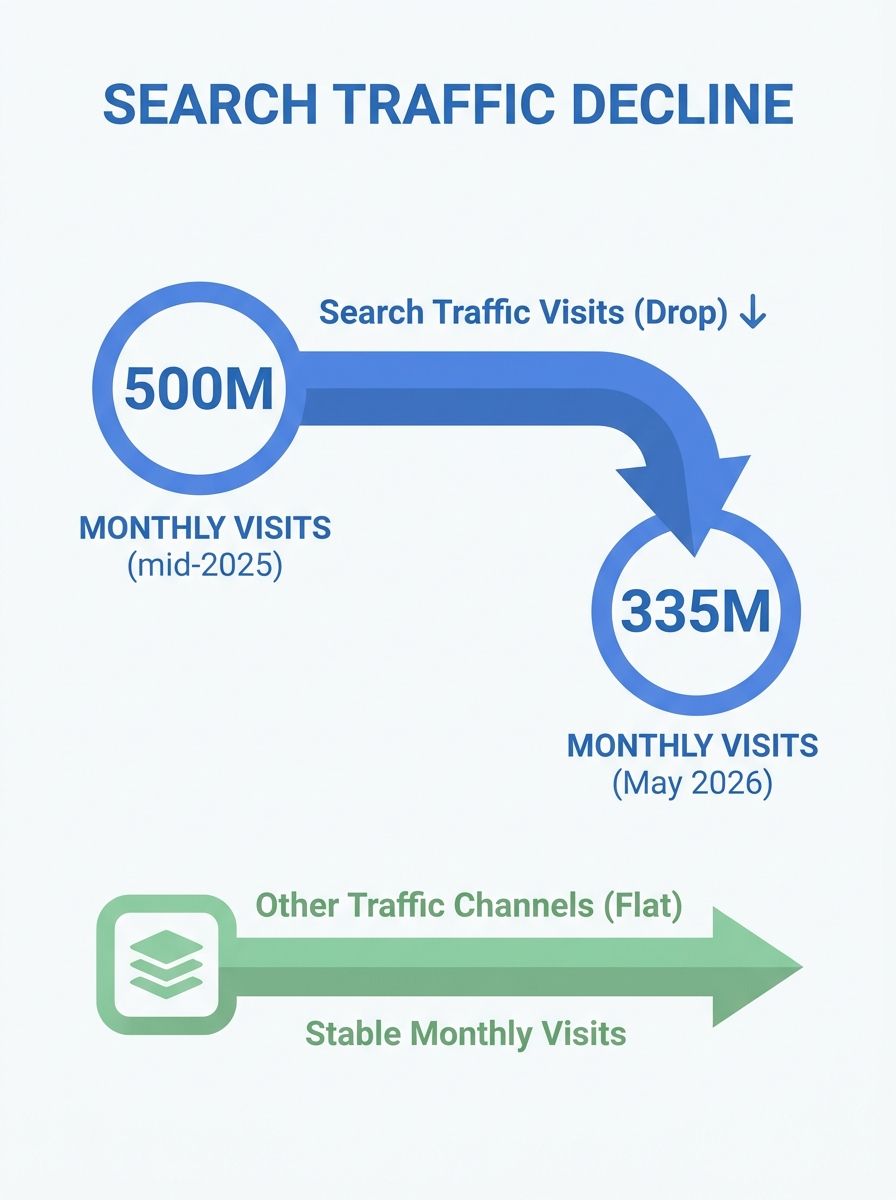
Search traffic to websites dropped from approximately 500 million visits per month in mid-2025 to around 335 million by May 2026, a decline of roughly 25% over the past year, according to Ahrefs data cited by venture capital firm a16z in a report published June 14. Every other major traffic channel,
 Marcus Webb··3 min read
Search Traffic to Websites Fell 25% Over Past Year as AI Overviews Block Clicks, a16z Data Shows
Search traffic to websites dropped from approximately 500 million visits per month in mid-2025 to around 335 million by May 2026, a decline of roughly 25% over the past year, according to Ahrefs data cited by venture capital firm a16z in a report published June 14. Every other major traffic channel, direct, paid, and social, held relatively steady over the same period, isolating search as the sole category in freefall.
Zero-Click Searches Reached 68% of All Google Queries in 2026
The a16z analysis attributes the traffic collapse to what it calls the "steady and accelerating rise" of zero-click searches. In 2016, approximately 45% of Google searches ended without a user clicking any link, according to the data. That figure crossed 50% by 2019, reached 60% by 2024, and now stands at 68% in 2026, meaning more than two in three Google searches produce no website visit at all.
Google's AI Overviews, which place an AI-generated answer at the top of search results, answer the user's query before they have had a chance to click anything, the report states. Websites have been reporting the impact in their analytics consoles, watching organic traffic slide while impressions in Google Search Console continue to climb, users are seeing pages but not visiting them.
The shift creates a structural problem for businesses that relied on organic search as their primary discovery channel. Google's own data shows it delivers just 232 clicks per 1,000 queries to external websites, a finding that predated AI Overviews but has intensified under the current interface.
News and Informational Content Took Disproportionate Hit
Organic search traffic to major news sites fell to under 1.7 billion visits in May 2025 from a peak of over 2.3 billion just months earlier, according to Similarweb data cited in the a16z report. News and informational content, the kind of material that answers factual questions, has taken a disproportionate hit relative to other content types.
The CEO of The Atlantic said publicly that he expects Google traffic to eventually approach zero and that publishers need to rebuild their business models accordingly, the report states. Business Insider laid off roughly 21% of its staff in early 2025, with leadership explicitly citing traffic declines that were "beyond our control," according to the a16z analysis.
Google has pushed back on some of these figures, calling them based on "speculative or incomplete information," the report notes. The company has also argued that AI Overviews open up more discovery, not less, and that clicks following an AI-assisted search are more qualified.
Direct Traffic Remained Largest Channel as Search Fell Past It
In the a16z data, direct traffic remained the largest channel throughout the period, staying close to 500 million monthly visits, while search slid past it on the way down. Paid traffic held around 200 million monthly visits. Social stayed near 100 million. AI as a traffic source, shown in the chart, remains a rounding error, close to zero even as AI tools grow in popularity among users.
ChatGPT, Perplexity, and other AI tools are being used by hundreds of millions of people, but the traffic they send back to websites is minimal, the report states. AI is absorbing the attention that used to flow through Google, and only a small fraction of it is being redirected elsewhere on the web.
The trend poses immediate questions for SEO agencies evaluating their service models and clients measuring return on organic search investment. For a decade and a half, the playbook was relatively stable: rank in Google, get traffic. That equation is breaking down in ways that won't be easy to reverse, according to the a16z analysis.
What Happens Next
The 25% decline in search traffic over 12 months represents the most significant structural shift in organic discovery since Google became the dominant search engine. SEO agencies and their clients need to reassess whether traditional ranking-focused strategies still deliver measurable business outcomes when seven out of ten searches produce no click at all.
The immediate action item for marketing managers evaluating SEO retainers is to demand traffic and conversion data alongside ranking reports. If impressions are climbing but visits are collapsing, the agency's work is generating visibility that doesn't convert to business value. That gap is only widening as AI Overviews expand across more query types.
Whether AI platforms eventually develop into meaningful traffic sources through citations, linked summaries, or other mechanisms remains unclear. For now, businesses dependent on organic search need to diversify their discovery channels and rebuild audience relationships that don't rely on Google as the primary intermediary. The 335 million monthly visits that remain in the search channel will continue to shrink if current trends hold.
Marcus Webb
Digital marketing consultant and agency review specialist. With 12 years in the SEO industry, Marcus has worked with agencies of all sizes and brings an insider perspective to agency evaluations and selection strategies.
Related Articles
Ranking #1 on Google Now Delivers 58% Fewer Clicks Than It Used To, Gravitate Analysis Finds
A first-position Google ranking now delivers 58% fewer clicks than the same ranking delivered before AI Overviews began appearing in search results, according to an analysis released July 9, 2026 by Gravitate, a Vancouver-based digital marketing agency.
Google Search Delivers Just 232 Clicks Per 1,000 Queries to External Websites, SparkToro Data Shows
SparkToro analysis of Similarweb clickstream data shows 232 of every 1,000 U.S. Google searches produced a click to the open web between January and April 2026, down from 360 clicks per 1,000 searches in the firm's 2024 study, according to a report published June 10 by SparkToro co-founder Rand Fish
Google Introduces Further Exploration Links to AI Overviews as Publishers File Antitrust Suits Over 58 Percent Traffic Decline
Publishers filed antitrust lawsuits and European Commission complaints against Google as AI Overviews correlated with a 58 per cent click-through rate decline, prompting the search giant to introduce five traffic-restoration features on May 6, 2026, according to The Next Web.
Explore more topics