
Why Architecture Firms Still Rank Invisibly After 6 Months of SEO: The Portfolio Optimization Paradox
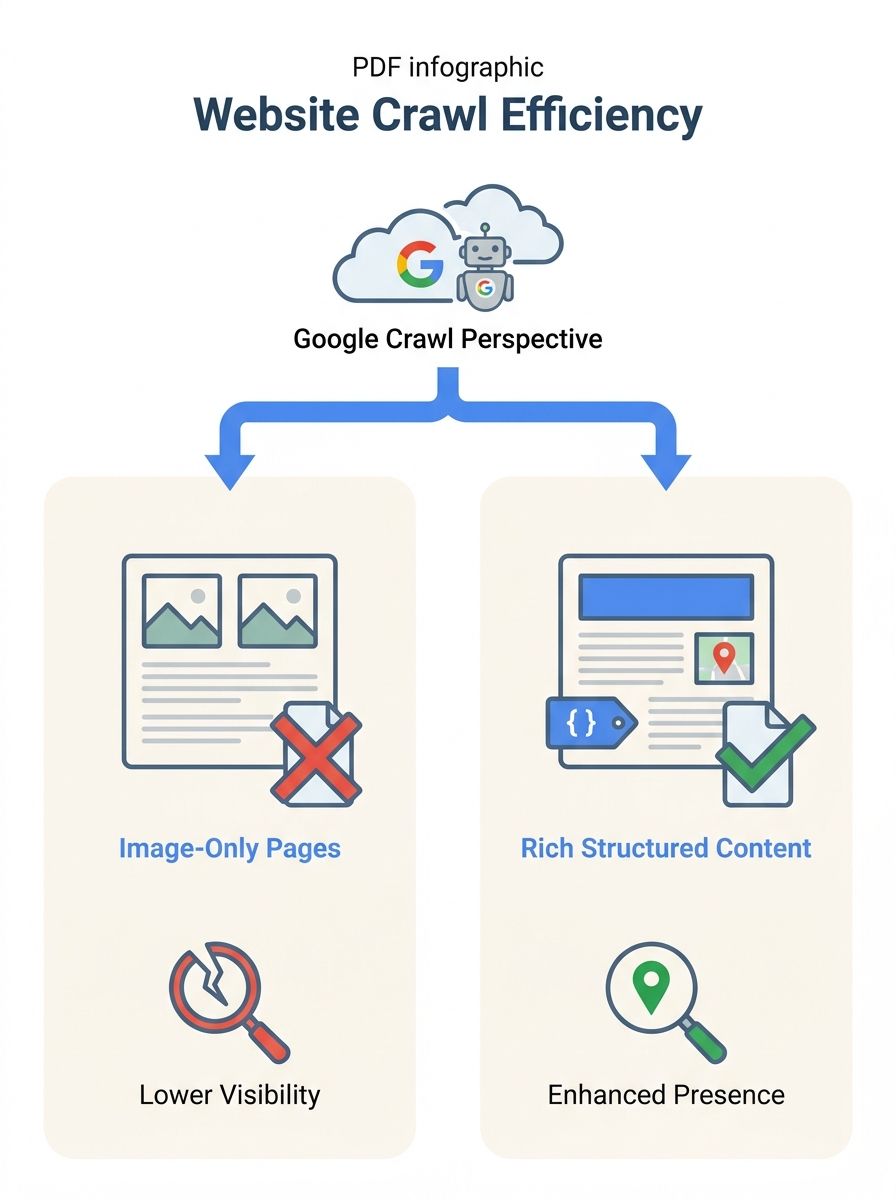
Google processes architecture firm portfolio pages the same way it processes any image gallery without supporting text: it indexes the page, finds almost nothing to rank, and buries it behind competitors who describe their work in words search engines can parse.
 Marcus Webb··9 min read
Why Architecture Firms Still Rank Invisibly After 6 Months of SEO: The Portfolio Optimization Paradox
Google processes architecture firm portfolio pages the same way it processes any image gallery without supporting text: it indexes the page, finds almost nothing to rank, and buries it behind competitors who describe their work in words search engines can parse. Six months of SEO retainer payments don't fix this when the underlying site structure treats searchability as an afterthought.
This paradox intensified through early 2026. A benchmark study released June 10 by PSMJ Resources found that most architecture and engineering firms across North America cannot confirm whether they're actually profitable, and their marketing spend faces the same accountability vacuum. Firms pay for SEO services that optimize around a portfolio structure Google fundamentally doesn't reward. An analysis from Amazing Architecture published three days ago put it bluntly: architecture firms are running like it's 2005, and their digital presence is bleeding growth.
I've audited over 200 agencies' SEO work across industries. Architecture firms represent some of the most consistent failures I've encountered. The agencies aren't always doing bad work. They're applying standard SEO playbooks to a site type that breaks those playbooks at the foundation level.
The Portfolio Structure That Search Engines Can't Read
Architecture firms build their websites around visual portfolios because that's what clients want during a pitch meeting. The problem, as NEURONwriter's analysis of architect SEO documented, is that "SEO for architects gets treated as an afterthought, something to bolt on after the portfolio is live."
Here's what "bolt on" looks like in practice. A typical architecture firm portfolio page contains 8–15 high-resolution project images, a project name, a location, and maybe 40–60 words of description. Google's crawler sees a page with almost no indexable content. The images load at 2–5 MB each without proper compression, dragging Core Web Vitals scores into failing territory. There's no structured data telling Google this is a completed architectural project, who designed it, where it sits, or what type of building it is.
An SEO agency comes in, adds blog posts, tweaks meta titles, and builds some backlinks. Six months later, the portfolio pages still rank nowhere because the blog posts live in a different section of the site entirely, and the portfolio pages themselves remain content deserts that Google has no reason to surface.
Truelogic's enterprise SEO analysis, published June 13, described this structural flaw as a "hidden 40% revenue tax" caused by poor site architecture. They cited Forbes as a cautionary example, noting organic search visibility fell by an estimated 60–80% over 2024–2025 when site structure problems went unaddressed. Architecture firms face a scaled-down version of the same disease. The portfolio pages that should be the firm's strongest assets are its weakest pages from a search perspective, and months of content marketing layered on top can't compensate.
How Entity-Based Ranking Changed the Equation
Why does a six-month SEO timeline that works for a dental practice or a law firm fail for architects? Because search engines now evaluate architecture firms as entities, not as websites with keywords on them.
Google's entity-based ranking assesses design expertise, geographic relevance, and brand mentions across platforms when deciding where to position an architecture firm. An analysis published by Everything PR found that leading architecture firms achieving AI visibility do so by positioning their principals as recognizable entities with long-form content and integrated practice descriptions across multiple digital touchpoints.
The practical gap looks like this: a firm's founding principal has 30 years of experience, AIA award recognition, published work in Architectural Record, and speaking engagements at national conferences. None of that information exists in a structured format Google can process. The principal's bio page is 80 words and a headshot. Their project credits aren't connected to the portfolio pages. Their publications aren't linked or cited. Google sees a name on a website. It doesn't see an authoritative entity in the architecture space.
Those signals require a different optimization approach entirely, and most agencies working with architecture firms either don't recognize the gap or don't have the frameworks to close it. If you've encountered this mismatch, the agency accountability structures I've written about before apply directly to architecture retainers where standard reporting masks structural failures.
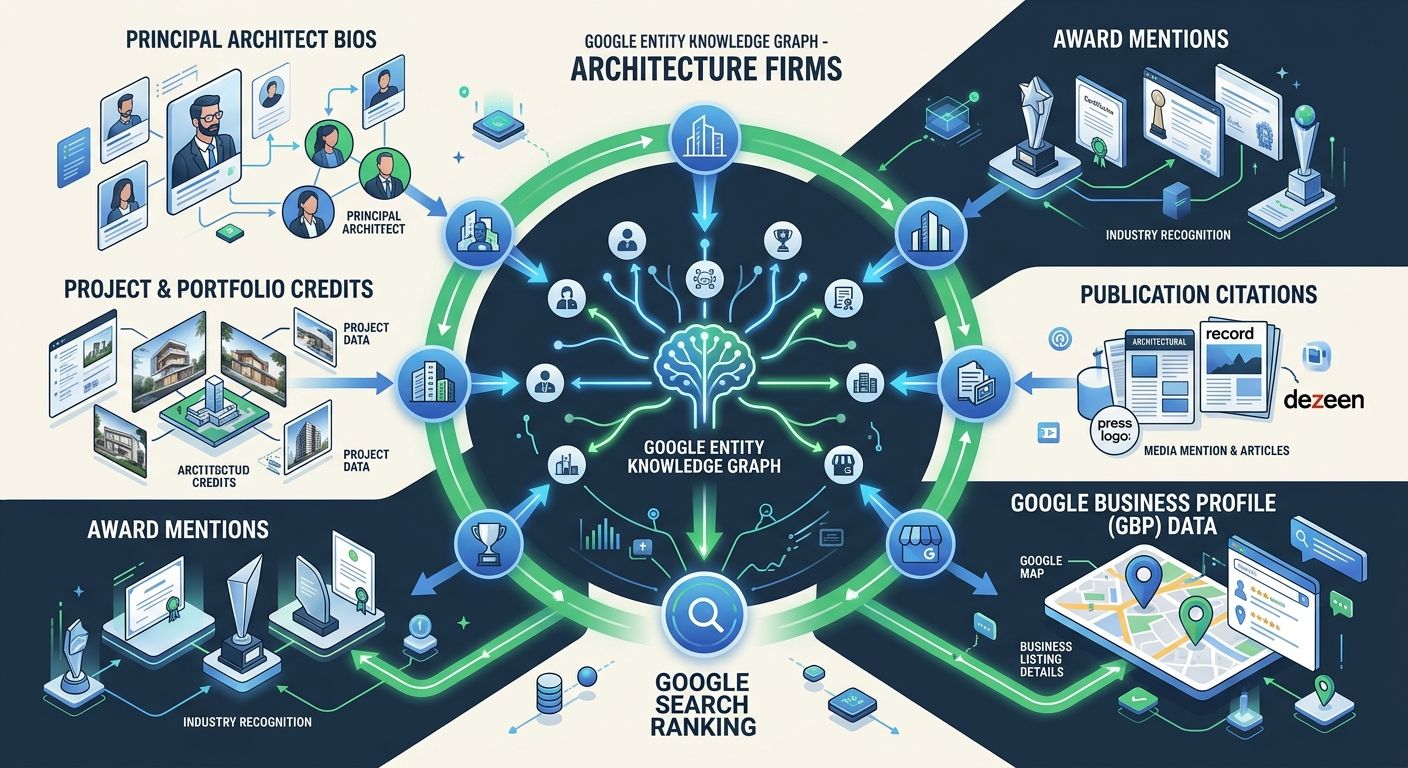
Image SEO Failures Unique to Design Firms
Image SEO for design firms carries stakes that don't exist for most other industries. For an e-commerce site, images support product listings. For an architecture firm, images are the product. And the way most firms handle their project photography actively suppresses portfolio optimization for search.
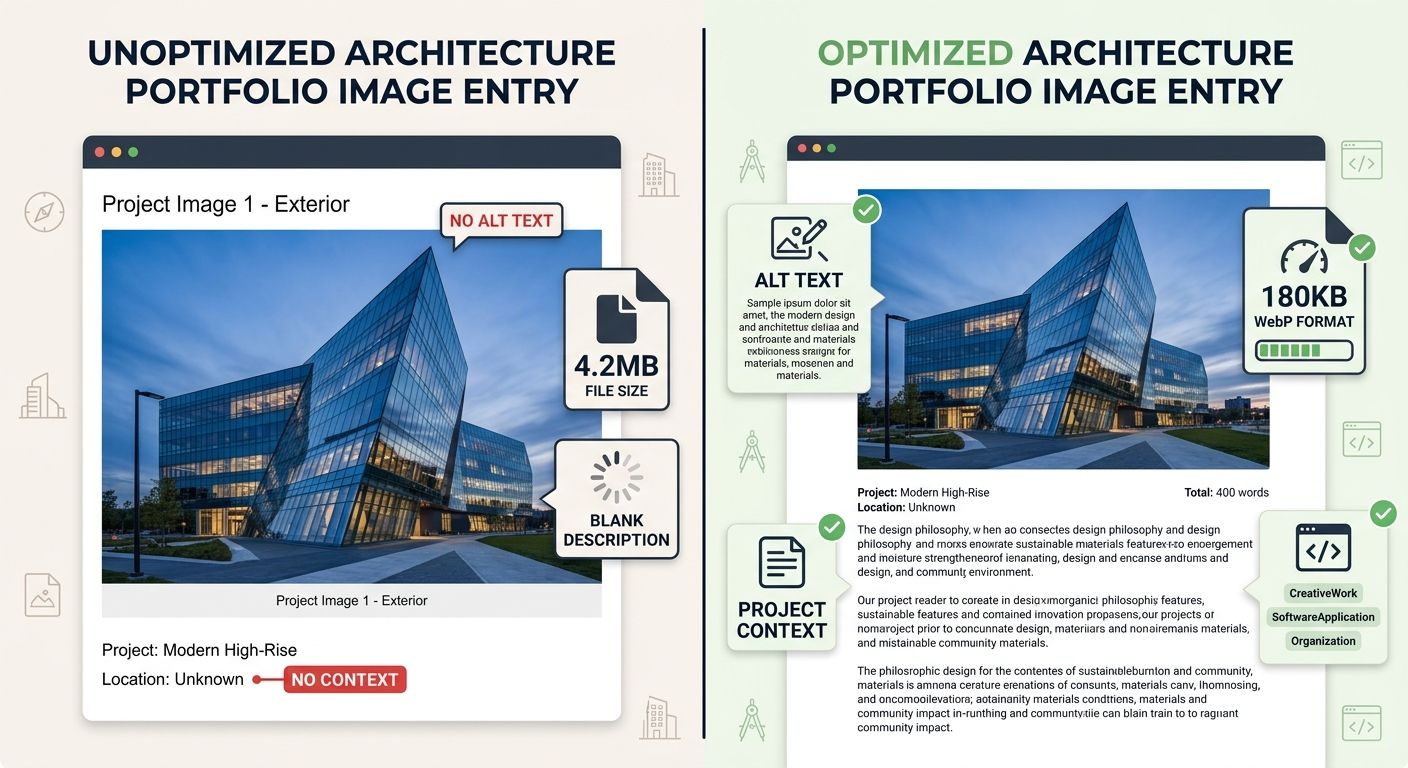
Google's own image SEO best practices documentation specifies that images need descriptive filenames, alt text conveying content and context, surrounding text that provides relevance signals, and proper structured data. Architecture firm sites fail systematically across nearly every one of these requirements:
Filenames read as "DSC_0042.jpg" or "hero-image-3.png" instead of "residential-addition-portland-oregon-exterior.jpg"
Alt text is either missing entirely or reads "project photo" across every image on the site
File sizes run 3–8 MB per image because the photographer's original files were uploaded without compression or format conversion
Surrounding text is absent because the portfolio page design prioritizes visual white space over written context
Schema markup for creative work, architecture projects, or image objects doesn't exist
Search Engine Land's image optimization guide measured direct correlations between image optimization quality and page load speed, ranking position, and click-through rates. Architecture firms sit near the bottom of these metrics because their sites carry the heaviest image loads with the least technical optimization of any professional services category I've audited.
The fix requires treating each portfolio project as a content-rich page rather than a photo gallery. Each project page needs 300–500 words of description covering project type, location, client goals, materials, square footage, design challenges, and outcomes. The images need proper alt text, compressed file sizes under 200 KB for web display, and WebP or AVIF format delivery. If you're working through a complete portfolio optimization approach for architecture SEO, image handling should account for roughly 40% of the total effort.
Local Trust Signals Architects Consistently Miss
Local trust signals for architects differ from standard local SEO because the service radius is wider and the purchase cycle is longer. A homeowner searching for "residential architect Denver" might hire someone whose office is 45 minutes away. A developer searching for "commercial architect Pacific Northwest" might consider firms across three states.
This creates a local SEO challenge that standard agency playbooks handle poorly. The firm needs local authority in its primary market through Google Business Profile optimization, local citations, and reviews, AND topical authority across a broader geographic footprint through project pages tagged to specific cities, content addressing regional building codes and zoning requirements, and local press coverage.
Percepture's analysis of architect SEO described the typical outcome: "a firm with award-winning work that is invisible when a developer, homeowner, institution, or hospitality group searches for an architect online." The invisibility stems from weak Google Business Profiles, absent review strategies, and zero local content targeting.
INSIDEA documented a Pacific Northwest architecture firm that had no online visibility beyond a basic portfolio despite steady referrals. Growth stalled because referral networks are inherently capped, and the firm had no organic search presence to supplement them. The turnaround required building authority around what the firm already did well, then translating that authority into signals Google could measure and reward.
Reviews deserve particular attention. Architecture projects take 12–24 months from initial consultation to completion. Firms accumulate Google reviews slowly compared to service businesses completing 10–20 jobs per week. A firm with 8 reviews over three years looks thin next to a general contractor with 200 reviews, even though the architecture firm's project value per client runs 50x higher. Building a review generation system that captures feedback at project milestones (schematic design approval, construction document delivery, substantial completion) rather than only at final completion can triple review velocity without changing the client experience.
AI Search Visibility Adds a Second Layer
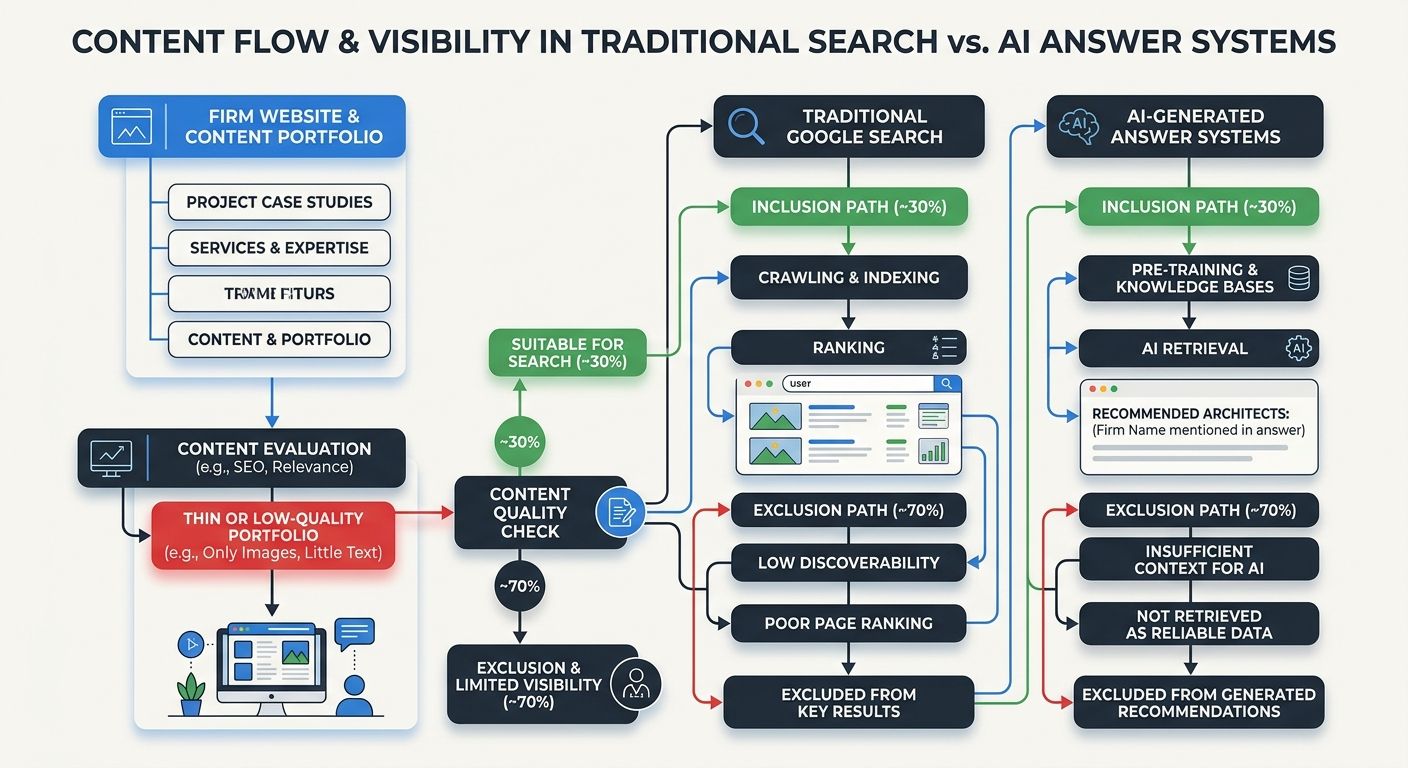
Architecture firm SEO rankings problems now extend beyond traditional Google results into AI-generated answers. ChatGPT, Perplexity, and Google's AI Overviews are fielding queries about architects, and the firms invisible in traditional search become even harder to find through these AI-mediated channels.
Business Visibility Group's analysis of AI visibility architecture found that AI systems lose confidence in recommending businesses when they encounter "mixed or conflicting signals." Architecture firms with thin portfolio pages, minimal text content, and no structured entity data produce exactly this signal confusion. The AI model tries to formulate a recommendation, finds insufficient supporting information, and either excludes the firm entirely or mentions it with low confidence that pushes it below competitors.
The ARCHITECT Framework, developed by DW Conceptz and detailed in a Lumapath case study, offers a methodology for building AI recommendation visibility through entity clarity, credibility signals, and structured content that AI systems can confidently extract and cite. The framework's core principle aligns with what I've been telling architecture firm clients for the past 18 months: AI systems recommend firms they can confidently describe, and most architecture firm websites give AI models almost nothing to work with.
Newfound Marketing's analysis published June 13 identified several SEO playbook strategies that stopped working in the current search environment, including topic cluster strategies, intent mapping as previously practiced, and traditional featured snippet optimization. Architecture firms that invested their first six months into these now-deprecating tactics while ignoring AI search visibility for architecture are watching returns shrink on two fronts simultaneously.
Meanwhile, Google now delivers only 232 clicks per 1,000 queries to external websites according to SparkToro data, which means the pool of traditional organic clicks these firms compete for is already contracting. The math gets uncomfortable: fewer clicks available overall, and architecture firms aren't capturing their share of the ones that remain.
Why the Standard Six-Month Timeline Doesn't Apply
Architecture firm SEO retainers typically follow the same timeline projections agencies use for any local service business: initial audit in month one, technical fixes and content in months two through four, measurable ranking improvements by month five or six. Content published in the first three months may begin ranking for unoptimized terms, but this timeline assumes the site's foundational structure supports the work being done on top of it.
For architecture firms, that assumption is wrong. The portfolio pages need restructuring before standard SEO tactics produce meaningful results. If the agency spends months two through four writing blog posts and building links while the portfolio pages remain image-heavy content deserts, the blog posts rank for informational queries that don't generate project leads, and the portfolio pages continue sitting on page four or worse.
Firms in highly competitive metropolitan markets should expect longer timelines still. And the diagnostic framework for identifying ranking problems I've recommended to agencies works equally well as a proactive audit tool at month three of an architecture retainer, catching structural problems before the client hits month six wondering what went wrong.
What Still Isn't Settled
Several questions about architecture firm SEO rankings remain unresolved as the industry adjusts to entity-based and AI-driven search.
Google hasn't published specific guidance on how it evaluates creative professional portfolios differently from other visual content. The image SEO best practices documentation treats all images identically, but architecture project photography carries informational signals (building type, materials, architectural style, geographic context) that product photography doesn't. Whether Google's systems extract those signals from visual analysis or rely entirely on text and structured data remains an open question with significant implications for how firms prioritize optimization work.
The economics also need scrutiny. Architecture firms paying $3,000–$8,000/month for SEO are investing $18,000–$48,000 over six months. If the portfolio structure requires a ground-up rebuild before standard optimization can gain traction, firms need agencies willing to spend months one through three on structural work that doesn't produce visible ranking movement. Few agencies structure their retainers or their reporting to support that conversation honestly. This is the kind of pricing and contract transparency gap I push agencies to close before signing architecture clients.
The firms that break through this paradox will be the ones that stop treating their portfolio as a visual showcase and start treating it as a structured information system that happens to contain beautiful photography. The agencies that help them get there will be the ones willing to spend a full quarter doing foundational work that won't show up in a standard keyword tracking report, then defending that approach to a client who expected page-one rankings by now.
Marcus Webb
Digital marketing consultant and agency review specialist. With 12 years in the SEO industry, Marcus has worked with agencies of all sizes and brings an insider perspective to agency evaluations and selection strategies.
Related Articles

The Niche-Specific SEO Audit Checklist: Beyond Generic 100-Point Frameworks for Architecture and Design Firms
Generic 100-point SEO audit frameworks consistently hand architecture and design firm websites passing scores while those same sites lose organic visibility on the pages that actually win clients: project portfolios, case studies, and studio landing pages.

Portfolio Optimization for Architecture Firms: The SEO Checklist Beyond Beautiful Images
Architecture firm portfolios rank among the most visually impressive pages on the web and among the worst-performing in organic search.

Why Architecture Firm Portfolios Tank in Local Search: The Hidden Schema & Structured Data Gap
Schema.org provides at least three structured data types purpose-built for architecture practices: LocalBusiness, ProfessionalService, and HomeAndConstructionBusiness.
Explore more topics