
Why Architecture Firm Portfolios Tank in Local Search: The Hidden Schema & Structured Data Gap
Schema.org provides at least three structured data types purpose-built for architecture practices: LocalBusiness, ProfessionalService, and HomeAndConstructionBusiness.
 Marcus Webb··9 min read
Why Architecture Firm Portfolios Tank in Local Search: The Hidden Schema & Structured Data Gap
Schema.org provides at least three structured data types purpose-built for architecture practices: LocalBusiness, ProfessionalService, and HomeAndConstructionBusiness. The overwhelming majority of firm websites deploy none of them, and that missing architecture firm schema markup is the primary reason portfolio pages fail to surface in the map pack results where clients actually hire architects.
Three Schema Types Built for Architects, Rarely Deployed
Schema.org's vocabulary already contains the structured data architecture firms need to describe themselves to search engines. As outlined in a detailed breakdown of Schema.org's options for architecture and construction businesses, firms operating in local markets should use LocalBusiness or HomeAndConstructionBusiness markup, while larger national or international practices fit the Organization type. A third option, ProfessionalService, explicitly describes service-oriented firms and allows specification of service areas, operating hours, and credentials.
These three types each serve a distinct purpose. LocalBusiness tells Google where the firm physically exists. ProfessionalService tells Google what the firm does and who it serves. HomeAndConstructionBusiness signals the industry vertical. Layering two or more of these together creates what I call the Three-Layer Schema Stack: an identity layer (who you are), a service layer (what you do and where), and a portfolio layer (proof of completed work). Most architecture websites have zero of these three layers in place, according to analysis from Uncommon Architects, which found that many firm websites lack even basic text alongside their visual portfolios, let alone structured data.
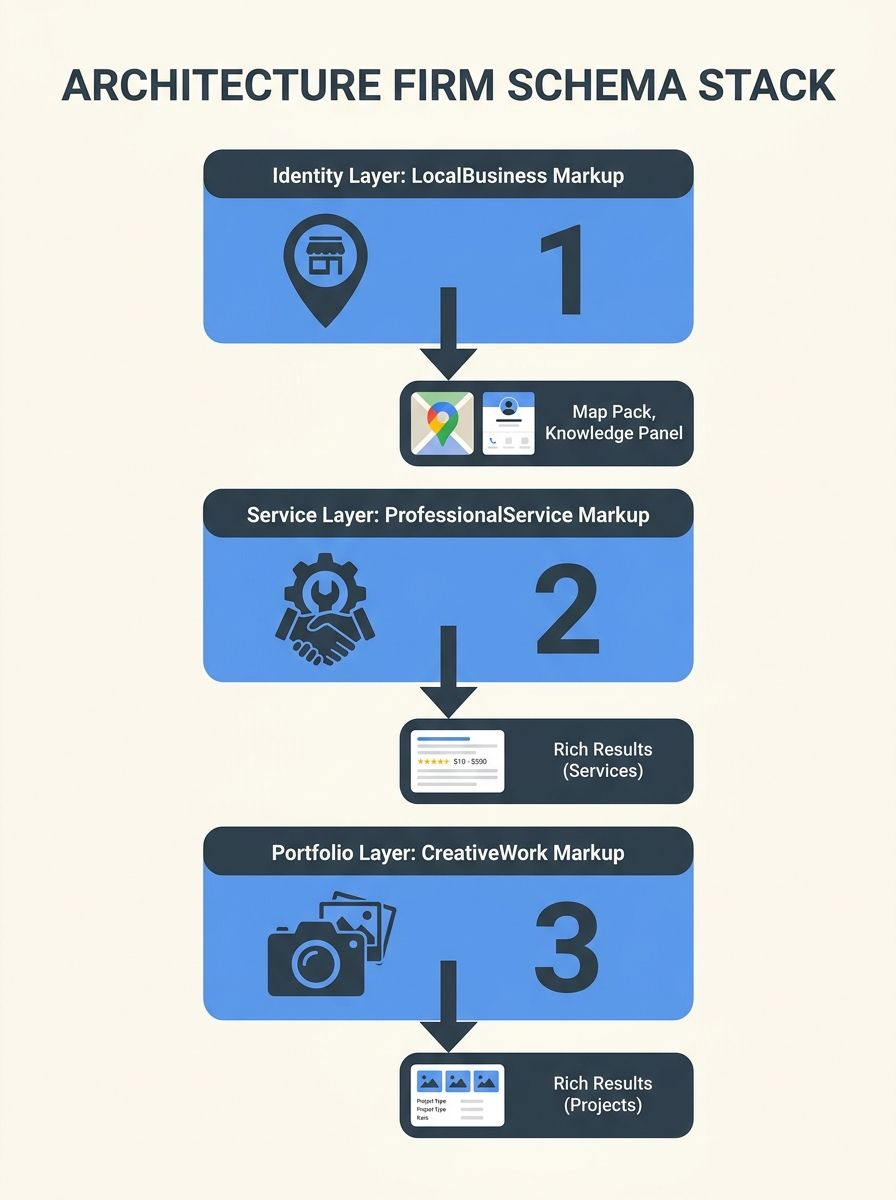
Why does this matter so much? Because portfolio structured data SEO fills a gap that good design alone can't bridge. Google's crawlers and AI systems parse code and metadata. They don't evaluate the aesthetic quality of a rendering or the spatial intelligence behind a floor plan. Without structured data explicitly declaring "this firm is located in Portland, Oregon, specializes in sustainable residential design, and completed 47 projects in the last 3 years," the search engine has to guess. And guessing means losing to competitors who provide that data in machine-readable form.
One B2B manufacturer saw organic visits jump from 800 to 12,000 monthly sessions after implementing industry-specific schema. Architecture firms sit in a strikingly similar position: high-quality work, visually rich websites, and almost no structured data to help search engines make sense of any of it.
How the Structured Data Gap Destroys Map Pack Visibility
Why do architecture firms with perfect NAP (Name, Address, Phone) consistency still get buried in local results? Brad Holmes, a technical SEO consultant, answers bluntly: "I see it all the time — local businesses with perfect NAP consistency still buried in map results because their data isn't reinforced by schema."
His argument is that structured data functions as a trust signal, not a ranking boost. It helps Google connect the dots between a firm's website, its Google Business Profile, its directory listings, and its physical location. Without that connective tissue, Google treats each signal as isolated. The firm's address on the website says one thing, the GBP listing says the same thing, but there's no structured layer confirming they describe the same entity. That ambiguity costs visibility.
For architecture firms, this problem compounds because their portfolio pages typically contain nothing but images. No structured project descriptions, no location data, no service type declarations. Google indexes these pages, finds minimal extractable content, and assigns them low relevance for local queries like "residential architect near me" or "commercial architecture firm [city name]." The pages exist in the index. They rank for almost nothing.
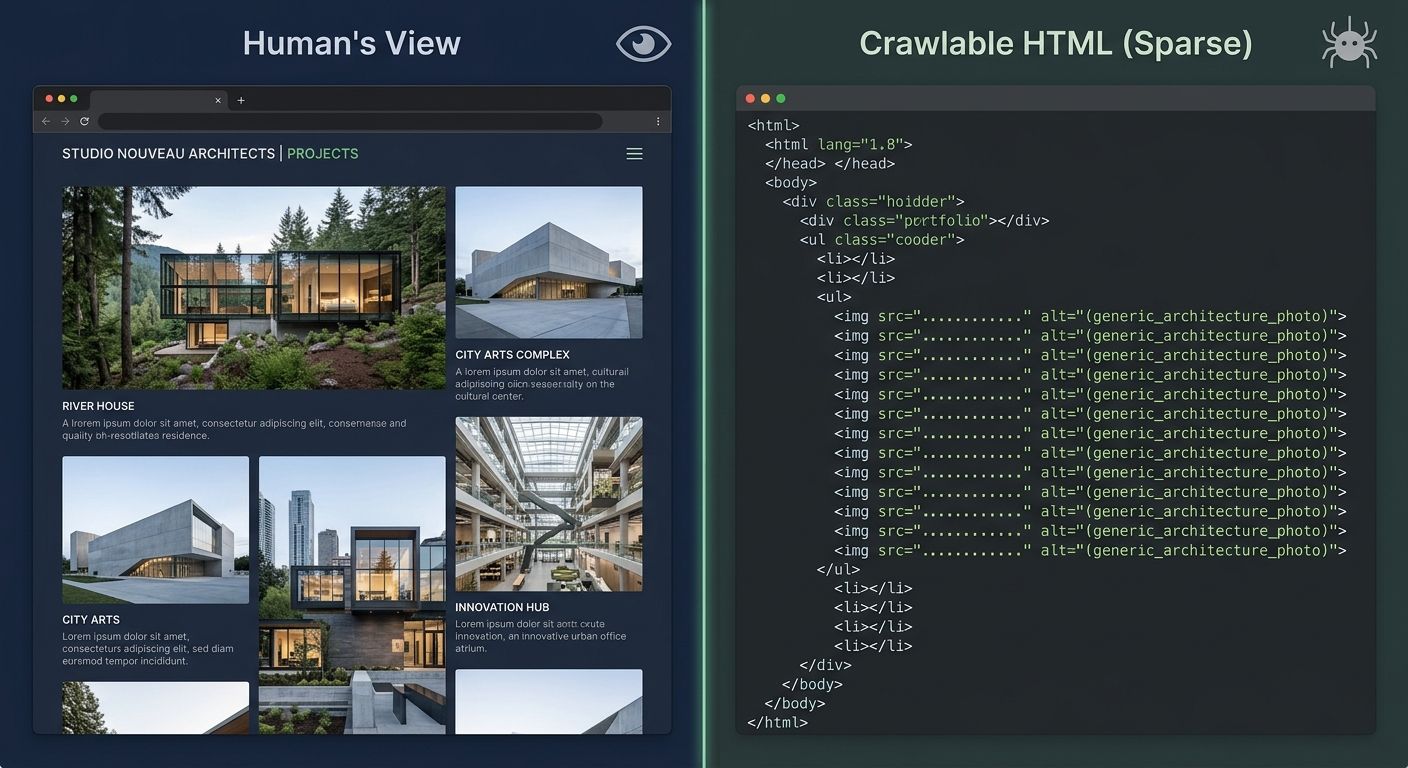
Local trust signals in the map pack depend on 3 core verification layers: GBP completeness and accuracy, citation consistency across directories, and on-site structured data that reinforces both. Firms that nail the first two layers but skip the third leave Google with an incomplete picture. And in competitive local markets where 5 or 6 firms vie for 3 map pack slots, incomplete pictures lose.
As Elsner's analysis of local SEO for architects puts it: "For most architecture firms, local SEO is the pillar with the highest return per hour of effort. Clients hire architects they can meet, and Google knows it." That's why the map pack sits above organic results for local architectural queries. Firms that don't appear there are invisible to the highest-intent searchers.
What Portfolio Pages Need to Contain (Beyond Beautiful Images)
The typical architecture firm portfolio page contains a project name, 8 to 15 images, and maybe a one-sentence description. That's the equivalent of handing Google a blank business card with a pretty logo. Compare that to what search engines can actually extract when portfolio structured data SEO is done right.
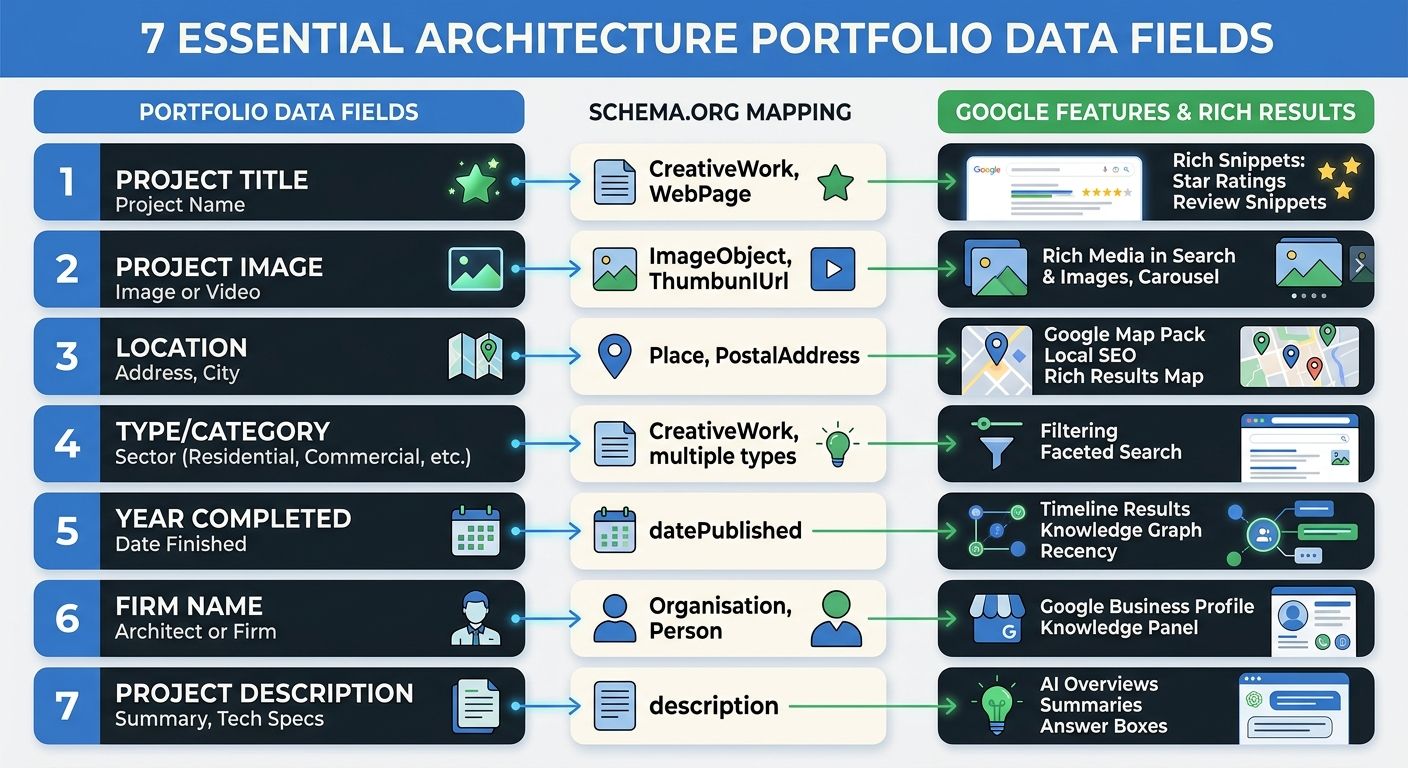
Each project page should contain machine-readable data across 7 specific fields, based on the Architect Portfolio Visibility System documented by Percepture in May 2026:
Project type (residential, commercial, institutional, mixed-use)
Location (city, neighborhood, state/region)
Client type (private homeowner, developer, municipality, nonprofit)
Design challenge (what problem the project solved)
Solution approach (design methodology and materials)
Materials used (concrete, steel, timber, glass, etc.)
Outcome metrics (square footage, budget range, timeline, awards)
Each of these fields maps to Schema.org properties. Project type and solution approach can be encoded within CreativeWork markup. Location data feeds into the geo and areaServed properties. Materials and outcomes can populate the description and abstract fields. Together, they transform a portfolio page from a visual gallery into a structured dataset that Google, ChatGPT, Perplexity, and AI Overviews can all parse and cite.
We've covered the broader portfolio optimization challenge before, and the conclusion holds: firms that invest exclusively in visual presentation and neglect textual and structural depth will continue to rank invisibly, regardless of how stunning their work is.
Schema Implementation: Choosing the Right Markup Type
Which schema type should your architecture firm actually deploy? The answer depends on your firm's size, geographic scope, and the specific pages being marked up. Here's how the options break down:
Schema Type | Best For | Key Properties | Local Pack Impact |
|---|---|---|---|
LocalBusiness | Single-office firms targeting nearby clients | address, geo, openingHours, areaServed | High — directly feeds map pack eligibility |
ProfessionalService | Multi-service firms (architecture + interior design + planning) | serviceType, areaServed, hasOfferCatalog | Medium — reinforces service relevance |
HomeAndConstructionBusiness | Residential-focused firms | Same as LocalBusiness, plus industry signal | High — Google maps this to home/construction queries |
Organization | Multi-office or international firms | Same base properties, broader scope | Low for local, useful for brand knowledge panels |
CreativeWork | Individual portfolio project pages | author, locationCreated, dateCreated, description | Indirect — feeds AI systems and rich snippets |
The approach I recommend for firms with 1 to 3 offices: deploy LocalBusiness or HomeAndConstructionBusiness on your homepage, ProfessionalService on your services pages, and CreativeWork on each individual portfolio project page. That covers all three layers of the Schema Stack and gives Google structured data at every level of your site hierarchy.
Google confirmed at I/O 2026 that structured data remains valuable for rich results. The Digital Applied analysis of the I/O announcements captured the key statement: "Schema.org structured data remains valuable for rich results even though no special markup is required for AI responses specifically." The honest interpretation is that schema signals trust and content structure to Gemini the same way it signals structure to Googlebot. The mechanism is correlation rather than direct causation, but the practical effect is real and measurable.
If your local rankings have plateaued after months of SEO work, missing schema is one of the first things to audit. I've evaluated over 200 agencies and seen countless firms stuck at positions 4 through 7 in local results for exactly this reason.
Image SEO: The Overlooked Companion to Schema
Architecture firm schema markup gets the most attention in technical discussions, but image optimization is the other half of the equation. Portfolio pages are 80% to 95% images by visual weight, and every one of those images carries metadata that Google reads (or doesn't).
The baseline requirements for portfolio image SEO:
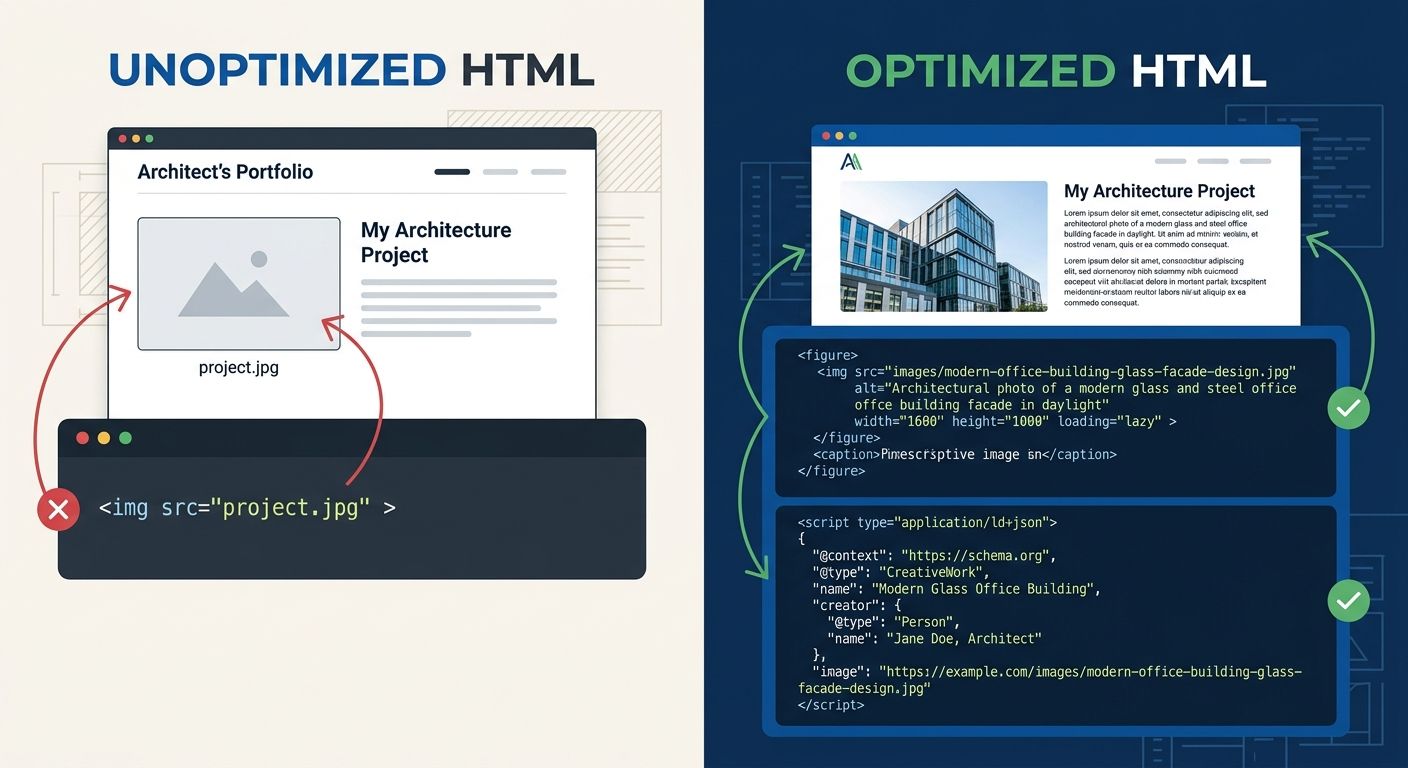
File names: Descriptive and keyword-rich. "modern-commercial-office-design-tampa.webp" gives Google 5 ranking signals. "IMG_4892.jpg" gives it zero.
Alt text: Each image needs a unique alt attribute that describes what's depicted and where. "Exterior view of a 12,000-square-foot mixed-use building in downtown Austin" is infinitely more useful than "project photo."
Format: WebP or AVIF formats load 25% to 35% faster than equivalent JPEGs, which directly affects Core Web Vitals scores and, by extension, local ranking signals.
Dimensions: Serve images at the display size. A 4000×3000 pixel photo rendered at 800×600 on screen wastes bandwidth and slows page load.
These aren't optional extras. For architecture firms, images ARE the content. If Google can't read them, the page has no content from an indexing perspective. And a page with no indexable content won't rank for anything, regardless of how much schema you add on top.
The full portfolio optimization checklist covers additional image-level tactics, but the core principle holds: every image needs to carry its own weight in metadata, because Google can't admire your design skills through a crawler.
The AI Retrieval Layer: Schema's Growing Role Beyond Traditional Search
With search traffic declining 25% year-over-year as AI Overviews absorb clicks, the structured data conversation extends well beyond traditional rankings. AI systems like Google's Gemini, ChatGPT, and Perplexity use retrieval-augmented generation (RAG) to pull information from web pages. Schema markup makes content dramatically easier for these systems to identify, extract, and cite.
A complete guide from GetPassionfruit describes this as "a systematic process that, when done correctly, dramatically increases your visibility in AI search results, rich snippets, and voice responses." The data backs this up: pages with structured data see citation rates in AI responses at levels measurably higher than equivalent unstructured pages, because the AI system can extract clean entities (firm name, location, service type, project details) instead of parsing ambiguous prose.
For architecture firms, this means the portfolio page that includes CreativeWork schema with location, project type, materials, and a clear description becomes citable by AI systems answering queries like "best sustainable architects in Denver" or "commercial architecture firms specializing in adaptive reuse." The portfolio page without that markup is invisible to the same queries, because the AI has nothing structured to grab.
What the Data Doesn't Tell Us
The structured data gap in architecture firm websites is well documented, but several questions remain open. We don't have reliable industry-wide adoption numbers. Nobody has published a study saying "X% of architecture firms use LocalBusiness schema" with a sample size large enough to trust. The claims about adoption being low come from consultants (myself included) who've audited dozens or hundreds of sites individually. That's directional evidence, not statistical proof.
We also don't know precisely how much of the map pack algorithm responds to on-site schema versus GBP signals versus review volume versus proximity. Google doesn't publish those weights, and anyone who claims exact percentages is selling you something. What we do know is that structured data reinforces other signals and fills gaps that text content alone can't address. For local search visibility, architecture firms should treat schema as connective infrastructure: it doesn't generate rankings on its own, but without it, other ranking signals work at reduced efficiency.
The AI retrieval angle adds another layer of uncertainty. Google's own statement from I/O 2026 explicitly says no special markup is required for AI responses. But the correlation between structured data and AI citation rates is consistent across multiple analyses. Whether that correlation holds as AI Overviews evolve through the rest of 2026 and into 2027 is an open question. The safe bet is to implement the markup now, because it benefits traditional search regardless of what happens with AI, and the downside risk of having clean, accurate structured data on your website is exactly zero.
Marcus Webb
Digital marketing consultant and agency review specialist. With 12 years in the SEO industry, Marcus has worked with agencies of all sizes and brings an insider perspective to agency evaluations and selection strategies.
Related Articles

Portfolio Optimization for Architecture Firms: The SEO Checklist Beyond Beautiful Images
Architecture firm portfolios rank among the most visually impressive pages on the web and among the worst-performing in organic search.

Why Architecture Firms Still Rank Invisibly After 6 Months of SEO: The Portfolio Optimization Paradox
Google processes architecture firm portfolio pages the same way it processes any image gallery without supporting text: it indexes the page, finds almost nothing to rank, and buries it behind competitors who describe their work in words search engines can parse.

The Niche-Specific SEO Audit Checklist: Beyond Generic 100-Point Frameworks for Architecture and Design Firms
Generic 100-point SEO audit frameworks consistently hand architecture and design firm websites passing scores while those same sites lose organic visibility on the pages that actually win clients: project portfolios, case studies, and studio landing pages.
Explore more topics