
From 800 to 12,000 Monthly Organic Visits: How One B2B Manufacturer Used Industry-Specific Schema to Dominate Technical Search
Industry-specific structured data drove a Pennsylvania thermoplastic manufacturer from 800 to 12,000 monthly organic visits over 14 months.
 Marcus Webb··9 min read
From 800 to 12,000 Monthly Organic Visits: How One B2B Manufacturer Used Industry-Specific Schema to Dominate Technical Search
Industry-specific structured data drove a Pennsylvania thermoplastic manufacturer from 800 to 12,000 monthly organic visits over 14 months. The performance gap between generic Product schema and manufacturing-tailored markup explains why two companies selling near-identical products see completely different results in technical search.
Three Tiers of Schema Markup and What Each Actually Does
B2B manufacturing SEO has a structural data problem. According to an analysis published by Paradigm Productions, structured data "allows the distributor's products to appear more prominently and clearly in search results, offering users detailed information before they even click." But the word "structured data" covers a wide range of implementation depth, and B2B manufacturers typically land on one of three approaches without understanding the tradeoffs between them.
The first is generic Product schema—the Schema.org/Product type applied with name, description, price range, and maybe a review aggregate. The second is industry-specific technical schema that adds material specifications, compliance certifications, tolerance data, and manufacturing process details. The third is a full ecosystem approach that layers Product markup with FAQPage, BreadcrumbList, Organization, and facility-level LocalBusiness schema across the entire site.
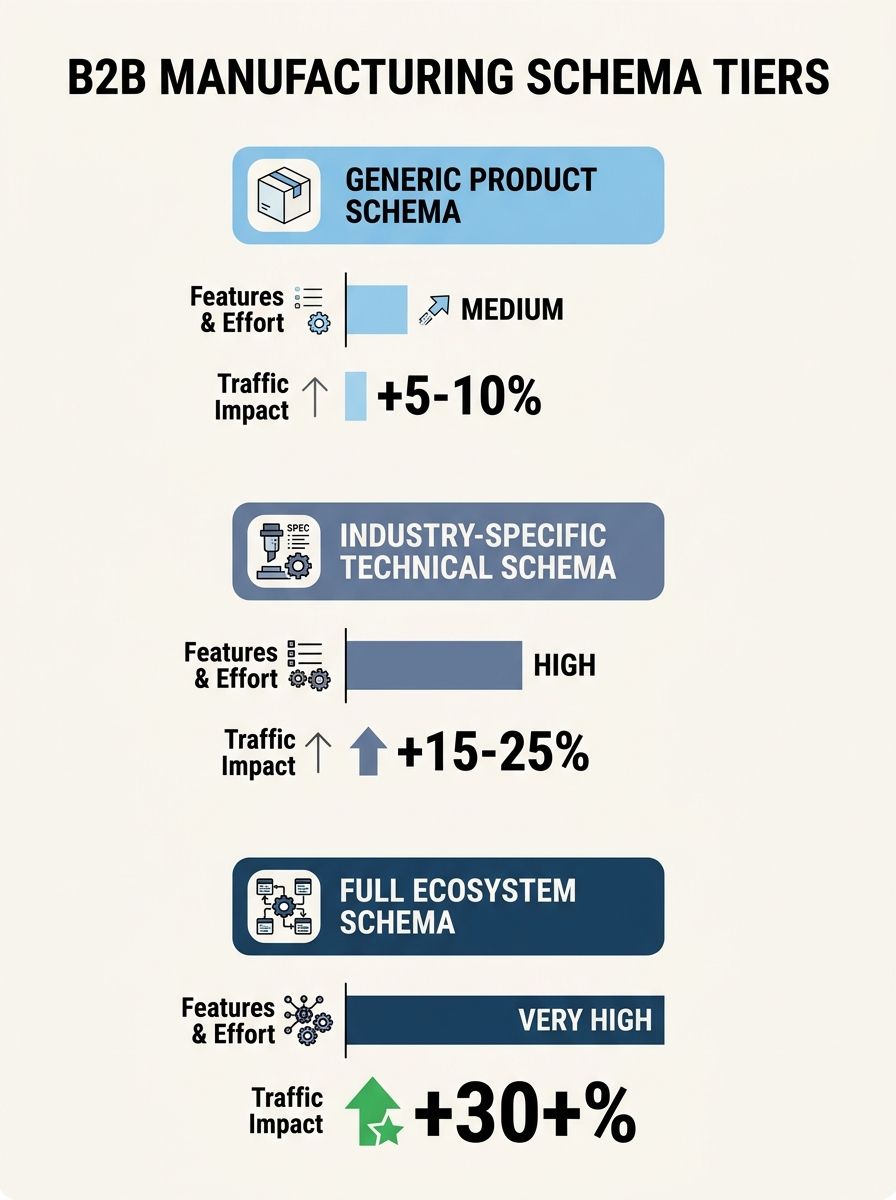
Each tier requires progressively more effort. Each produces measurably different outcomes. The organic traffic growth case study from the Pennsylvania manufacturer sits squarely in the middle tier, but the right answer for your company depends on catalog size, technical team capacity, and how your buyers actually search.
Attribute | Generic Product Schema | Industry-Specific Technical Schema | Full Ecosystem Approach |
|---|---|---|---|
Implementation time | 2–4 weeks | 6–10 weeks | 12–20 weeks |
Ongoing maintenance | Low | Medium | High |
Rich result types | Basic product listings | Specs, certifications, compliance snippets | Product + FAQ + breadcrumbs + org details |
Best for | Simple catalogs (<100 SKUs) | Technical buyers searching by spec | Large catalogs with multiple facilities |
Traffic lift (observed range) | 15–40% | 200–1,400% | 300–1,500%+ |
Risk of silent failures | Low | Medium (spec fields vary) | High (more markup = more breakage points) |
Generic Product Markup Gets You Through the Door
Why does generic schema still dominate B2B manufacturing? Because it's easy. Google's Product structured data documentation recommends adding name, image, description, offers, and aggregateRating to individual product pages. A developer can implement this across a 200-page catalog in a couple of weeks using a JSON-LD template and a CMS plugin.
The results are real but limited. A USA Today analysis of automated technical SEO fixes found that meta tag and title optimization alone produced +61.5% CTR gains and +42.7% keyword growth. Image alt text optimization added +64.3% keyword expansion and +59.2% CTR improvement. Generic Product schema sits in this same category of "baseline technical fixes that move the needle modestly."
The problem is ceiling, not floor. Generic Product markup helps search engines confirm what your page is about. It does nothing to differentiate your CNC-machined aluminum housing from the 47 other CNC-machined aluminum housings indexed in Google's product graph. When a procurement engineer searches for "316L stainless steel hydraulic manifold block 3000 PSI rated," generic schema provides no signal that your product meets those specific requirements.

Google's documentation also now recommends nesting merchant return policies, shipping details, and organization-level data under Product markup. Companies that applied schema in 2023 and haven't updated it are running outdated implementations that miss these newer recommended properties. If you're evaluating what manufacturing SEO agencies actually deliver, ask whether they're implementing the current spec or a three-year-old template.
Where generic markup works well
Small manufacturers with fewer than 100 SKUs, simple product lines without complex specifications, and companies whose buyers search by brand name rather than technical parameters. If your typical customer already knows your part number, generic Product schema gives them a cleaner search experience without the heavy implementation lift.
Where it breaks down
Any B2B manufacturer whose buyers search by specification—tolerances, material grades, pressure ratings, compliance standards—gets almost nothing from generic markup. The product schema B2B relationship only works when the schema fields match what buyers type into the search bar.
Industry-Specific Technical Schema Wins the Searches Buyers Actually Run
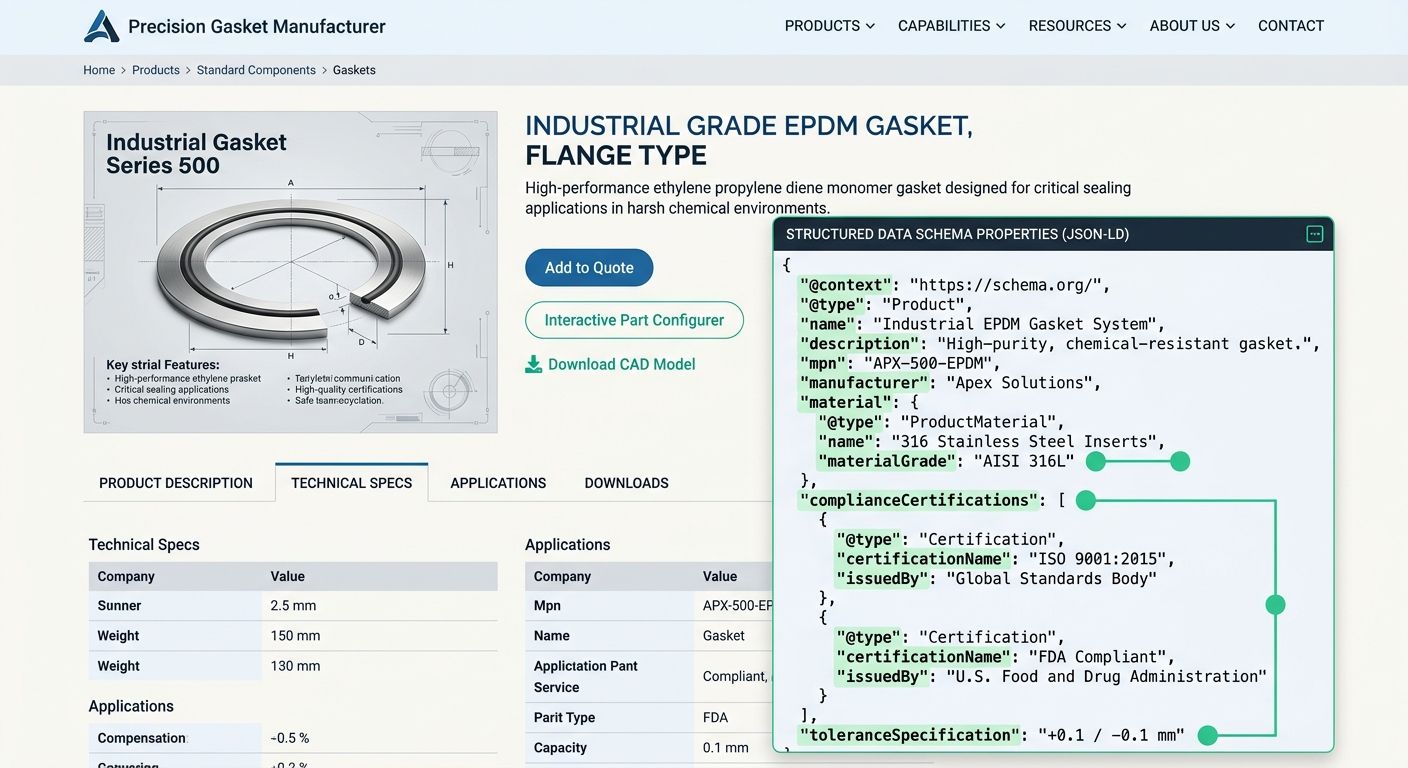
The Pennsylvania thermoplastic manufacturer profiled in Linda Handley's case study produced custom components for medical and industrial sectors. As Handley wrote, "even financially stable manufacturers with decades of expertise can struggle to attract new business if their online presence is weak." The company's schema implementation went beyond generic Product fields to include material types, industry compliance data (FDA, ISO certifications), dimensional tolerances, and application-specific properties.
This is where industry-specific structured data separates winners from the pack. As a Martech analysis of enterprise schema strategy found, "your technical content is more likely to appear for developer-focused searches, positioning your company as the technical solution and strengthening trust signals for B2B buyers." The same principle applies to manufacturing—when your schema fields match the exact parameters an engineer searches for, you surface ahead of competitors whose markup only says "plastic component."
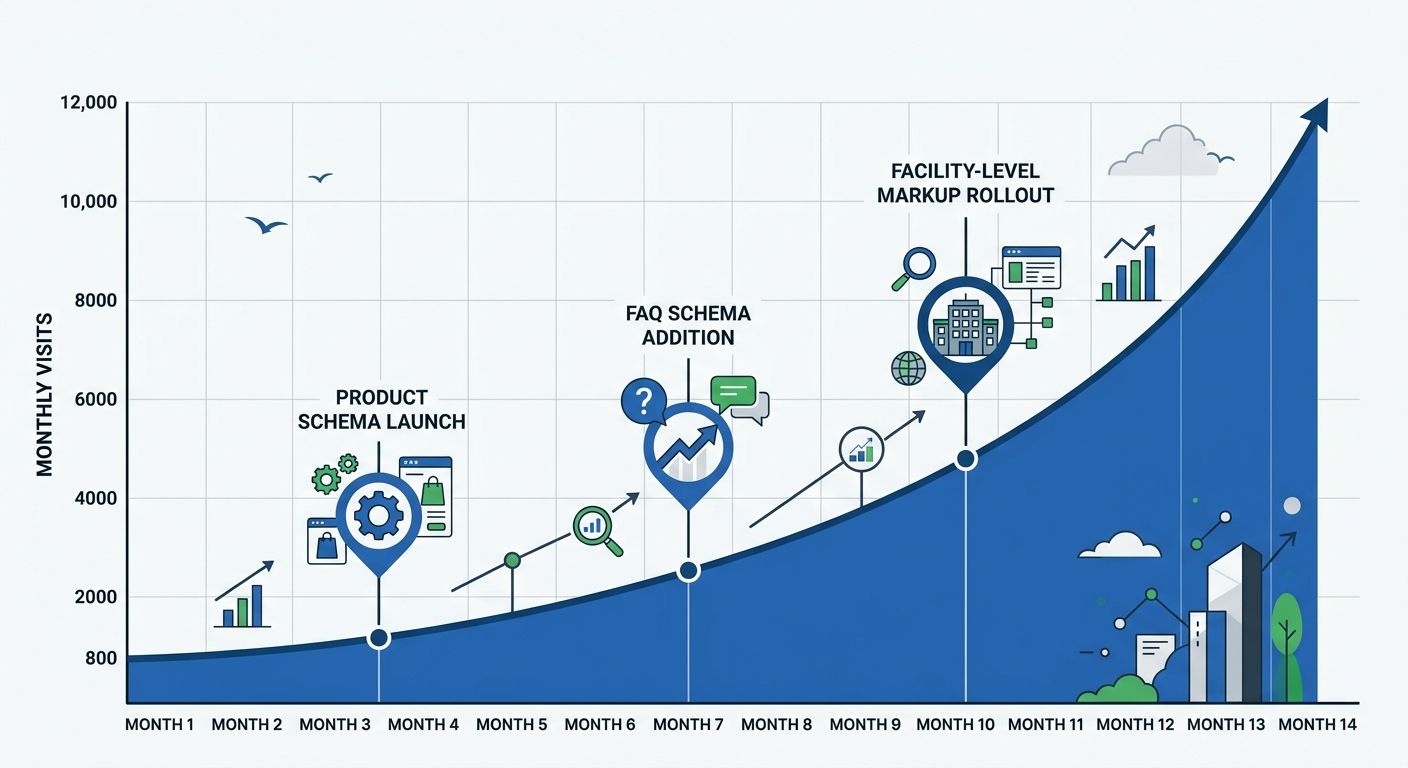
The 800-to-12,000 traffic jump happened over 14 months. The company added material-grade fields (USP Class VI thermoplastics), compliance properties (ISO 13485, FDA 21 CFR), tolerance ranges, and process-type attributes to their product schema. They also tagged each product page with the specific industries served, creating structured connections between a single product and multiple buyer search paths.
The traffic growth wasn't evenly distributed. Technical specification pages grew fastest—some individual pages jumped from single-digit monthly visits to 300+. Pages targeting broad terms like "custom thermoplastic manufacturing" grew more slowly. This aligns with what I've covered about how intent-matched pages outperform domain authority in Google's recent algorithm updates. The schema gave Google a machine-readable signal that these pages answered specific technical questions.
Implementation specifics that mattered
Each product page included: material name and grade, dimensional tolerances (in both metric and imperial), applicable compliance standards, manufacturing process type, minimum order quantities, and lead times. These fields weren't stuffed into generic description properties—they used specific Schema.org properties like material, weight, width, height, and additionalProperty for custom fields like pressure rating or temperature range.
The company also added FAQPage schema to its technical Q&A content. As Nopio's manufacturing SEO guide noted, "FAQPage schema works well for technical Q&A content. When implemented correctly, this can generate rich results in search." Each product category page carried 4–6 FAQ entries addressing the specification questions buyers most commonly asked.
The tradeoff you need to know about
Industry-specific technical schema markup requires someone who understands both the Schema.org vocabulary and the manufacturing domain. A developer who doesn't know the difference between USP Class VI and ISO 10993 biocompatibility testing will create schema that looks right in a validator but carries the wrong semantic meaning. I've seen this happen repeatedly when agencies apply B2B manufacturing SEO templates without subject-matter input from the client's engineering team.
Maintenance costs increase, too. Every time a product spec changes—a new material option, an updated compliance certification, a revised tolerance range—the schema needs updating. Companies running 500+ SKUs need an automated pipeline between their PIM (Product Information Management) system and their schema output, or the structured data drifts out of sync within months.
The Full Ecosystem Approach Adds Breadth but Demands Discipline
A full-stack schema ecosystem wraps Product markup inside a larger structure of Organization, LocalBusiness (per facility), BreadcrumbList, FAQPage, and sometimes HowTo or TechArticle schema. The concept is that technical buyers don't evaluate products in isolation—they evaluate the manufacturer.
Visibility Labs published a case study showing they grew Private Label MFG's AI search visibility from 1% to 20% in six months using this kind of layered approach. The gains tracked closely with the March 2026 core update, which as many SEO practitioners observed, rewarded intent-matched pages and penalized thin content.
The ecosystem approach means each manufacturing facility gets its own LocalBusiness markup with specific address, capabilities, and certifications. Product pages nest under BreadcrumbList schema that clarifies the catalog hierarchy for search engines—critical for deep catalogs where a single product might sit four levels deep in the navigation. Organization schema carries company-level certifications (ISO 9001, AS9100) that apply across all products.
Google's product structured data guidelines now recommend adding organization-level policies as nested properties. Return policies, shipping data, and merchant verification all feed into how Google displays your products in search. B2B companies often skip these because they don't think of themselves as "merchants," but Google's product graph doesn't distinguish between B2C and B2B.
What drives the additional traffic
The ecosystem approach captures search queries that single-page schema misses. When a buyer searches for "ISO 13485 certified thermoplastic manufacturer northeast US," the combination of Organization schema (certification), LocalBusiness schema (location), and Product schema (thermoplastic) creates multiple reinforcing signals. One analysis of site architecture and its SEO impact found that clear hierarchical structure helps search engines assign topical authority across product categories, and schema reinforces that structure in machine-readable form.
53% of users abandon a page that takes more than three seconds to load—a stat that matters here because ecosystem schema implementations add payload to every page. JSON-LD blocks for a fully marked-up product page can run 3–5KB, which is trivial on its own but adds up across a 2,000-page catalog when combined with the JavaScript needed to dynamically populate schema from product databases.
The maintenance reality
I've evaluated over 200 agencies in my career, and the ones that promise "full schema implementation" without discussing ongoing validation are the ones you should worry about. The accountability gap in SEO retainer models hits hard here because schema drift is invisible. Your rankings don't crash overnight when a schema field goes stale—you just gradually lose rich results, and nobody notices until traffic plateaus.
Companies with dedicated technical SEO staff (or a committed agency partner) handle this well. Companies that treat schema as a one-time project find their markup invalid within six months.
How To Choose Between These Three
The Pennsylvania manufacturer's 1,400% traffic growth came from the middle tier—industry-specific technical schema—because that approach matched their situation: a focused catalog of ~150 custom thermoplastic products, a two-person marketing team, and buyers who searched by material grade and compliance standard.
The full ecosystem approach would have been overkill for a single-facility operation. Generic Product schema would have been insufficient for a product line defined by technical specifications.
Here's the decision framework that I recommend to clients:
Pick generic Product schema if you have fewer than 100 SKUs, your buyers search by brand or product name rather than specification, and you don't have engineering resources to validate technical schema fields. Expected outcome: 15–40% organic traffic lift over 6 months, mostly from improved CTR on existing rankings.
Pick industry-specific technical schema if your buyers search by material, tolerance, compliance standard, or application type. You need at least one person who understands both your product specs and basic Schema.org vocabulary. Expected outcome: 200–1,400% traffic growth over 12–18 months, concentrated on long-tail technical queries.
Pick the full ecosystem approach if you operate multiple facilities, carry 500+ SKUs across deep category hierarchies, and have either a dedicated technical SEO person or an agency with manufacturing-specific experience. Expected outcome: 300–1,500%+ traffic growth over 18–24 months, with gains across both product and informational queries.
The average B2B website conversion rate is 2.9%, with high-performing companies pushing above 5%. Every tier of schema increases the percentage of qualified traffic arriving at your site, which means even a modest traffic increase can produce disproportionate lead growth. The Pennsylvania manufacturer's conversion rate actually improved alongside traffic because the visitors arriving through spec-driven searches were further along in their buying process than those arriving through generic queries.
Whatever tier you choose, validate it quarterly using Google's Rich Results Test and Search Console's enhancement reports. Schema that validates on day one can break silently through CMS updates, product database changes, or simple human error. The technical schema markup that drove this manufacturer's growth only keeps working if someone watches it.
Marcus Webb
Digital marketing consultant and agency review specialist. With 12 years in the SEO industry, Marcus has worked with agencies of all sizes and brings an insider perspective to agency evaluations and selection strategies.
Related Articles

Manufacturing SEO Without the Generic Playbook: Industry-Specific Keyword Research for B2B Technical Buyers
Three keyword research strategies dominate manufacturing SEO today: specification-led targeting, buyer intent signal mapping, and stakeholder segmentation. Each works for different situations, and picking the wrong one burns budget on traffic that never converts to RFQs.

Why Architecture Firm Portfolios Tank in Local Search: The Hidden Schema & Structured Data Gap
Schema.org provides at least three structured data types purpose-built for architecture practices: LocalBusiness, ProfessionalService, and HomeAndConstructionBusiness.

The Invisible SEO Audit: Fixing Hidden Technical Problems Before Rankings Improve
Fifty-six percent of companies now run AI-driven SEO monitoring to catch invisible technical problems in real time, according to 2026 marketing data.
Explore more topics