
Search Engine Journal Updates Multi-Location SEO Framework for AI-Powered Search Era
Search Engine Journal published a revised multi-location SEO framework on June 9 that repositions Google's local ranking factors as entity-matching mechanisms rather than directory lookups, according to the guide authored by the publication's technical SEO team. The framework addresses how businesse
 Marcus Webb··4 min read
Search Engine Journal Updates Multi-Location SEO Framework for AI-Powered Search Era
Search Engine Journal published a revised multi-location SEO framework on June 9 that repositions Google's local ranking factors as entity-matching mechanisms rather than directory lookups, according to the guide authored by the publication's technical SEO team. The framework addresses how businesses with 10 or more physical locations should structure Google Business Profiles, local landing pages, and backlink strategies under AI-powered search conditions where traditional local pack visibility metrics no longer capture complete performance.
Google's Entity-Matching Framework Replaces Directory Logic
The guide documents Google's shift from keyword-based directory matching to what Search Engine Journal characterizes as "a sophisticated entity matching engine" that evaluates individual storefronts independently while analyzing the broader brand ecosystem, according to the publication. Google now determines local relevance by analyzing data across an entire location footprint rather than treating each storefront as an isolated listing.
Search Engine Journal identifies three evolved ranking factors: relevance as conceptual matching and entity clustering, distance based on real-time user location or query modifiers, and prominence evaluated individually per storefront even for national brands. The guide states that "relevance is no longer just about matching keywords on the page, but about how accurately a specific storefront matches the intent of a search query."
Bulk Verification Threshold Set at 10 Locations
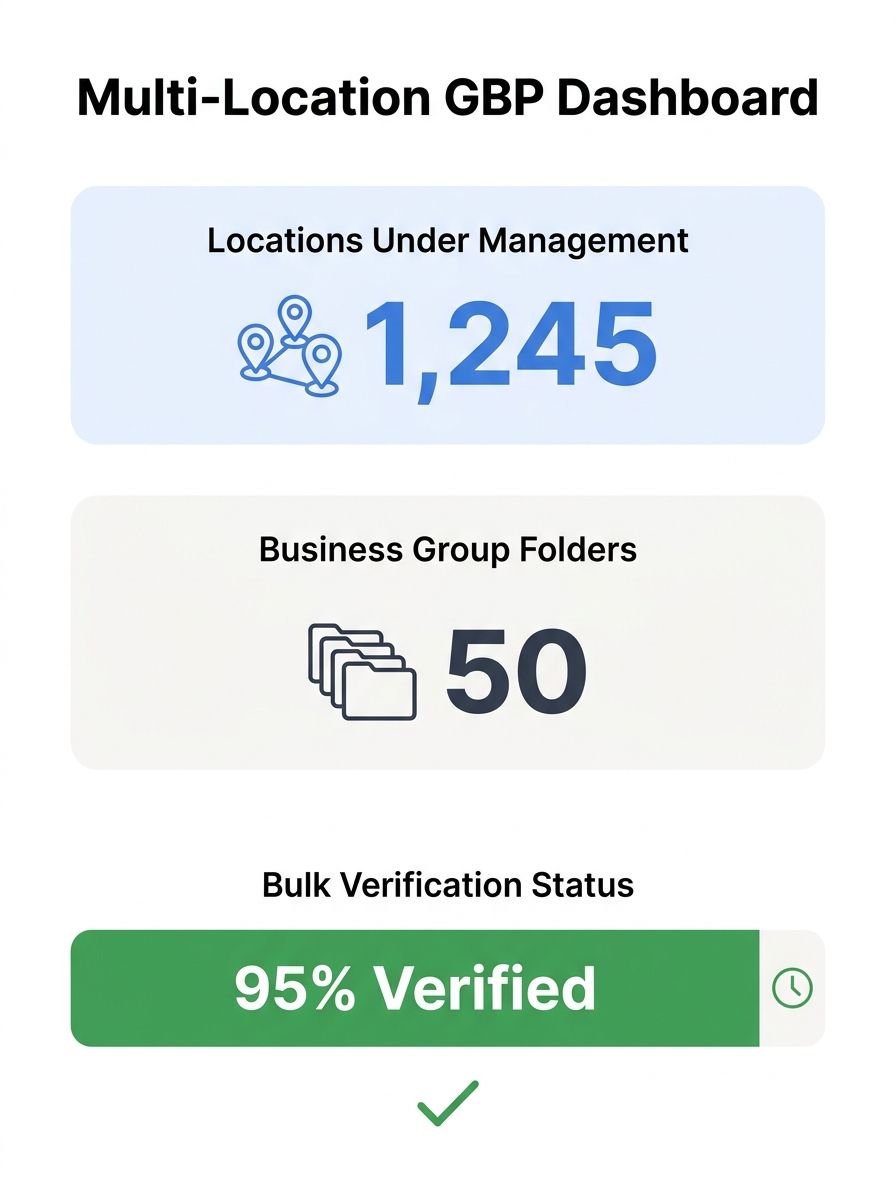
Businesses operating 10 or more locations under the same name can submit a single master spreadsheet with unique store codes for bulk verification, according to the guide's technical specifications. Google approves the main business account through this process, which Search Engine Journal positions as mandatory infrastructure for moving away from individual location management.
The framework details three access-level tiers for corporate GBP setups: owners with full control including deletion rights and integration changes, managers who can edit hours and descriptions across regions, and site managers restricted to location-specific updates. Search Engine Journal specifies that business groups function as folders grouping regions or sub-brands, enabling teams to update information and sync data across specific shop clusters.
The guide explicitly warns against programmatically creating "lots of doorway pages," recommending instead "localized entity pages that add value to users who would land on them." Each Google Business Profile listing should connect to dedicated local landing pages featuring unique, localized content, schema markup, and regional context.
Prominence Signals Measured at Storefront Level
Google evaluates prominence individually per storefront rather than applying national brand authority uniformly, according to Search Engine Journal's framework. The guide lists four prominence determinants: review velocity and freshness with active owner responses, hyperlocal backlinks from regional news sources and neighborhood blogs, consistent NAP data across directories and mapping apps, and offline foot traffic patterns Google uses to validate community presence.
The publication notes that home services SEO agencies and real estate SEO companies managing multi-location clients face distinct challenges under the entity-matching model, as each property or service area requires independent authority signals. Hospitality SEO agencies working with hotel chains encounter similar storefront-level prominence requirements that national brand metrics cannot satisfy.
Distance remains "an underlying and unyielding factor that businesses cannot optimize for," the guide states, with Google prioritizing either the user's real-time location or explicit location modifiers in queries. Search Engine Journal provides two query examples: "emergency dentists" prioritizes real-time user location, while "emergency dentists Grimsby" prioritizes the location modifier regardless of where the searcher physically stands.
AI Overview Integration Reshapes Local Pack Strategy
Search Engine Journal positions AI Overviews as increasingly appearing for local queries, stating that "the way users are interacting with, identifying, and finding local businesses and services has evolved." The guide frames the recommendations as "an evolution of the local SEO playbook and not a revolution of your entire local SEO strategy," acknowledging that location pages, reviews, and service area business models remain foundational.
The publication references Google's 2016 Possum update, which introduced address-based filtering that made virtual offices and shared-address listings riskier for local pack visibility, as the last major structural shift in local ranking mechanics before the current AI-powered evaluation systems. Search Engine Journal notes that multi-location SEO approaches "have changed substantially since 2020."
Businesses with local SEO rankings that plateau after initial gains may encounter the entity-clustering requirements the guide outlines, particularly around category alignment and service-level definition accuracy across locations. The framework's emphasis on conceptual matching over keyword matching parallels broader Google core update patterns prioritizing intent-matched pages documented in May 2026 algorithm shifts.
Services Implications
Marketing managers evaluating multi-location SEO proposals should verify whether prospective agencies structure campaigns around entity-matching principles or still operate on directory-listing logic from the pre-2020 era. The 10-location bulk verification threshold Search Engine Journal documents provides a clear technical litmus test: agencies managing enterprise local SEO should demonstrate GBP corporate account architecture with business groups and tiered access controls as baseline infrastructure, not premium add-ons.
The guide's warning against programmatic doorway pages creates accountability pressure for agencies selling automated location-page generation services to franchise clients or service-area businesses. Request sample local landing pages and confirm each contains unique regional context and schema markup that serves user intent rather than simply populating city-name templates with identical service descriptions.
Prominence signals measured at individual storefront level require agencies to source hyperlocal backlinks and cultivate location-specific review velocity rather than relying on national-level domain authority to lift all locations uniformly. CMOs should audit whether existing retainers allocate per-location outreach and review management resources proportional to the number of physical storefronts under management, as Search Engine Journal's framework suggests national brand strength no longer transfers automatically to each local entity.
Marcus Webb
Digital marketing consultant and agency review specialist. With 12 years in the SEO industry, Marcus has worked with agencies of all sizes and brings an insider perspective to agency evaluations and selection strategies.
Related Articles

Small Local Businesses Hold Structural Search Advantage Over National Chains Through Proximity Signals
Proximity-based ranking factors give single-location businesses a structural advantage over national chains in local search results, allowing firms with complete Google Business Profile listings and recent reviews to outrank 900-branch competitors in map pack placements, according to an analysis pub
Search Engine Journal Publishes Five-Factor AI Visibility Framework for Local Business Discovery Across ChatGPT and Google AI Overviews
Search Engine Journal published a five-factor optimization framework September 9 targeting local business visibility in ChatGPT and Google AI Overviews, addressing a discovery channel that now reaches 2.

Multi-Local Market SEO Framework Shows 50% Traffic Gains in Retail Case Study, ACAI Analysis Reports
ACAI published a multi-local market SEO framework June 13 documenting how localized content strategies delivered a 50% increase in local traffic and 30% conversion rate improvement for a global retail brand, according to analysis posted on the platform. A separate tech startup case study showed 40%
Explore more topics