
Why Your Local SEO Rankings Plateau After Six Months — and the Five Audit Fixes That Break the Ceiling
The local SEO plateau is a signal exhaustion problem. Agencies front-load Google Business Profile optimization, citation building, and on-page local keywords in months one through three, then stop feeding Google's local algorithm fresh inputs.
 Marcus Webb··9 min read
Why Your Local SEO Rankings Plateau After Six Months — and the Five Audit Fixes That Break the Ceiling
The local SEO plateau is a signal exhaustion problem. Agencies front-load Google Business Profile optimization, citation building, and on-page local keywords in months one through three, then stop feeding Google's local algorithm fresh inputs. Rankings flatten because the signal supply flatlined first.
How Google's Local Algorithm Runs Out of New Inputs
Why does the plateau consistently appear around the 6-month mark? Because that's roughly the half-life of the initial optimization batch. According to BrightLocal's local ranking research, at least 8 signal categories drive map pack positions: GBP signals, review signals, on-page signals, link signals, citation signals, behavioral signals, personalization, and social signals. The typical local SEO launch heavily invests in GBP signals and citations during month 1, adds some on-page content in months 2-3, and then shifts the team's attention to the next client onboarding.
The analysis from upGrowth Digital describes the downstream effect: "Traffic flatlines. The team panics. They commission more content. The plateau holds. Six months later they conclude 'SEO does not work in our category' and shift budget to paid," according to upGrowth's 2026 plateau analysis. That pattern played out across dozens of their client teams over an 18-month observation period.
For white-label providers managing 15, 30, or 50+ local clients simultaneously, the economics of this failure mode are brutal. Your partner agency sees the initial ranking gains, renews the contract, and then watches the dashboard go sideways for 4 months until they cancel. The local search audit that would have prevented churn never happened because nobody scheduled it.
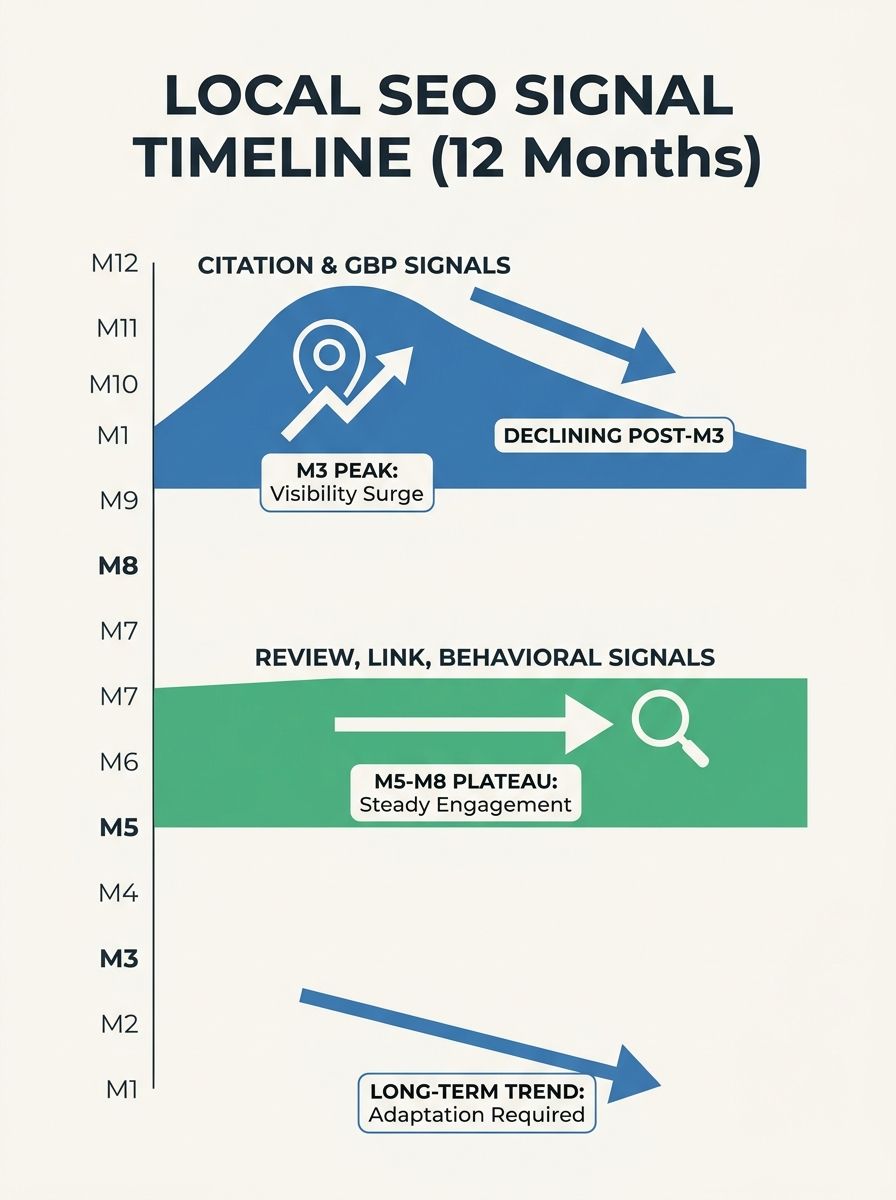
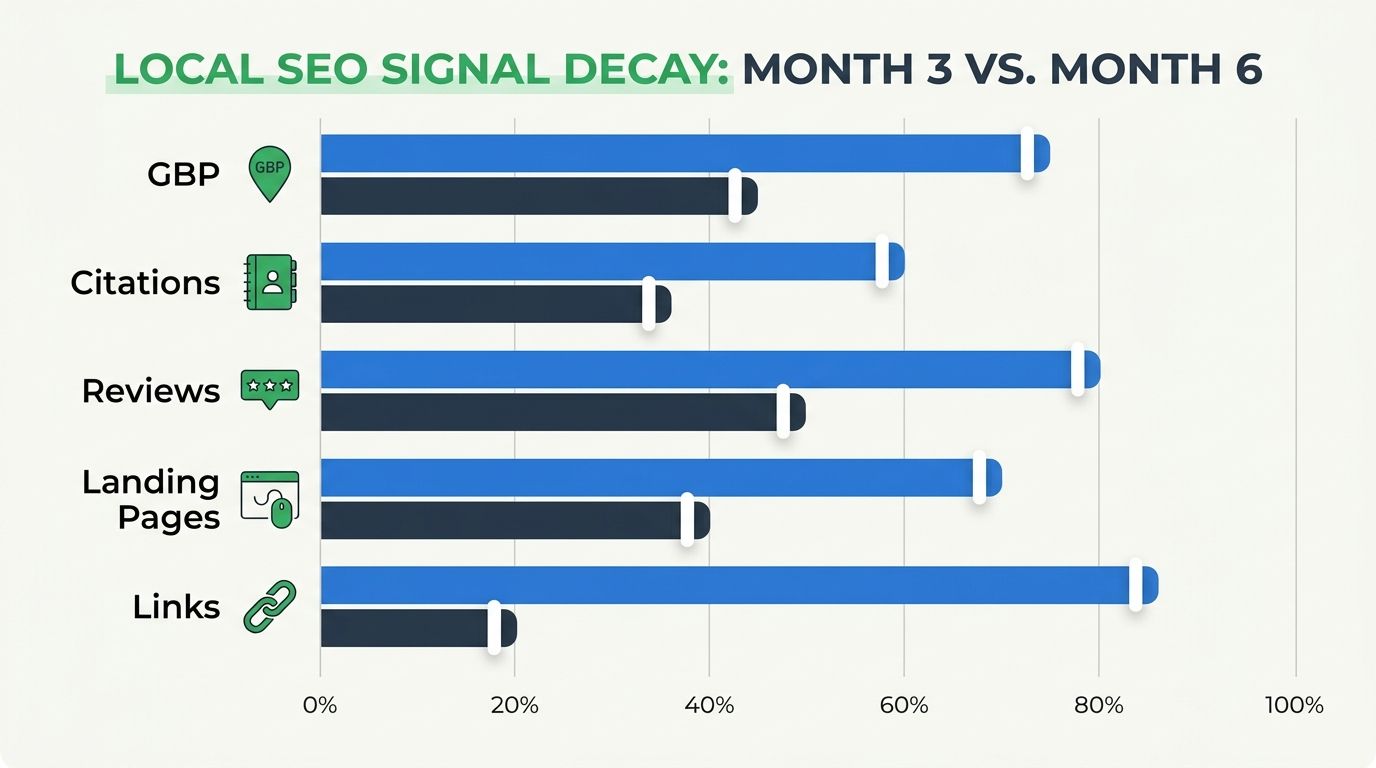
The mechanism underneath is straightforward. Google's local algorithm evaluates freshness, velocity, consistency, and breadth of signals on a rolling basis. A one-time optimization sends a burst of positive signals that gradually becomes stale data. Competitors who keep feeding the algorithm — even slowly — overtake the stalled listing. The 5 audit fixes below target the specific signal categories that decay fastest and create the most measurable ceiling on map pack ranking factors.
GBP Category and Attribute Misalignment
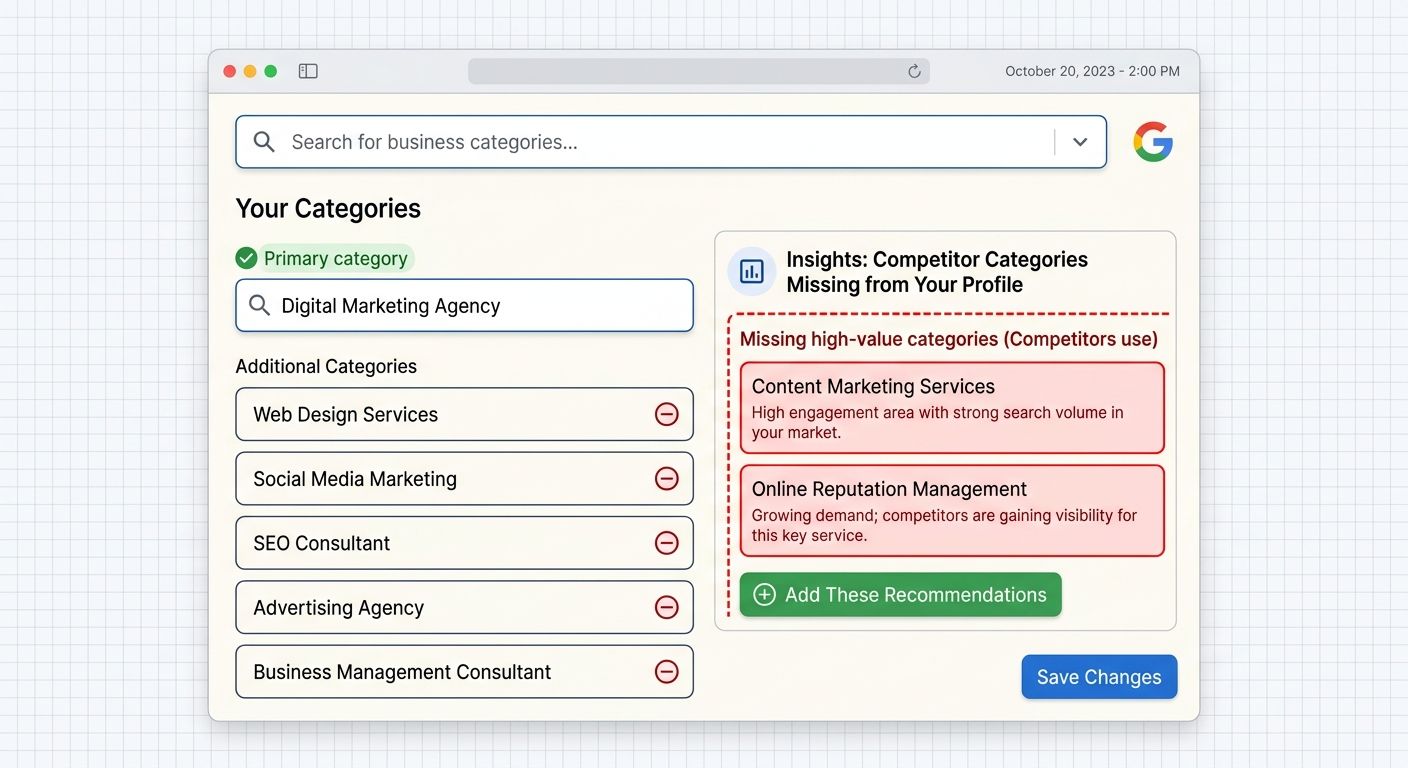
The single most common error in a Google Business Profile audit is wrong or incomplete category selection. ReplyOnTheFly's 2026 GBP checklist identifies the top problems as "wrong business categories, missing profile fields, inconsistent contact information, and neglected reviews." A 15-minute audit catches most of these, yet white-label teams rarely revisit categories after the initial setup.
Google allows 1 primary category and up to 9 additional categories per listing. Most businesses launch with 2-3 categories chosen quickly during onboarding. Six months later, the competitive landscape has shifted. A personal injury attorney who listed "Personal Injury Attorney" as their primary category and skipped "Car Accident Lawyer" is invisible for an entire cluster of high-intent queries. ALM Corp's GBP audit checklist documents 27 specific fixes across categories, reviews, landing pages, duplicates, and citations that affect local rankings in Google Maps.
The attribute fields matter almost as much. Google surfaces attributes like "wheelchair accessible," "women-led," "LGBTQ+ friendly," and "free Wi-Fi" in local results and filters. Empty attribute fields are missed ranking and visibility opportunities. In a white-label context, this means building category and attribute reviews into your 90-day and 180-day audit cycles — not treating the initial GBP setup as the final version.
For agencies exploring how GBP optimization delivers the highest ROI for small businesses, category accuracy is where the conversation starts.
NAP Entity Drift Across Your Citation Network
The second fix addresses local citation authority — specifically, the slow corruption of NAP (Name, Address, Phone) data across dozens or hundreds of directory listings. A contributor on Reddit's r/localseo community describes the problem precisely: "Most local rankings drop because Google sees small mismatches between the GMB listing, website schema, and external citations."
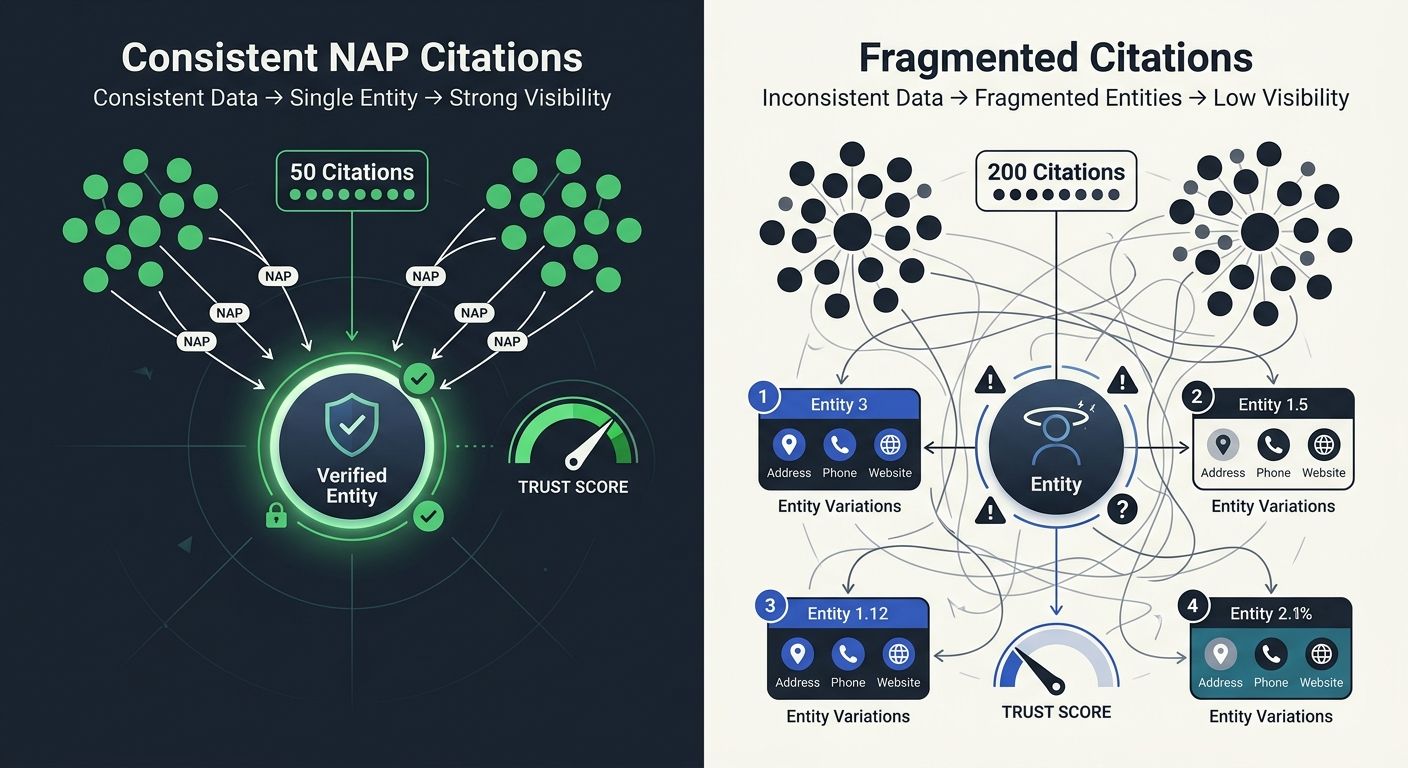
The drift happens quietly. A business moves suites from 104 to 210. Someone updates the website and GBP but forgets Yelp, Yellow Pages, Healthgrades, and 40 other directories. A data aggregator still distributes the old phone number. Six months after launch, a white-label team has 35 citations with 3 different phone number formats, 2 address variations, and an outdated suite number on 8 platforms.
According to CitationsCheck's analysis of map pack ranking factors, "the more often your NAP is repeated on authoritative sites, the stronger your local authority appears to Google." But inconsistent repetition is worse than no repetition. Google's local algorithm uses entity reconciliation — it tries to confirm that all mentions of a business resolve to a single verified entity. Conflicting data degrades that confidence score.
The audit fix: export every known citation, compare each field against the canonical GBP listing, and flag discrepancies. For white-label operations running 30+ clients, this means either a dedicated citation monitoring tool or a quarterly manual sweep. The investment is low relative to the impact. A clean citation network with 50 consistent listings outperforms a messy one with 200 conflicting entries.
The Review Velocity Cliff
Review signals carry significant weight in Google's local ranking system. The Local SEO Guide's citation research identifies reviews alongside citations and link signals as primary contributors to the prominence factor that drives map pack visibility. But the pattern white-label teams see over and over is a review spike during launch (when the client is excited and actively requesting reviews) followed by a slow decline to near-zero new reviews per month.
The mechanism matters here. Google evaluates review recency, review velocity (the rate of new reviews over time), and review diversity (how many platforms carry reviews). A business that accumulated 45 reviews in months 1-3 and then added 2 reviews in months 4-6 shows decelerating social proof. A competitor adding 4-6 reviews per month with consistent pacing looks healthier to the algorithm, even with a lower total count.
The SEO Works describes the broader version of this decay: "If brand mentions and link activity slow down, then over time, rankings begin to stall," according to their flatlining traffic analysis. Reviews are the most visible form of brand mention in local search, and their decline creates a compounding drag on rankings.
The audit fix is structural. White-label teams need to build review generation into the ongoing monthly deliverable, not the launch phase. That means email or SMS review request sequences triggered by service completion, review response templates for the client or their staff, and monthly reporting on review velocity — not total review count. We've written before about why steady weekly review cadences beat one-time campaign spikes, and the data holds up across every vertical I've audited.
Stale Landing Pages and Missing Location Signals
On-page local signals decay differently from GBP and citation signals. They don't become inaccurate — they become irrelevant. A location page built during the launch phase with 800 words of area-specific content, a Google Map embed, and local schema markup sends strong signals in month 1. By month 6, that same page hasn't been updated, Google has crawled it 15-20 times without finding new content, and competitors have published fresher location-specific pages with more recent references.
Search Engine Land's GBP audit guide emphasizes a factor that many agencies overlook: "If you're not physically located within a city's borders, and your map pin sits anywhere outside the Google-defined border of your city, you will struggle to rank for explicit terms." This physical location constraint means location pages need to work harder with on-page signals to compensate. Outdated pages can't do that work.
The audit fix has 3 components. First, update location pages with current local references — recent community events, neighborhood developments, seasonal service offerings — at minimum every 90 days. Second, verify that local business schema markup matches the GBP listing exactly (schema drift is a silent killer that compounds the NAP issues from Fix 2). Third, run a geo-grid scan to identify the actual ranking radius for each target keyword.
Dream Warrior Group's GBP audit guide recommends exactly this approach: "Run a geo-grid scan to understand where your actual ranking radius ends and where the gaps are. Use GBP Insights to track what is working and what is not," according to their audit methodology. For white-label teams, geo-grid data is one of the most powerful reporting tools available — it shows the partner agency precisely where their client ranks across a geographic area, not just for a single centroid point.
If you're running technical SEO audits as part of your agency's service delivery, adding a local landing page freshness check to the audit template takes 10 minutes per client and catches decay before it compounds.
When Link and Mention Signals Go Dark
The fifth signal category that creates a local SEO plateau is external links and unstructured brand mentions. These are the hardest signals for white-label teams to generate at scale because they require genuine outreach, PR activity, or community involvement that goes beyond template-based optimization.
A local business that earned 12 backlinks from community organizations, local news sites, and industry directories during the launch phase has a fixed link profile by month 4. No new links means no new authority signals. Google's link evaluation for local search considers link velocity alongside total link count. A profile that stops growing signals a business that stopped being relevant to its local ecosystem.
According to Good At Marketing's analysis of local SEO stalls, the trajectory is unmistakable: "You climbed into the top five for 'plumber near me,' your phone rang, and for six glorious months you felt like you'd figured out the internet. Then, quietly, the calls slowed." The link and mention signal category is usually the last to plateau and the hardest to restart, which is why it gets overlooked in favor of easier GBP tweaks.
The audit fix: catalog all linking domains pointing to the client's site and their local landing pages. Identify which links were acquired during the initial push and whether any have been lost (link rot runs at roughly 6-10% per year for small business sites). Then build a quarterly local link acquisition target — even 2-3 new locally relevant links per quarter maintains signal velocity. Sponsoring a local 5K race, contributing a guest column to a neighborhood blog, or joining the chamber of commerce directory all generate the kind of locally relevant links that Google weights heavily in map pack calculations.
For agencies that want to vet link quality before committing resources, we've broken down how to audit an agency's link building approach in a separate piece.
Where This Audit Framework Falls Short
The 5-fix audit model works when the local SEO plateau is caused by signal decay — which accounts for the majority of cases I've evaluated across 200+ agency relationships. But the model can't fix 3 structural problems.
First, physical location constraints. If a client's business sits outside the Google-defined city boundary for their target keywords, no amount of signal optimization will overcome the geographic penalty. Search Engine Land's data confirms that physical location relative to city borders is a hard ranking factor for explicit local terms. The honest answer is sometimes "you need a second location" or "target the suburb name instead."
Second, category saturation. In markets where 40+ competitors have well-optimized GBP profiles, strong citation networks, and active review generation, the ceiling may be determined by factors beyond any single business's control — population density, click-through rate patterns, and Google's decision about how many map pack slots to show. Running the 5-fix audit in a saturated market produces smaller gains than in an undersaturated one.
Third, algorithm changes. Google adjusts its local ranking signals regularly. The relative weight of GBP signals versus citation signals versus review signals shifts over time — BrightLocal's research tracks these changes annually and notes that "improving your local SEO is not a one-time action." An audit framework designed around today's signal weights needs recalibration when Google changes the formula.
For white-label providers, the practical implication is that building transparent reporting dashboards with geo-grid data, review velocity metrics, citation consistency scores, and link acquisition rates gives your partner agencies the evidence they need to keep clients engaged through the plateau period. The 5 fixes break the ceiling when the ceiling is signal decay. When it's structural, the best service you can provide is honest diagnosis and realistic expectation-setting — two things that separate durable agency relationships from 6-month churn cycles.
Marcus Webb
Digital marketing consultant and agency review specialist. With 12 years in the SEO industry, Marcus has worked with agencies of all sizes and brings an insider perspective to agency evaluations and selection strategies.
Related Articles

Review Velocity Over Volume: Why Steady Weekly Review Cadences Beat One-Time Campaign Spikes for SEO
Review velocity—the steady rate at which new Google reviews appear on a business profile—outperforms total review count as a local search ranking signal once a business passes roughly 50 reviews.

The Local SEO Setup Audit: Why Incomplete Google Business Profiles Cost Small Businesses Thousands in Lost Visibility
Roughly 86% of impressions on Google Business Profiles come from unbranded discovery searches — "plumber near me," "emergency dentist open Sunday" — according to Birdeye's 2026 analysis of local search behavior.

Beyond Rankings: How Google Reviews Drive Hidden SEO Value Your Agency Isn't Auditing
Straight North's analysis of Google's hidden ranking signals surfaced a conclusion that should make every white-label SEO provider uncomfortable: the reason most agencies ignore reviews in their audits is the same reason Google trusts them. Reviews are hard to game.
Explore more topics