
Review Velocity Over Volume: Why Steady Weekly Review Cadences Beat One-Time Campaign Spikes for SEO
Review velocity—the steady rate at which new Google reviews appear on a business profile—outperforms total review count as a local search ranking signal once a business passes roughly 50 reviews.
 Marcus Webb··9 min read
Review Velocity Over Volume: Why Steady Weekly Review Cadences Beat One-Time Campaign Spikes for SEO
Review velocity—the steady rate at which new Google reviews appear on a business profile—outperforms total review count as a local search ranking signal once a business passes roughly 50 reviews. Businesses collecting 3–5 fresh reviews per month consistently outrank competitors sitting on hundreds of aging ones.
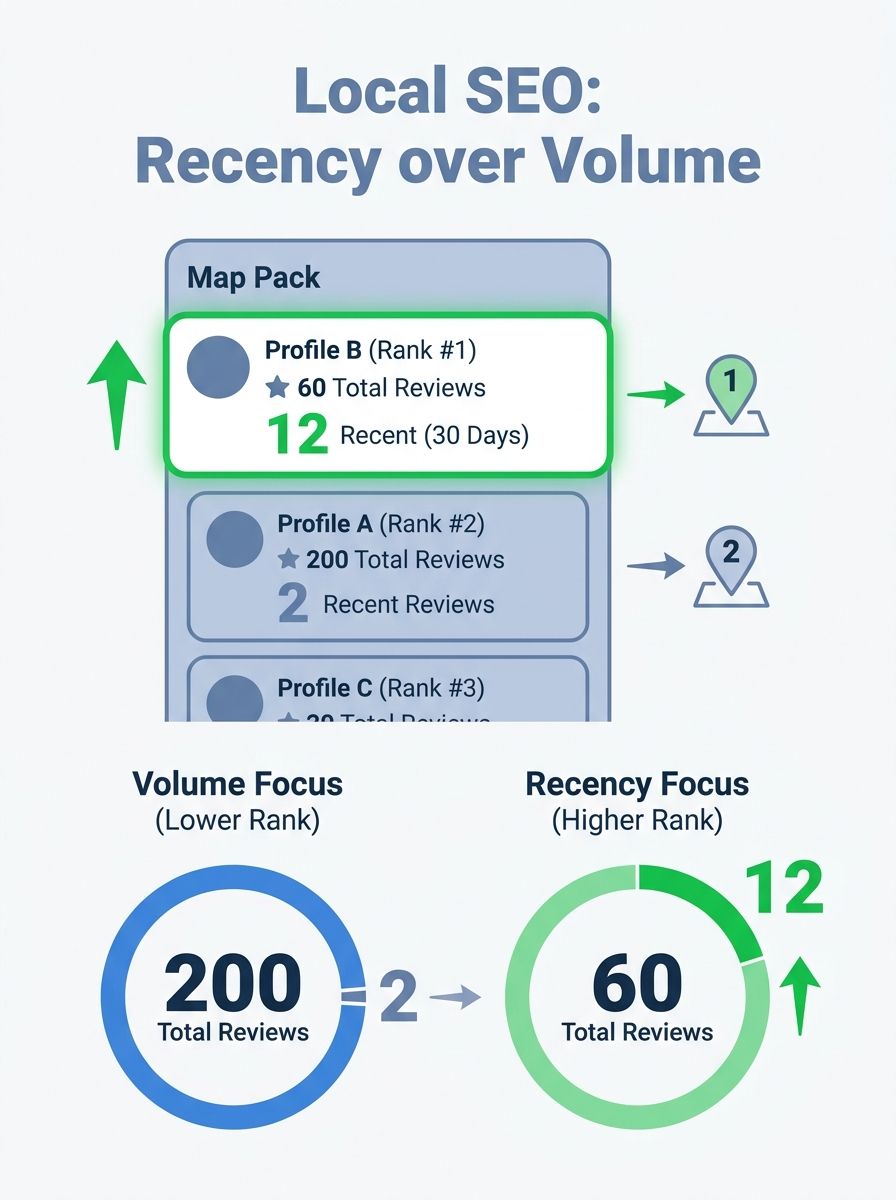
The pattern across local SEO audits is uncomfortably consistent: a business runs a big review push, collects 40–60 reviews in two weeks, then goes silent for six months. Their Map Pack ranking spikes briefly and slides back to where it started. A practitioner on r/localseo tracked review velocity against total review count across 22 local clients over four months and found that in 18 of those 22 categories, velocity correlated more strongly with ranking position than volume did. Businesses with only 60 total reviews but 12 new ones in the last 30 days consistently outranked competitors carrying 200+ reviews with just 2–3 recent ones. The Google review frequency algorithm rewards rhythm, and these seven rules are how I help clients build review cadence SEO into daily operations instead of treating it as a quarterly campaign.
Cross the 50-review threshold before you obsess over pace
Below a certain volume, velocity barely registers as a local search velocity ranking signal. The breakpoint sits around 50 total reviews. Beneath that number, you don't have enough aggregate social proof for Google to trust your listing, and potential customers aren't clicking through because a 4.8-star average on 11 reviews doesn't carry the same weight as a 4.6 on 85. According to Moz's local ranking factor analysis, reviews account for a significant portion of local SEO ranking factors in 2026, making them essential for businesses competing in local markets.
So if you're sitting at 18 reviews, your first priority is volume, full stop. Run whatever ethical outreach you need—post-service emails, QR codes at the register, follow-up texts—to get past 50. Once you cross that line, the dynamic shifts. Additional volume shows diminishing returns, and the pace of new reviews becomes what separates a page-one Map Pack listing from a page-two ghost. I've watched businesses with 300+ reviews and strong historical velocity still lose ground to newer competitors simply because the new players were adding 8–10 reviews per month while the incumbents coasted on reputation they assumed was self-sustaining.
Match your weekly target to your industry's top three competitors
A sustained review strategy vs campaign spikes only works if your cadence matches what Google sees as normal for your category and geography. The weekly target for a personal injury attorney in Dallas looks different from a nail salon in Portland. According to Robben Media's analysis of competitive local markets, highly competitive industries like restaurants, hair salons, and medical practices require 1–4 new reviews per week to stay visible in local search results.
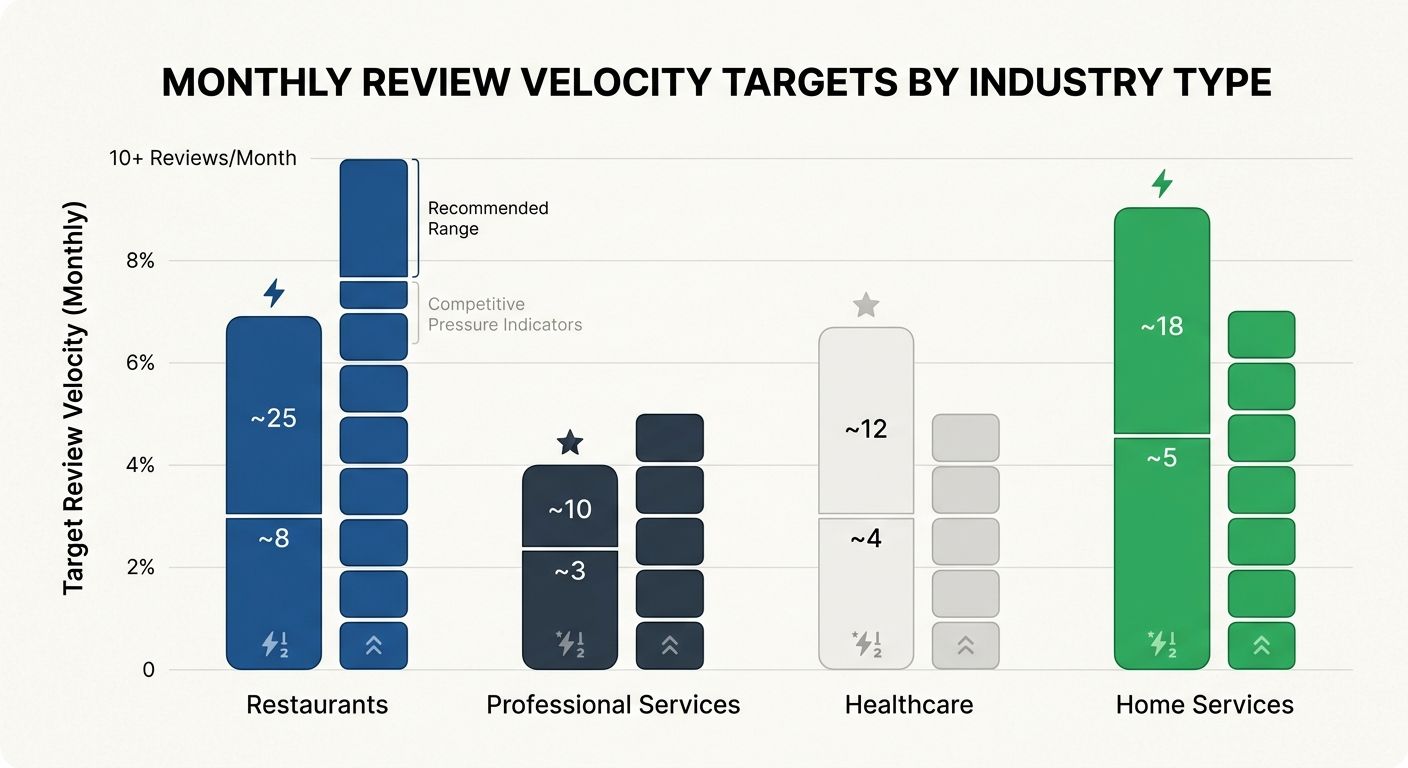
Here's how the monthly benchmarks break down by industry:
Industry | Monthly Target | Weekly Equivalent | Competitive Pressure |
|---|---|---|---|
Restaurants / Retail | 8–15 reviews | 2–4 per week | High — frequent customer volume |
Professional Services (law, accounting) | 4–8 reviews | 1–2 per week | Medium — longer sales cycles |
Healthcare (dental, chiropractic) | 3–6 reviews | 1 per week | Medium — compliance friction |
Home Services (plumbing, HVAC) | 4–10 reviews | 1–3 per week | High — seasonal variation |
The practical move is to look at what the top three listings in your local pack are averaging per month and set your target at or slightly above that pace. As one SEO practitioner put it in the r/localseo analysis: "Don't aim for a total review number. Aim for a minimum reviews-per-month rate based on what the top 3 in your category are averaging. That's the number that actually matters." If you're already using a structured local SEO audit process, add competitor review velocity tracking as a standard line item.
Automate the request, personalize every response
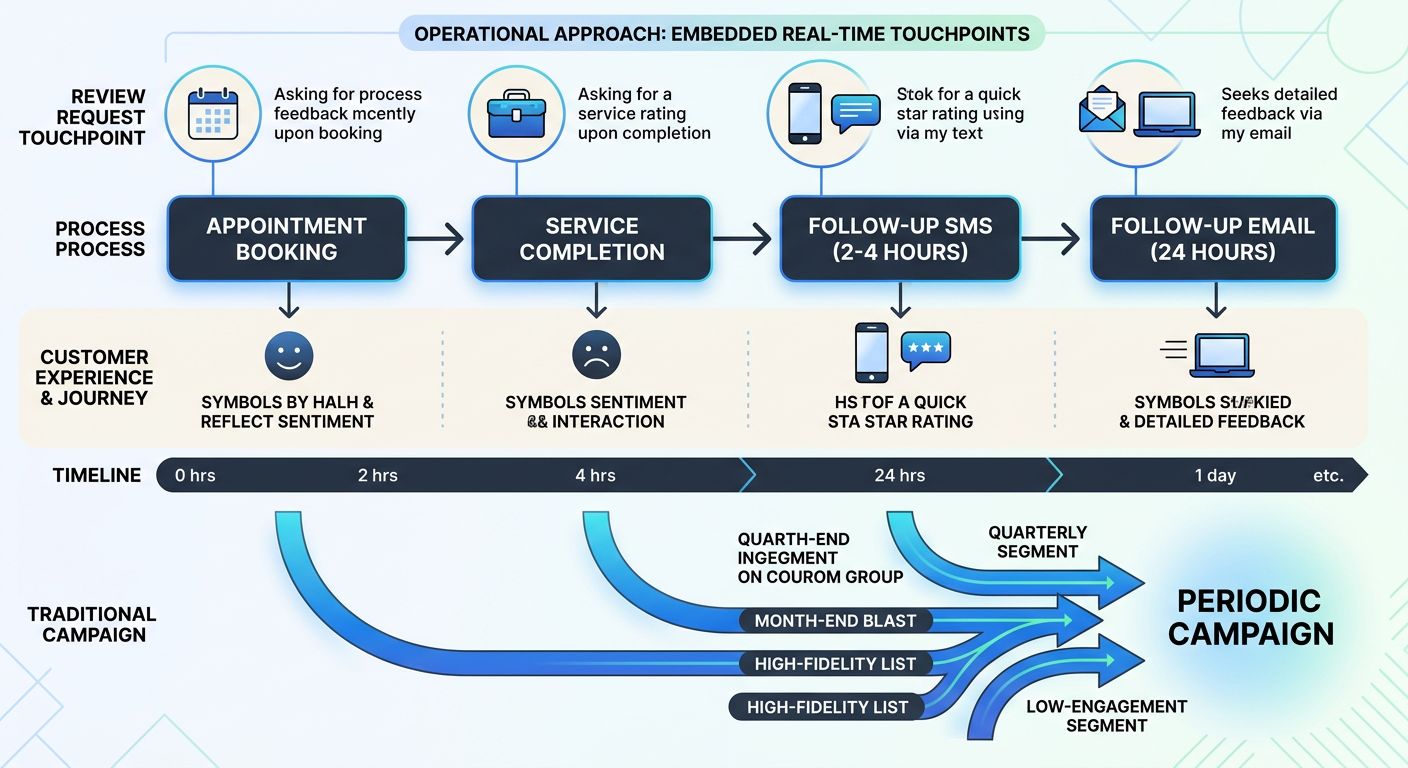
The temptation with review cadence programs is to automate everything—the ask, the follow-up, and the response. Automate the first two. Never automate the third. Tools like Birdeye, Podium, and Yext can schedule SMS follow-ups 2–4 hours after a service appointment and a backup email 24 hours later, keeping the request cadence steady without manual effort. That operational consistency is what makes a weekly review target sustainable instead of dependent on whoever remembers to ask.
But response diversity matters for rankings in ways that most businesses ignore. Locations that respond to reviews with templated, identical replies saw a 12% drop in search visibility compared to locations where responses were varied and personalized. Google's systems can detect cookie-cutter responses, and reviewers can too. When you respond to a review, reference something specific the customer mentioned—the service they received, the staff member they praised, the problem you solved. This isn't a courtesy exercise; it's a ranking signal.
As Straight North's research on review signals explains, "reviews work best when treated as trust infrastructure rather than short-term reputation management". A personalized response turns a review into a two-way conversation that Google interprets as genuine business engagement, and that interpretation directly feeds how Google weighs review signals in its ranking systems.
Track recency decay the way you track keyword positions
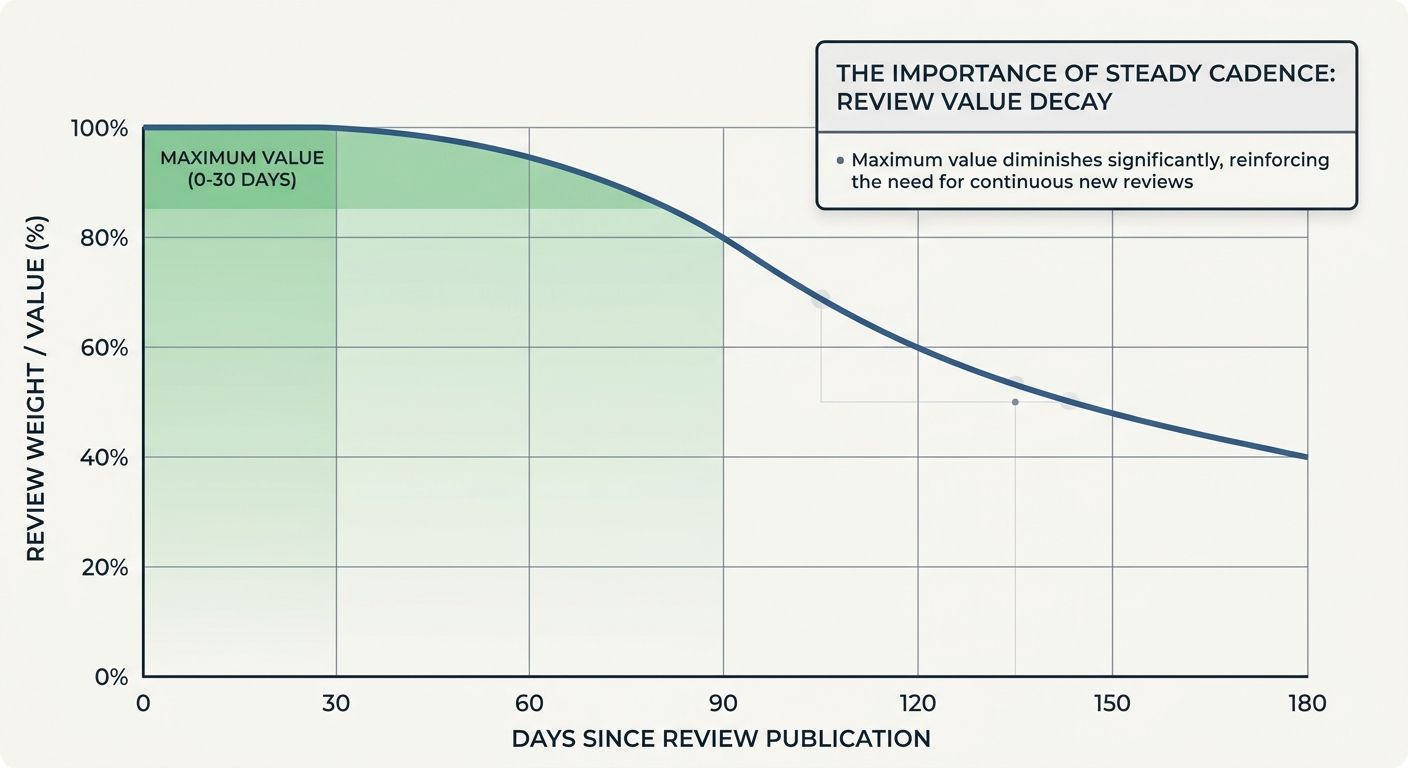
Google applies recency decay to reviews, and the math is worth internalizing. Reviews under 30 days old carry maximum algorithmic weight. At 90 days, their influence drops by roughly 20%. Past 180 days, a review still contributes to your overall rating and total count, but its impact on your ranking position has faded substantially. This decay curve is why a one-time campaign produces a ranking spike followed by a slide—you're watching the algorithmic value of those reviews evaporate in real time.
Build recency decay into whatever dashboard you use for local SEO tracking. If you're working with SERP tracking and audit platforms, add a custom metric for "reviews acquired in last 30 days" and "reviews acquired in last 90 days" alongside your Map Pack positions. The correlation between those two numbers and your ranking movement will be more consistent than almost any other signal you're tracking for local. I've started including a "review freshness score" in every client report—simply the percentage of a business's total reviews that are less than 90 days old. Anything below 15% is a warning sign that velocity has dropped below sustainable levels.
Treat a review spike like a spam signal—because Google does
Collecting 50 reviews in a single week after months of silence is the review equivalent of building 200 backlinks overnight. Google's spam detection systems are specifically tuned to flag unnatural review patterns, and a sudden spike is the most obvious pattern to detect. The consequences range from individual review suppression (Google quietly hides reviews it considers suspicious) to full listing penalties that tank your visibility across all local queries.
The r/localseo practitioner who tracked 200 local service businesses reported finding businesses with 300+ Google reviews and strong historical velocity that had solid Map Pack presence—but when checked across AI search platforms like ChatGPT, Siri, and Perplexity, many were completely invisible. Google has also tightened its spam policies around manipulation tactics in AI-powered search features, and review pattern anomalies are part of that broader enforcement picture.
The safe velocity profile looks organic: gradual increases during busy seasons, slight dips during slow periods, and a baseline that never drops to zero. If a client tells me they want to "catch up" after a six-month dry spell, I push back hard. Spreading the catch-up over 8–12 weeks instead of 2 weeks costs the same amount of effort but eliminates the spike risk entirely.
Write reviews into your operations playbook, not your marketing calendar
The fundamental problem with campaign-based review collection is structural. Marketing campaigns end. Operations don't. When a business treats reviews as a campaign—allocating budget for a burst, hiring a temporary review management service, or running a "feedback month" promotion—the review cadence SEO benefit dies the moment the campaign wraps.
The businesses I see winning local search velocity ranking signals have built review requests into their operational workflow at the transaction level. The HVAC tech's dispatch software sends a satisfaction check 3 hours after the appointment closes. The dental office's front desk hands the patient a card with a QR code during checkout. The restaurant's POS system triggers a post-visit text within 2 hours. None of these touchpoints require marketing department involvement or budget approval because they're embedded in the service delivery process itself.
As Igniting Business's analysis of Google review factors documents, four elements—recency, frequency, average rating, and comparative review count—each contribute to local ranking performance. But frequency and recency are the two that decay fastest without a system to sustain them. Average rating is relatively stable once you've collected enough reviews, and comparative count is a one-time threshold to clear. The ongoing work is always pace. When you understand how schema markup for reviews ties into technical SEO, you can see the full picture: structured data tells Google what your reviews say, while velocity tells Google those reviews reflect a living, active business.
Monitor content quality inside reviews, not just star counts
Star ratings get all the attention, but the text content within reviews sends signals that affect which queries your listing appears for. Reviews that mention specific services and locations correlate with improved rankings for those niche terms. A review that says "best emergency plumbing service in Westlake" gives Google more ranking information than a five-star review that says "great job, thanks!" As Visual Realm's research on customer reviews and local SEO explains, your customers' own words keep informing Google that "this business does X, Y, and Z, and people are happy about it"—functioning like fresh, user-generated content that you don't have to write or maintain.
This means your review request process should be designed to elicit descriptive responses, not just ratings. Instead of "Please leave us a review," try "We'd love to hear about your experience with [specific service] at our [location] office." The prompt shapes the response, and the response shapes what Google learns about your business. You don't need to tell customers what to write—you need to ask them the right question so their natural answer includes the terms that matter for your local rankings. Tracking keyword presence in review text is a metric I've added to quarterly reporting for every local client, and the correlation between service-specific review language and ranking for those service queries is strong enough to justify the effort.
When These Rules Break Down
Every rule above assumes you're operating a legitimate business with real customers and genuine service delivery. If your transaction volume is so low that you can't generate 3–5 organic reviews per month without incentivizing or fabricating them, the problem isn't your review strategy. It's your business model, and no amount of review cadence optimization will fix that underlying gap.
These rules also carry less weight in markets where the top competitors all have similar velocity profiles and similar review counts. In those saturated environments, differentiation shifts to other local ranking factors—proximity, category relevance, and Google Business Profile completeness. The velocity advantage is most pronounced when your competitors are still relying on old review stockpiles or running occasional campaign spikes, which, based on the hundreds of audits I've run, describes the majority of local markets.
And there's one more exception worth naming. AI search platforms—ChatGPT, Perplexity, Siri—don't use review signals the same way Google's traditional local algorithm does. The r/localseo data showed businesses with 300+ reviews and strong velocity that were completely invisible in AI search results. If your strategy is shifting toward AI search visibility and entity optimization, review velocity alone won't get you there. You'll need structured data, entity signals, and content architecture that these systems can parse. For traditional Google local search, though, a steady weekly review cadence remains one of the highest-ROI activities you can invest in—and one of the few ranking signals where a small business can outpace a larger competitor through better systems alone.
Marcus Webb
Digital marketing consultant and agency review specialist. With 12 years in the SEO industry, Marcus has worked with agencies of all sizes and brings an insider perspective to agency evaluations and selection strategies.
Related Articles

Why Your Local SEO Rankings Plateau After Six Months — and the Five Audit Fixes That Break the Ceiling
The local SEO plateau is a signal exhaustion problem. Agencies front-load Google Business Profile optimization, citation building, and on-page local keywords in months one through three, then stop feeding Google's local algorithm fresh inputs.

Beyond Rankings: How Google Reviews Drive Hidden SEO Value Your Agency Isn't Auditing
Straight North's analysis of Google's hidden ranking signals surfaced a conclusion that should make every white-label SEO provider uncomfortable: the reason most agencies ignore reviews in their audits is the same reason Google trusts them. Reviews are hard to game.

The Local SEO Setup Audit: Why Incomplete Google Business Profiles Cost Small Businesses Thousands in Lost Visibility
Roughly 86% of impressions on Google Business Profiles come from unbranded discovery searches — "plumber near me," "emergency dentist open Sunday" — according to Birdeye's 2026 analysis of local search behavior.
Explore more topics