
Website Migrations Trigger 50% Traffic Drops That Persist Up to 18 Months When SEO Teams Miss Launch Window, Analysis Shows
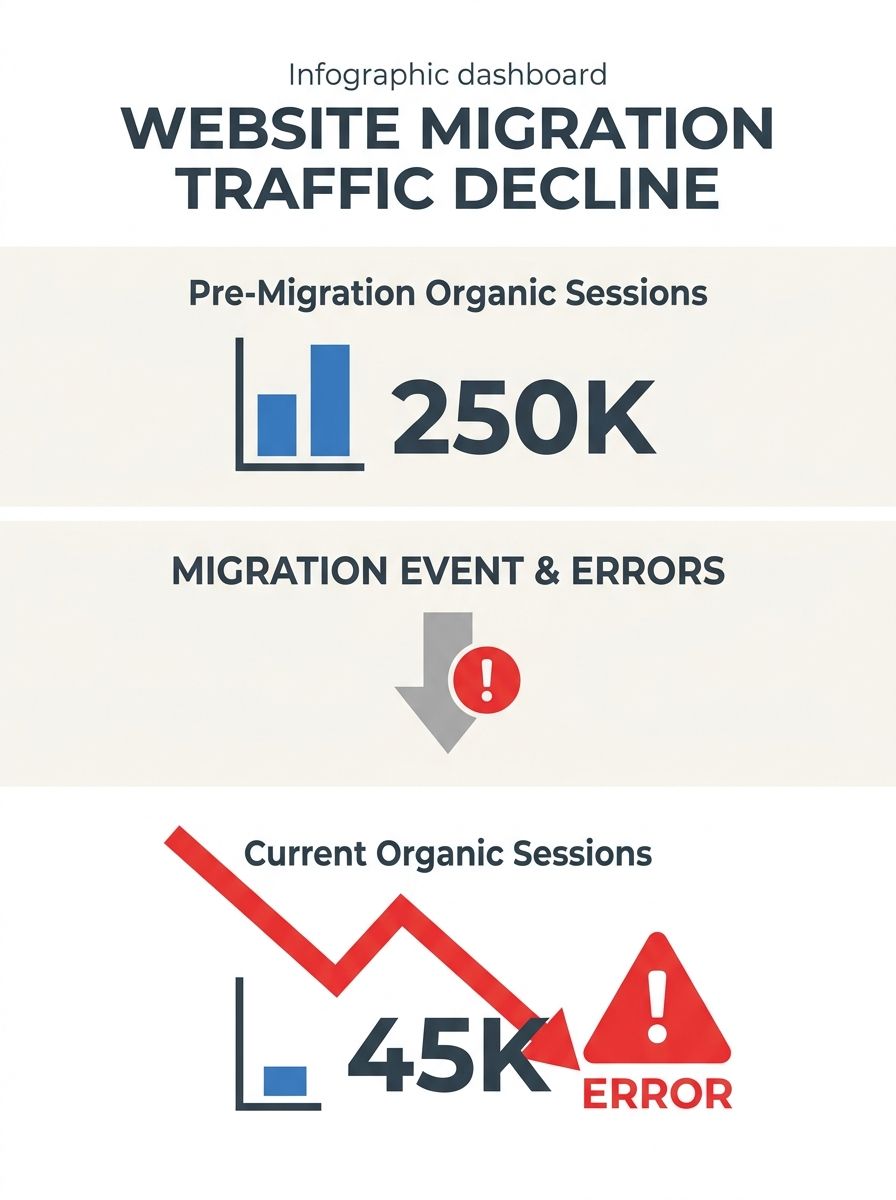
Website migrations that exclude SEO teams during planning cause organic traffic drops exceeding 50 percent and require 12 to 18 months of recovery work, according to a Search Engine Journal technical analysis published June 5, 2026. The research distinguishes normal post-migration volatility (10-30
 Marcus Webb··4 min read
Website Migrations Trigger 50% Traffic Drops That Persist Up to 18 Months When SEO Teams Miss Launch Window, Analysis Shows
Website migrations that exclude SEO teams during planning cause organic traffic drops exceeding 50 percent and require 12 to 18 months of recovery work, according to a Search Engine Journal technical analysis published June 5, 2026. The research distinguishes normal post-migration volatility (10-30 percent dips that recover within six weeks) from what practitioners now call "migration hangovers"—prolonged visibility losses triggered by broken redirects, leftover staging tags, and content relevance shifts that compound over months.
What Differentiates Migration Hangovers From Expected Traffic Fluctuations
Normal post-migration volatility presents as a 10-20 percent traffic dip that stabilizes and recovers within two to six weeks with no ongoing errors in Google Search Console, the analysis states. Migration hangovers exceed 30-50 percent drops, generate new crawl errors or 404 responses in Search Console, show declining indexed page counts, and fail to stabilize after four or more weeks.
Google requires weeks to months to fully crawl sites after structural changes depending on URL count, according to the report. The search engine processes URL changes through a multi-stage workflow designed to transfer ranking signals and ensure users reach correct content. Sites with migration hangovers show compounding signal loss as Google's re-evaluation stalls on technical errors that teams missed during launch preparation.
The distinction matters for agencies evaluating service quality and CMOs assessing migration project risks. A 30 percent traffic drop remains recoverable but prevention costs less than remediation, the guidance notes. Companies that scope migrations as technical projects between developers and designers rather than strategic business decisions with SEO implications face the highest hangover risk.
Six Technical Causes That Trigger Prolonged Traffic Loss
Broken or missing 301 redirects strip ranking power when Google treats old pages as deleted rather than moved, the analysis states. Common redirect errors include missing redirects entirely, temporary 302 redirects used instead of permanent 301s, redirect chains with multiple hops that slow crawling, and redirects pointing to irrelevant pages. Each missed high-authority URL compounds traffic loss.
Noindex tags left over from staging environments instruct Google to ignore pages and begin de-indexing entire sites. Developers set pages to noindex during staging to prevent premature indexing then forget to remove tags before launch. Re-indexing after tag removal requires several days to weeks, the report notes.
Canonical tags pointing to old URLs or domain structures delay ranking signal transfer because Google continues crediting old URLs while ignoring new pages. New pages fail to index because Google identifies old URLs as true authority sources. Manual review catches canonical errors that typical crawling tools miss, according to the guidance.
Content changes during redesign hurt relevance when teams rewrite copy or remove well-ranking pages. Keyword relevance changes follow content edits to heading structures, body content, internal linking patterns, title tags, meta descriptions, formatting consistency, and missing content elements including images, videos, and body copy.
Page speed regression occurs when new designs or content management systems slow site performance. Google uses Core Web Vitals as ranking signals, meaning performance drops chip away at rankings over time, the analysis states.
Unnecessary URL structure changes create avoidable ranking volatility even when teams implement 301 redirects correctly. Redirects transfer authority imperfectly, and changing URLs at scale forces search engines to reassess page signals and process new site structures. Google requires additional time to understand relationships between old and new URLs on larger or more complex websites.
Agencies can reference established migration recovery frameworks when diagnosing which technical causes drove specific traffic losses. The redirect authority preservation playbook details how 301 implementation quality affects signal transfer during domain moves.
Pre-Migration Planning Determines Success Months Before Launch
Successful website migrations begin months before code changes, with pre-migration phases determining whether sites face normal volatility or extended hangovers, the Search Engine Journal analysis states. Teams that involve SEO practitioners during planning stage migrations as strategic business decisions rather than technical handoffs between developers and designers.
The report recommends comprehensive pre-launch audits that verify redirect accuracy, confirm noindex tag removal, validate canonical tag targets, document content changes against ranking page inventory, test page speed against pre-migration baselines, and justify URL structure changes against business requirements. Sites that pass these checkpoints experience 10-30 percent volatility that recovers within six weeks.
Teams can apply traffic drop diagnostic frameworks systematically when pre-launch audits reveal potential issues. The structured approach identifies which technical factors create highest hangover risk before sites deploy.
What Happens Next
Business owners evaluating SEO agency capabilities should verify whether service agreements include pre-migration SEO audits, redirect mapping protocols, post-launch monitoring windows, and defined recovery processes for traffic drops exceeding 30 percent. Agencies that scope migrations as developer-only projects signal service gaps that expose clients to 12-18 month recovery timelines.
Marketing managers planning site redesigns in 2026 face increasing migration complexity as Google's AI-driven re-evaluation processes extend the time required for full ranking signal transfer. The June 2026 guidance positions pre-launch SEO involvement as non-negotiable rather than optional, shifting migration project timelines to accommodate audit phases that occur months before launch windows.
CMOs should budget migration projects to include SEO practitioner time during planning, development, staging, and post-launch phases rather than treating organic visibility as a post-deployment concern. The 50 percent drop threshold separates preventable volatility from hangovers that require dedicated remediation resources and executive patience through extended recovery periods.
Marcus Webb
Digital marketing consultant and agency review specialist. With 12 years in the SEO industry, Marcus has worked with agencies of all sizes and brings an insider perspective to agency evaluations and selection strategies.
Related Articles
Website Domain Migration Without Ranking Loss: The Complete 301 Redirect and Authority Preservation Playbook
A domain migration preserves rankings when three things execute correctly: complete 1:1 URL mapping with permanent 301 redirects, a pre-migration technical SEO audit that benchmarks every ranking signal worth protecting, and aggressive post-launch monitoring for at least 12 weeks.
The Website Migration SEO Checklist: Pre-Launch Technical Validation That Prevents 90% of Ranking Loss
Pre-launch technical validation centered on 301 redirect integrity, staging crawlability, and traffic-weighted URL prioritization prevents the vast majority of organic ranking loss during website migrations.

SEO Platform GadgetsFarms Publishes Website Migration Framework Detailing Redirect Strategy and Traffic Protection
GadgetsFarms published a website migration framework on August 27 addressing URL inventory management, redirect mapping, and organic traffic preservation during platform moves, according to the guide released on the platform's blog.
Explore more topics