
The SEO Agency Accountability Gap: Why Most Retainer Models Are Structurally Designed Against Client Results
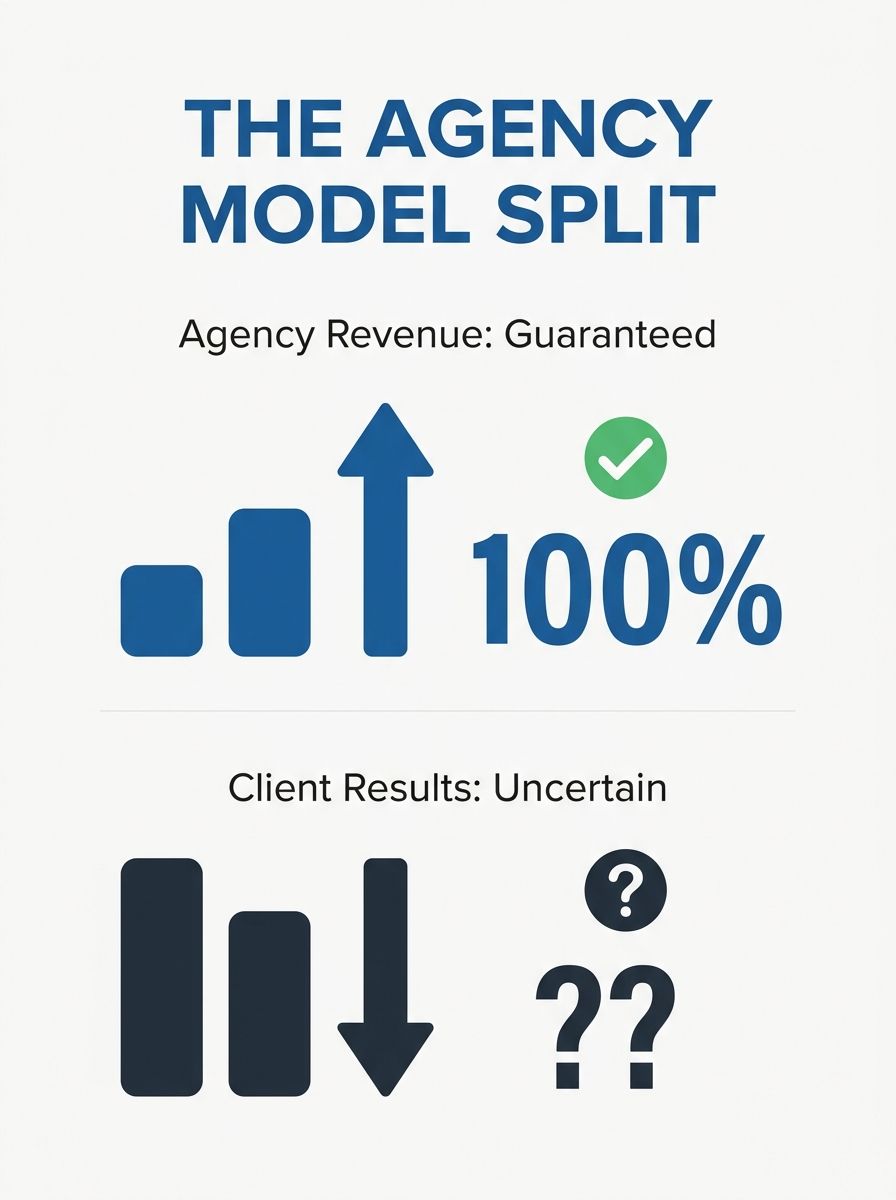
The typical mid-market SEO retainer runs $3,000 to $10,000 per month, locks the client into a 12-month contract, and contains no binding performance benchmarks. That combination of guaranteed revenue and zero required outcomes is the structural core of the agency accountability gap.
 Marcus Webb··8 min read
The SEO Agency Accountability Gap: Why Most Retainer Models Are Structurally Designed Against Client Results
The typical mid-market SEO retainer runs $3,000 to $10,000 per month, locks the client into a 12-month contract, and contains no binding performance benchmarks. That combination of guaranteed revenue and zero required outcomes is the structural core of the agency accountability gap.
The gap matters because it shapes everything downstream. When an agency's revenue is secure for 12 months regardless of performance, the internal incentive shifts from driving results to retaining the contract. Reporting becomes a justification exercise. Strategy meetings become update calls. And the client, who signed up expecting measurable growth, gets monthly PDFs full of keyword positions without any clear connection to revenue.
I've reviewed over 200 agency contracts in my 12 years in the SEO industry. The pattern is consistent enough to describe as structural, not anecdotal. The problem sits inside the contract terms themselves.
How the Standard Retainer Creates Misaligned Incentives
An SEO agency retainer model guarantees monthly payment in exchange for a set of deliverables. Those deliverables are almost always defined as activities (audits, content production, link building, reporting) rather than outcomes (traffic growth, lead volume, revenue impact). The agency gets paid whether the activities produce results or not.
This is the incentive misalignment at the heart of the model. Canny Creative's agency analysis describes the traditional retainer structure as one that "locks clients into long contracts with vague deliverables and little accountability." The agency is incentivized to keep the client happy enough to stay, but not necessarily to push for the difficult, risky changes that drive real SEO growth.
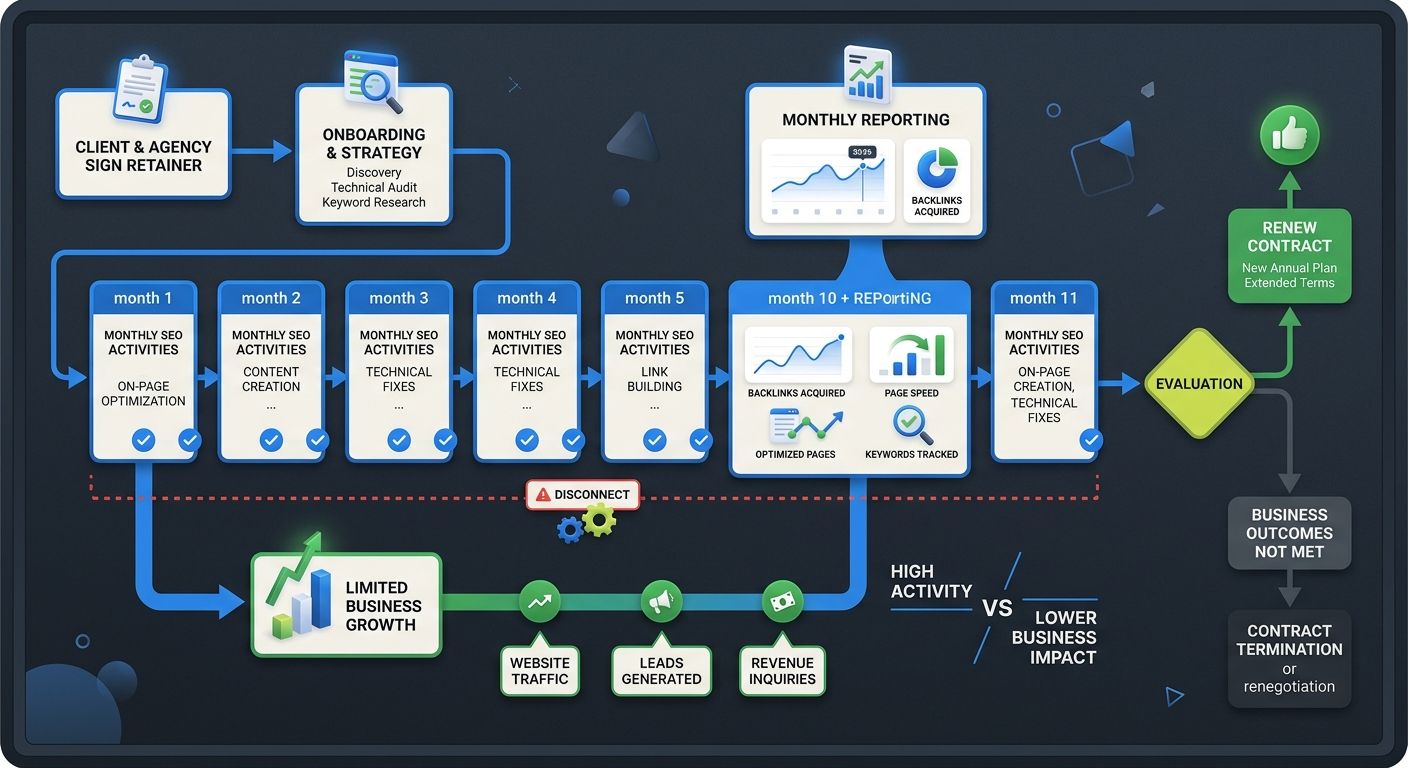
Think about what this means in practice. A client signs a 12-month retainer at $5,000 per month. That's $60,000 in committed spend. The agency assigns a junior strategist, a content writer, and a part-time link builder. They produce four blog posts a month, run a quarterly technical audit, and send a monthly report. Every deliverable gets checked off. But organic traffic stays flat because the real problem is site architecture, cannibalized pages, or keyword targeting that doesn't match buyer intent.
The agency fulfilled the contract. The client didn't get results. Both statements are true at the same time, and that's the accountability gap.
As Hashmeta wrote in their analysis of agency failures, "agencies often either promise unrealistic short-term results or use the long-term nature of SEO as a perpetual excuse for lack of progress." The retainer structure makes both behaviors equally rational from the agency's perspective.
Three Structural Flaws in 12-Month Contracts
The accountability gap isn't one problem. It's three separate contract design flaws that reinforce each other.
Flaw 1: Deliverable-based scoping instead of outcome-based scoping. Contracts specify "8 blog posts per month" or "20 backlinks per quarter" rather than "15% organic traffic growth by month 6." This lets the agency define success as task completion. If you've ever hired an agency that misread your keyword intent data, you've seen how perfectly executed deliverables can still miss the target entirely.
Flaw 2: Early termination penalties that remove the client's exit power. Breaking a 12-month contract typically costs 3 or more months' fees, according to Rankosys. For a $5,000/month retainer, that's $15,000 to walk away. The penalty removes the client's strongest accountability tool: the ability to leave. And it removes the agency's strongest motivation to perform: the risk of losing the account.
Flaw 3: Reporting that measures activity, not impact. Monthly reports track rankings, impressions, and clicks. These metrics move in directions that can be framed as positive even when business results are stagnant. A report showing "42 keywords improved in position" sounds productive until you realize none of those keywords drive qualified traffic. Building a reporting dashboard your clients actually trust requires tying SEO metrics directly to business KPIs, and most retainer agreements don't require that level of transparency.
These three flaws create a system where an agency can underperform for an entire contract term without formal accountability. The client's only real recourse is to not renew, and by that point, they've already lost 12 months and tens of thousands of dollars.
Hourly Billing Compounds the Problem
Some agencies offer hourly billing as an alternative to retainers, often positioning it as more flexible and transparent. The incentive structure is actually worse.
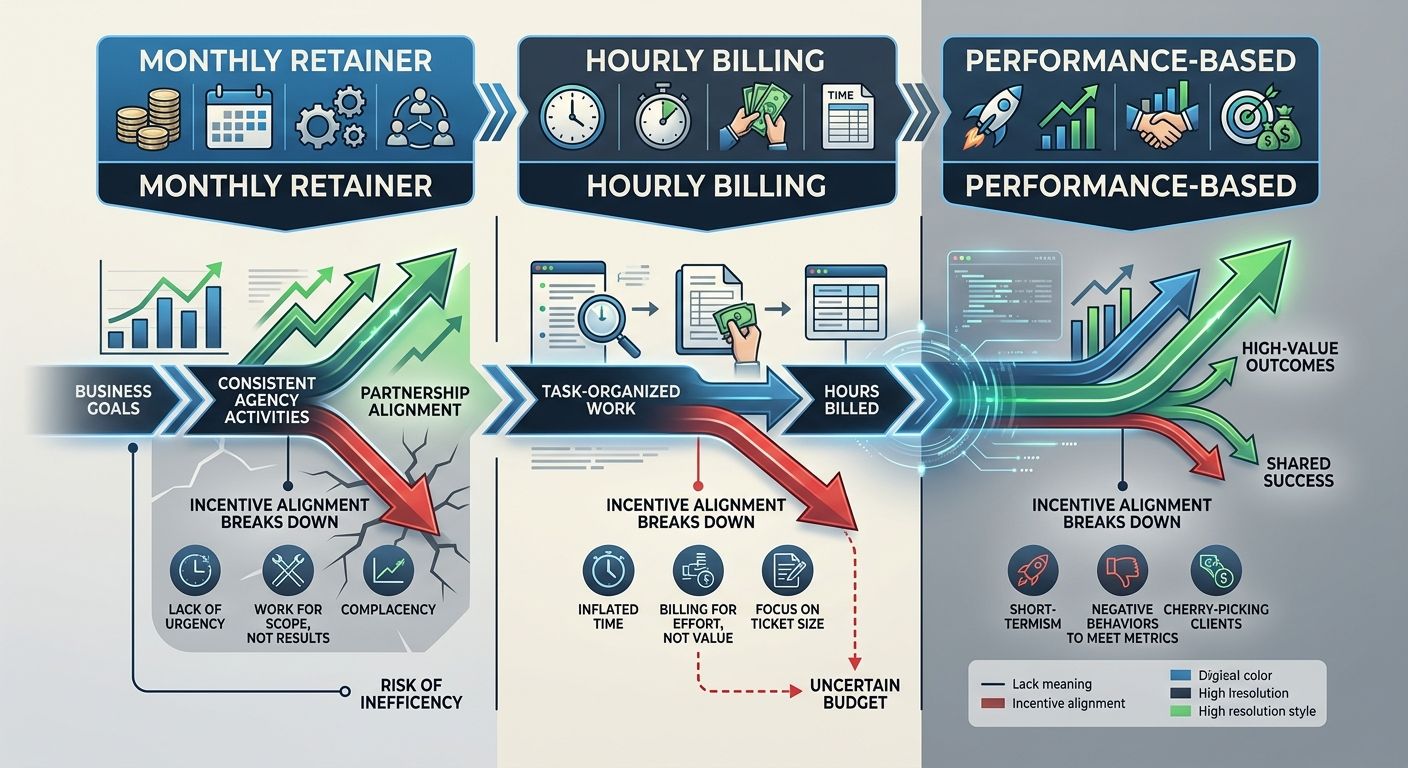
TryAnalyze.ai's contract analysis puts it directly: "Hourly contracts are the riskiest because they create misaligned incentives. The client wants you to work fewer hours; you want to work more." The agency profits from spending more time, not from producing better results. Every efficiency gain reduces agency revenue.
Hourly billing also creates a second problem: unpredictable costs for the client. An SEO agency pricing guide from Perfection Marketing notes that monthly retainers work best for established businesses needing ongoing optimization, while hourly rates suit specific, short-term projects. Setup fees alone can run $2,000 to $10,000, with tool subscriptions adding $200 to $500 per month on top of hourly rates. Clients who choose hourly billing to avoid long-term commitment often end up paying more per unit of work with even less accountability for outcomes.
Performance-Based SEO Has Its Own Traps
Performance-based SEO sounds like the obvious fix. The agency only gets paid when results arrive. The client carries no risk of paying for underperformance. SEO agency incentives are perfectly aligned with client outcomes.
The reality is more complicated. Performance-based SEO models tend to concentrate on the metrics easiest to manipulate. An agency paid per ranking improvement will chase low-competition keywords that move quickly but drive no business value. An agency paid per traffic increase will target high-volume informational queries that attract visitors who never convert.
The performance-based SEO model works like this: you agree on a goal first, and if the team hits that goal, you pay them. If they don't hit the goal, you don't pay. That sounds clean. But the goal definition becomes the entire negotiation. Agencies that accept pure performance risk will protect themselves by choosing goals they know they can hit easily, not goals that represent real business growth for the client.
There's also a timeline mismatch. SEO typically requires 4 to 8 months before producing measurable results, according to InfluenceFlow's pricing guide. An agency working on pure performance pay earns nothing for the first several months. This creates cash flow pressure that pushes agencies toward short-term tactics (aggressive link building, keyword stuffing, thin content at scale) rather than the structural improvements that produce lasting organic growth.
The agencies willing to accept pure performance-based contracts tend to fall into two categories. Category one: agencies confident they can game the agreed-upon metrics. Category two: agencies desperate enough for new business to accept unfavorable terms. Neither category is likely to deliver the strategic, long-term SEO work that actually grows a business.
How Retainer and Performance Contracts Compare on Key Risk Factors
When evaluating which model fits your situation, looking at specific contract attributes side by side clarifies where each model breaks down. The comparison between a retainer vs performance contract often gets oversimplified into "safe vs risky," but the risk profile shifts depending on what you measure.
Attribute | Monthly Retainer | Hourly Billing | Performance-Based | Hybrid (Base + Bonus) |
|---|---|---|---|---|
Agency revenue predictability | High (guaranteed) | Medium (variable hours) | Low (outcome-dependent) | Medium (base guaranteed) |
Client cost predictability | High (fixed monthly) | Low (variable) | Low (depends on results) | Medium (base fixed, bonus variable) |
Incentive alignment | Weak (paid for activity) | Weak (paid for time) | Strong on paper, gameable in practice | Moderate (bonus creates partial alignment) |
Typical contract length | 12 months | Project-based or open-ended | 6-12 months | 6-12 months |
Early termination cost | 3+ months' fees | None to minimal | Varies widely | 1-2 months' base fee |
Metric manipulation risk | Low (metrics aren't tied to pay) | Low | High (agency optimizes for payout metrics) | Moderate |
Best suited for | Established businesses needing ongoing work | Short-term consulting projects | Businesses with clear, measurable KPIs | Mid-market companies wanting balanced risk |
This table makes one thing visible that gets lost in sales conversations: no single model solves the accountability problem completely. Each model trades one type of risk for another. The question is which risks your business can absorb.
If you're comparing boutique agencies versus enterprise firms, the contract model matters as much as the agency's size or reputation. A boutique agency on a hybrid contract with quarterly performance reviews will often outperform a large firm on a rigid 12-month retainer, simply because the contract structure keeps the smaller team more focused on outcomes.
Building a Contract That Closes the Gap
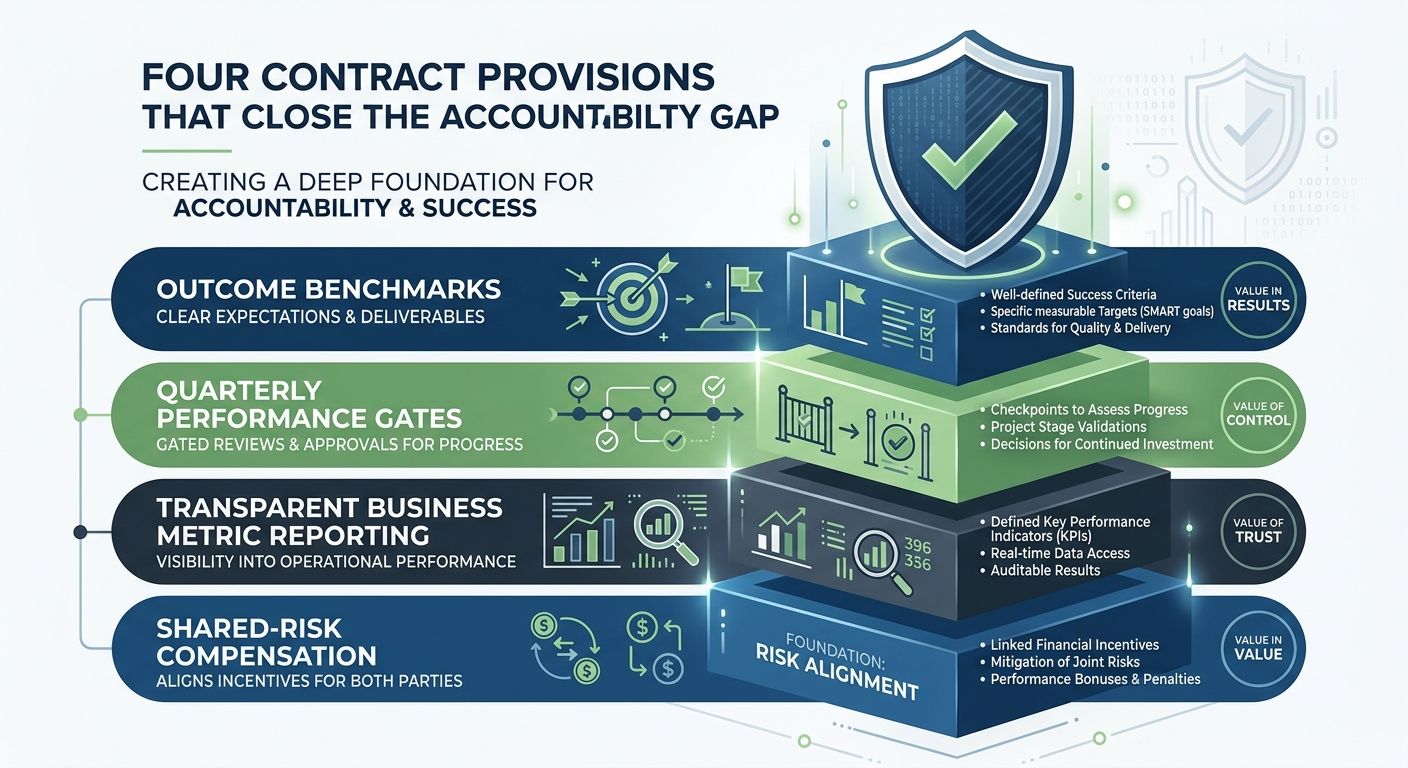
The accountability gap shrinks when contracts are designed with four specific provisions.
Outcome benchmarks with defined timelines. The contract should specify measurable targets (organic traffic, qualified leads, revenue from organic search) and the timeline for reaching them. These benchmarks don't replace deliverables. They sit alongside them as the actual measure of whether the engagement is working.
Quarterly performance gates. Instead of a single 12-month commitment, break the contract into quarterly periods. At each gate, both parties review performance against benchmarks. If benchmarks aren't met, the client can exit without penalty. Rankosys describes this approach through agencies that "earn your business every single month by delivering measurable progress. No lock-in also means they stay sharp, because your retention depends on their performance, not on a contract clause."
Shared-risk compensation. A hybrid model with a reduced base retainer (covering agency operating costs) plus performance bonuses tied to outcome benchmarks aligns incentives without creating the cash flow problems of pure performance-based pay. The base fee might cover 60% to 70% of the agency's standard rate, with the remaining 30% to 40% earned through hitting agreed targets.
Transparent reporting with business metrics. Monthly reports should include revenue attribution, lead quality scores, and conversion data alongside standard SEO metrics. The client should have direct access to analytics platforms, not just exported reports. Before signing any contract, auditing the agency's approach to link building and requesting sample reports from existing clients will tell you whether the agency measures what matters.
What Still Isn't Settled
The shift toward performance-based SEO and hybrid contracts is real, but the industry hasn't resolved several foundational questions. Attribution remains messy. Organic search produces results that are influenced by brand awareness, paid media, product quality, and seasonal trends. Isolating the agency's contribution from these other factors is genuinely difficult, and no contract structure has solved that problem cleanly.
There's also the AI search question. As Google moves toward AI-powered search experiences, the metrics that retainer contracts were built around (rankings, organic clicks, SERP positions) are becoming less reliable as measures of search visibility. An agency could do excellent work optimizing for AI Overviews and generative search results, but if the contract still measures success by traditional organic traffic, that work won't show up in performance reviews. Research from Raibec identifies unclear goals and overestimated potential as core reasons 90% of SEO services fail to meet expectations. As the definition of "SEO success" shifts under everyone's feet, that failure rate may climb before it improves.
The accountability gap won't close through better contracts alone. It requires agencies willing to tie their income to client outcomes and clients willing to define those outcomes clearly, invest in proper attribution, and accept realistic timelines. Both sides have work to do, and the contracts they sign together will reflect whether either side is serious about doing it.
Marcus Webb
Digital marketing consultant and agency review specialist. With 12 years in the SEO industry, Marcus has worked with agencies of all sizes and brings an insider perspective to agency evaluations and selection strategies.
Related Articles

The SEO Agency Trust Verification Framework: Auditing Real Results Beyond Monthly Reports
Verifying an SEO agency's real performance requires auditing three things their monthly reports rarely show: revenue attribution from organic search, ranking movement on terms that actually convert, and independent third-party traffic validation.

DIY SEO Tools vs. Agency Services: The Real Cost-Benefit Analysis for Mid-Market Businesses in 2026
The standard "in-house vs agency SEO" debate gives mid-market companies a false binary that leads to overspending in both directions — paying agencies $5,000–$10,000 per month for tasks a $200 tool handles, while skipping the strategic work where professional firms actually earn their fee.
6 Ways SEO Agencies Misread Keyword Intent Data — and the Client Campaigns That Suffer for It
Keyword intent misalignment kills more SEO agency-client relationships than bad backlinks, thin content, and missed deadlines combined.
Explore more topics