
6 Ways SEO Agencies Misread Keyword Intent Data — and the Client Campaigns That Suffer for It
Keyword intent misalignment kills more SEO agency-client relationships than bad backlinks, thin content, and missed deadlines combined.
 Marcus Webb··10 min read
6 Ways SEO Agencies Misread Keyword Intent Data — and the Client Campaigns That Suffer for It
Keyword intent misalignment kills more SEO agency-client relationships than bad backlinks, thin content, and missed deadlines combined. Agencies routinely classify keywords by volume and difficulty while ignoring whether the content they build matches what Google has already decided the searcher wants. The campaigns that result generate traffic that doesn't convert and rankings that don't hold.
I've reviewed agency proposals and campaign audits for over a decade. The pattern is consistent: an agency pitches a keyword list sorted by monthly search volume, the client signs, and 6 months later the traffic graph looks healthy while the pipeline stays flat. As a Surfer SEO case study documented, "one of the biggest mistakes is people sacrificing intent for search volume, which in turn sacrifices their budget." That sacrifice happens at the proposal stage, before a single piece of content gets written. If you're evaluating agencies, the six failures below are what you should be screening for.
Volume-First Targeting Destroys Conversion Economics
The most common content targeting mistake agencies make is treating search volume as the primary keyword selection metric. An agency presents a spreadsheet with 200 keywords, sorted descending by monthly searches, and the client approves because bigger numbers feel like bigger opportunity. But a keyword with 12,000 monthly searches and informational intent will generate a fundamentally different ROI than one with 800 searches and clear purchase intent.
According to Bilarna's practical guide on keyword intent, ignoring keyword intent leads to misaligned marketing efforts where high traffic volumes generate few qualified leads and produce poor return on investment. I've seen this play out with actual dollar figures attached: one B2B software client I audited was paying $8,500/month to an agency that had built 47 blog posts around high-volume informational keywords. Monthly organic traffic sat at 31,000 sessions. Monthly leads from organic: 4. That's a cost-per-lead of $2,125 from a channel that should have been delivering leads at $80-150 each.
The fix is straightforward in theory. Every keyword research process should include an intent classification step before content briefs are written, as Rankmax's search intent guide outlines: informational keywords get educational content, commercial keywords get comparison articles, and transactional keywords get product or pricing pages. When you're vetting an agency, ask them to walk you through how they decided which keywords to target. If the answer centers on volume and keyword difficulty scores with no mention of intent mapping, you're looking at a campaign headed for high-traffic, low-conversion territory.
Commercial and Transactional Queries Require Different Content (Your Agency Might Not Know the Difference)
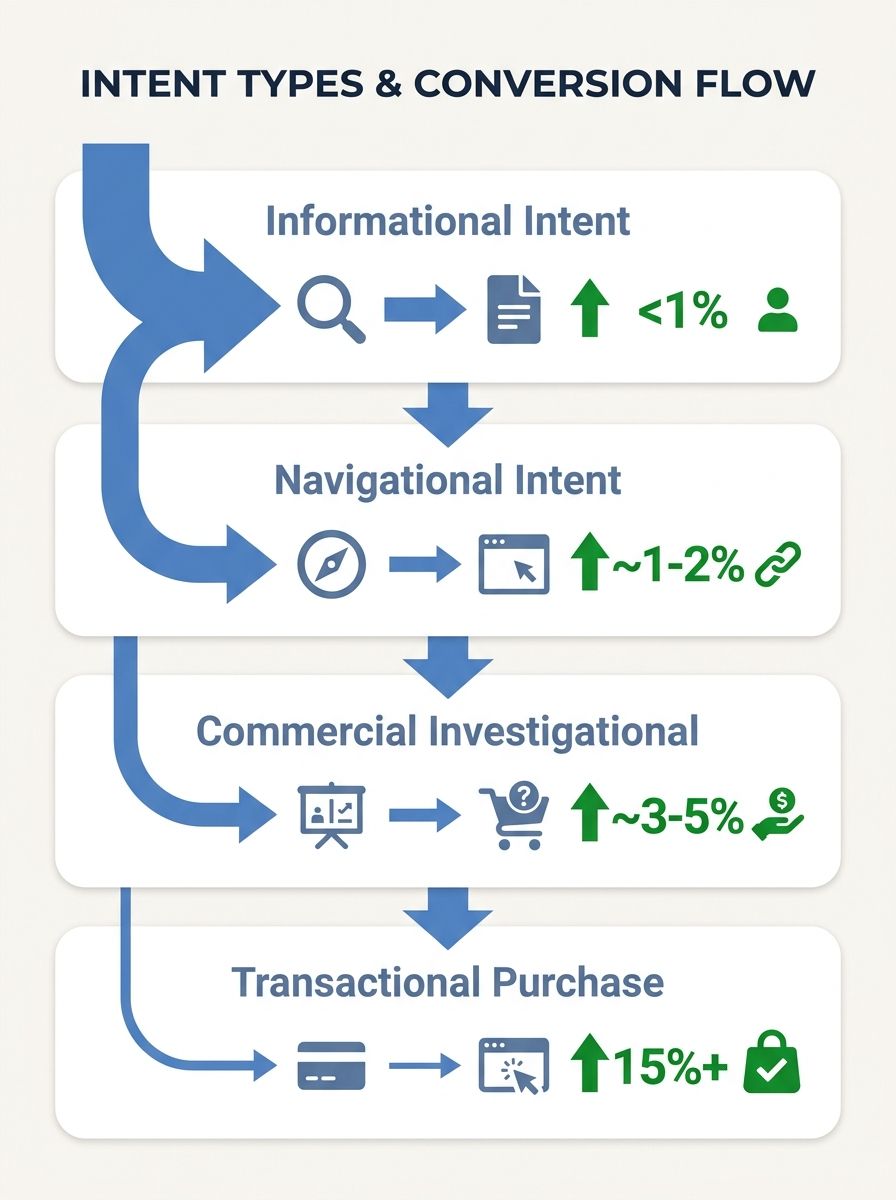
The four-intent model — informational, navigational, commercial, transactional — is standard knowledge. What's less standard is agencies actually applying it correctly. The most frequent conflation I see in proposals is treating commercial-investigation keywords and transactional keywords as the same thing.
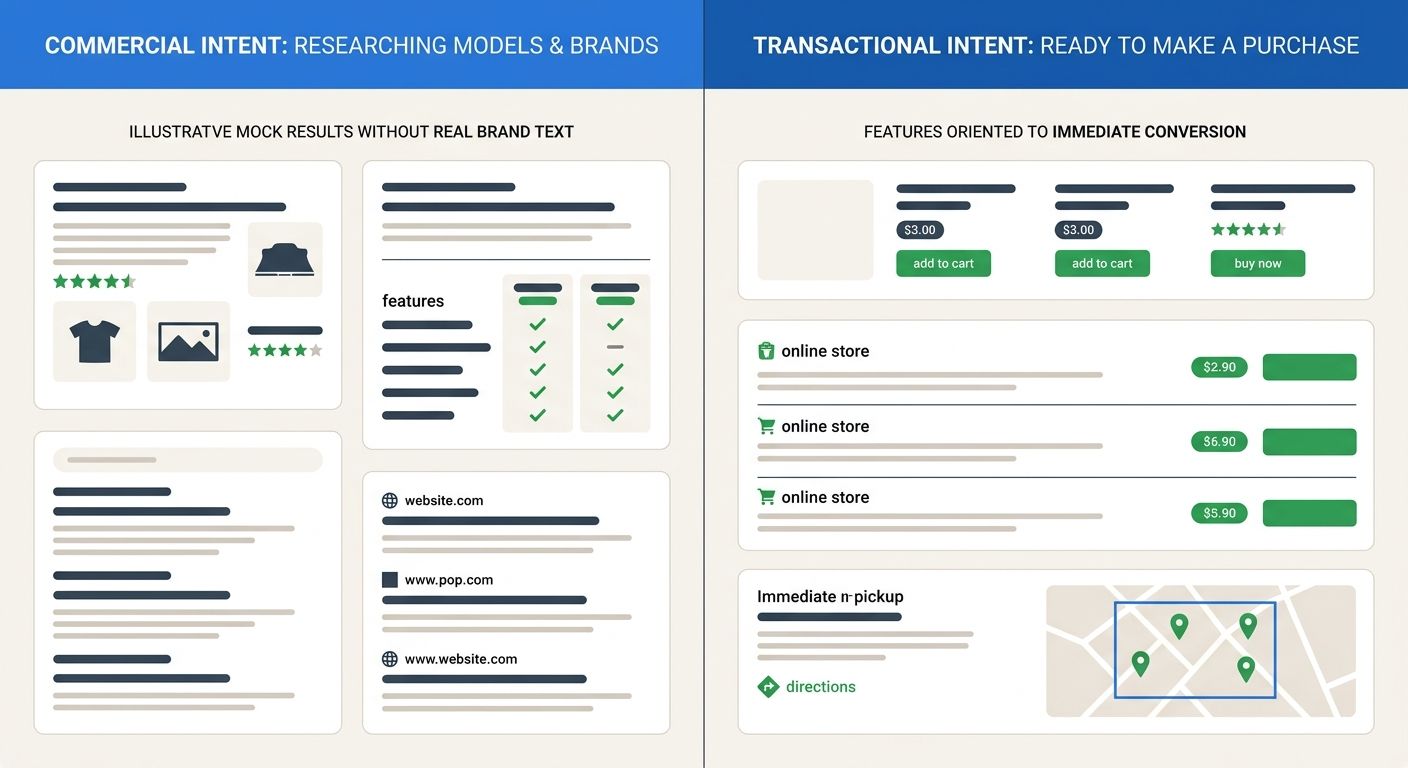
Someone searching "best project management software for construction" is in commercial investigation mode. They want comparisons, reviews, and feature breakdowns. Someone searching "Procore pricing annual plan" has already decided and needs a transactional page. The content formats are different. The CTAs are different. The conversion expectations are different.
When agencies build a single landing page that tries to serve both intents — half comparison content, half pricing table — the page underperforms for both audiences. Laura Schiele, writing for Search Engine Land, points out that "this disconnect usually stems from a lack of understanding of where users actually are in their purchase journey." Performance marketers offer a "free audit" when someone has barely discovered the brand, or push a demo request when the searcher is still comparing 6 vendors.
If you're in a B2B vertical where buying cycles stretch 3-9 months, this distinction matters enormously. Agencies working with technical buyers in manufacturing or complex enterprise sales need to build separate content assets for each intent tier. During agency evaluation, ask the team to categorize 10 of your target keywords into all four intent buckets and explain what content format each one gets. If they lump commercial and transactional together, that's a red flag worth $15,000-40,000 in wasted content production over a 12-month engagement.
When Buyer Journey Keywords Get Replaced by Keyword Grouping
Search intent analysis done well maps every keyword to a specific stage of the buyer's journey. As Moz's buyer journey framework explains, the journey starts with awareness (the buyer identifies a problem), moves through consideration (the buyer evaluates solutions), and ends at decision (the buyer chooses a vendor). Each stage has its own keyword patterns, content needs, and conversion expectations.
What agencies actually do, in roughly 60-70% of the proposals I've reviewed, is group keywords by topic cluster instead of by journey stage. They'll build a "content hub" around a broad topic — say, "warehouse management" — and create 20 articles that all target the awareness stage because informational keywords are easier to rank for and produce more impressive traffic reports. The consideration and decision stages get 2-3 pages at most, usually an afterthought tagged onto the bottom of the content calendar.
This creates a funnel that's wide at the top and nonexistent in the middle. Visitors arrive, learn something, and leave — because there's no content guiding them from "I have a problem" to "this company can solve it." HubSpot's research on buyer journey keyword mapping makes the case that SEO becomes a revenue channel only when keyword research accounts for all three stages.
The evaluation question here is specific: ask the agency to show you where their proposed content calendar addresses each journey stage. Count the pages. If 80% of the calendar is awareness-stage content, the campaign will produce traffic reports that look great and pipeline reports that look empty. Agencies that understand this build reporting dashboards that track stage-specific metrics — not just aggregate organic sessions.
Mixed-Intent Pages Google Can't Classify
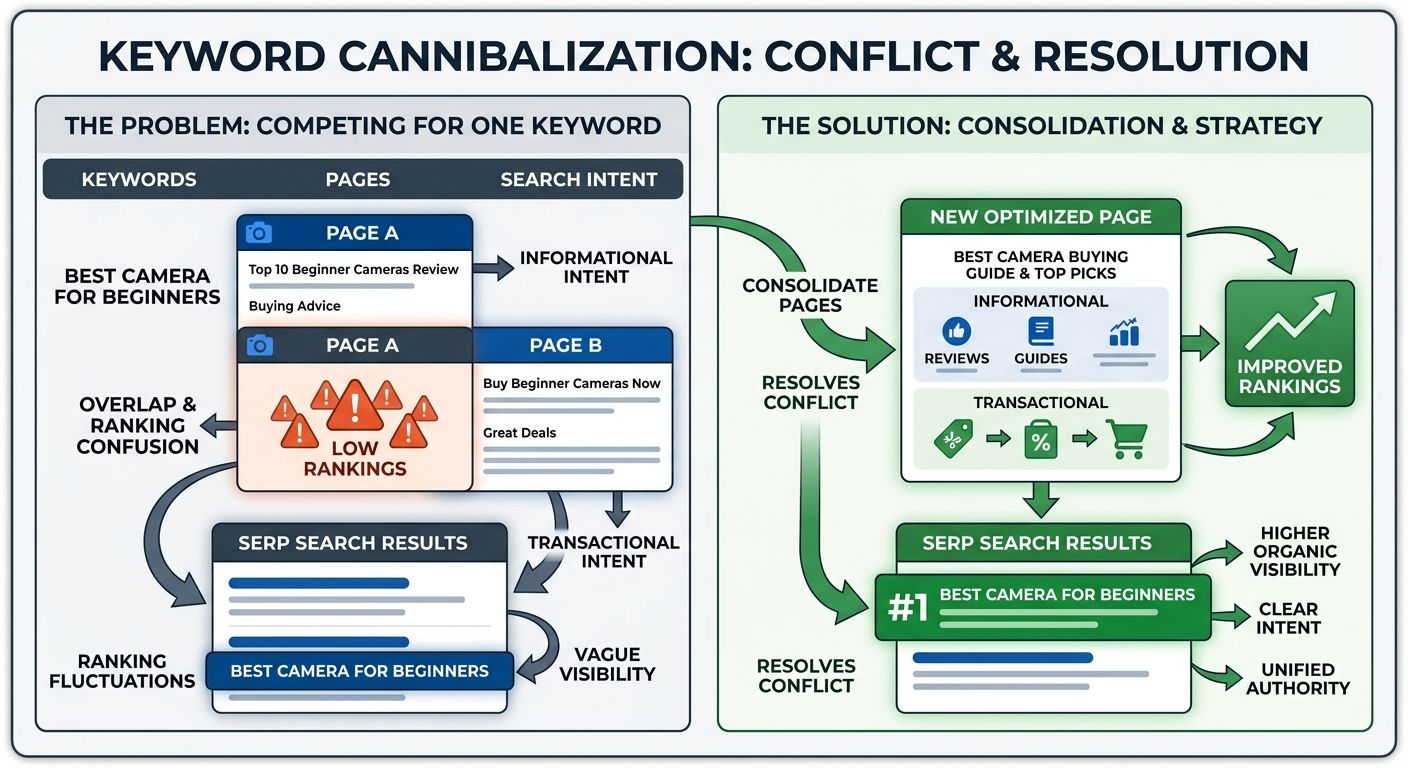
When multiple pages target the same keyword but serve different intents, Google gets confused about which one to rank. Mixed-intent pages compete internally, splitting relevance and visibility. This is keyword cannibalization driven by intent confusion, and it's one of the hardest SEO campaign failures to diagnose because the symptoms look like a technical SEO problem when the root cause is strategic.
Here's how it typically unfolds: an agency creates a blog post targeting "enterprise data backup solutions" with informational content explaining what enterprise backup is. Three months later, they create a product page targeting the same keyword with transactional content. Google now has two pages from the same domain, each signaling a different intent. Neither ranks well because the algorithm can't determine which page the site considers authoritative for that query.
I audited one e-commerce client in 2025 whose agency had produced 340 pages over 18 months. Of those, 67 pages had significant keyword overlap with conflicting intent signals. When we consolidated those 67 pages down to 29 with clear, single-intent targeting, organic traffic to those URLs increased 43% within 8 weeks. Rankings for the target keywords improved by an average of 11 positions.
The agencies that handle this well maintain a living keyword map — a document that assigns every target keyword to exactly one URL with a declared intent classification. When you're comparing boutique agencies against enterprise firms, this operational discipline is one of the clearest differentiators. Ask to see a sample keyword map from a current client (anonymized). The format tells you everything about their process maturity.
Pushing "Book a Demo" on Someone Who Googled "What Is"
This failure is the most visible and the easiest to spot during an agency pitch. An agency builds an informational blog post targeting "what is zero-trust security architecture" and ends it with a CTA reading "Schedule your free security audit today." The searcher is at the earliest possible awareness stage. They're learning vocabulary. Asking them to book an audit is the SEO equivalent of proposing marriage on a first date.
The data on this is unambiguous. Pages with CTA-content mismatch see bounce rates 25-40% higher than pages where the CTA matches the visitor's intent stage. An informational page should offer deeper educational content — a related guide, a downloadable framework, a newsletter signup. A commercial-investigation page should offer comparisons, case studies, or a tool trial. Only transactional pages should carry hard conversion CTAs like demo requests or purchase buttons.
As one SEO practitioner noted in an analysis of common intent mismatches, "fixing these two common mistakes is one of the first things I teach SEO teams I work with. Getting them right makes all your on-page and content work more impactful." The CTA mismatch problem compounds over time: Google's behavioral signals (dwell time, pogo-sticking, return-to-SERP rate) pick up on visitors who arrive, encounter an irrelevant ask, and leave. Over 3-6 months, those behavioral patterns can suppress rankings for the page entirely.
When reviewing agency proposals, look at the content briefs. If every brief ends with the same CTA regardless of keyword intent, the agency is running a template-driven process that ignores intent alignment. Agencies that audit their link building strategy with rigor tend to apply the same discipline to CTA matching — ask about both.
Treating Intent as Fixed When Google Keeps Reclassifying the SERP
This is the failure that catches even competent agencies off guard. A keyword that showed transactional intent in January — with product pages dominating the first page — can shift to informational intent by June if Google detects a change in user behavior patterns. The SERP is the real-time expression of Google's intent classification, and it moves.
Tools like Ahrefs, Semrush, and Google Search Console can track these shifts. Nucleo Analytics' breakdown of intent tools details how Search Console reveals which queries drive impressions versus clicks, while Ahrefs and Semrush assist in identifying SERP trend changes over time. Google Trends helps detect regional intent variations — a keyword that's transactional in New York might be informational in rural markets where the product category is less established.
The problem is that most agencies classify intent once, during the initial keyword research phase, and never revisit it. They build a content asset, optimize it for the intent they identified at kickoff, and move on. When Google's May 2026 core update shifted ranking signals significantly, agencies that hadn't reclassified their keyword intent maps in 6+ months saw pages drop 15-30 positions because the content no longer matched what Google's algorithm considered the dominant intent for those queries.
Intent Shift Signal | What It Looks Like in Data | Agency Response Required |
|---|---|---|
SERP type change | Product pages replaced by how-to guides in top 5 | Reclassify keyword from transactional to informational |
Featured snippet appears | Google adds a definition box above organic results | Create concise answer-format content for the query |
AI Overview activates | Query now triggers an AI-generated answer panel | Restructure content for answer-engine extraction |
Local pack insertion | Map results appear for previously non-local query | Add local landing pages or geo-modified content |
Video carousel appears | YouTube results dominate above-the-fold | Produce video content or optimize existing video metadata |
A responsible agency reviews SERP composition for target keywords quarterly at minimum, monthly for high-priority terms. During your agency evaluation, ask: "How often do you reclassify keyword intent, and what triggers a reclassification?" If the answer is "we do it during onboarding," the campaign will drift out of alignment within 2-3 months.
The Intent Proof Test: Three Questions Before You Sign
The six failures above collapse into a single diagnostic: agencies that treat search intent analysis as a one-time checkbox rather than an ongoing strategic discipline will produce campaigns that rank for keywords without converting visitors into revenue. I've formalized this into what I call the Intent Proof Test — three questions that separate agencies with real intent methodology from those running volume-driven playbooks.
Question 1: "Show me how you classified the intent for each keyword in this proposal." An agency with a real process will show you a spreadsheet or tool export with intent tags (informational, navigational, commercial, transactional) assigned to every keyword, along with the content format mapped to each tag. An agency without one will talk in generalities about "targeting the right audience."
Question 2: "Which keywords in this list would you NOT build content for, and why?" Agencies that understand buyer journey keywords will identify terms where the intent doesn't match business goals or where the SERP is dominated by content formats they can't realistically compete with. An agency that wants to build content for every keyword on the list is optimizing for billable hours, not results.
Question 3: "How do you handle keywords where the SERP shows mixed intent?" This is the hardest question and the most revealing. Strong agencies will describe a process for analyzing SERP composition, identifying the dominant intent, and either creating content matched to that dominant intent or splitting the keyword across multiple content assets with clear internal linking. Weak agencies won't understand the question.
These three questions take 10 minutes in a sales call. They'll save you $50,000-150,000 in wasted annual retainer spend. The agencies that answer well — with specifics, examples, and documented process — are the ones whose campaigns survive Google's quarterly algorithm adjustments and deliver compounding organic revenue rather than flat traffic graphs. Intent alignment isn't a feature of a good SEO campaign. It's the structural foundation that determines whether the campaign produces business results or produces reports.
Marcus Webb
Digital marketing consultant and agency review specialist. With 12 years in the SEO industry, Marcus has worked with agencies of all sizes and brings an insider perspective to agency evaluations and selection strategies.
Related Articles

The Manufacturing SEO Conversion Gap: Why Rankings Don't Equal Pipeline for B2B Industrial Firms
Ranking page one for "contract manufacturer" is actively harming the pipeline at dozens of industrial firms I've audited in the past three years. The ranking itself isn't the problem. The problem is what happens after the click: nothing. No RFQ. No qualified lead. No sales conversation.

Programmatic SEO vs. Editorial Content Strategy: Which Approach Wins for Lead Generation in B2B Markets
Programmatic SEO templates generated 55.5% of one B2B SaaS company's total site traffic (over 1.1 million monthly visits) according to a 2026 case study tracked by Averi.ai. But that traffic didn't produce pipeline until an editorial content layer was already in place.

The SEO Agency Accountability Gap: Why Most Retainer Models Are Structurally Designed Against Client Results
The typical mid-market SEO retainer runs $3,000 to $10,000 per month, locks the client into a 12-month contract, and contains no binding performance benchmarks. That combination of guaranteed revenue and zero required outcomes is the structural core of the agency accountability gap.
Explore more topics