
The Manufacturing SEO Conversion Gap: Why Rankings Don't Equal Pipeline for B2B Industrial Firms
Ranking page one for "contract manufacturer" is actively harming the pipeline at dozens of industrial firms I've audited in the past three years. The ranking itself isn't the problem. The problem is what happens after the click: nothing. No RFQ. No qualified lead. No sales conversation.
 Marcus Webb··7 min read
The Manufacturing SEO Conversion Gap: Why Rankings Don't Equal Pipeline for B2B Industrial Firms
Ranking page one for "contract manufacturer" is actively harming the pipeline at dozens of industrial firms I've audited in the past three years. The ranking itself isn't the problem. The problem is what happens after the click: nothing. No RFQ. No qualified lead. No sales conversation. The agency sends a cheerful report showing upward keyword movement, the marketing director forwards it to the VP of sales, and the VP of sales says, "Great, but where are the opportunities?"
That disconnect is the manufacturing SEO conversion gap, and it's eating six-figure annual retainers alive across the industrial sector. I'm going to walk through three specific reasons why this gap exists and, more importantly, why the agencies servicing these accounts keep ignoring it.
The Keyword Intent Problem Is Worse in Manufacturing Than Anywhere Else
B2B industrial search conversion depends on one thing above all: whether the person clicking your result is ready to buy, or whether they're a college student writing a paper on supply chain logistics. In manufacturing SEO, the gap between those two audiences is enormous, and it often hides behind impressive traffic numbers.
Here's the math that should make every industrial marketing director uncomfortable. High-performing manufacturing websites convert qualified visitors at rates between 2% and 6%, according to Konstruct Digital's analysis of dozens of industrial clients. That range sounds reasonable until you realize it applies to qualified traffic. If your agency is driving 10,000 monthly visits on broad terms like "injection molding" or "CNC machining," the share of those visitors who could ever become customers might be 5% of the total. Your effective conversion rate against total organic traffic drops well below 1%.
Contract manufacturer keyword intent is where this gets specific. Someone searching "contract manufacturer" could be a procurement engineer evaluating suppliers, or they could be a journalist, a competitor, or a business school student. The term has volume. It ranks well on agency reports. But it tells you almost nothing about buyer readiness.
Compare that to a search like "ISO 13485 contract machining services medical devices." That query has maybe 40 searches per month. An agency focused on traffic metrics would never prioritize it. But every single person typing that phrase is a buyer. They know the certification they need, the process they need, and the industry they're in. Those low-volume, high-intent technical keywords convert at two to three times the rate of their broader counterparts.
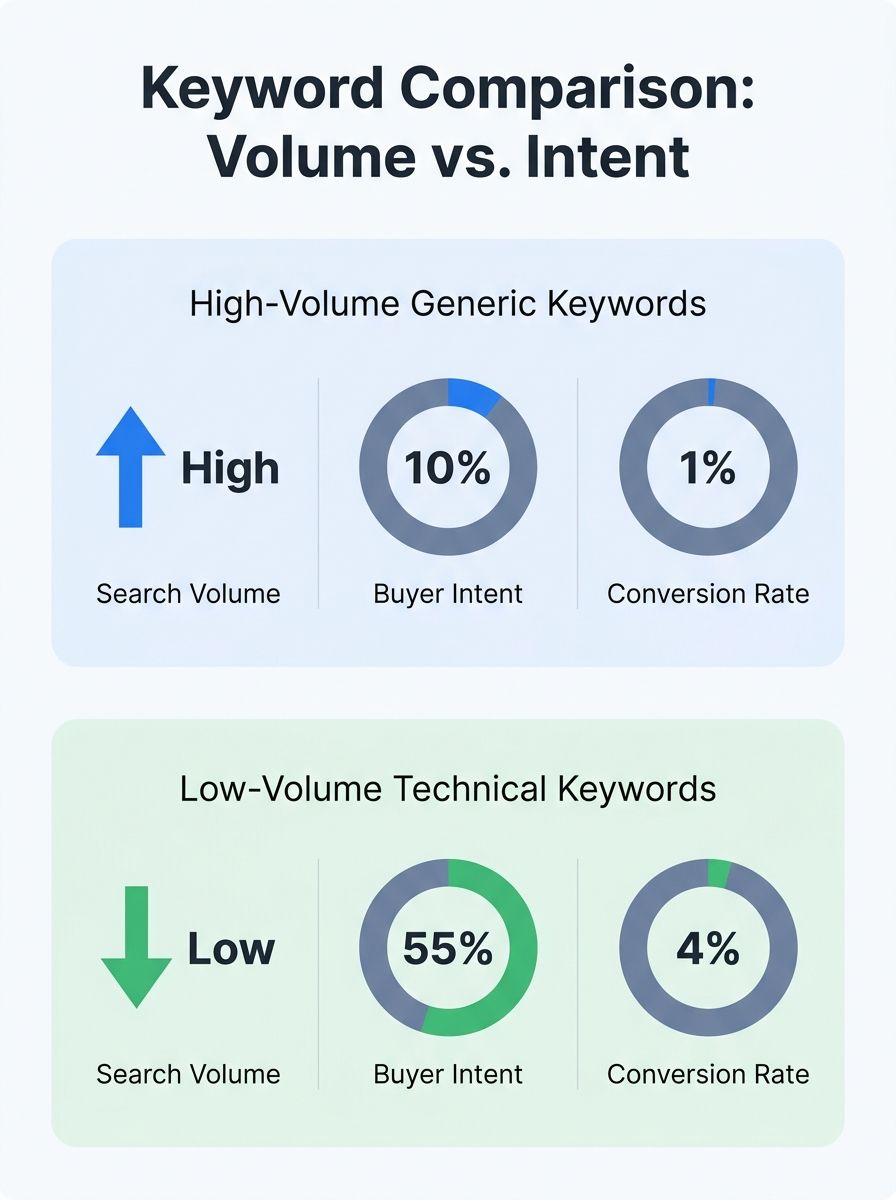
The agencies that understand this distinction structure their keyword strategies around the manufacturing buyer's journey, mapping terms from awareness to consideration to purchase. The agencies that don't understand it hand you a ranking report full of green arrows pointing up and call it a win.
I've reviewed agencies where the entire keyword list consisted of 15 broad head terms. No long-tail variations. No specification-based modifiers. No material-grade or compliance-standard terminology. If your agency's keyword research for a precision machining company doesn't include terms with ASTM, ASME, or MIL-SPEC modifiers, they're optimizing for vanity, not pipeline.
Your Conversion Infrastructure Is Built for the Wrong Buyer
The second piece of evidence is structural. Even when the right traffic arrives, most manufacturing websites fumble the handoff from search result to sales pipeline. And this is where technical SEO manufacturing pipeline work diverges sharply from what agencies typically deliver.
I audit manufacturing websites regularly. The pattern is remarkably consistent. The agency optimized title tags, cleaned up crawl errors, and built some backlinks. The organic traffic went up. But the pages those visitors land on have 22-field RFQ forms, no visible certifications, no downloadable spec sheets, and a generic "Contact Us" call-to-action that could belong to a dentist's office.
Manufacturing websites optimize for relationship initiation, not checkout completion. Nopio's research on B2B manufacturing SEO makes this distinction explicit: industrial SEO achieves lead capture conversion rates of 2-5%, higher than many B2B sectors, but only when the site is built to serve the specific needs of technical buyers. Engineers want material data sheets. Procurement managers want certification badges and lead-time estimates. Compliance officers want regulatory documentation. A single "Request a Quote" button with a sprawling form serves none of them well.
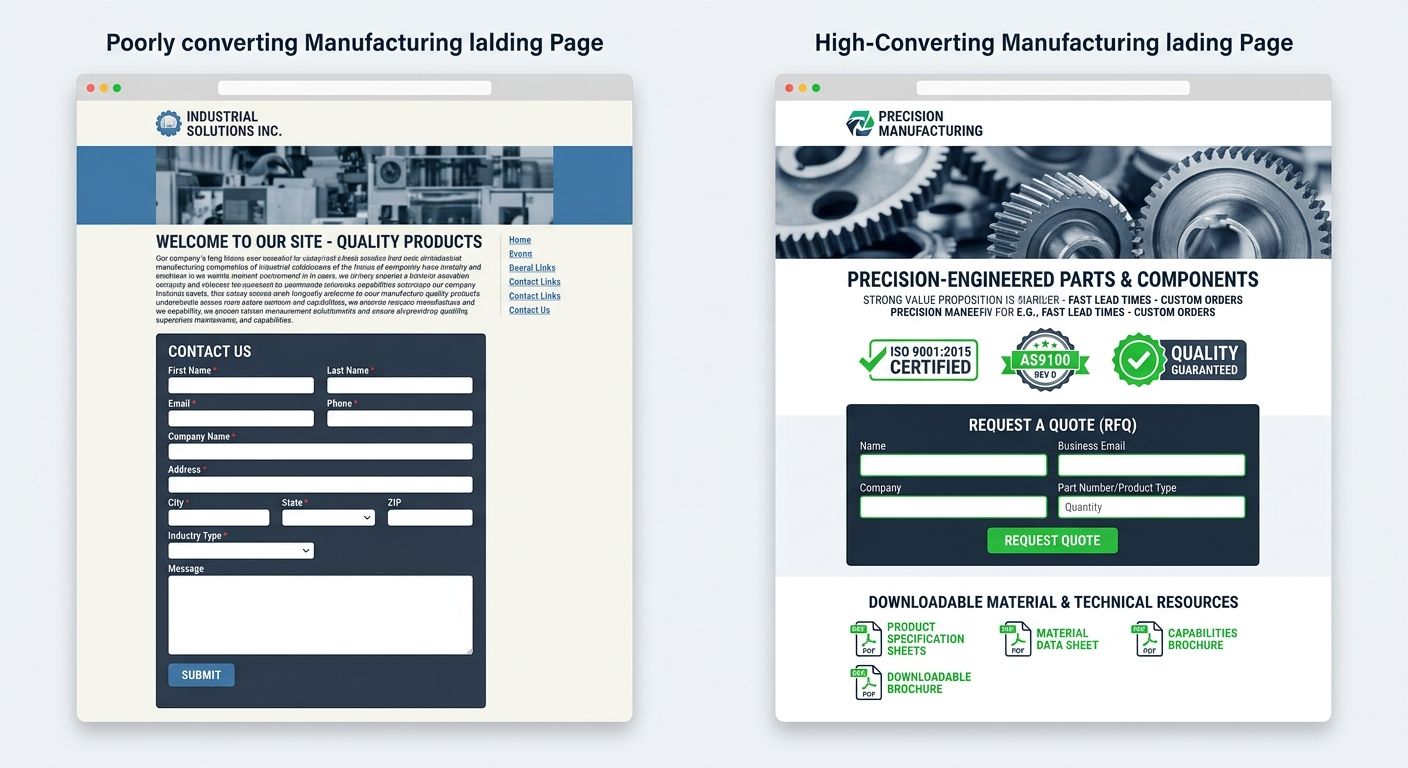
The fix isn't complicated. One valve manufacturer I encountered during an agency review had reduced their RFQ form from 20 fields to 7 and added ISO, UL, and ITAR certification badges above the fold. Form submissions jumped measurably. The SEO agency they worked with at the time had nothing to do with that change. It came from the internal marketing team after months of frustration with rising traffic and flat lead counts.
This points to a deeper evaluation question when you're vetting manufacturing SEO agencies. Does the agency's scope of work include conversion rate optimization on key landing pages? Or does the engagement stop at rankings and traffic? If the answer is the latter, you're paying for half a strategy.
The issue extends to content structure, too. Industrial buyers who use AI tools during procurement research — and the numbers suggest the vast majority now do — encounter your content through AI Overviews and LLM-generated summaries. If your capability pages lack clear heading hierarchy, structured data, and declarative answers in the first paragraph of each section, you're losing visibility in exactly the channels where purchase-ready buyers spend their time. We've covered how AI crawlers interact with site architecture differently than traditional Googlebot, and manufacturing sites with deep product catalogs are especially vulnerable to getting parsed poorly.
The Agency Reporting Gap Keeps Everyone Comfortable
Here's the third and most frustrating piece of the puzzle: the way most agencies report on manufacturing SEO ROI actively obscures the conversion gap.
I've sat in quarterly business reviews where an agency presented 47 slides. Rankings up. Traffic up. Domain authority up. Impressions up. And then someone from the client's sales team asks, "How many of those visits turned into qualified leads?" Silence. Or worse: "We don't have CRM access, so we can't track that."
That's an accountability failure, and it's rampant. According to First Page Sage's 2026 B2B conversion benchmarks, the biggest issue for B2B marketers isn't low conversion rates. It's simply not understanding what conversion rate to expect at scale. Agencies exploit this knowledge gap, intentionally or not, by keeping the conversation focused on metrics the client can't easily connect to revenue.
Manufacturing agency benchmarking should start with a single question: does the agency connect organic search performance to CRM pipeline data? If the answer is no, the relationship has a structural flaw. I've written before about how agency credentials don't guarantee client ROI, and manufacturing is the sector where that gap between credentials and outcomes is widest.
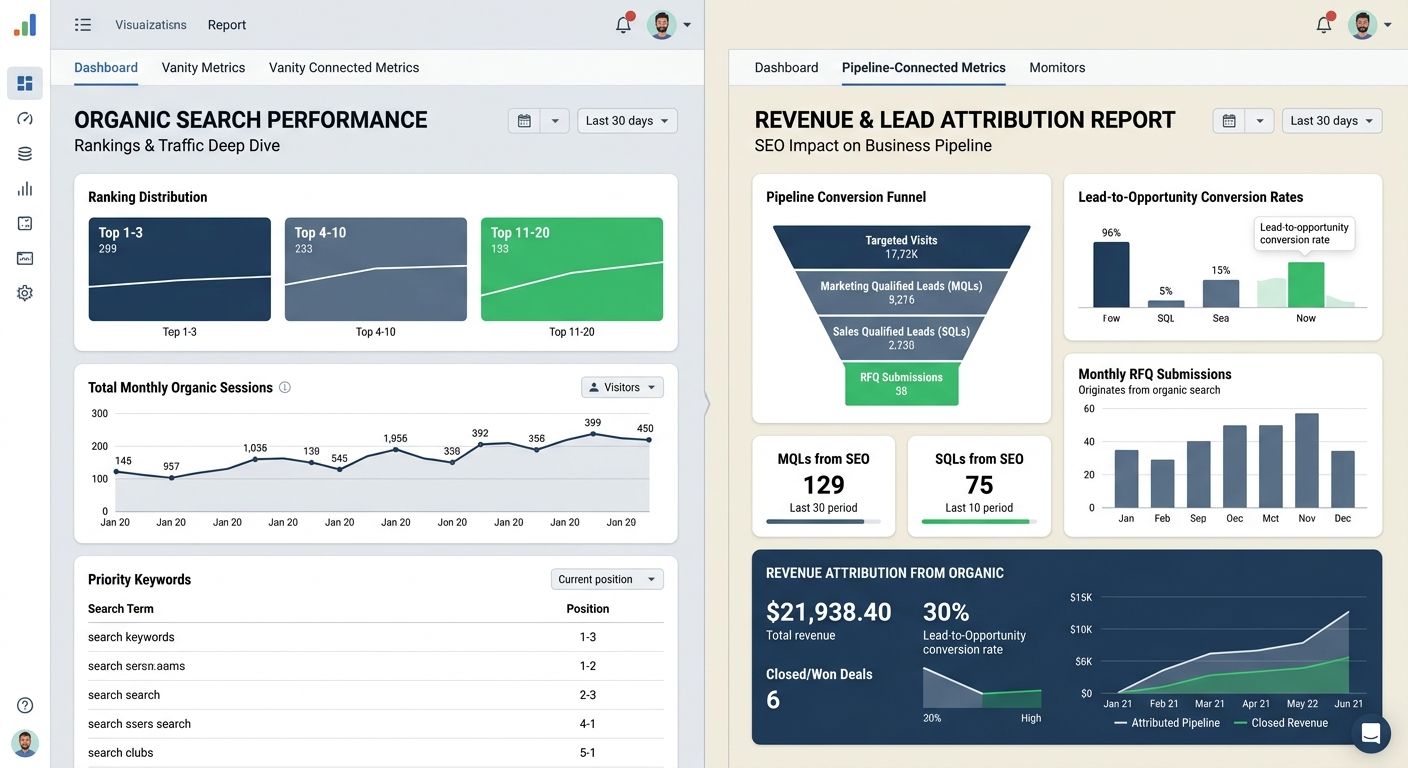
Here's what a meaningful manufacturing SEO report should include:
Organic traffic to product and capability pages specifically, not total site traffic
RFQ or quote form submissions attributed to organic search, by landing page
Assisted conversions where organic search touched the buyer's path before a direct visit or phone call
Keyword movement for specification-driven terms, not head terms alone
Lead quality indicators from CRM data, even if it's as simple as "sales accepted" vs. "disqualified"
The manufacturing marketing benchmarks published by WebFX give your numbers context, but the context only matters if you're measuring the right things. A single qualified lead in precision manufacturing can represent $50,000 to $500,000 in annual revenue. Reporting on traffic without connecting it to those outcomes is like reporting on how many people drove past your factory without tracking who walked in.
And this is where the agency selection process matters most. The difference between product-focused and enterprise SEO skill sets is real, and manufacturing sits in an awkward middle ground. You need technical SEO depth to handle complex product catalogs. You need content strategy that speaks to engineers, not consumers. And you need an agency willing to be measured on pipeline contribution, not search position alone.
The agencies that refuse to be measured on pipeline metrics are, in my experience, the same ones that guarantee rankings. Both behaviors signal the same thing: a preference for metrics they can control over outcomes that actually matter to the client's business.
Where This Leaves the Manufacturing SEO Budget
The thesis holds up under scrutiny, and it's getting worse. As AI-driven search continues to reshape how industrial buyers find suppliers — with click-through rates declining significantly across search results — the gap between ranking and pipeline will only widen for firms that don't adapt.
The conventional wisdom in manufacturing marketing has been simple: rank higher, get more traffic, win more business. That logic made sense when a page-one result meant a phone call. It doesn't hold when 70% of the buyer's decision-making happens before they ever pick up the phone, and when AI tools increasingly mediate what information those buyers see.
If you're a manufacturing firm spending $8,000 to $20,000 per month on SEO, the question you should ask your agency isn't "What did we rank for this month?" The question is: "Which of these rankings produced a qualified lead, and what was that lead worth?" If your agency can't answer that, or won't answer it, the conversion gap lives inside your retainer agreement.
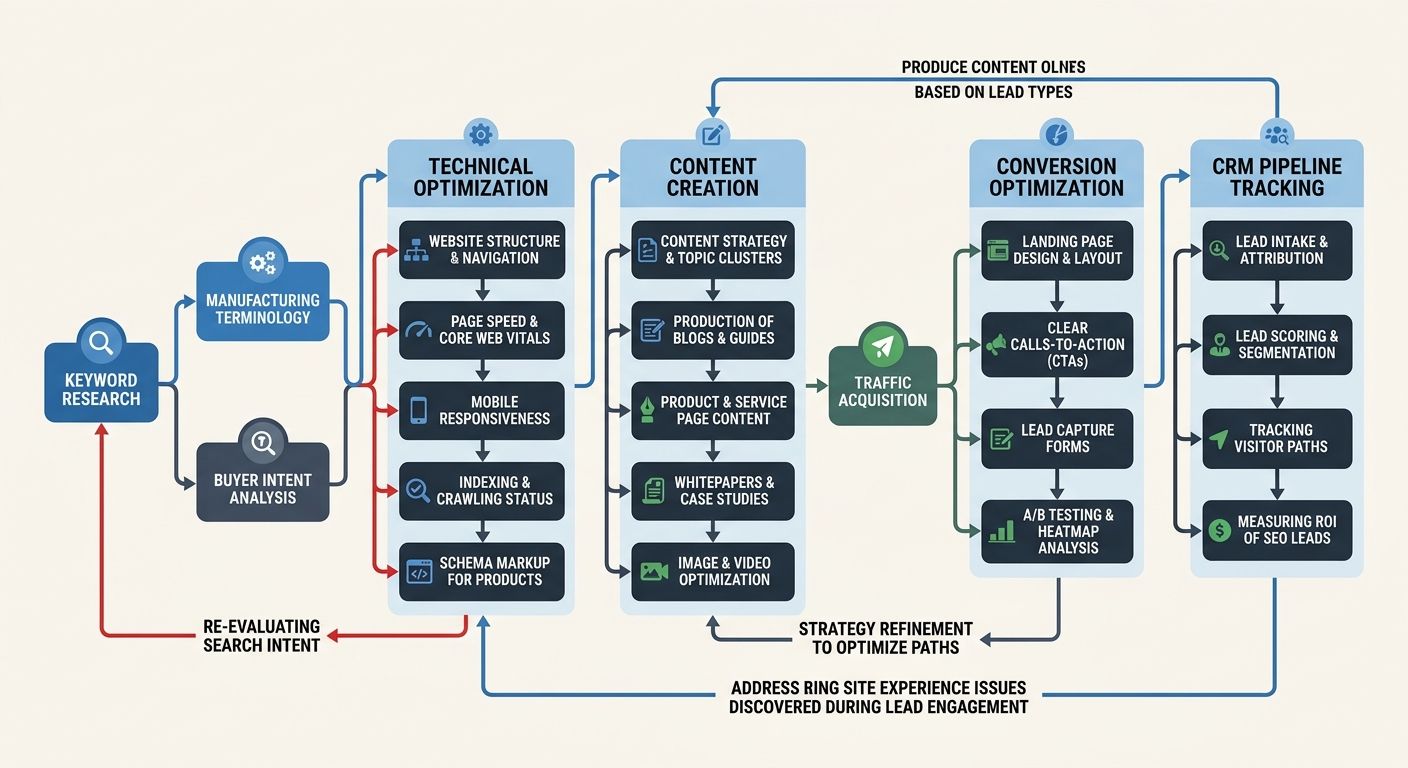
The firms closing this gap share three traits. They insist on CRM integration in their agency scope of work. They build content around the specifications and certifications their actual buyers search for, even when search volume looks small. And they evaluate their agency on pipeline metrics quarterly, with the same rigor they'd apply to a trust verification audit on any other marketing vendor.
Ranking page one was supposed to be the hard part. For manufacturing firms, it turns out that converting those rankings into revenue is harder — and far fewer agencies know how to do it.
Marcus Webb
Digital marketing consultant and agency review specialist. With 12 years in the SEO industry, Marcus has worked with agencies of all sizes and brings an insider perspective to agency evaluations and selection strategies.
Related Articles
6 Ways SEO Agencies Misread Keyword Intent Data — and the Client Campaigns That Suffer for It
Keyword intent misalignment kills more SEO agency-client relationships than bad backlinks, thin content, and missed deadlines combined.
Manufacturing SEO Without the Generic Playbook: Industry-Specific Keyword Research for B2B Technical Buyers
Three keyword research strategies dominate manufacturing SEO today: specification-led targeting, buyer intent signal mapping, and stakeholder segmentation. Each works for different situations, and picking the wrong one burns budget on traffic that never converts to RFQs.
Stop Chasing AI Overviews: Why Optimizing for Traditional Blue Links Still Drives More Qualified B2B Pipeline in 2026
B2B marketing teams are redirecting budget toward AI Overview optimization based on a flawed assumption: that appearing in Google's AI-generated summaries produces the same pipeline outcomes as ranking in traditional organic results.
Explore more topics