
Manufacturing SEO Without the Generic Playbook: Industry-Specific Keyword Research for B2B Technical Buyers
Three keyword research strategies dominate manufacturing SEO today: specification-led targeting, buyer intent signal mapping, and stakeholder segmentation. Each works for different situations, and picking the wrong one burns budget on traffic that never converts to RFQs.
 Marcus Webb··8 min read
Manufacturing SEO Without the Generic Playbook: Industry-Specific Keyword Research for B2B Technical Buyers
Three keyword research strategies dominate manufacturing SEO today: specification-led targeting, buyer intent signal mapping, and stakeholder segmentation. Each works for different situations, and picking the wrong one burns budget on traffic that never converts to RFQs.
Why Generic Manufacturing Keywords Fail Technical Buyers
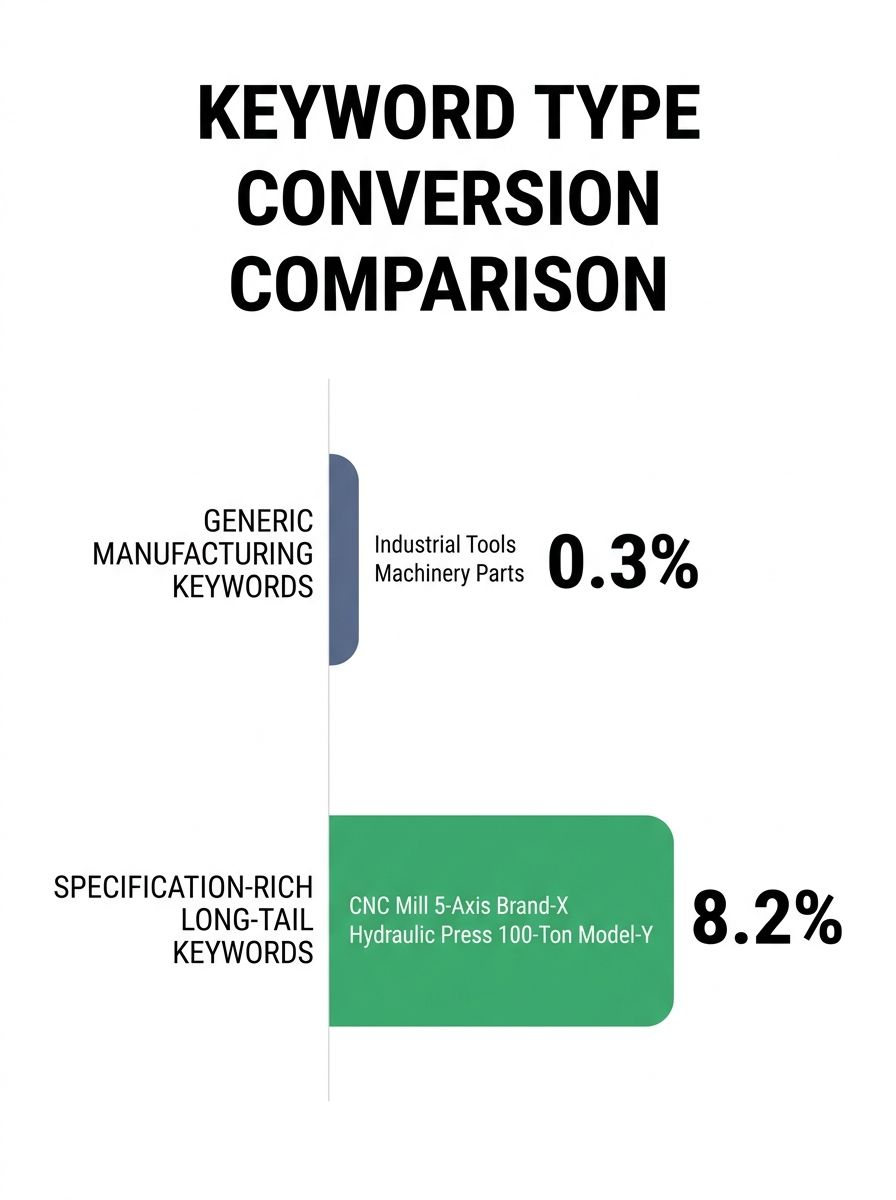
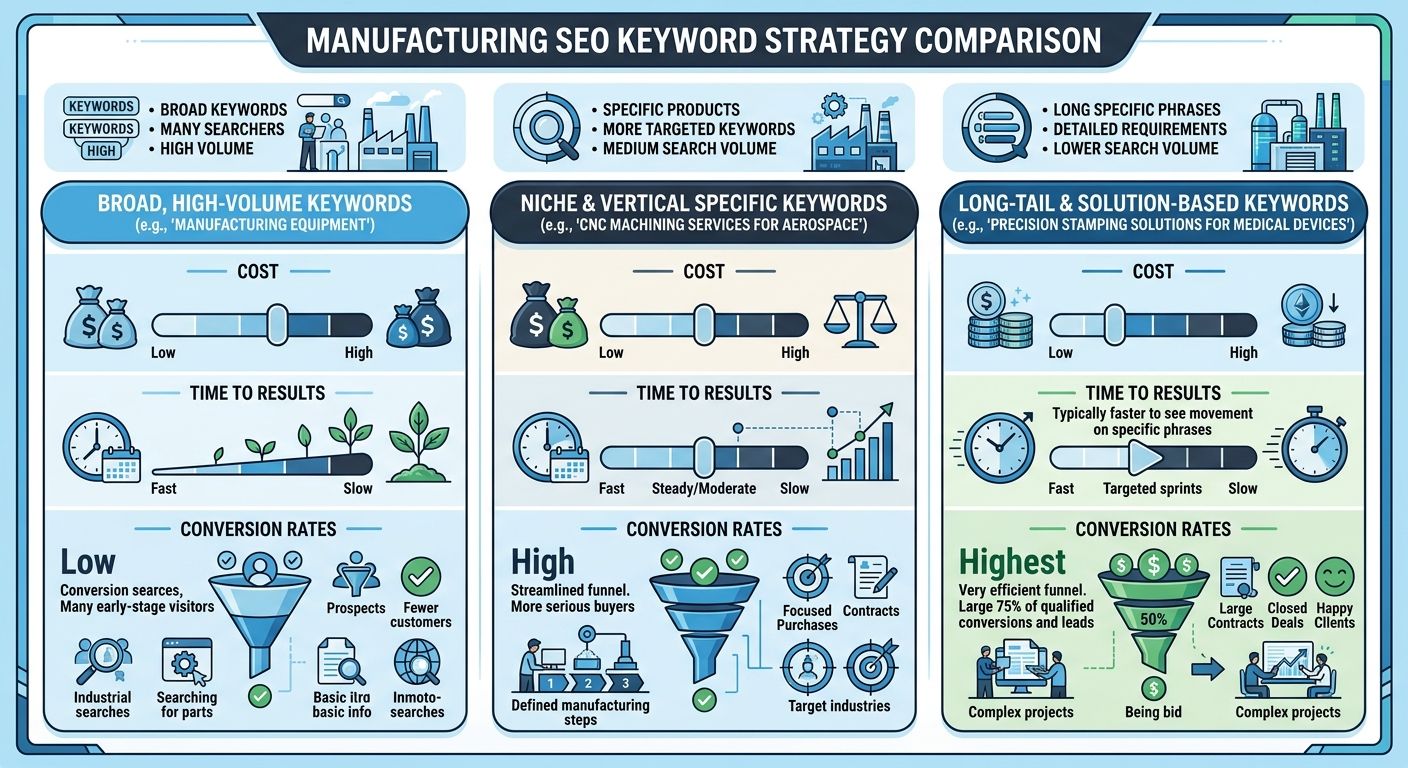
The average B2B purchase now involves 11.4 stakeholders, up from 6.8 in 2016. When a plant manager, procurement officer, and quality engineer all participate in the same buying decision, a keyword like "manufacturing equipment" serves none of them. That term pulls 14,800 monthly searches and converts at roughly 0.3% for most industrial sites. Compare that to "5-axis CNC machining center ISO 9001 certified," which pulls 90 searches per month but converts at 8.2% or higher.
Manufacturing SEO is specification-led. Buyers search for specific performance attributes, material properties, compliance certifications, and application requirements rather than brand names or general category terms. This matches what government procurement data confirms: on platforms like GSA Advantage, buyers use precise terms like technical specifications, NSNs, or exact product names instead of browsing general categories.
The question for any contract manufacturer or industrial equipment supplier is which research method will surface those high-conversion terms fastest. I've evaluated 200+ agencies over 12 years, and the ones that deliver real pipeline for manufacturers always anchor their approach in one of three strategies. Here's how each performs, what it costs, and where it breaks down.
Specification-Led Keyword Targeting
This approach builds your entire keyword map around technical specifications, part numbers, material grades, tolerances, and compliance standards. Google Keyword Planner surfaces high-frequency search terms for specific industrial equipment, including phrases like "industrial pump parameters" and "automation equipment specifications" that generic research tools often miss.
The process starts with your product catalog. Pull every spec sheet, every material datasheet, every certification badge. A typical contract manufacturer with 200 SKUs can generate 1,500 to 3,000 keyword variations from specs alone. Each combination of material (316L stainless steel), process (TIG welding), tolerance (±0.005"), and certification (AS9100D) creates a distinct search phrase that a real buyer types.
How It Works in Practice
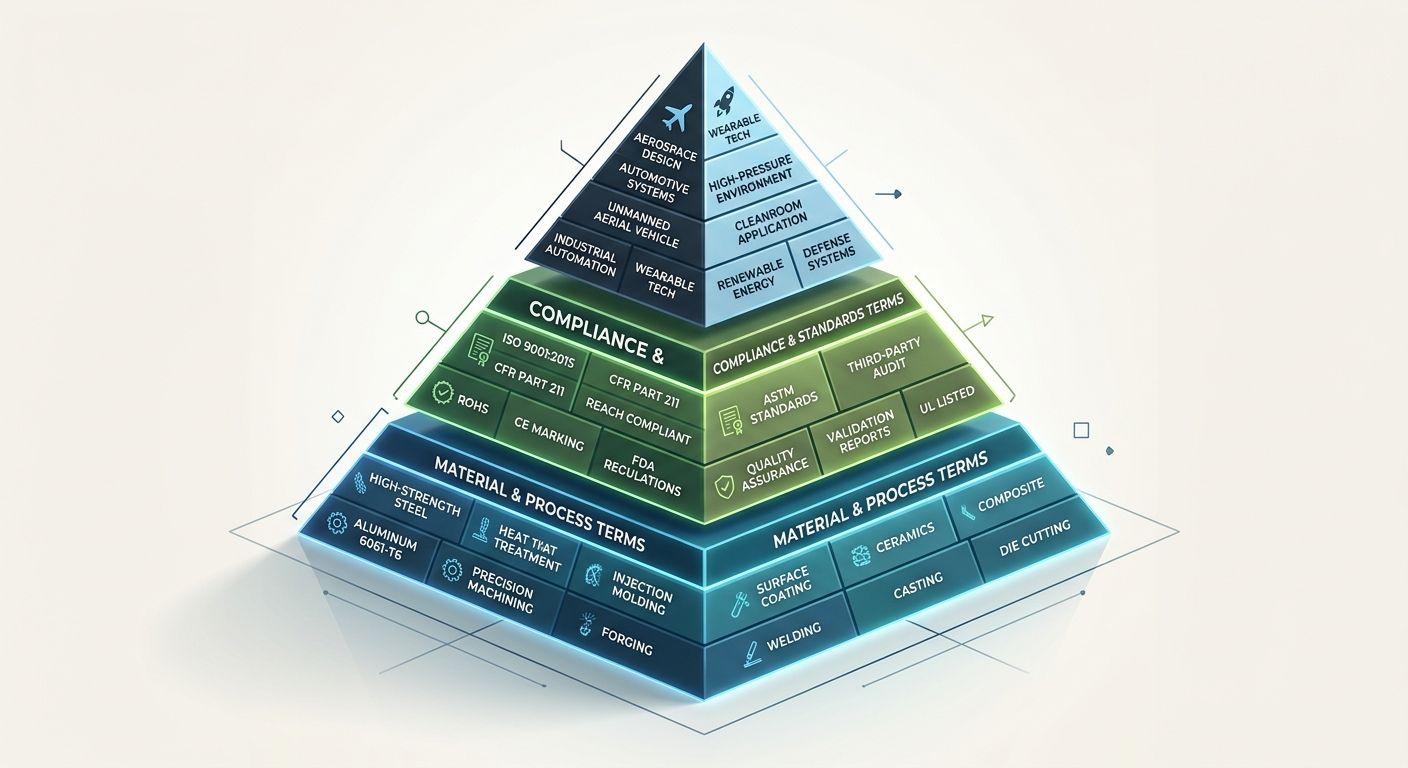
You build keyword clusters around three layers:
Material and process terms: "custom plastic injection molding," "aluminum die casting A380 alloy," "precision CNC turning brass 360"
Compliance and certification terms: "ISO 13485 medical device machining," "ITAR registered contract manufacturer," "FDA compliant silicone molding"
Application-specific terms: "aerospace bracket machining," "automotive fuel rail manufacturing," "semiconductor wet bench fabrication"
A specification-based keyword strategy often produces 72% of its qualified traffic from terms with fewer than 200 monthly searches. The volume looks small per term. The aggregate across 1,500+ variations adds up to substantial, qualified traffic.
Tradeoffs
The upside is clear: high intent, high conversion, low competition. Most of these terms have keyword difficulty scores under 25. You can rank on page one within 60 to 90 days for many of them.
The downside is labor. Building and maintaining a spec-led keyword database for 200+ products requires 40 to 80 hours of initial research. You need someone who understands the technical language. Agencies without manufacturing expertise consistently misidentify terms, targeting "metal cutting service" when buyers actually search "abrasive waterjet cutting 6061-T6 aluminum." That gap between generic and specific phrasing represents the difference between 0.5% and 9% conversion rates.
Intent Signal Keyword Mapping
This strategy uses buyer intent data to identify which companies and roles are actively researching your product category, then reverse-engineers the keywords those buyers use. As MarketBetter's 2026 guide explains, intent data "illuminates the dark funnel" enough to shift from reactive selling to proactive engagement.
Why does this matter for keyword research? Because the terms buyers use during active evaluation differ sharply from the terms they use during early awareness. A procurement officer comparing vendors searches "contract manufacturer lead time comparison medical devices," not "contract manufacturing." Intent signals tell you which phase your target accounts occupy and which keywords to prioritize for each phase.
How It Works in Practice
Consider the example from SupplyCo's research: a plant manager in Michigan downloading spec sheets for 5-axis machining centers, attending IMTS sessions on automation, and filing for equipment financing. Those three signals together indicate active buying intent. The keywords that buyer uses during this phase are specific: "5-axis simultaneous machining center under $500K," "Mazak vs DMG Mori 5-axis comparison," "5-axis machine shop financing options."
Intent mapping tools (Bombora, 6sense, TechTarget Priority Engine) track these signals at the account level. Bombora alone monitors intent signals across 5,000+ B2B topics and covers 86% of the Fortune 500. You feed account-level intent data into your keyword research to prioritize terms that active buyers search during evaluation.
The practical output looks like this:
Awareness phase keywords (15% of budget): "benefits of outsourcing precision machining," "when to use contract manufacturing"
Evaluation phase keywords (50% of budget): "CNC machining tolerances for medical implants," "ISO 13485 machine shop RFQ process"
Decision phase keywords (35% of budget): "contract machining quote request," "[your company] vs [competitor] lead times"
Tradeoffs
Intent mapping produces the highest ROI per keyword when it works. Organizations that connect SEO performance to revenue outcomes are 58% more likely to secure increased marketing budgets. The signal-to-noise ratio is strong because you're building content around terms that verified buyers actually search.
The downside is cost. Bombora starts at $25,000 per year for manufacturing verticals. 6sense pricing runs $36,000 to $120,000 annually depending on account volume. Smaller manufacturers with annual marketing budgets under $100,000 can't justify that spend. You also need a marketing operations person (or agency) capable of connecting intent data to keyword tools. That's a skill set many B2B SEO agencies claim but few demonstrate with manufacturing-specific results.
Stakeholder Segmentation Across the Buying Committee
This third approach segments keyword research by the roles involved in each purchasing decision. With 11.4 stakeholders per B2B purchase, a single keyword set misses most of the committee. The C-suite, the plant engineer, and the procurement officer all search differently for the same product.
How It Works in Practice
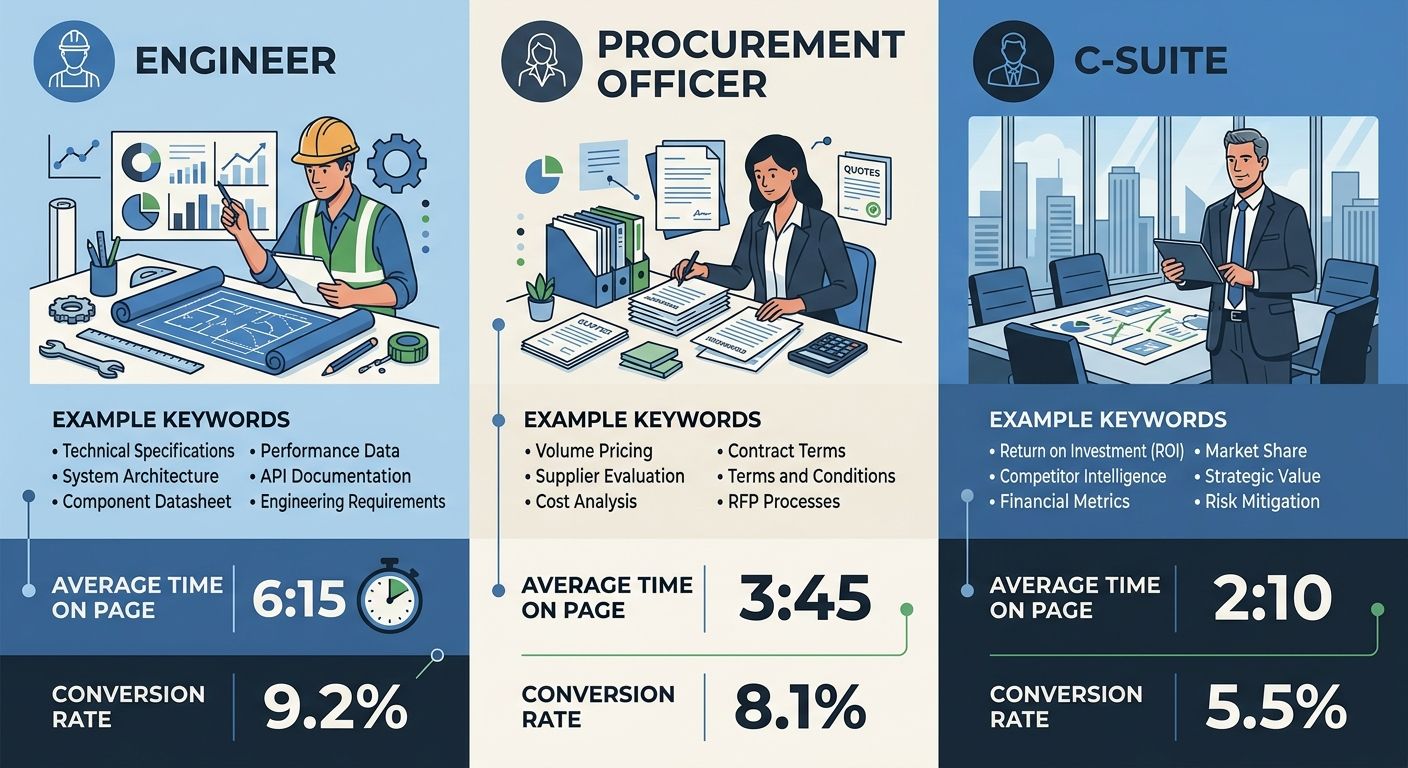
You build separate keyword clusters for each role:
For engineers and technical evaluators (the people writing specs): Terms focus on performance data. "Tensile strength 17-4PH stainless steel," "surface finish Ra 0.8 μm CNC grinding," "thermal conductivity copper alloy C110 vs C101." These terms get searched 3x to 5x more often on Tuesday through Thursday between 9 AM and 2 PM, matching the workday pattern of engineers doing active research.
For procurement officers (the people managing costs and compliance): Terms focus on supplier qualification. "AS9100D certified machine shops Midwest," "contract manufacturer DPMO rates," "supplier corrective action response time benchmarks." Procurement-specific pages convert 4.1% on average when they include pricing ranges, lead times, and capacity data.
For C-suite and operations leadership (the people approving budgets): Terms focus on business outcomes. "ROI of outsourcing precision machining," "reducing manufacturing lead time impact on revenue," "total cost of quality contract manufacturing." These pages need different content structures. Leadership readers spend 47 seconds on average per page, compared to 3 minutes 12 seconds for engineers reviewing spec sheets.
Tradeoffs
Stakeholder segmentation produces the broadest keyword coverage of the three approaches. You capture traffic from every role on the buying committee, which matters because the average industrial equipment purchase cycle runs 6 to 18 months with multiple touchpoints.
But this approach triples your content production requirements. Instead of one page per product or service, you need three to five pages, each optimized for a different stakeholder's search behavior. For a manufacturer with 50 service categories, that's 150 to 250 pages of content. Production costs run $300 to $800 per page when using writers with actual manufacturing expertise, pushing total investment to $45,000 to $200,000 before the first page ranks.
If your site architecture can't support that volume cleanly, you'll also face crawl budget and internal linking problems. Pages competing against each other for similar terms (cannibalization) is the number one technical SEO issue I see on manufacturing sites with 500+ pages.
Side-by-Side Comparison
Factor | Specification-Led | Intent Signal Mapping | Stakeholder Segmentation |
|---|---|---|---|
Setup cost | $3,000–$8,000 (research labor) | $25,000–$120,000/yr (tools + ops) | $45,000–$200,000 (content production) |
Time to first results | 60–90 days | 30–60 days (if content exists) | 120–180 days |
Best conversion rate | 8–12% on long-tail specs | 6–9% on intent-matched terms | 3–5% average across all roles |
Keyword volume per term | 10–200 searches/month | 50–500 searches/month | 20–1,000 searches/month |
Ongoing maintenance | 10–15 hrs/month | 20–30 hrs/month | 30–50 hrs/month |
Ideal catalog size | 100+ SKUs or services | 20–100 high-value products | 50+ service categories |
Required expertise | Technical writing + SEO | Marketing ops + data integration | Content strategy + manufacturing knowledge |
Works for contract manufacturer visibility | Strong | Moderate | Strong |
Who Should Pick Which
The honest answer is that most manufacturers with annual revenue above $10 million should combine two of these three approaches, not pick one. But your starting point depends on where you are today.
Pick specification-led targeting first if you have 100+ products or services, limited marketing budget (under $50,000), and technical staff who can support keyword research. This approach delivers the fastest wins with the lowest investment, and manufacturing SEO agencies that specialize in industrial clients almost always start here. It's the foundation that makes the other two approaches work better.
Add intent signal mapping if your average deal size exceeds $50,000 and your sales cycle runs longer than 90 days. The tool costs are steep, but one additional closed deal per quarter pays for a full year of Bombora. This approach works best when you already have spec-led content ranking, because the intent data tells you which existing pages to promote to accounts showing buying signals.
Layer in stakeholder segmentation if you're competing against well-funded competitors who already own the specification-driven search results. When you can't outrank a competitor for "ISO 13485 CNC machining," you build separate pages for the procurement officer searching "supplier audit checklist ISO 13485" and the VP of Operations searching "outsourcing medical device machining cost analysis." You surround the competitor's single-keyword advantage with 5 pages that cover the full buying committee.
The manufacturers I've watched fail at industrial equipment search optimization share one pattern: they treated keyword research as a one-time project instead of an ongoing system. Top-performing manufacturing pages should be reviewed every 90 days to refresh statistics and align with algorithm updates. New certifications, new materials, new compliance standards all generate new B2B technical buyer intent terms that your competitors haven't targeted yet. The window of opportunity for each new spec-driven keyword is 6 to 12 months before competitors notice the traffic. Whichever approach you choose, the manufacturers who run their research quarterly outperform those who run it annually by a wide margin on both traffic and pipeline generation.
Marcus Webb
Digital marketing consultant and agency review specialist. With 12 years in the SEO industry, Marcus has worked with agencies of all sizes and brings an insider perspective to agency evaluations and selection strategies.
Related Articles

The Manufacturing SEO Conversion Gap: Why Rankings Don't Equal Pipeline for B2B Industrial Firms
Ranking page one for "contract manufacturer" is actively harming the pipeline at dozens of industrial firms I've audited in the past three years. The ranking itself isn't the problem. The problem is what happens after the click: nothing. No RFQ. No qualified lead. No sales conversation.

From 800 to 12,000 Monthly Organic Visits: How One B2B Manufacturer Used Industry-Specific Schema to Dominate Technical Search
Industry-specific structured data drove a Pennsylvania thermoplastic manufacturer from 800 to 12,000 monthly organic visits over 14 months.
6 Ways SEO Agencies Misread Keyword Intent Data — and the Client Campaigns That Suffer for It
Keyword intent misalignment kills more SEO agency-client relationships than bad backlinks, thin content, and missed deadlines combined.
Explore more topics