
The Website Migration SEO Checklist: Pre-Launch Technical Validation That Prevents 90% of Ranking Loss
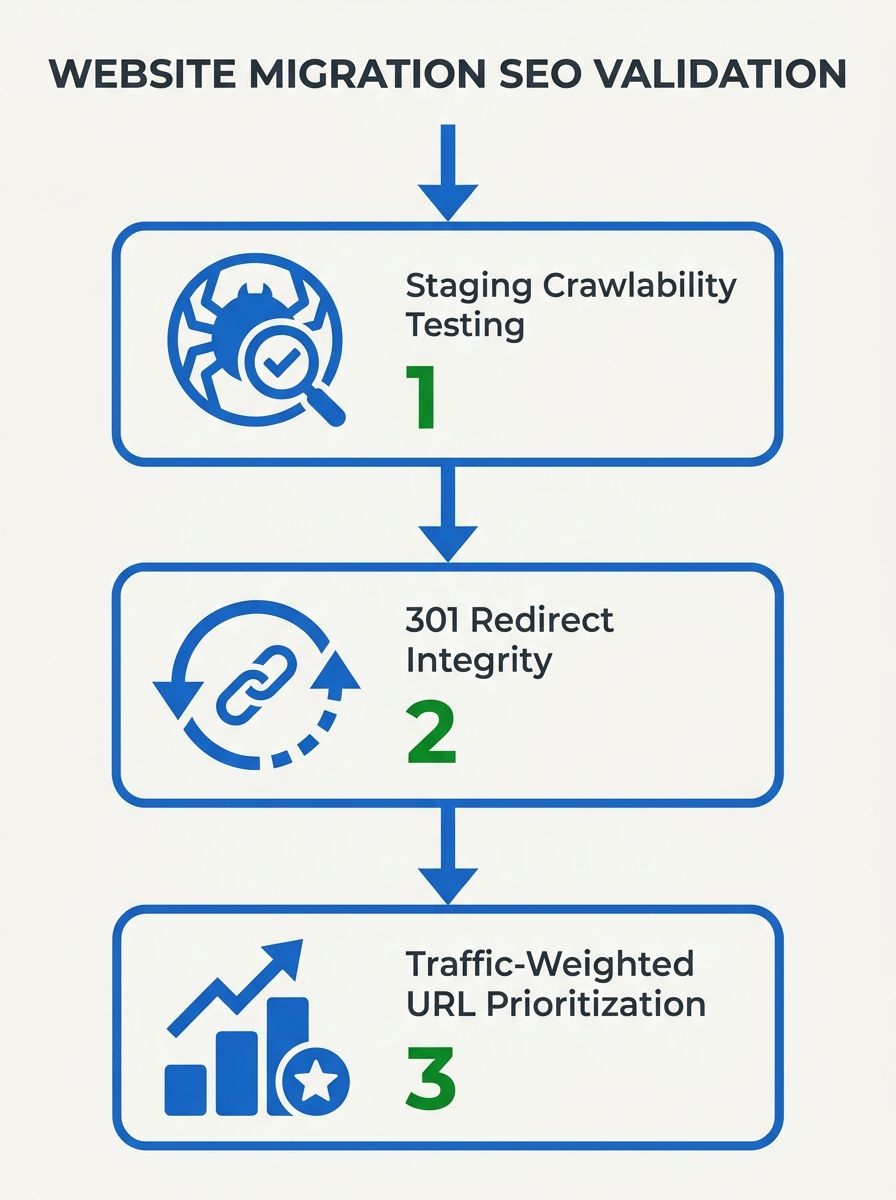
Pre-launch technical validation centered on 301 redirect integrity, staging crawlability, and traffic-weighted URL prioritization prevents the vast majority of organic ranking loss during website migrations.
 Marcus Webb··9 min read
The Website Migration SEO Checklist: Pre-Launch Technical Validation That Prevents 90% of Ranking Loss
Pre-launch technical validation centered on 301 redirect integrity, staging crawlability, and traffic-weighted URL prioritization prevents the vast majority of organic ranking loss during website migrations. Sites that skip structured pre-launch SEO validation face average recovery times exceeding 500 days, with 17% of migrated sites never recovering their pre-migration traffic levels.
I've reviewed the redirect maps for more than 40 agency-led migrations, both as a consultant and during my years running agency operations. The pattern repeats with distressing consistency: the development team treats the redirect file as a spreadsheet exercise they can finish the Friday before launch, the SEO team assumes devs understand why redirect chains matter, and nobody crawls the staging environment with the same tools they'd use on a production site. The client loses 30-60% of their organic traffic within two weeks. The agency scrambles. The relationship erodes. I've watched this happen with agencies billing $15,000/month and agencies billing $150,000/month — budget alone doesn't protect you from a broken process.
For white-label SEO providers, the exposure compounds. When you're executing a migration on behalf of a partner agency, your name isn't on the deliverable, but the ranking loss traces directly back to your team. The partner agency didn't hire you to be the reason their client's organic revenue cratered during Q4. A disciplined website migration SEO checklist, validated before the DNS switch, is the single most important deliverable in any white-label migration engagement. I've written previously about the hidden technical mistakes that destroy post-migration rankings, but this piece goes further upstream — into the pre-launch validation protocols that prevent those mistakes from reaching production in the first place.
Why the 301 Redirect Audit Framework Collapses at Scale
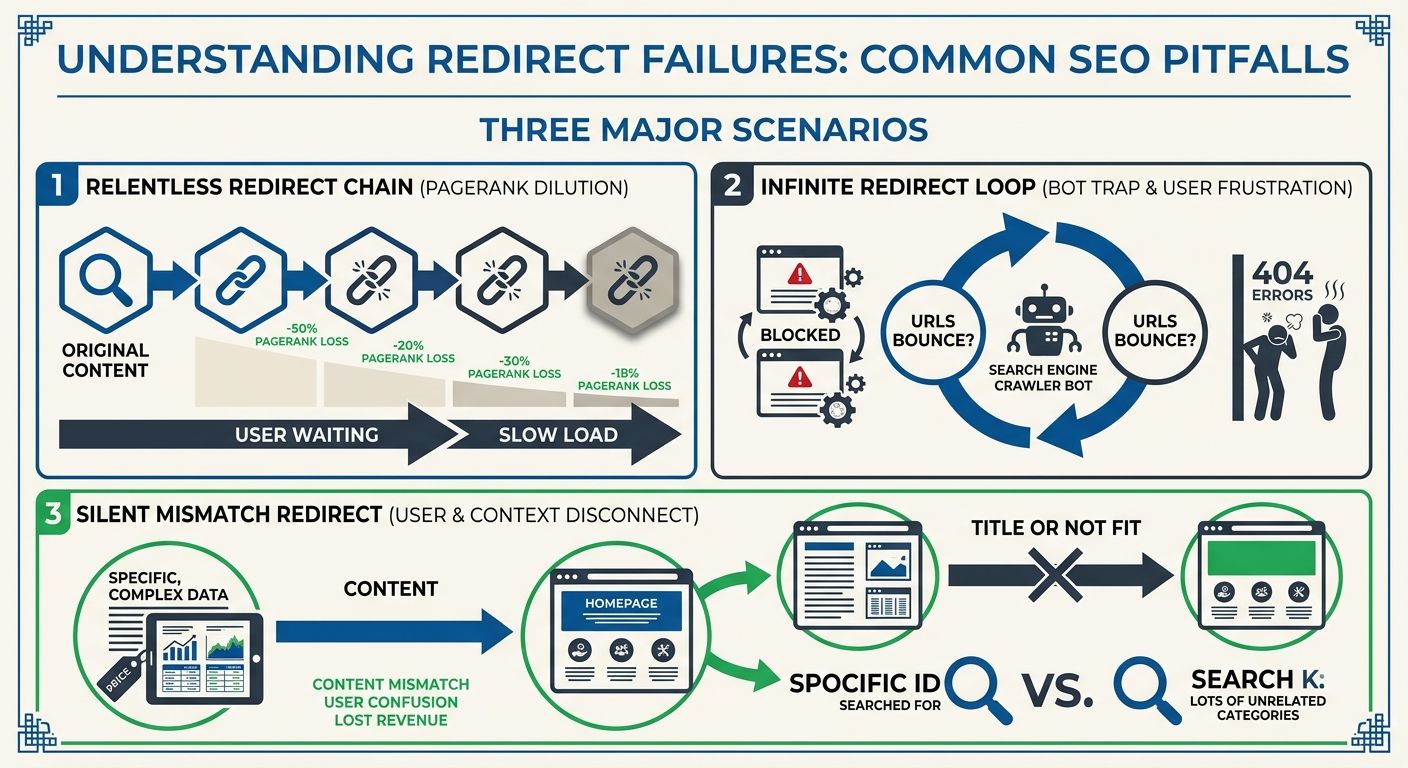
The most common cause of significant ranking loss during migration is missing or incorrectly configured 301 redirects, according to Dynadot's domain migration analysis. That finding aligns with every migration postmortem I've conducted. The redirect map is where migrations go to die, and the failures cluster into three categories that a proper 301 redirect audit framework catches before launch: chains, loops, and silent mismatches.
Redirect chains — where URL A redirects to URL B, which redirects to URL C, which finally resolves to URL D — drain PageRank at each hop and confuse crawlers. Screaming Frog's redirect checker allows you to enter any URL and see the full redirect path, exposing chains of five, six, or seven hops that nobody on the migration team knew existed. On enterprise sites with 50,000+ URLs, I've seen redirect maps where 12-18% of entries pointed to intermediary URLs from a previous migration rather than the final destination. Each of those chains bleeds authority that the client paid years to build. As Softtrix's technical SEO audit guidelines state plainly: "Never use redirect chains and loops, as they will waste time on crawling the site and disorient the crawlers."
Redirect loops — where URL A points to URL B and URL B points back to URL A — are rarer but catastrophic. They generate infinite redirect errors that prevent both users and crawlers from reaching the destination page. A single loop buried in a 10,000-row redirect map can affect an entire subdirectory if the pattern is inherited through regex-based redirect rules. The fix is mechanical but tedious: every redirect rule in the map needs validation against both the source URL list and the destination URL list before launch. You test each rule against both databases. There's no shortcut that works reliably.
Silent mismatches are the subtlest problem and the one I see white-label teams miss most often. A silent mismatch occurs when a redirect technically works — the old URL returns a 301, the new URL returns a 200 — but the destination page is semantically wrong for the original query. Redirecting a category page for "red shirts" to the homepage rather than the parent "shirts" category, as Zozimus Agency's redirect audit guide illustrates, preserves the HTTP status code while destroying the topical relevance signal. Google treats this as a soft 404 over time. The ranking value evaporates within 4-8 weeks, and by then the migration team has moved on to their next engagement.
Migration Crawlability Testing the Staging Environment
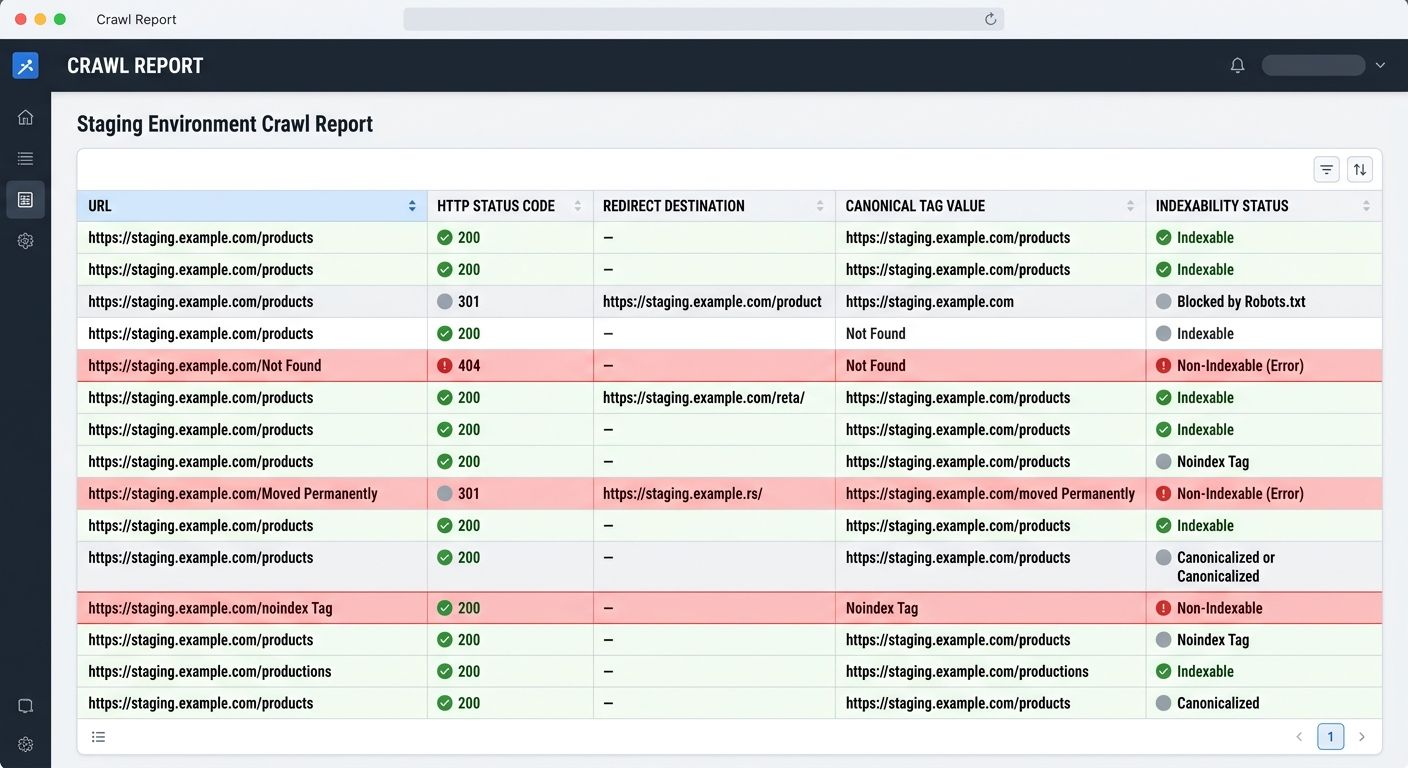
Migration crawlability testing on a staging environment is where pre-launch SEO validation either proves itself or reveals that the checklist was performative. The staging site should be crawled with the same tools — Screaming Frog, Sitebulb, or your crawler of choice — using the same configuration you'd apply to the production site. Yet fewer than one in three migration teams I've audited actually performed a full crawl of staging before launch.
The staging crawl serves four specific purposes. First, it validates that the redirect map produces the correct HTTP status codes (301s, not 302s) and resolves to the intended destination URLs. Second, it confirms that noindex directives are present on the staging environment itself — Semrush's migration checklist specifically warns that staging environments must be blocked from indexing to prevent duplicate content issues with the production site, a step I've seen skipped on roughly 25% of the migrations I've reviewed. Third, the staging crawl surfaces broken internal links that the development team introduced during the URL structure changes. Fourth, it verifies that canonical tags on the new site point to the correct new URLs rather than the old domain, a problem that persists on 30-40% of migrated sites for weeks after launch when nobody validates it beforehand.
The timing matters as much as the crawl itself. Webflow's migration guide emphasizes that "a quiet window gives you space to validate redirects, templates, and analytics before search engines recrawl the full website." Launching during peak traffic hours — Monday at 10am, for instance — means that any issues you discover are already affecting real users and real revenue before you can fix them. I recommend launching between 10pm and 2am on a Tuesday or Wednesday, when organic traffic is typically at its weekly low. The 4-hour window after launch is your validation period: you're comparing the live site's crawl behavior against the staging baseline and confirming that Search Console isn't reporting a spike in crawl errors.
For white-label teams, this staging validation step is also your proof-of-work documentation. If the partner agency's client loses rankings 6 weeks after migration and points the finger at your team, the staging crawl report is your defense. It shows exactly what you validated, when you validated it, and what the HTTP status codes were at the time of launch. I keep these reports for a minimum of 12 months. The enterprise SEO governance frameworks that are gaining traction in 2026 all emphasize this kind of documented validation chain, and white-label migration work should follow the same standard.
Traffic-Weighted URL Prioritization Changes the Math
Enterprise SEO migration planning breaks down when teams try to give equal attention to every URL. A site with 200,000 indexed pages cannot receive the same per-URL validation effort as a 500-page corporate site. The math doesn't work, the budget doesn't support it, and it isn't necessary. The principle that the top 20% of pages drive 80% of organic traffic holds true on virtually every site I've audited, and migration validation should reflect that distribution directly.
The process starts with pulling 12 months of organic landing page data from Google Analytics and Google Search Console. You're looking for every URL that received at least one organic click in the past year, ranked by sessions, and you're tagging each one with its primary ranking keyword cluster and average position. The top 20% of those URLs by organic traffic become your Tier 1 validation targets. These pages get individual redirect verification, canonical tag confirmation, metadata comparison (title tag, meta description, heading structure), internal link integrity checks, and structured data validation. Edge45's migration checklist recommends validating "core technical signals such as indexability, mobile setup and structured data at a high level," and for Tier 1 pages, that validation needs to happen at a granular, page-by-page level rather than through sampling.
Tier 2 pages — the next 30% by traffic — get redirect verification and canonical checks, but metadata and structured data are validated through sampling rather than exhaustive review. Tier 3 pages — the remaining 50% — get redirect validation only, typically through automated crawl comparison rather than manual review. This tiered approach allows a team of 2-3 SEO analysts to thoroughly validate a 100,000-page migration in 15-20 working days rather than the 60-80 days an equal-attention approach would demand. For white-label providers billing on fixed project fees, this is the difference between a profitable engagement and a loss leader.
The IoVista 2026 migration checklist captures the launch-day essentials: "Remove noindex tags, activate redirects, confirm analytics and tracking, verify SSL, and test key pages immediately after go-live." That "test key pages" instruction is doing enormous work in that sentence. If you haven't already defined which pages are "key" through traffic-weighted prioritization, you're guessing at launch — and guessing during a migration is how you end up explaining a 45% traffic drop on a Friday afternoon call. The internal link architecture of the new site also needs attention before launch, a discipline that connects to how developer teams can build SEO validation into their deployment pipeline rather than treating it as a post-launch afterthought.
Submitting the Change of Address tool in Google Search Console before redirects are fully live and verified is another failure mode that Dynadot's analysis flags as a direct cause of ranking loss. The Change of Address signal tells Google to start transferring ranking signals to the new domain immediately. If your redirects aren't in place — or worse, if they're pointing to incorrect destinations — you've asked Google to propagate errors across your entire domain's ranking profile. The Change of Address submission should be the last step, executed only after the post-launch crawl confirms that Tier 1 and Tier 2 redirects are resolving correctly. SeoProfy's migration service documentation reinforces this sequencing: audit the current site, map old URLs to new URLs, prepare redirects, check metadata and canonicals, test the staging site, validate tracking, and only then monitor performance after launch.

What This Leaves Unresolved
The framework I've outlined above catches the failures I see most often, and it works within the budget and timeline constraints that white-label SEO providers actually operate under. But there are gaps I haven't fully solved, and I don't think the industry has either.
The biggest unresolved question is AI crawler behavior during migrations. Traditional Googlebot crawl behavior during a domain migration is well-documented: it follows 301s, transfers PageRank (with some deprecation), and re-indexes the new URLs within days to weeks depending on the site's crawl budget. But the AI search agents from Perplexity, ChatGPT's browsing mode, and Google's own Gemini-powered features don't necessarily follow the same patterns. Some AI crawlers don't render JavaScript at all, making headless or single-page application migrations particularly risky in ways that a staging crawl focused on Googlebot user-agent behavior won't catch. I've started including separate user-agent testing for known AI crawlers in my pre-launch validation, but the landscape of AI search visibility requirements is shifting fast enough that any specific crawler list I publish today will be incomplete within months.
The second gap is post-migration monitoring duration. The standard recommendation — and the one I give clients — is 90 days of active monitoring after launch, tracking indexed page counts, crawl errors, and organic traffic weekly. But I've seen migrations where the ranking impact didn't fully manifest until month 4 or 5, especially on sites where Google's crawl rate for deep pages is low. The 17% of sites that never recover their pre-migration traffic levels likely include a significant portion where the monitoring window was too short and the team had already declared the migration successful. I don't have a clean answer for how long monitoring should extend, particularly for white-label providers whose project scope and billing typically end at the 90-day mark.
And there's a third issue that's more organizational than technical. The best website migration SEO checklist in the world fails when the SEO team doesn't have authority to block a launch. I've been in rooms where the development deadline was set by a contract obligation or a board presentation, and the SEO team's staging crawl surfaced 2,000 redirect errors on a Wednesday with the launch scheduled for Friday. The migration launched on Friday. The rankings collapsed on Monday. The SEO team had the data to prevent it and lacked the organizational standing to act on it. That's a governance problem, and it's where the intersection of diagnosing hidden technical blockers and enterprise decision-making structures gets uncomfortable. Pre-launch validation only prevents ranking loss if someone with authority is willing to delay the launch when the validation fails. Without that commitment, the checklist becomes documentation of a preventable disaster rather than prevention of one.
Marcus Webb
Digital marketing consultant and agency review specialist. With 12 years in the SEO industry, Marcus has worked with agencies of all sizes and brings an insider perspective to agency evaluations and selection strategies.
Related Articles
Website Domain Migration Without Ranking Loss: The Complete 301 Redirect and Authority Preservation Playbook
A domain migration preserves rankings when three things execute correctly: complete 1:1 URL mapping with permanent 301 redirects, a pre-migration technical SEO audit that benchmarks every ranking signal worth protecting, and aggressive post-launch monitoring for at least 12 weeks.
Website Migrations Trigger 50% Traffic Drops That Persist Up to 18 Months When SEO Teams Miss Launch Window, Analysis Shows
Website migrations that exclude SEO teams during planning cause organic traffic drops exceeding 50 percent and require 12 to 18 months of recovery work, according to a Search Engine Journal technical analysis published June 5, 2026. The research distinguishes normal post-migration volatility (10-30

SEO Platform GadgetsFarms Publishes Website Migration Framework Detailing Redirect Strategy and Traffic Protection
GadgetsFarms published a website migration framework on August 27 addressing URL inventory management, redirect mapping, and organic traffic preservation during platform moves, according to the guide released on the platform's blog.
Explore more topics