
Multi-Local Market SEO Framework Shows 50% Traffic Gains in Retail Case Study, ACAI Analysis Reports
ACAI published a multi-local market SEO framework June 13 documenting how localized content strategies delivered a 50% increase in local traffic and 30% conversion rate improvement for a global retail brand, according to analysis posted on the platform. A separate tech startup case study showed 40%
 Marcus Webb··3 min read
Multi-Local Market SEO Framework Shows 50% Traffic Gains in Retail Case Study, ACAI Analysis Reports
ACAI published a multi-local market SEO framework June 13 documenting how localized content strategies delivered a 50% increase in local traffic and 30% conversion rate improvement for a global retail brand, according to analysis posted on the platform. A separate tech startup case study showed 40% faster time-to-market and 60% higher user engagement through content management system optimization.
The framework addresses content duplication penalties that occur when businesses replicate identical pages across regional markets. Search engines penalize duplicate content regardless of geographic targeting, creating scaling friction for multi-location brands attempting to maintain local relevance without editorial redundancy.
Case Study Performance Data
The global retail implementation measured performance across regional content variations over an unspecified period. The 50% local traffic increase and 30% conversion rate gain followed deployment of customized regional content rather than translated duplicates, the analysis states.
The tech startup case reduced content production cycles from planning to publication by 40% using content management system features including multilingual support and geo-targeting capabilities. User engagement rose 60% compared to prior non-localized baseline metrics, according to the case study data ACAI cited.
Neither case study identified the companies by name or disclosed implementation timelines. The analysis did not specify measurement periods for the reported percentage gains.
Framework Components for Regional Scaling
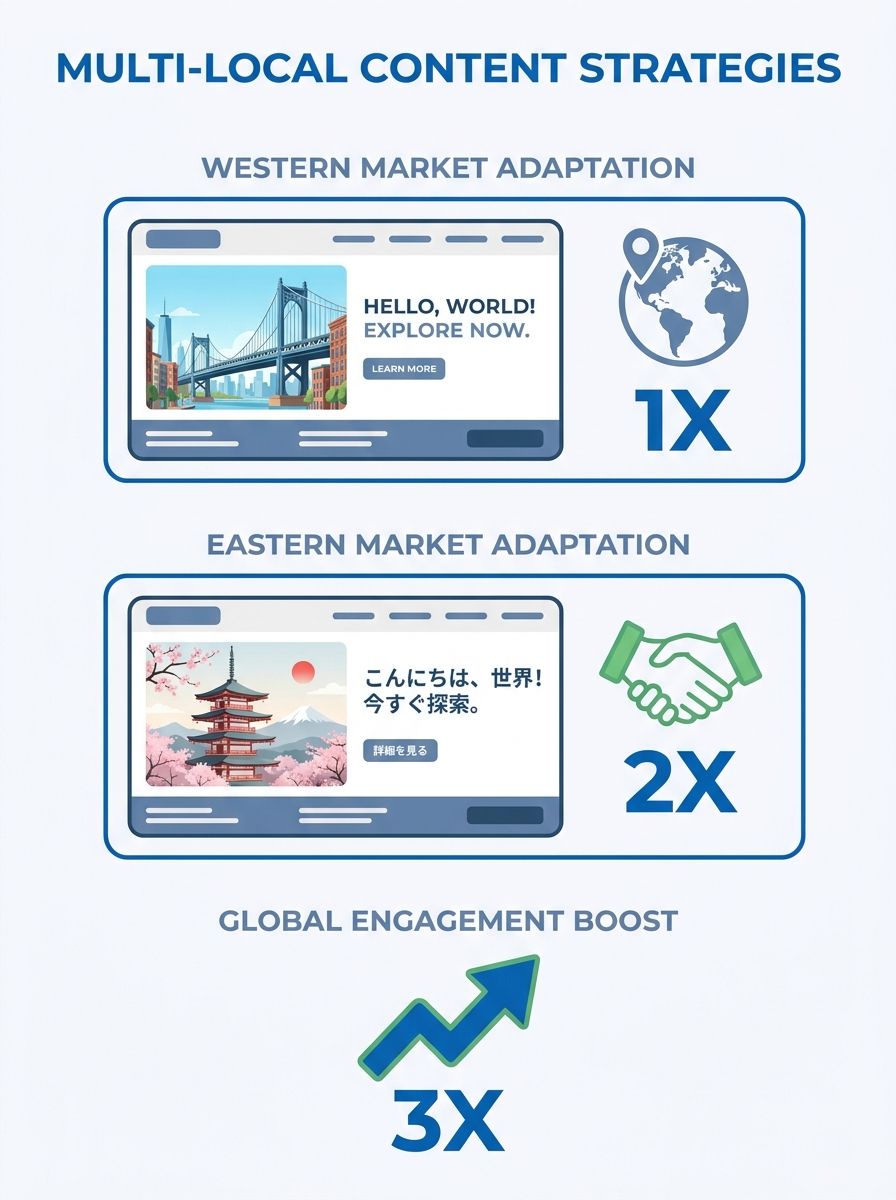
The ACAI framework distinguishes content customization from duplication through three criteria: cultural adaptation of language idioms and examples, locally relevant imagery selection, and market-specific user experience adjustments that extend beyond direct translation.
Template structures emerged as the recommended scaling mechanism. The analysis positions templates as efficiency tools that provide consistent information architecture while accommodating regional customization in headlines, product descriptions, and calls-to-action without producing identical content strings search engines would flag.
The framework recommends content management systems with native multilingual support, geo-targeting rule engines, and version control for regional variants. Google Analytics and SEMrush received specific mentions as tracking tools for localized content performance measurement, the analysis notes.
Best practices outlined in the publication include three operational guidelines: investing in professional localization rather than automated translation, maintaining market-specific editorial calendars for timely regional relevance, and conducting regular analytics audits to identify underperforming local variants.
The analysis links content quality to engagement metrics including time-on-page and bounce rates, positioning these user experience signals as search ranking factors that reward culturally appropriate localization. Search engines favor content that resonates with local audiences through reduced bounce rates and increased session duration, the framework states.
Technology Integration Requirements
Content management system selection criteria emphasized features beyond basic multilingual capabilities. The analysis identified version control systems that track regional content variations, workflow tools that route content to market-specific editors, and publishing controls that prevent cross-regional content syndication as technical requirements for duplication avoidance.
Analytics integration focuses on geographic segmentation that isolates regional performance metrics. The framework recommends tracking organic search traffic, conversion rates, and engagement metrics separately for each market to identify localization effectiveness and justify continued investment in regional content production.
The publication referenced Moz's international SEO guide as supplemental reading for technical implementation details including hreflang tag configuration and regional URL structure decisions between subdirectories, subdomains, and country-code top-level domains.
Context and Outlook
Multi-location SEO management represents a structural challenge for agencies serving franchises, retail chains, and service businesses operating across metropolitan markets. Search Engine Journal's updated multi-location framework for AI-powered search noted similar tensions between content efficiency and local differentiation, while local SEO ranking plateaus often stem from insufficient geographic customization depth.
The case study data ACAI published lacks controls and sample size disclosures that would contextualize the 50% and 60% performance gains. Marketing managers evaluating localization investments require baseline metrics, implementation costs, and time-to-result data beyond percentage-gain headlines to build business cases for regional content production.
Template-based scaling introduces quality control challenges agencies must address through editorial governance. The framework's emphasis on "quality localization" without specifying cost structures, headcount requirements, or review workflows leaves implementation details undefined for CMOs planning multi-market campaigns. Google's May 2026 core update rewarded intent-matched pages over domain authority, suggesting localized content quality carries ranking weight, but agencies need operational models that deliver cultural customization at sustainable cost per market.
Marcus Webb
Digital marketing consultant and agency review specialist. With 12 years in the SEO industry, Marcus has worked with agencies of all sizes and brings an insider perspective to agency evaluations and selection strategies.
Related Articles

Search Engine Journal Updates Multi-Location SEO Framework for AI-Powered Search Era
Search Engine Journal published a revised multi-location SEO framework on June 9 that repositions Google's local ranking factors as entity-matching mechanisms rather than directory lookups, according to the guide authored by the publication's technical SEO team. The framework addresses how businesse

Multilingual Websites Require Platform-Specific Optimization Beyond Google as Hebeos Publishes 2026 International SEO Framework
Correct hreflang implementation with reciprocal tags, deliberate URL architecture choices, and native-language keyword research per market form the technical foundation for international search visibility, according to a multilingual SEO framework published September 17 by Hebeos, a web localization

AI Models Collapse Regional SEO Authority Signals Into Single Global Representation
Large language models trained on multi-market content fail to preserve local authority signals that international SEO teams build site-by-site, instead collapsing 40 regional websites into a single composite brand impression that erases market-specific expertise demonstrations, according to an analy
Explore more topics