
Portfolio Optimization for Architecture Firms: The SEO Checklist Beyond Beautiful Images
Architecture firm portfolios rank among the most visually impressive pages on the web and among the worst-performing in organic search.
 Marcus Webb··9 min read
Portfolio Optimization for Architecture Firms: The SEO Checklist Beyond Beautiful Images
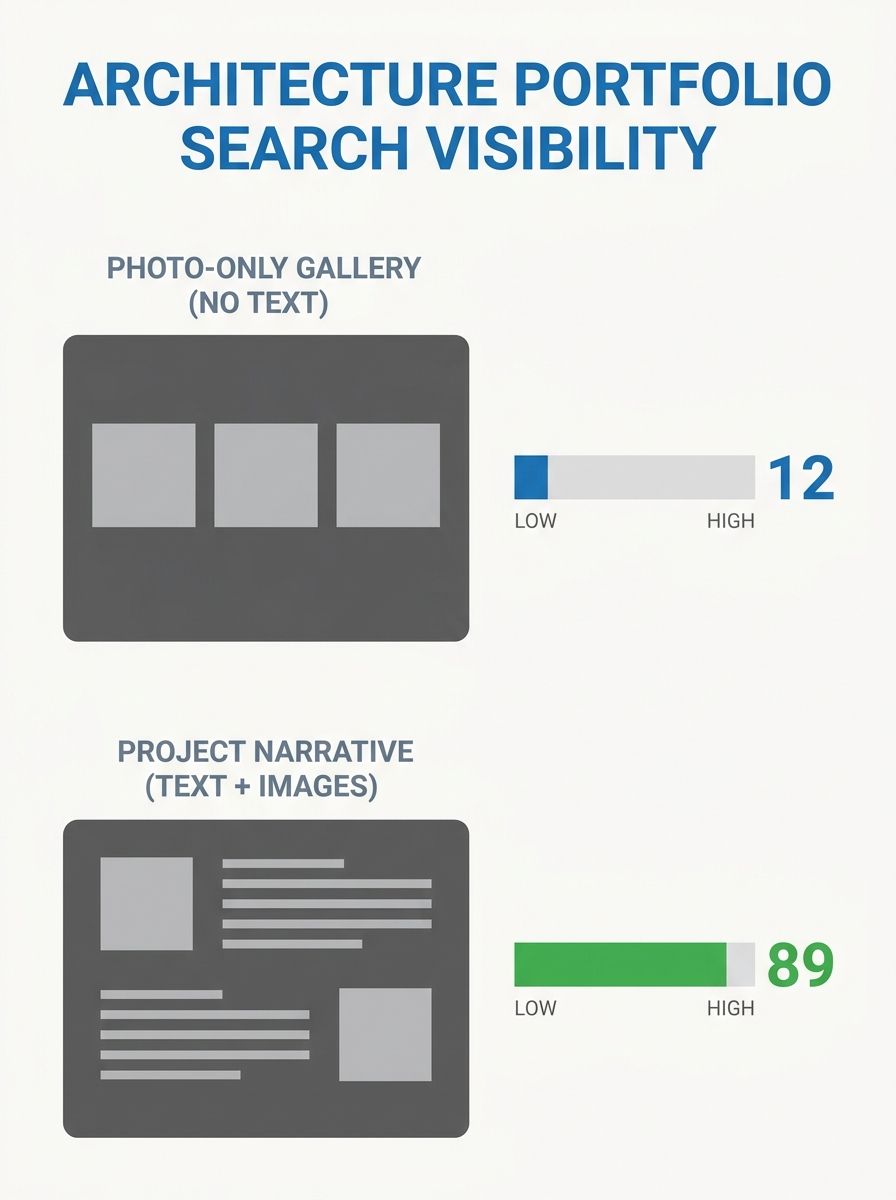
Architecture firm portfolios rank among the most visually impressive pages on the web and among the worst-performing in organic search. The disconnect is structural: high-resolution project galleries carry almost zero indexable text, bloated file sizes, and no schema markup, which means Google treats them as decorative dead weight rather than lead-generating assets.
The seven rules below are what I hand to every white-label partner and in-house team before they touch an architecture firm's portfolio. They're ordered by impact, and each one addresses a specific failure mode I've seen undermine architecture firm lead generation despite gorgeous design work. Firms using SEO-optimized images paired with detailed case studies see up to 65% higher engagement rates than firms relying on visuals alone, according to industry benchmark data. That gap is entirely fixable.
Write 300 words of project narrative before you upload a single photo
Search engines can't rank what they can't read. Architecture firm portfolio pages averaging fewer than 50 words of body text consistently lose to pages with 300+ words of descriptive copy. Envision IT Solutions' guide to portfolio optimization states directly: "Your portfolio should not only highlight previous projects but also narrate stories behind each design." Rich content including project descriptions, material choices, zoning challenges, and client testimonials gives Google the textual signals it needs to match the page to real queries.
Each project page should cover the project's location (city, neighborhood), the building type (residential, commercial, mixed-use), the square footage, the timeline, the specific design challenges solved, and the materials used. This copy serves two audiences simultaneously. It helps architecture portfolio SEO by giving crawlers keyword-rich text, and it builds credibility with prospective clients who want to understand your design process before making contact.
For white-label teams building these pages on behalf of architecture clients, I recommend a standardized brief template the firm completes for each project. You handle the on-page optimization; they supply the narrative details only they know. A 12-question intake form covering location, scope, materials, client goals, and design constraints produces enough raw material for 400 to 500 words per page with minimal editing.
Name every image file like a search query, not a camera export
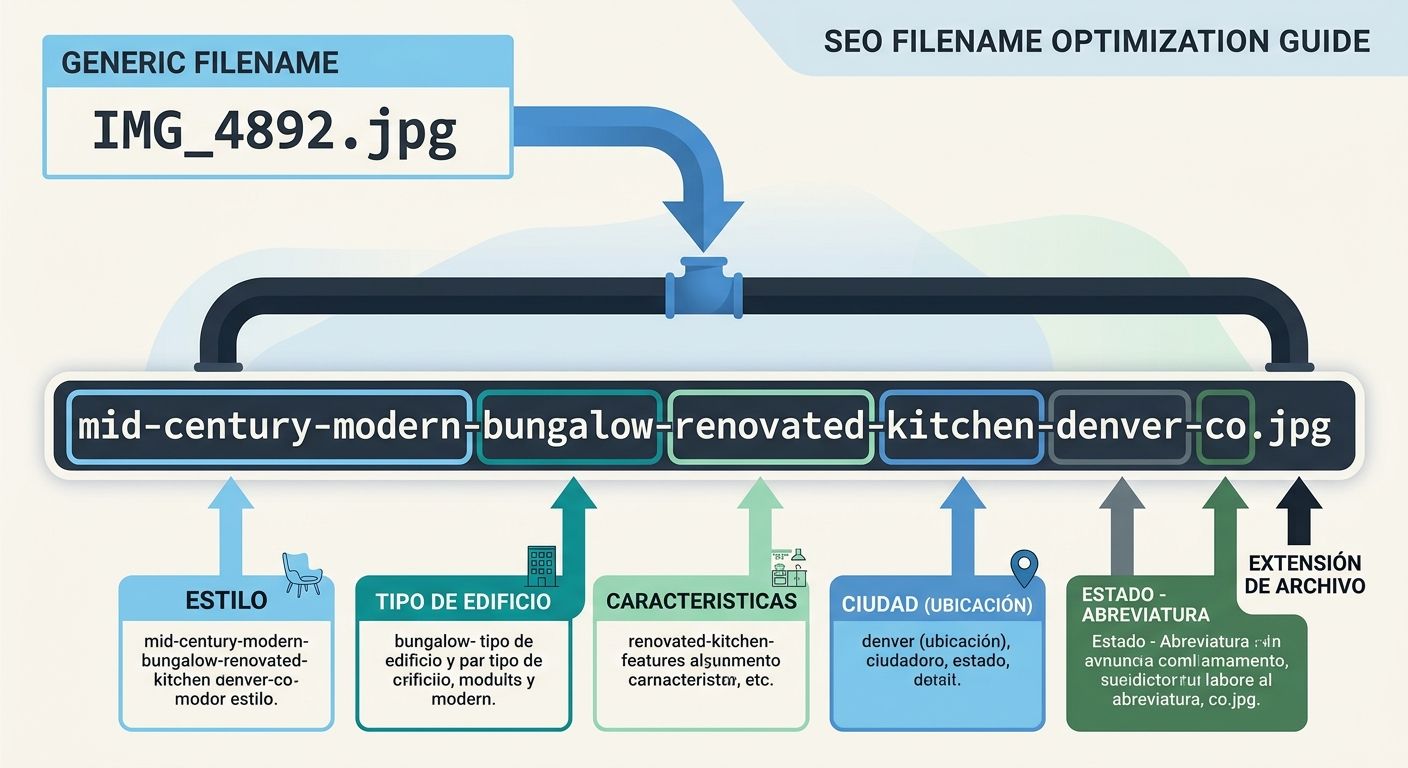
Image optimization for architects starts at the file system level, before any image touches a CMS. A file named "IMG_4892.jpg" tells Google nothing. A file named "modern-residential-kitchen-design-portland-me.webp" communicates what the image depicts, where the project sits geographically, and what service category it represents.
Marketing LTB's 2026 image optimization guide documented a site built entirely on this approach: "The file names were descriptive. The alt text was specific. Every image was compressed, resized, and formatted correctly before uploading. The surrounding content on each page gave Google the context it needed." Within 3 to 6 months, the site began ranking in both Google Images and standard organic results.
Here's the naming convention I give to white-label teams:
Format: [style]-[building-type]-[feature]-[city]-[state-abbreviation].webp
Example: contemporary-office-lobby-glass-facade-austin-tx.webp
Alt text: Expand the filename into a natural sentence: "Contemporary office lobby with glass facade designed by [Firm Name] in Austin, Texas"
Every portfolio page for a typical architecture firm carries 8 to 15 images. That's 8 to 15 opportunities for keyword-rich file names and alt attributes per page, which compounds across a portfolio of 20 to 40 projects into hundreds of indexable image signals. The volume effect matters: Google's systems interpret consistent, descriptive naming patterns as a quality signal across the entire domain.
Add visible captions beneath every portfolio image
This rule surprises most teams, but the evidence behind it is direct. Digital Applied's 2026 image SEO guide describes visible image captions as "a powerful and underused image SEO signal," explaining that "Google reads captions as high-confidence context for what an image depicts, often weighted more heavily than alt text because they are visible to users."
Captions serve a different function than alt text. Alt text is a fallback for screen readers and broken images. Captions are visible, editorial descriptions that contextualize the image for human visitors while simultaneously feeding Google high-confidence textual signals. For architecture portfolio pages, each caption should identify the specific element shown ("South-facing living area with floor-to-ceiling glazing, Napa Valley residence, 2024"), the materials or techniques used, and the design intent behind the featured space.
The implementation cost is trivial. Most CMS platforms support image captions natively. White-label teams already running technical SEO audits for client acquisition should add caption presence to their architecture-specific audit checklist. A single descriptive sentence of 10 to 20 words per image is sufficient.
Implement LocalBusiness and ImageObject schema on every project page
Portfolio site structured data is the technical layer that translates visual content into machine-readable context. Without it, search engines guess at the relationship between your firm, your projects, and the locations you serve.
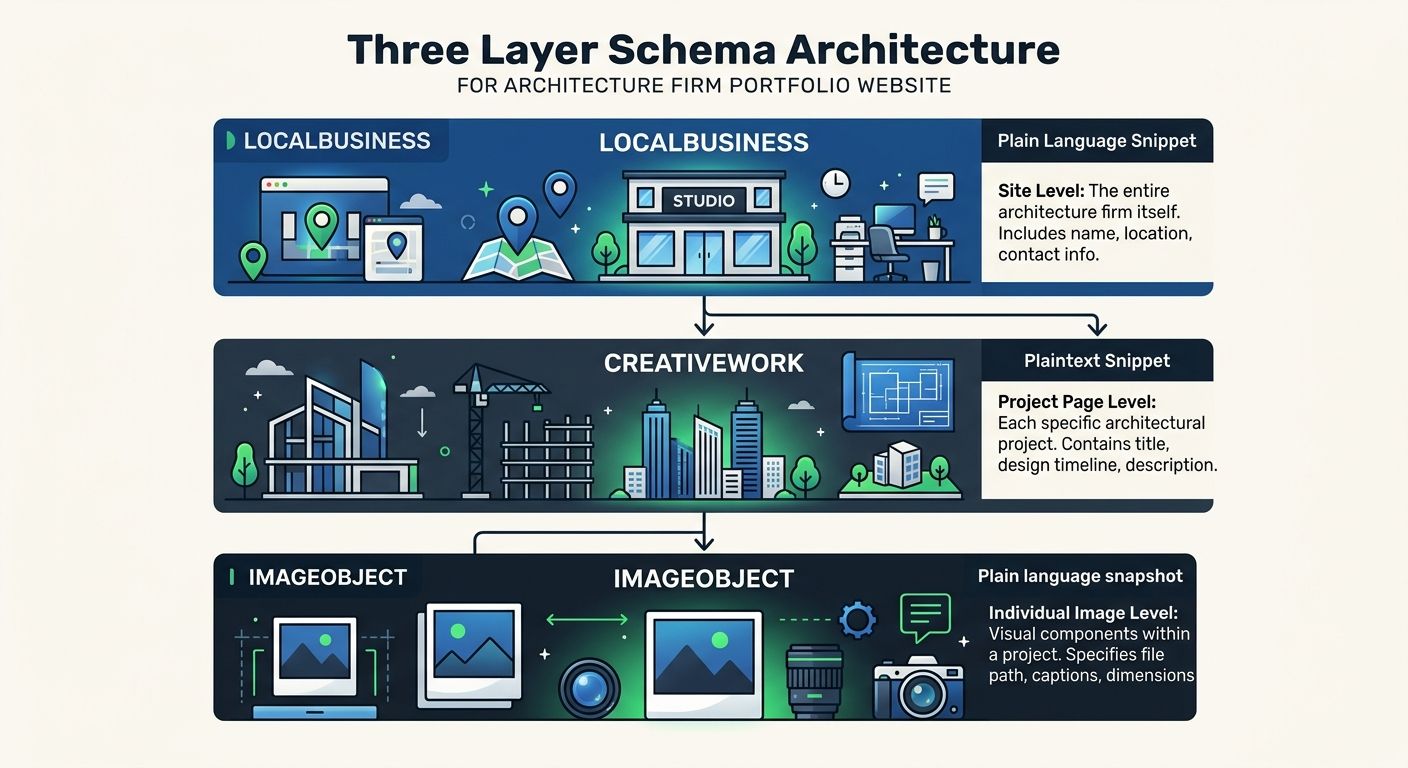
Padula Media's architecture SEO guide recommends that firms "employ LocalBusiness schema markup to detail your architecture firm's essential information, like name, address, contact, and hours of operation, to search engines." They also advise using Product schema on distinct architectural designs or services to improve presence in search results. For architecture portfolios specifically, I recommend a three-layer schema approach:
Schema Type | What It Covers | Where to Place It |
|---|---|---|
LocalBusiness (or ProfessionalService) | Firm name, address, phone, hours, service area | Site-wide, in the footer or header markup |
ImageObject | Individual project photos with descriptions, creator, location | Each image on project portfolio pages |
CreativeWork | Project details: date completed, location, description, architect | Each project page as the primary page-level schema |
This layered structure helps Google understand that a specific image belongs to a specific project, completed by a specific firm, in a specific city. When a potential client searches "modern office architect Denver," the structured data connects your portfolio page to that query even if those exact words don't appear in your body copy.
White-label partners who've handled schema implementations for B2B manufacturers will recognize the approach. The schema types differ, but the principle holds: explicit machine-readable context outperforms implicit signals with measurable consistency.
Compress every image below 200KB without visible quality loss
Sites that take 6 seconds to load lose most visitors. Glowify Designs' analysis of website speed and Google ranking documents advanced optimization techniques including script deferral, image compression, and layout stabilization as essential for meeting Google's performance thresholds. Architecture portfolios are especially vulnerable because designers resist compression, fearing degraded visual quality.
The solution is format selection, not quality reduction. WebP and AVIF formats deliver 25% to 50% smaller file sizes than JPEG at equivalent visual fidelity. A 2MB hero image of a completed building facade can typically compress to 150KB in WebP format with no perceptible loss at screen resolution. Multiply that saving across 12 images per project page and 30 projects in a portfolio, and you're removing 500MB+ of unnecessary page weight from the site.
Core Web Vitals scores, particularly Largest Contentful Paint (LCP), directly reflect image weight. Google's documentation sets an LCP threshold of 2.5 seconds for a "good" rating. Architecture portfolios with uncompressed images routinely hit 6 to 8 seconds on mobile connections, pushing them below competitors who invested in proper compression. Over half of searches in the design space now occur on phones, so mobile performance determines whether prospects ever see your work.
For teams already tracking Core Web Vitals as part of local SEO audits, add image format verification and file size limits to the architecture-specific checklist. Responsive srcset attributes are equally important: serve a 400px-wide image to mobile devices instead of the 2400px desktop version.
Optimize your Google Business Profile with project-specific posts
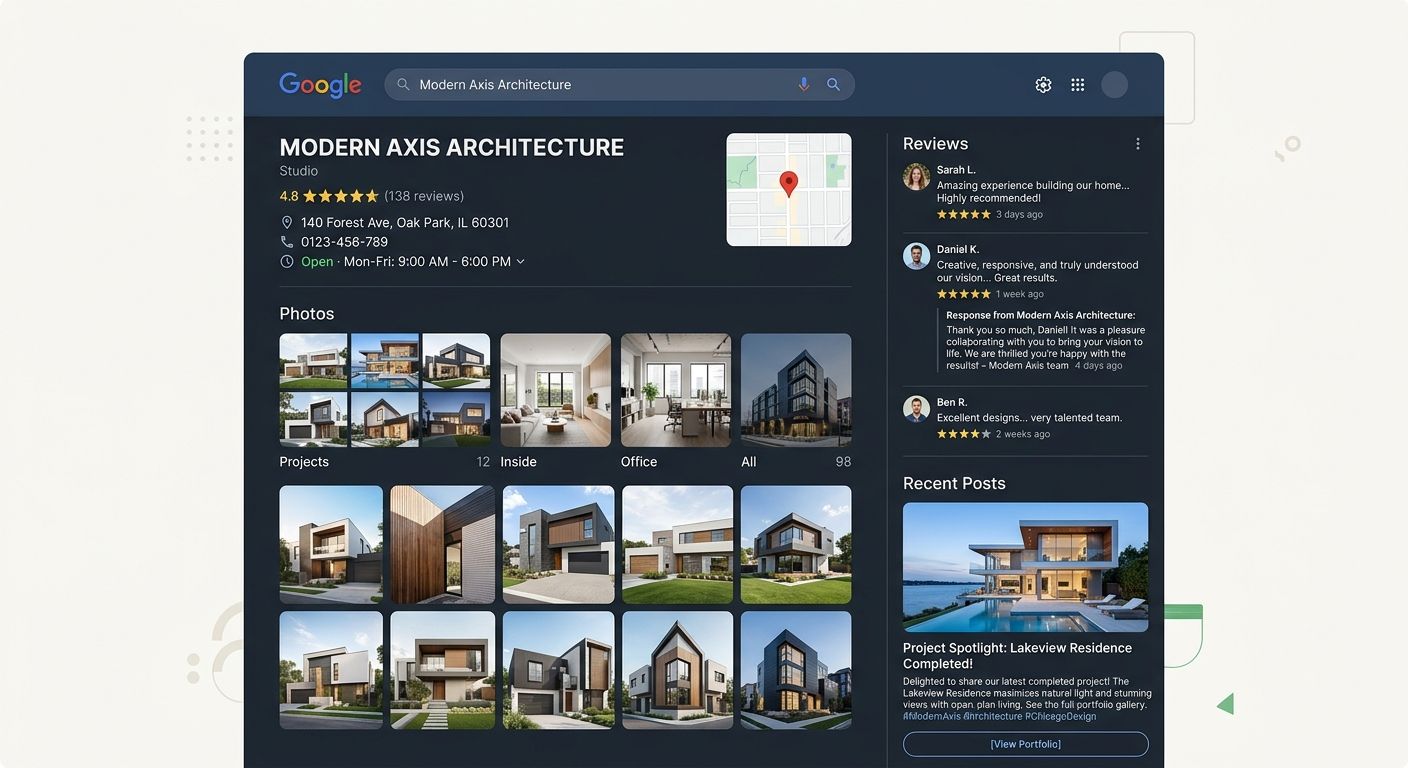
Nearly 46% of Google searches carry local intent, which makes local SEO for architecture firms one of the highest-return channels available. Your Google Business Profile (GBP) is the centerpiece of that channel, and most architecture firms treat it as an afterthought they set up once and forget.
Monograph's local SEO guide for architects emphasizes that "positive reviews are also considered to be a factor in search ranking and can therefore help you to get more visibility in local search." The guide recommends encouraging clients to leave reviews on your GBP and other third-party review sites, then responding to every review to demonstrate engagement.
Beyond reviews, GBP offers project-specific posting capabilities that architecture firms consistently underuse. Each completed project deserves a GBP post with a representative image (properly named and compressed, per the earlier rules), a 150 to 300 word description, and a link back to the full project page on your portfolio site. This creates a reinforcement loop: GBP post links to portfolio page, portfolio page carries LocalBusiness schema pointing back to GBP, and the combination strengthens geographic relevance for every target market you serve.
For white-label teams managing multiple architecture clients, GBP optimization follows the same multi-location SEO principles applicable to any service business. The difference is content quality: architecture firms have original photography that outperforms the stock imagery most service businesses rely on for their GBP posts.
Build internal links between project pages based on shared attributes
Architecture portfolios typically isolate each project in its own gallery with no connections to related work. No links tie a residential project in Denver to another residential project in Boulder, even though a prospective client searching "residential architect Colorado" would benefit from encountering both. Internal linking based on shared attributes (building type, region, material palette, design style) creates topical clusters that strengthen each page's relevance for category-level queries.
The implementation is straightforward. At the bottom of each project page, add a "Related Projects" section linking to 3 to 5 other projects sharing at least one attribute. Use descriptive anchor text that includes the shared characteristic ("See our other modern residential projects in Colorado" rather than "View more"). This approach follows the same connectivity logic described in our SEO debugging workflow for ranking diagnostics, where orphaned pages consistently underperform pages with strong internal link networks.
For a portfolio of 30 projects, this structure creates 90 to 150 internal links that didn't exist before. Each link passes topical relevance and helps Google map the thematic relationships between your projects, which forms the structural foundation of architecture portfolio SEO done well.
When These Rules Break Down
These seven rules assume a firm with at least 10 completed projects, an active pipeline producing new work worth photographing, and a geographic market worth targeting with local search. Three scenarios require adjustments.
Firms with fewer than 5 projects should prioritize depth over breadth. Write 600+ words per project page instead of 300, include process photos and sketches alongside finished shots, and concentrate schema markup on CreativeWork rather than distributing effort across all three layers. The goal is making each existing page as rich as possible until the portfolio grows.
Firms pursuing exclusively national or international clients (stadium specialists, airport architects, embassy designers) should deprioritize GBP optimization and redirect that effort toward industry-specific backlink acquisition from publications like Architectural Record, Dezeen, and ArchDaily. Local SEO for architecture firms at that scale matters less than authority signals within the sector itself.
And for engagements where a white-label partner handles ongoing content but the principal architect insists on approving every caption and alt tag: build the approval workflow into the project intake template from day one. The constraint is never technical. It's the feedback loop between the agency doing the optimization and the person whose name sits on the building. Solve the process problem first, and the SEO work flows at a pace that actually produces results within a normal retainer cycle.
Marcus Webb
Digital marketing consultant and agency review specialist. With 12 years in the SEO industry, Marcus has worked with agencies of all sizes and brings an insider perspective to agency evaluations and selection strategies.
Related Articles

Why Architecture Firms Still Rank Invisibly After 6 Months of SEO: The Portfolio Optimization Paradox
Google processes architecture firm portfolio pages the same way it processes any image gallery without supporting text: it indexes the page, finds almost nothing to rank, and buries it behind competitors who describe their work in words search engines can parse.

The Niche-Specific SEO Audit Checklist: Beyond Generic 100-Point Frameworks for Architecture and Design Firms
Generic 100-point SEO audit frameworks consistently hand architecture and design firm websites passing scores while those same sites lose organic visibility on the pages that actually win clients: project portfolios, case studies, and studio landing pages.

Why Architecture Firm Portfolios Tank in Local Search: The Hidden Schema & Structured Data Gap
Schema.org provides at least three structured data types purpose-built for architecture practices: LocalBusiness, ProfessionalService, and HomeAndConstructionBusiness.
Explore more topics