
The Complete SEO Tool Stack Audit Checklist: How to Evaluate, Consolidate, and Right-Size Your Agency's Technology Budget in 2026
Google searches that end without a click now account for 58% of all queries, and over half of Google results pages display an AI Overview — yet the median agency's SEO tool stack still concentrates its budget on tracking traditional blue-link positions.
 Marcus Webb··10 min read
The Complete SEO Tool Stack Audit Checklist: How to Evaluate, Consolidate, and Right-Size Your Agency's Technology Budget
Google searches that end without a click now account for 58% of all queries, and over half of Google results pages display an AI Overview — yet the median agency's SEO tool stack still concentrates its budget on tracking traditional blue-link positions. A proper SEO tool stack audit exposes this mismatch and redirects spend toward the capabilities that actually move revenue.
Where the Typical Agency SEO Software Budget Actually Goes
The numbers are worse than most agency owners think. According to KEO Marketing's SEO ROI investment guide, companies in competitive verticals need 40-60% higher digital marketing budget allocations to achieve comparable SEO outcomes. That pressure pushes agencies to stack tool after tool, each promising a slightly different angle on the same underlying data.
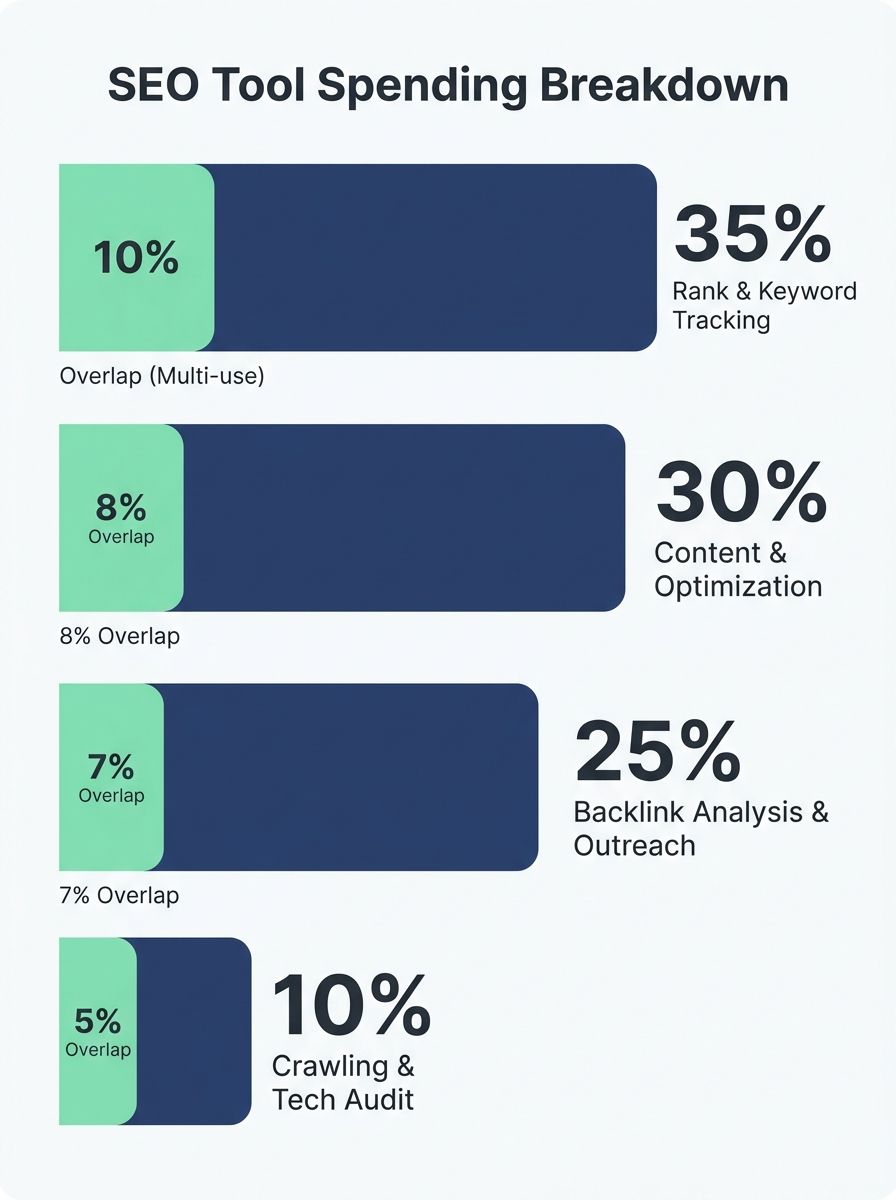
A typical mid-market agency running 8 tool subscriptions might carry: two rank trackers (one "primary," one for client-facing reports), two crawlers (one for technical audits, one embedded in an all-in-one platform), a backlink index, a content optimization tool, a local SEO platform, and a keyword research suite. Annual cost for that stack runs between $18,000 and $45,000 depending on seat counts and crawl limits.
The problem is SEO platform overlap. At least 3 of those 8 tools share core crawling, rank-tracking, and keyword-database functions. You're paying triple for the same SERP data packaged in different dashboards. As Search Engine Land's 2026 evaluation guide puts it: "Your boss still expects SEO to show business impact — not how many keywords or prompts you can track, how fast you can optimize content, or what your visibility score is. That is exactly where most tools still fail miserably."
Every agency tool evaluation should start with a simple question: which subscriptions would nobody notice if they disappeared tomorrow? In my 12 years working with and inside agencies, I've never seen a stack where the answer was "none."
The Three-Signal Audit Framework
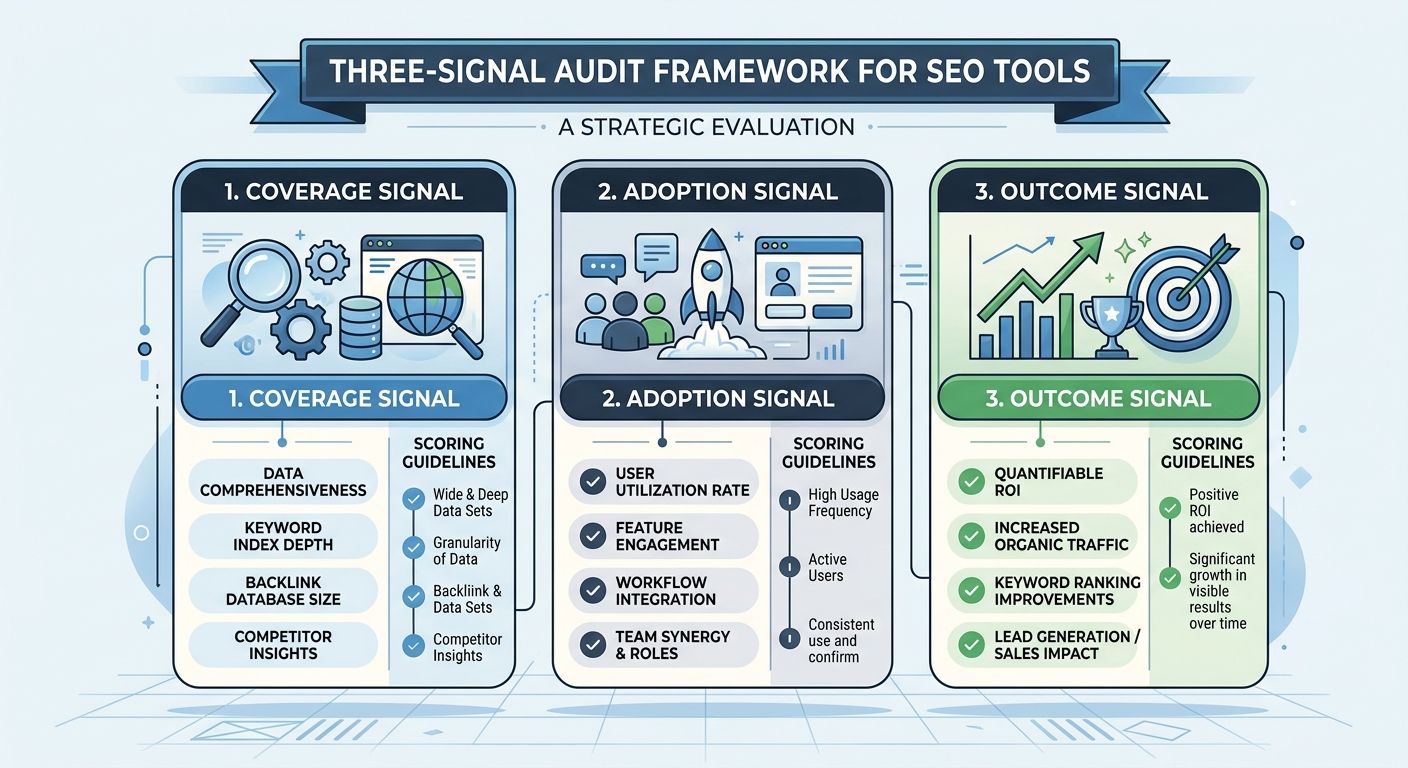
I've audited tool stacks for over 40 agencies across three countries. The pattern that separates useful tools from expensive noise comes down to three measurable signals: Coverage, Adoption, and Outcome. Score every tool in your stack across all three, and the consolidation decisions become obvious.
Coverage asks: what unique capability does this tool provide that no other tool in the stack duplicates? If a tool's primary function (say, rank tracking) is already handled by another platform, it needs a distinct secondary function (like AI Overview tracking or SERP feature monitoring) to justify its seat.
Adoption asks: how many team members actively used this tool in the past 90 days, and how many workflows depend on its data? Tools with fewer than 2 active users per month are dead weight. According to a RankDots analysis of agency growth stacks, "most tech stacks carry unnecessary dead weight. Consolidate your budget around a few core platforms that actually integrate with one another."
Outcome asks: can you trace this tool's output to a client-facing deliverable that influenced a ranking change, traffic gain, or revenue metric? If the connection requires more than two logical steps to explain, the tool is providing comfort, not value.
Running a Coverage Map
The coverage signal is where you'll find the fastest budget wins. Pull up every tool subscription your agency pays for and map each one against nine core SEO functions:
Function | Ahrefs | SEMrush | Screaming Frog | Surfer | BrightLocal | Google Search Console |
|---|---|---|---|---|---|---|
Rank Tracking | ✓ | ✓ | ✗ | ✗ | ✓ (local) | ✓ (limited) |
Site Crawling | ✓ | ✓ | ✓ | ✗ | ✗ | ✓ (limited) |
Backlink Index | ✓ | ✓ | ✗ | ✗ | ✗ | ✓ (partial) |
Keyword Research | ✓ | ✓ | ✗ | ✓ | ✗ | ✓ (partial) |
Content Optimization | ✗ | ✓ | ✗ | ✓ | ✗ | ✗ |
Local SEO | ✗ | ✓ (basic) | ✗ | ✗ | ✓ | ✗ |
AI Overview Tracking | ✓ (new) | ✓ (new) | ✗ | ✗ | ✗ | ✗ |
Technical Audit Depth | ✓ | ✓ | ✓✓ | ✗ | ✗ | ✗ |
Schema Validation | ✗ | ✗ | ✓ | ✗ | ✗ | ✓ |
This table illustrates a common scenario. An agency paying for Ahrefs ($199-$999/month), SEMrush ($139-$499/month), and Screaming Frog ($259/year) has triple coverage on crawling and double coverage on rank tracking and backlink analysis. The annual cost of that overlap alone runs $2,500-$8,000 depending on plan tiers.
Your coverage map should answer two things. First, where do you have 3+ tools covering the same function? Those are your consolidation targets. Second, where do you have 0 tools covering an emerging function? AI Overview citation tracking, schema drift monitoring, and AI crawler access verification (GPTBot, OAI-SearchBot) are the three biggest gaps I see in agency stacks right now. According to real-time search data, 72% of websites fail at least one critical technical SEO factor, and proper optimization can increase organic traffic by 30%. The tools catching those failures matter. The tools duplicating each other's crawls don't.
If you've been thinking through the real cost-benefit of DIY tools versus agency services, the coverage map is where that analysis becomes concrete rather than theoretical.
Adoption Metrics That Expose Dead Weight
Why do agencies keep paying for tools nobody uses? Because cancellation requires someone to make a decision, and inertia is cheaper than deliberation. But adoption data forces the conversation.
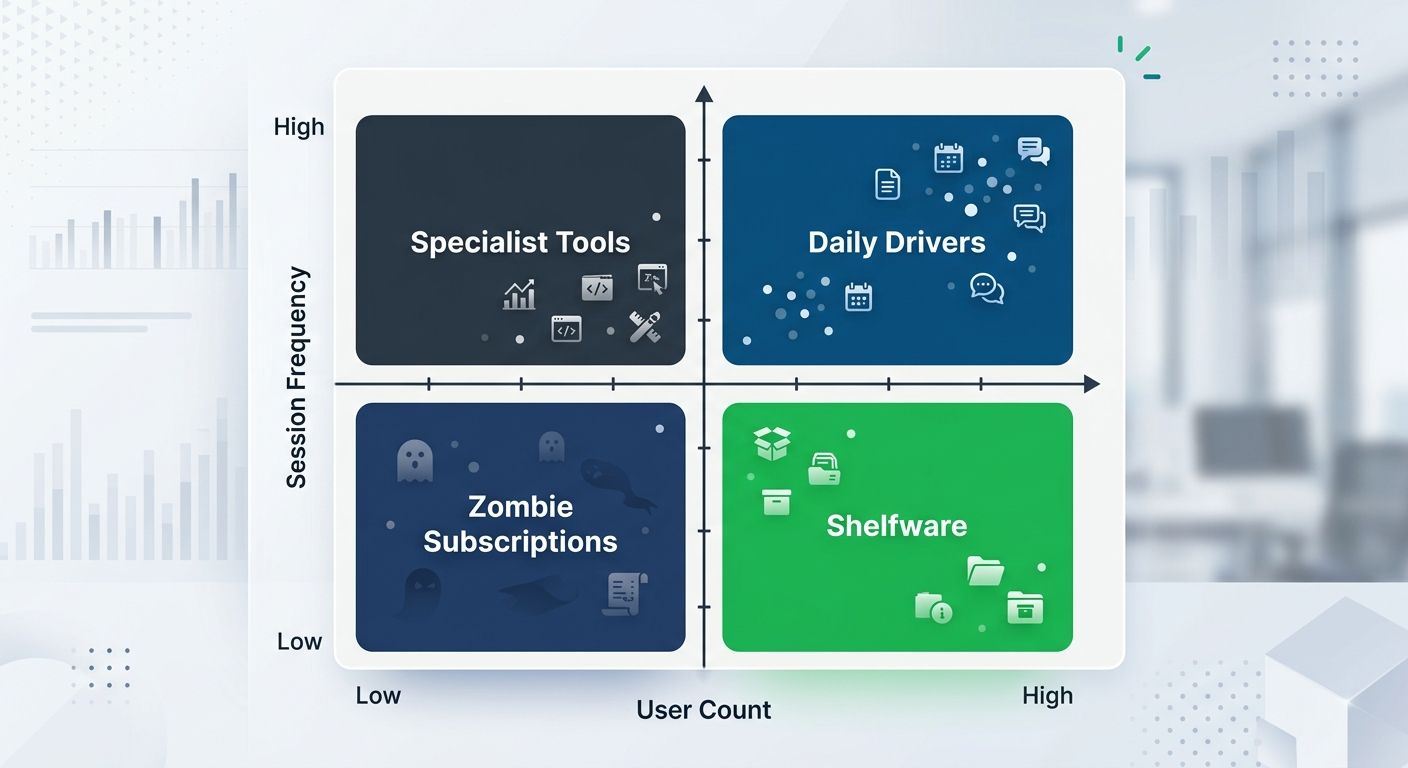
Pull login data or API usage logs for every tool over the past 90 days. You're looking for four categories:
Daily drivers (used by 3+ team members, 15+ sessions per month): These are your stack's backbone. Protect them, invest in training for them, and build your workflows around their outputs.
Specialist tools (used by 1-2 people, 5-15 sessions per month): These earn their keep if those sessions produce client-facing deliverables. A crawler that one technical SEO specialist runs for every site audit is high-value despite low total logins. But a content tool that one person opens twice a month to "check scores" is a subscription waiting to be cut.
Zombie subscriptions (fewer than 5 sessions per month across all users): Cancel immediately. I've seen agencies carry $4,000-$7,000 in annual zombie subscriptions — tools purchased for a specific client engagement that ended 8 months ago but nobody flagged for cancellation.
Shelfware (purchased but never fully deployed): These are the tools where you're paying enterprise pricing but using starter-level features. According to a Yahoo Finance report on SEO costs, "for many companies, SEO software significantly reduces the need for large agency retainers by enabling internal teams to manage optimization workflows." But that reduction only materializes if the software actually gets used. Shelfware delivers the cost without the capability.
Connecting Tool Outputs to Business Outcomes
The outcome signal is the hardest one to measure and the most important one to get right. I've watched agencies justify $30,000 annual tool budgets with metrics like "we track 50,000 keywords" or "we crawl 2 million pages per month." Those are activity metrics. They describe what the tool does, not what it accomplishes.
Each tool in your stack should connect to one of four business-level outcomes: rankings that drive qualified traffic, technical fixes that prevent indexing losses, content improvements that increase conversion rates, or reporting that retains clients. If a tool can't connect to at least one of those four, it belongs in your consolidation column.
This is especially critical now that agencies need to build transparent reporting dashboards clients actually trust. The tools feeding those dashboards should produce data that maps to revenue, not vanity metrics stacked in a PDF nobody reads past page two.
Here's a practical test: for every tool, write one sentence that completes this template: "This tool helped us [specific action] for [client name], which resulted in [measurable outcome]." If you can't complete that sentence with a real example from the past quarter, the tool fails the outcome signal.
How Martech Consolidation Changes the Calculation
The agency tool evaluation picture gets more complicated when you account for the martech consolidation wave reshaping the vendor landscape. House of MarTech's 2026 analysis warns that "mega-mergers at the top of the industry force capability changes downstream. Combined holding companies negotiate new terms with technology vendors. They build or acquire proprietary tools. They shift where budget flows, which affects vendor pricing power across the entire ecosystem."
What this means in practice: your tool stack is being reshaped whether you audit it or not. Vendor acquisitions kill integrations, change pricing tiers, and deprecate features you depend on. I've seen three agencies lose access to specific API endpoints after their preferred tool got acquired and the new parent company restructured the product.
InfoTrust's analysis on independent providers highlights another risk: "Consolidated agencies typically apply standardized strategies, limiting innovation and failing to address the unique needs of individual brands." The same logic applies to consolidated tool suites. An all-in-one platform that's 70% good across 10 functions often loses to a focused tool that's 95% good at the one function your agency depends on most.
The martech consolidation trend creates a specific budgeting tension. Do you consolidate into fewer, larger platforms for simplicity and volume discounts? Or do you maintain a best-of-breed approach with more vendor relationships and integration overhead? The Three-Signal Audit helps resolve this: if a consolidated platform scores well on Coverage, Adoption, and Outcome across the functions you use, consolidate. If it only scores well on Coverage but poorly on Adoption (because nobody likes using it) or Outcome (because its data quality is mediocre), keep the specialist tools.
Agencies navigating this tension should also understand how boutique versus enterprise agency models affect ROI decisions, since stack sizing should match your operational model.
The 2026 Gap Analysis: What Your Stack Probably Doesn't Cover
The final step in any SEO tool stack audit is identifying what's missing. Based on auditing 40+ agency stacks over the past two years, these are the five most common capability gaps:
AI Overview citation tracking. Over 50% of Google searches now trigger an AI Overview. Your rank tracker shows position 1 through 10, but does it show whether your client's content gets cited in the AI-generated summary above those results? Ahrefs and SEMrush have both added early versions of this tracking, but coverage is inconsistent. Budget allocation: $0 extra if your existing platform covers it, $100-$300/month if you need a dedicated solution.
AI crawler access verification. Google's December 2025 rendering update clarified that pages returning non-200 HTTP status codes get excluded from the rendering pipeline. Separately, GPTBot and OAI-SearchBot need explicit access to index your content for AI platforms. Most crawlers don't test for AI bot accessibility. Budget allocation: free if you add custom user-agent checks to your existing crawler, $50-$150/month for dedicated AI crawler simulation tools.
Schema drift monitoring. Structured data that was valid six months ago may no longer align with Google's current specifications. 72% of websites fail at least one critical technical SEO audit checkpoint, and schema errors are a growing contributor. Budget allocation: $0-$100/month depending on site complexity.
INP measurement at scale. Google's Core Web Vitals now include Interaction to Next Paint alongside LCP and CLS. Many agency-grade monitoring tools still default to FID in their dashboards. Make sure your performance monitoring captures INP data across the full client portfolio. Budget allocation: typically included in existing RUM (Real User Monitoring) tools, but verify.
Keyword cannibalization detection. SEO platform overlap in your content strategy is as wasteful as overlap in your tool stack. SEOmonitor's research on keyword cannibalization recommends reviewing "existing content for potential keyword overlap in your SEO-related pages" and identifying "opportunities to consolidate or differentiate content." Tools that flag when two client pages compete for the same query save hours of manual analysis.

Agencies already investing in technical SEO audits as a revenue stream should be especially alert to these gaps — your audit quality is only as good as the tools feeding it.
What These Numbers Still Can't Answer
The Three-Signal Audit gives you a structured, repeatable way to evaluate every tool in your stack against coverage, adoption, and outcome criteria. It surfaces overlap, identifies dead weight, and highlights gaps. Based on the stacks I've reviewed, agencies that run this process reclaim 25-40% of their SEO software budget within a single quarter.
But the numbers have limits. They can't tell you whether your team will actually adopt a replacement tool after you cut a redundant one. They can't predict which vendor will get acquired next quarter and deprecate the API you just built a workflow around. And they can't measure the switching cost of retraining five people on a new platform mid-campaign.
The audit also can't account for the human preferences that keep zombie subscriptions alive. People get attached to interfaces. They build muscle memory around specific dashboard layouts. A technically inferior tool that your team uses daily delivers more value than a superior tool that sits untouched because the learning curve felt too steep during a busy month.
Run the Three-Signal Audit quarterly. Document the scores. Track changes over time. But recognize that every consolidation decision is a bet on your team's willingness to change alongside the budget savings on the spreadsheet. The agencies that get this right treat martech consolidation as an operational change management project, not a line-item reduction exercise. The savings show up in the budget. The risk shows up in the transition.
Marcus Webb
Digital marketing consultant and agency review specialist. With 12 years in the SEO industry, Marcus has worked with agencies of all sizes and brings an insider perspective to agency evaluations and selection strategies.
Related Articles
SEO Tool Stack Consolidation: Building Your 2026 Agency Tech Stack Without Bloat
Agencies carrying 5 to 7 overlapping SEO subscriptions at $300–$450 per month can consolidate to a unified platform for roughly $100, recapturing $3,600–$5,400 annually per agency.
DIY SEO Tools vs. Agency Services: The Real Cost-Benefit Analysis for Mid-Market Businesses in 2026
The standard "in-house vs agency SEO" debate gives mid-market companies a false binary that leads to overspending in both directions — paying agencies $5,000–$10,000 per month for tasks a $200 tool handles, while skipping the strategic work where professional firms actually earn their fee.
White-Label SEO Tools vs. Full-Service Agency Ownership: Building Your Tech Stack for Margin and Client Retention in 2026
Agency tech stack ROI hinges on one architectural choice: whether you rent white-label SEO tools or own your reporting infrastructure outright.
Explore more topics