
SEO Tool Stack Consolidation: Building Your 2026 Agency Tech Stack Without Bloat
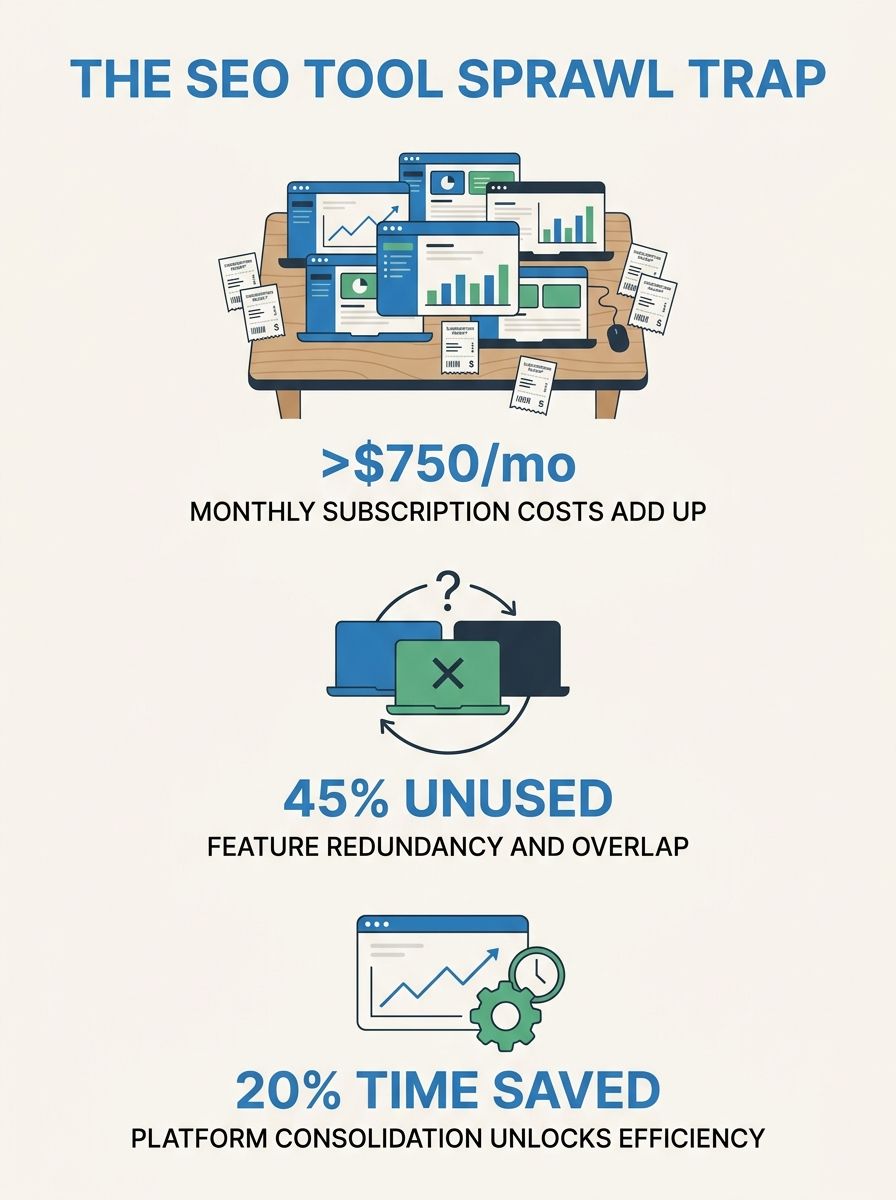
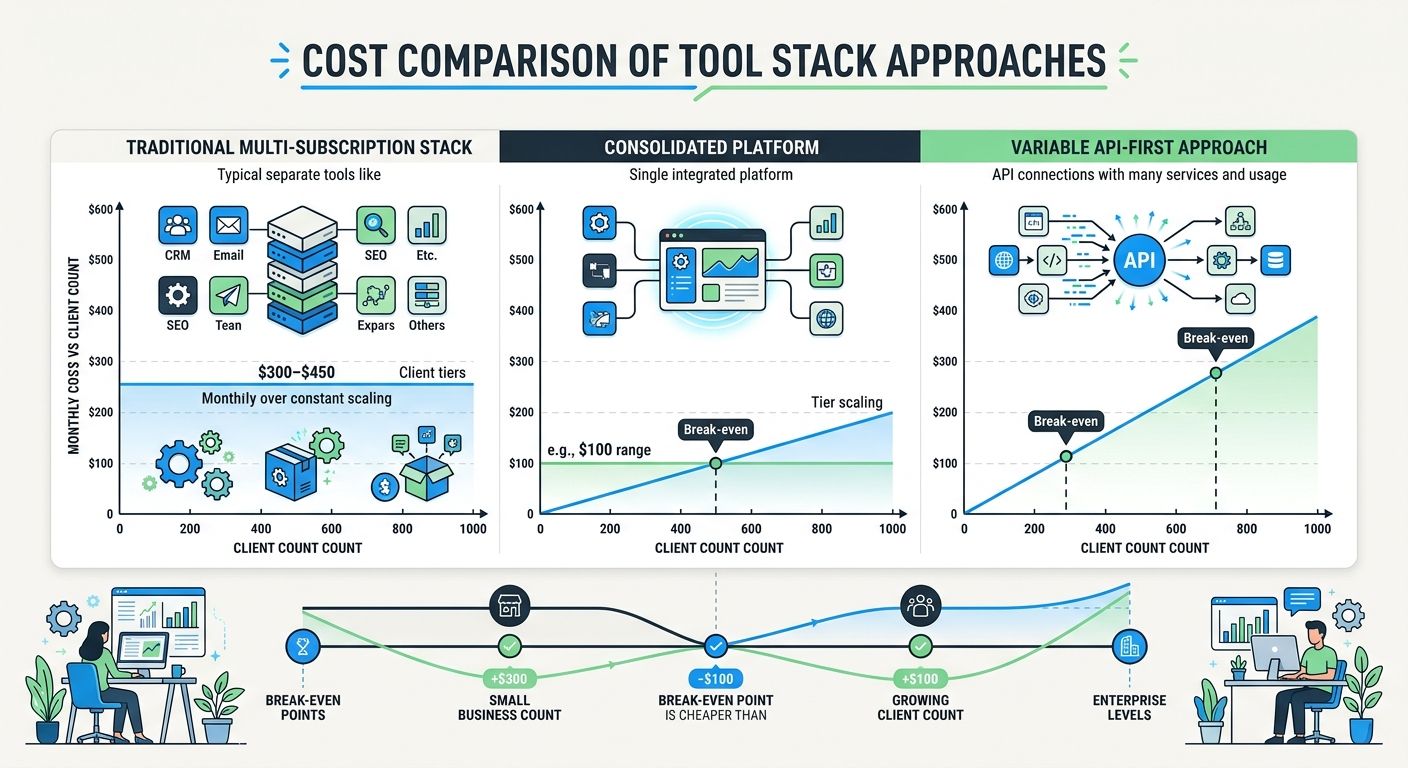
Agencies carrying 5 to 7 overlapping SEO subscriptions at $300–$450 per month can consolidate to a unified platform for roughly $100, recapturing $3,600–$5,400 annually per agency.
 Marcus Webb··9 min read
SEO Tool Stack Consolidation: Building Your 2026 Agency Tech Stack Without Bloat
Agencies carrying 5 to 7 overlapping SEO subscriptions at $300–$450 per month can consolidate to a unified platform for roughly $100, recapturing $3,600–$5,400 annually per agency. The real savings, though, come from eliminating the 8 to 12 analyst hours each month burned on reconciling data across disconnected dashboards.
Why Tool Sprawl Costs More Than the Subscriptions
The subscription fees are the visible expense. The hidden cost is operational drag. Every tool an agency adds introduces a separate login, a separate data model, a separate update cycle, and a separate export format that someone has to normalize before it reaches a client report.
I've reviewed the internal operations of over 200 agencies across 12 years, and the pattern is consistent: agencies that started with one platform in 2019 or 2020 bolted on 4 to 6 additional tools by 2023, usually one per new service offering or client request. A client wanted local rankings? Add BrightLocal. Content optimization? Add Clearscope. Backlink monitoring? Add Majestic on top of the Ahrefs subscription already running. By the time an agency hits 12 to 15 active subscriptions, nobody on the team can name them all without checking the credit card statement.
The Rankability blog's 2026 agency tool assessment flagged this directly, noting that Ahrefs in particular "made some questionable pricing decisions recently" that pushed agencies into paying premium rates for features they were already getting elsewhere. When your second-most-expensive tool duplicates 60% of the functionality of your most expensive one, you don't have a stack. You have a billing problem.
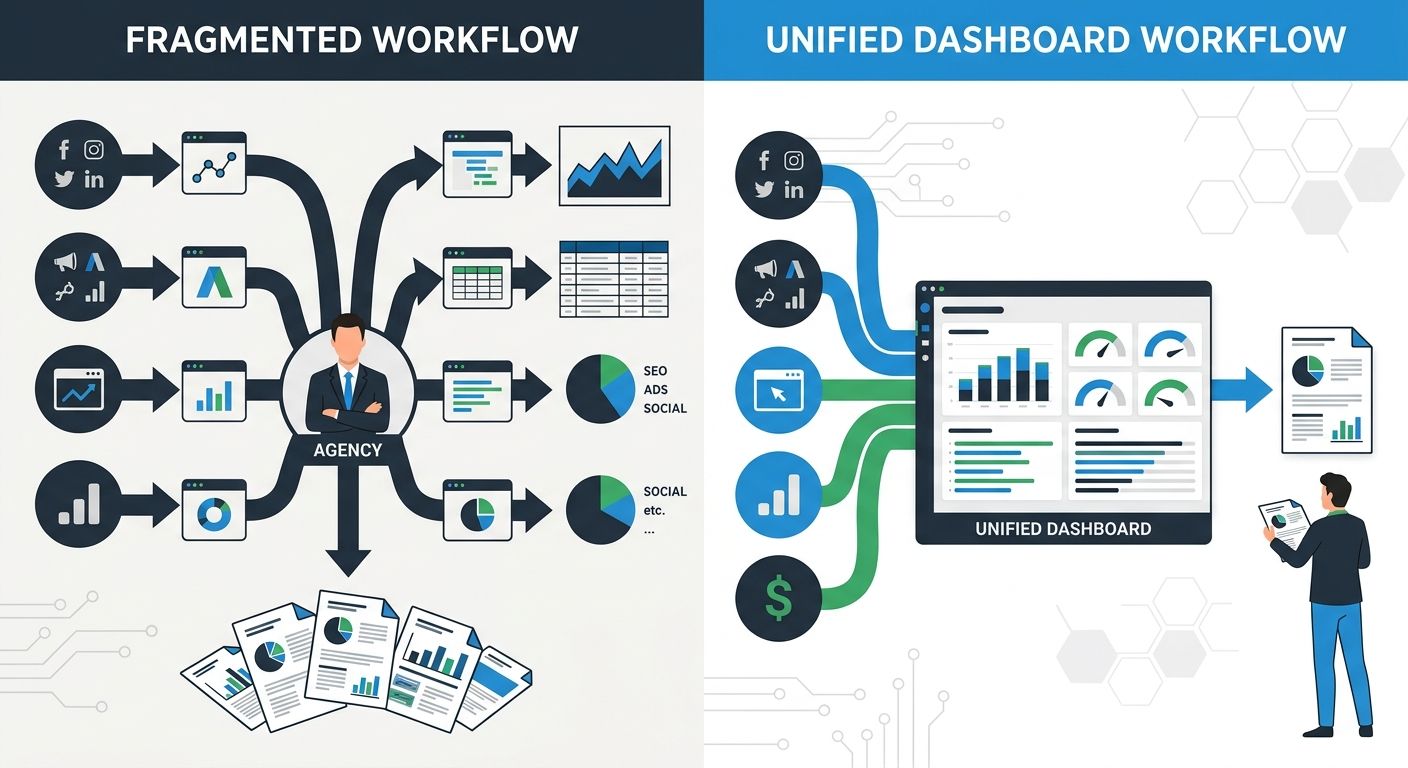
And the problem compounds when you try to unify reporting. If your rank tracking lives in SE Ranking, your backlink data lives in Ahrefs, your technical audits come from Screaming Frog, and your traffic data comes from GA4, someone has to manually stitch four data sources together every month for every client. That's where the 8 to 12 analyst hours disappear, and it's where errors creep into the numbers clients actually see. If you've ever dealt with red flags in agency reporting, mismatched data sources are one of the most common origins.
The 88% Problem That Broke Traditional Stacks
Why does 2026 require a different approach to your SEO tool stack than 2024 did? A Moz study of nearly 40,000 search queries provides the clearest answer: 88% of citations surfaced in Google's AI Mode don't match the pages ranking in traditional organic SERPs.
That number means rank tracking alone, the backbone of every agency stack built before this year, captures only a fraction of where clients are actually visible. Google's AI Overviews, ChatGPT search, and Perplexity all pull from different citation logic than the traditional ten blue links. An agency that reports "you rank #3 for [target keyword]" while the client is invisible in every AI-generated answer for that same query is delivering an incomplete picture at best.
The 2026 SEO tool stack now splits into two distinct functional layers. Traditional SEO covers keyword research, rank tracking, technical audits, and backlink monitoring. AI visibility tracking covers brand mentions and citations across AI-generated answers. Semrush's AI Visibility Toolkit monitors over 100 million prompts monthly. Ahrefs' Brand Radar scans across 243 million prompts. These aren't optional add-ons anymore; they're core measurement infrastructure.
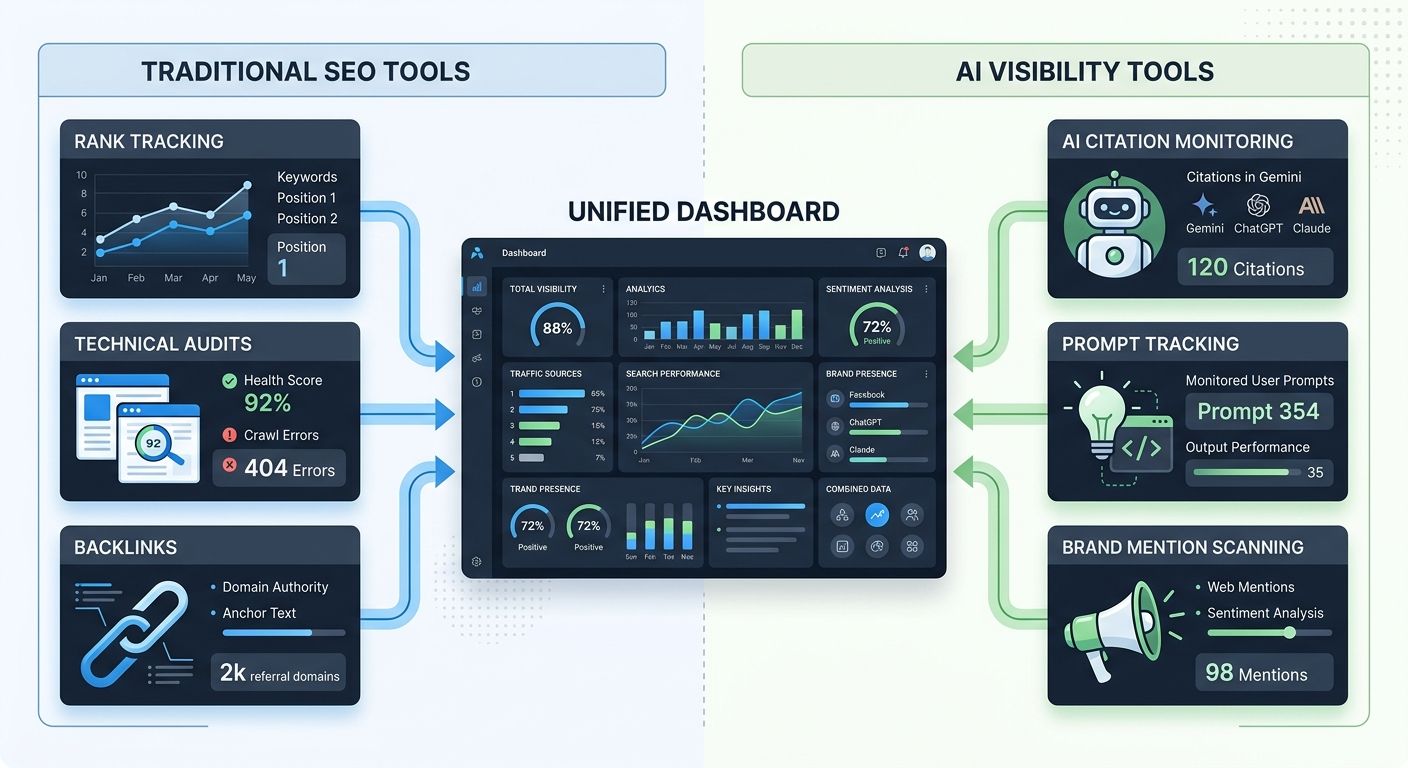
This dual-layer requirement is precisely why SEO software consolidation matters more now than it did two years ago. Adding AI visibility as a separate subscription on top of an already-bloated traditional stack pushes total costs past the point where margins make sense, especially for agencies managing 15 to 30 client accounts. Consolidation into platforms that handle both layers is the structural answer, and it's a factor you should weigh alongside the cost math of agency vs. in-house decisions.
The 7-Tool Core Stack for 2026
An analysis of agency tool recommendations from OneLittleWeb concluded that "the goal is not the biggest stack. It is the most efficient one." Their guidance: "Match your stack to your service, not the other way around." I agree with that principle, and I'd add one qualifier. Match your stack to your service and to the measurement layer your clients now require.
Here's what a lean, defensible 2026 agency stack looks like at the core level:
Tool | Function | Monthly Cost (Approx.) | Replaces |
|---|---|---|---|
Google Search Console | Indexing, performance, Core Web Vitals | Free | Nothing (non-negotiable) |
Google Analytics 4 | Traffic, conversions, user behavior | Free | Nothing (non-negotiable) |
Semrush or Ahrefs | Keyword research, backlinks, AI visibility | $129–$449 | 2–3 standalone tools |
Screaming Frog | Technical crawling, site audits | $259/year | Cloud-based crawler subscriptions |
Surfer or Clearscope | Content optimization, SERP analysis | $89–$199 | Manual content briefs |
AgencyAnalytics or Whatagraph | Client reporting, dashboard unification | $79–$179 | Manual report assembly |
Claude or ChatGPT (Pro) | Strategy briefs, analysis, content frameworks | $20–$200 | Multiple content ideation tools |
Seven tools. Two free, five paid. Total monthly spend for a mid-tier configuration lands between $350 and $650, which is substantially less than the $900 to $1,400 I routinely see on the expense reports of agencies running 12 to 15 separate subscriptions.
The critical decision in this stack is the Semrush-versus-Ahrefs choice, because it cascades through the rest of your tooling. As Webbiquity's comparison of all-in-one SEO suites notes, "best-of-breed tools offer greater functional depth, while all-in-one suites simplify management and integration." For agencies with fewer than 20 clients, Semrush's broader suite (including the AI Visibility Toolkit) typically provides better consolidation value. Agencies with heavy backlink analysis requirements for enterprise clients may find Ahrefs' link index depth worth the additional spend, even after the pricing increases.
Reporting Tools: Where Agency Budgets Leak the Fastest
The agency reporting tools comparison across the current market reveals a 3x to 5x pricing spread for functionally similar products. Whatagraph's 2026 analysis of SEO reporting tools documents this range across six platforms, with monthly costs spanning from $79 for basic dashboard tools to over $400 for enterprise reporting suites that include white-label customization and multi-channel blending.
Here's where I see agencies waste the most money: they subscribe to a reporting tool that duplicates the dashboards already available inside their primary SEO platform. Semrush includes a reporting module. Ahrefs includes basic reporting views. If your agency pays for Semrush at $229/month and then adds a $179/month reporting platform that pulls data from Semrush via API, you're paying twice for the same information in a slightly different visual format. That math only works if the presentation layer genuinely converts more prospects or retains more clients than the built-in option.
The agencies with the healthiest margins tend to pick one of two strategies. Strategy A: use the reporting built into their primary platform (Semrush, SE Ranking, or Ahrefs) and accept the template constraints. Strategy B: invest in a dedicated reporting tool like AgencyAnalytics or Whatagraph specifically because they serve 25+ clients and the time savings on report assembly (estimated at 4 to 6 hours per month per 10 clients) justifies the cost. There's no middle ground that makes financial sense.
For agencies exploring white-label tool ownership versus full-service subscriptions, the reporting layer is usually the first place to test consolidation because it has the most direct impact on monthly operational hours.
The Keep/Cut/Consolidate Audit Framework
Tool integration for agencies requires a structured decision process, not a gut-feeling purge. I recommend a quarterly audit using three lists. Every active subscription gets placed into exactly one:
Keep means the tool performs a function no other tool in your stack covers, and you've used it for at least 2 client deliverables in the past 90 days. Google Search Console and GA4 always land here. Screaming Frog lands here for any agency doing technical SEO.
Cut means the tool duplicates a function already covered by another subscription, or nobody on the team logged in during the past 60 days. This is where secondary rank trackers, redundant backlink checkers, and "we signed up for the free trial and forgot to cancel" subscriptions accumulate. I've seen agencies discover $200 to $400 per month in Cut-list subscriptions they'd been paying for 6 months or longer without anyone noticing.
Consolidate means two or more tools serve overlapping functions and one of them can absorb the other's role with acceptable trade-offs. The classic consolidation move in 2026 is collapsing a standalone content optimization tool into Semrush's content features (which now cover about 80% of what Surfer offers for most use cases). Another common consolidation: replacing a standalone AI visibility tracker with the AI monitoring modules now built into both Semrush and Ahrefs.
The discipline here matters because SEO tool market growth works against you. UserJot's comparison of all-in-one SEO tools observed that "premium suites can be cheaper than subscribing to several individual best-of-breed tools," but only if agencies actually cancel the individual tools after migrating. I've audited agencies paying for both Semrush and three of the standalone tools that Semrush's suite replaced, simply because no one owned the cancellation process. That's not a technology problem. That's an operations problem.
API-First Integration Changes the Consolidation Math
For agencies building toward scale (50+ clients), tool integration for agencies increasingly runs through API connections rather than manual exports. SE Ranking's API platform now supports live dashboards blending SEO, GEO, GA4, and Google Search Console data into a single view. DataForSEO's API stack provides rank tracking, SERP analysis, and backlink data through a pay-per-query model that can replace flat-rate subscriptions for agencies with variable client loads.
The API approach changes the consolidation math because it decouples data collection from data presentation. Instead of paying for 5 platforms that each include their own dashboard, an agency pays for raw data access and pipes it into one reporting interface. The up-front integration cost runs higher (typically 20 to 40 hours of developer time for initial setup, plus 2 to 4 hours monthly for maintenance), but the per-client marginal cost drops significantly after 30 to 40 accounts.
This approach pairs well with the technical SEO workflow integration that agencies building custom client portals are increasingly adopting. The 7-tool stack I outlined earlier serves agencies from 5 to 50 clients effectively. Beyond that threshold, the API-first model deserves serious evaluation.
What The Data Doesn't Tell Us
The consolidation numbers look clean on paper. $3,600 to $5,400 in annual savings per agency, 8 to 12 recovered analyst hours per month, 7 core tools instead of 15. Those figures hold up across the dozens of agency audits I've conducted.
But the data doesn't capture the switching cost of moving historical tracking data from one platform to another, the 2 to 3 month period where comparison metrics break because you've changed measurement tools mid-stream, or the client communication overhead when dashboards suddenly look different. One agency I worked with saved $4,800 annually by consolidating from 11 tools to 6, then spent an estimated $3,200 in staff time over the following quarter managing the transition and re-baselining client reports.
The 88% AI Mode citation gap is also a moving target. That Moz figure will look different 6 months from now as Google's AI Overviews continue evolving after what they called "the biggest change to Search in 25 years." Any stack you build today needs quarterly reassessment, because the AI visibility tools available in January 2027 will measure things that don't have product categories yet.
What I can say with confidence: agencies that don't consolidate will keep hemorrhaging margin on duplicate subscriptions and manual data reconciliation. Agencies that consolidate too aggressively will lose measurement depth at exactly the moment when AI visibility demands more granular tracking. The 7-tool framework gives you a defensible starting point. The quarterly Keep/Cut/Consolidate audit keeps it from calcifying into another legacy stack that nobody remembers how to justify.
Marcus Webb
Digital marketing consultant and agency review specialist. With 12 years in the SEO industry, Marcus has worked with agencies of all sizes and brings an insider perspective to agency evaluations and selection strategies.
Related Articles
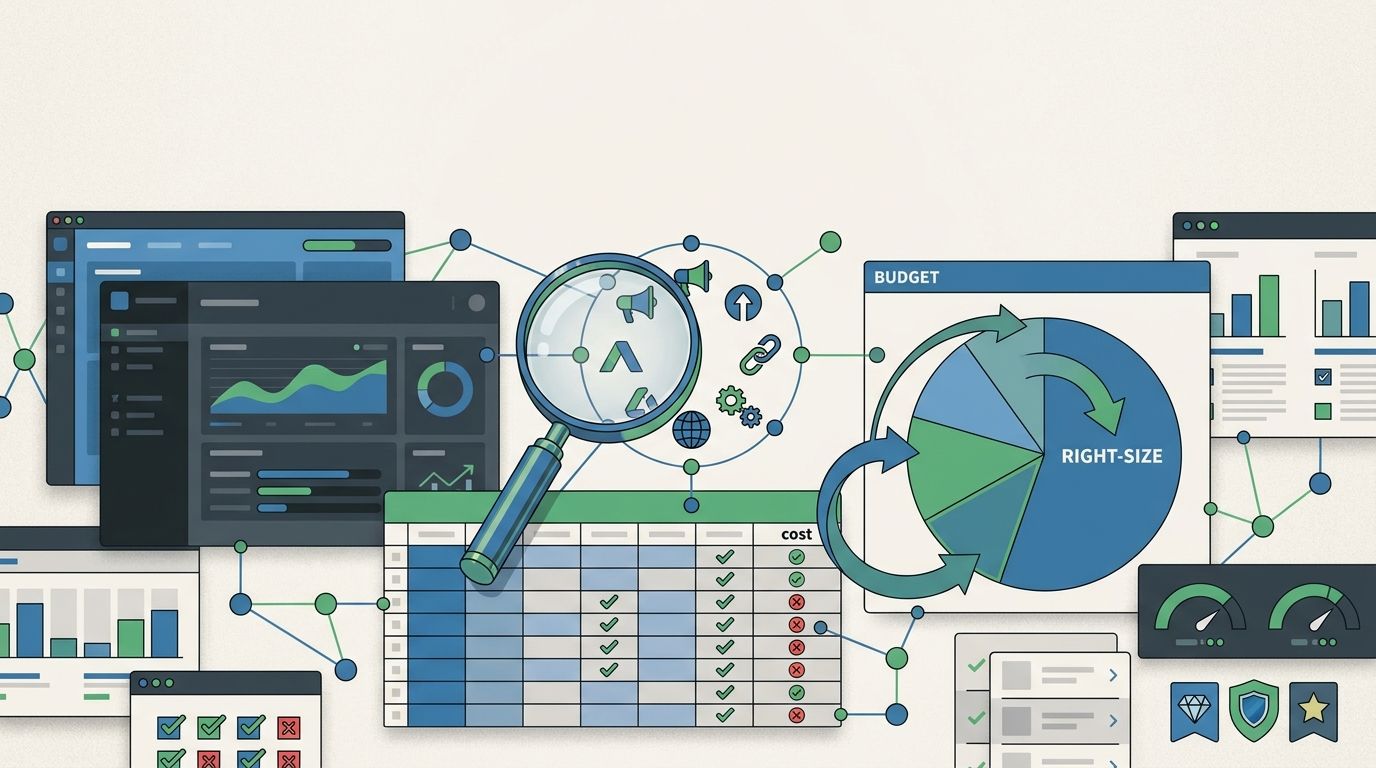
The Complete SEO Tool Stack Audit Checklist: How to Evaluate, Consolidate, and Right-Size Your Agency's Technology Budget in 2026
Google searches that end without a click now account for 58% of all queries, and over half of Google results pages display an AI Overview — yet the median agency's SEO tool stack still concentrates its budget on tracking traditional blue-link positions.
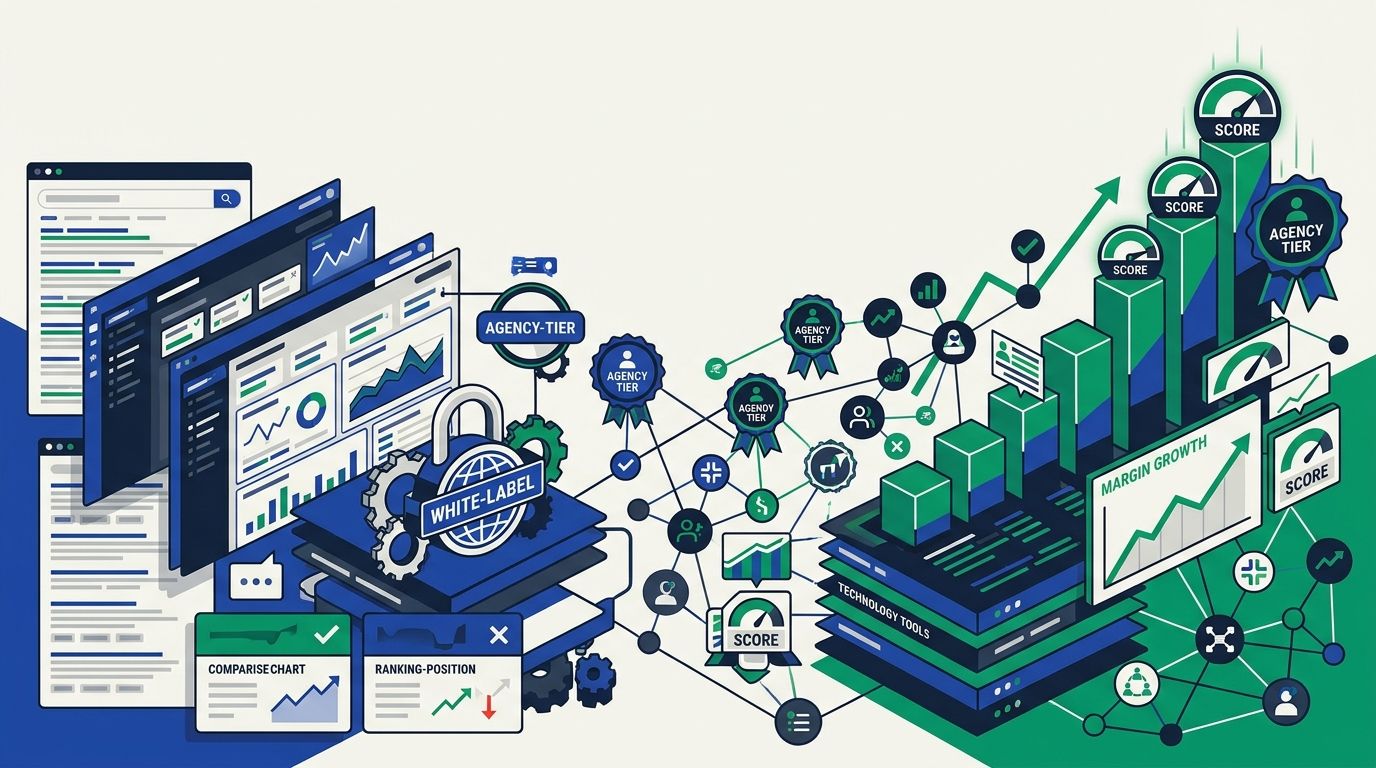
White-Label SEO Tools vs. Full-Service Agency Ownership: Building Your Tech Stack for Margin and Client Retention in 2026
Agency tech stack ROI hinges on one architectural choice: whether you rent white-label SEO tools or own your reporting infrastructure outright.
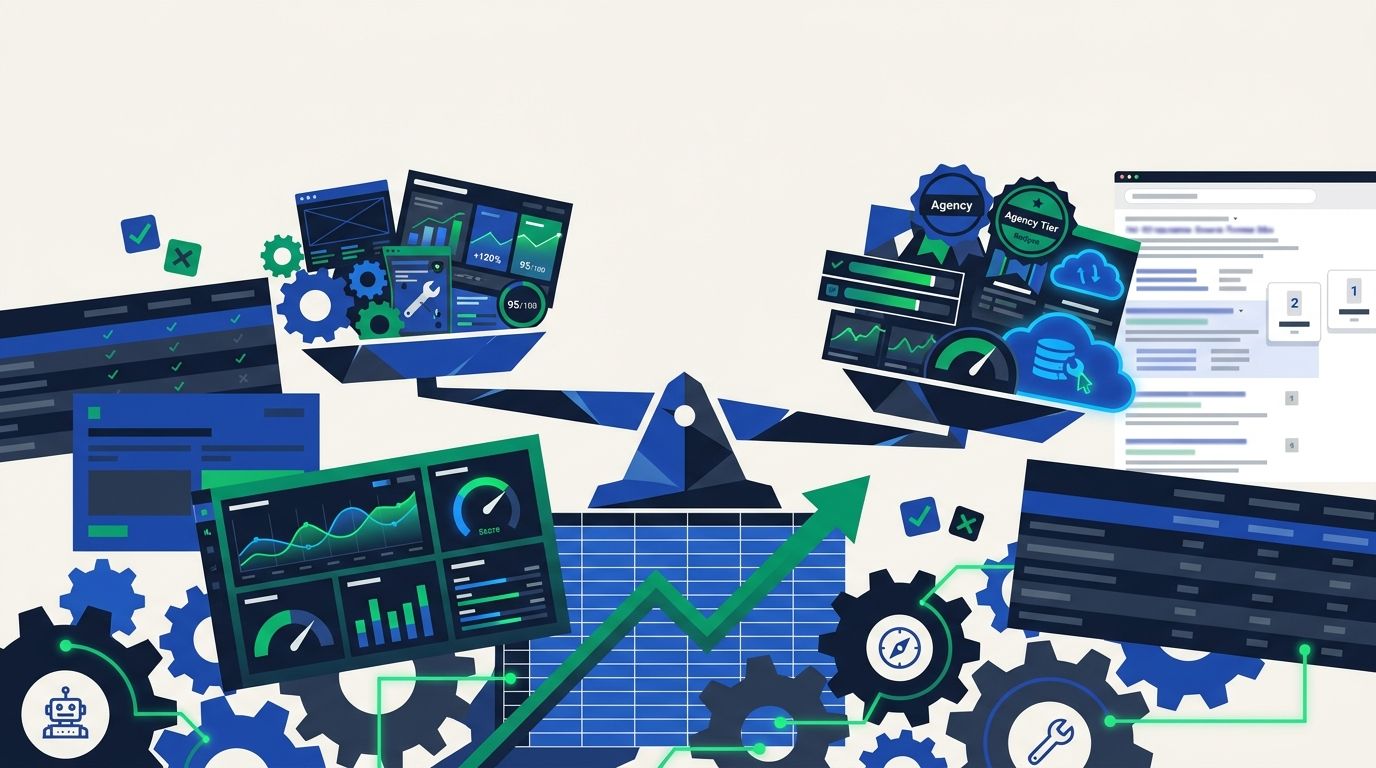
DIY SEO Tools vs. Agency Services: The Real Cost-Benefit Analysis for Mid-Market Businesses in 2026
The standard "in-house vs agency SEO" debate gives mid-market companies a false binary that leads to overspending in both directions — paying agencies $5,000–$10,000 per month for tasks a $200 tool handles, while skipping the strategic work where professional firms actually earn their fee.
Explore more topics