
White-Label SEO Tools vs. Full-Service Agency Ownership: Building Your Tech Stack for Margin and Client Retention in 2026
Agency tech stack ROI hinges on one architectural choice: whether you rent white-label SEO tools or own your reporting infrastructure outright.
 Marcus Webb··8 min read
White-Label SEO Tools vs. Full-Service Agency Ownership: Building Your Tech Stack for Margin and Client Retention in 2026
Agency tech stack ROI hinges on one architectural choice: whether you rent white-label SEO tools or own your reporting infrastructure outright. Agencies reselling white-label services generate 40–60% gross margins per campaign, but those that control their client-facing dashboards retain accounts 31% longer and compound that margin advantage with every renewal cycle.
The tension is real, and it gets sharper as your client roster grows. I've audited over 200 agency tech stacks across my career, and the pattern I keep seeing is the same: agencies reach a certain scale where the white-label model that got them to 20 clients starts silently eroding the margins that should come with clients 21 through 50. Recognizing that inflection point, and architecting your stack around it, is what separates agencies that plateau from agencies that build durable equity. The global SEO market now sits at $83.98 billion with a 12.3% annual growth rate, and agencies that get this wrong are leaving real money on the floor at a time when the addressable market is expanding faster than the labor pool can fill it.
The Margin Arithmetic That Shifts at Scale
The core economics of white-label SEO tools for agencies look excellent on paper when you're running lean. You wholesale fulfillment at $500–$1,500 per month per client and resell at $2,000–$4,000 per month. The spread is generous, and you avoid the roughly $300,000 or more it costs annually to maintain an in-house SEO team with analysts, content producers, and a technical specialist. According to SEO Vendor's 2026 agency guide, agencies using white-label fulfillment see average profit margins rise by up to 40%, and client acquisition accelerates by 43% because the agency can say "yes" to almost any prospect without worrying about capacity constraints.
Those numbers are legitimate at the early stage. I've seen agencies go from zero to $30,000 in monthly recurring revenue within six months on a purely white-label model, and the operational simplicity is hard to argue with. You don't recruit, you don't train, you don't manage PTO for a team of twelve. Providers like SEOReseller offer 1–2 day onboarding and pre-built reporting, which means your first client can be live before your business cards arrive from the printer. For agencies under roughly $800,000 to $1,000,000 in annual SEO revenue, the Growzify analysis confirms this model is more profitable at every revenue level below the break-even point of going in-house.
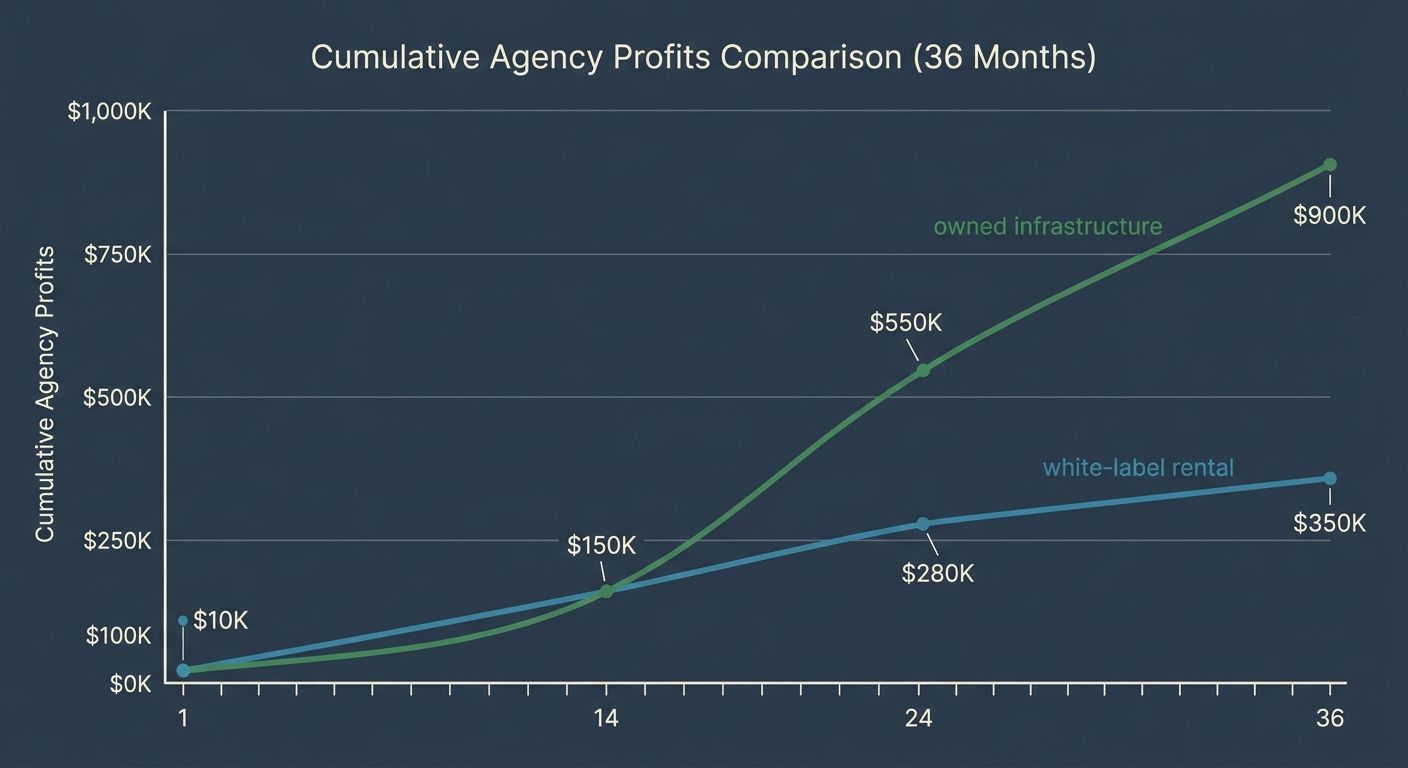
But there's a reason I said "below the break-even point." When you cross that threshold, the math inverts. Every additional client you add on a rented white-label stack generates a fixed percentage of margin, but the absolute dollar amount going to your fulfillment provider also grows in lockstep. If you're paying $1,200 per client per month to a white-label partner and charging $3,500, your gross margin is $2,300 per account. At 30 clients, that's $69,000 monthly gross profit. At 50 clients, $115,000. Sounds great until you realize a three-person in-house team capable of handling 50 accounts might cost you $25,000 per month all-in, giving you a gross margin of $150,000 instead. The $35,000 monthly difference between renting and owning gets hard to ignore when it compounds over 12, 24, 36 months. For agencies evaluating where they sit on this curve, running a thorough technology budget audit is the clearest way to see whether consolidation or ownership makes financial sense at your current scale.
Why Dashboard Ownership Rewrites the Retention Equation
Client retention through proprietary dashboards is the argument that doesn't show up in a simple cost-per-client comparison, and it's the one that matters most over a three-year horizon. When your client logs into a dashboard branded to your agency, populated with metrics you've chosen and organized into a narrative you control, the switching cost for that client goes up dramatically. They learn your interface, they build internal reporting workflows around your data presentation, and they start referencing your proprietary metrics in their own board meetings. That stickiness translates directly into retention, and according to retention analytics from Pursuit Pages, teams that use evidence-based dashboard insights show a 28% higher performance rate in client relationships.
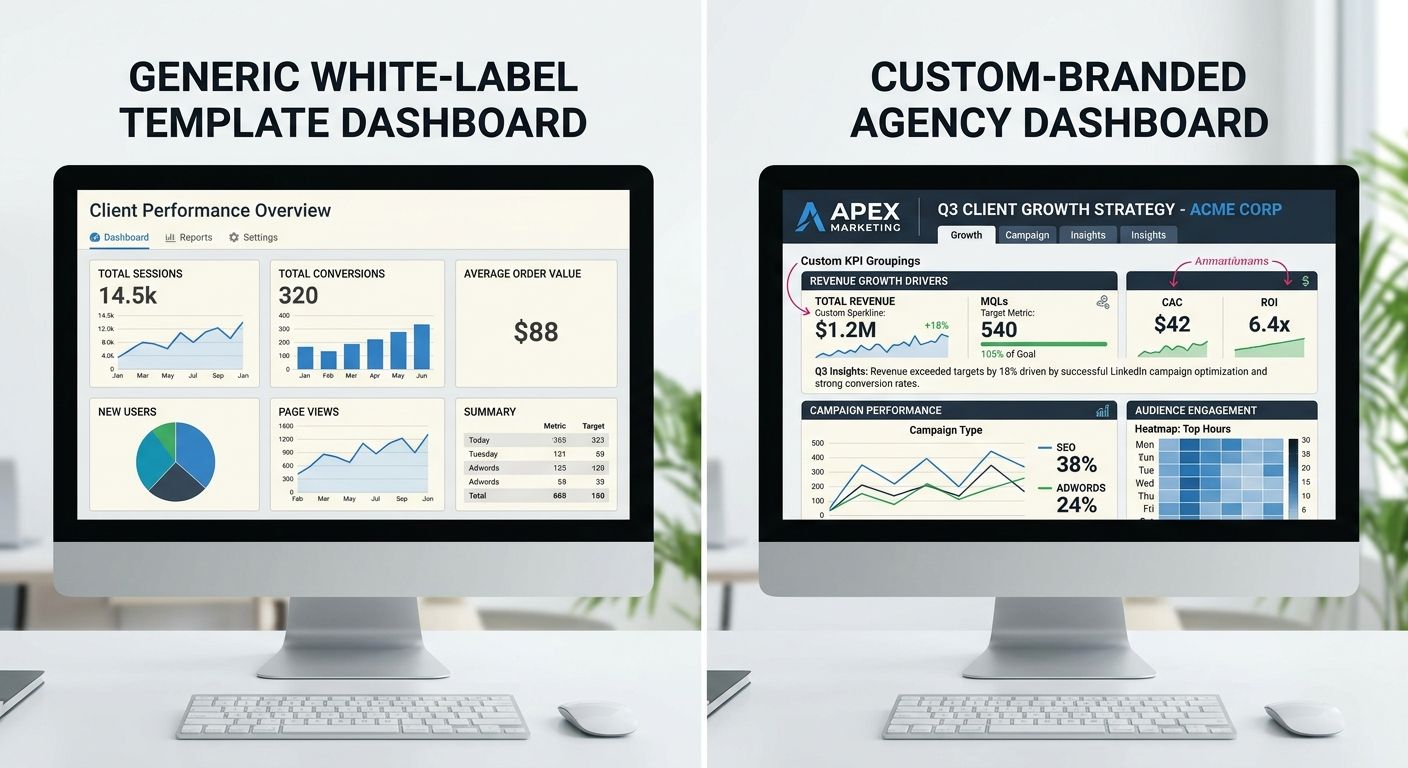
The flip side is what happens when your client's dashboard looks identical to dashboards from four other agencies using the same white-label provider. I've been on calls where a prospect pulled up their current agency's reporting and I could immediately identify the platform because I'd seen the exact same template from three other shops that week. When your reporting is visually and structurally indistinguishable from your competitor's reporting, you've commoditized the one touchpoint your client interacts with most frequently. The Ravetree agency tech stack guide found that 76% of senior marketers are skeptical that their tools will generate expected ROI, while 80% simultaneously say martech gives them a competitive edge. That paradox tells you something important: agencies have the tools, but most aren't deploying them in ways that feel differentiated to the client on the receiving end.
SEO reporting platform ownership doesn't require building from scratch, though that's where a lot of agency owners get overwhelmed and default back to renting. A middle path exists. You can start with a configurable platform, strip out the vendor's branding, and layer in custom KPI groupings that reflect how your agency actually thinks about campaign health. The agencies I've seen do this well treat their dashboard as a product, not an afterthought. They invest 15–20 hours upfront in designing the client experience, they iterate quarterly based on which sections clients actually click on, and they use the dashboard as the anchor for every monthly review call. Building a reporting dashboard your clients genuinely trust takes real effort, but the agencies that treat it as a product development exercise rather than a fulfillment checkbox are the ones whose clients renew without negotiating on price. The difference between a 12-month average client lifespan and a 20-month one, at $3,500 per month, is $28,000 in additional lifetime revenue per account.
The Integration Tax That Erodes Your Numbers
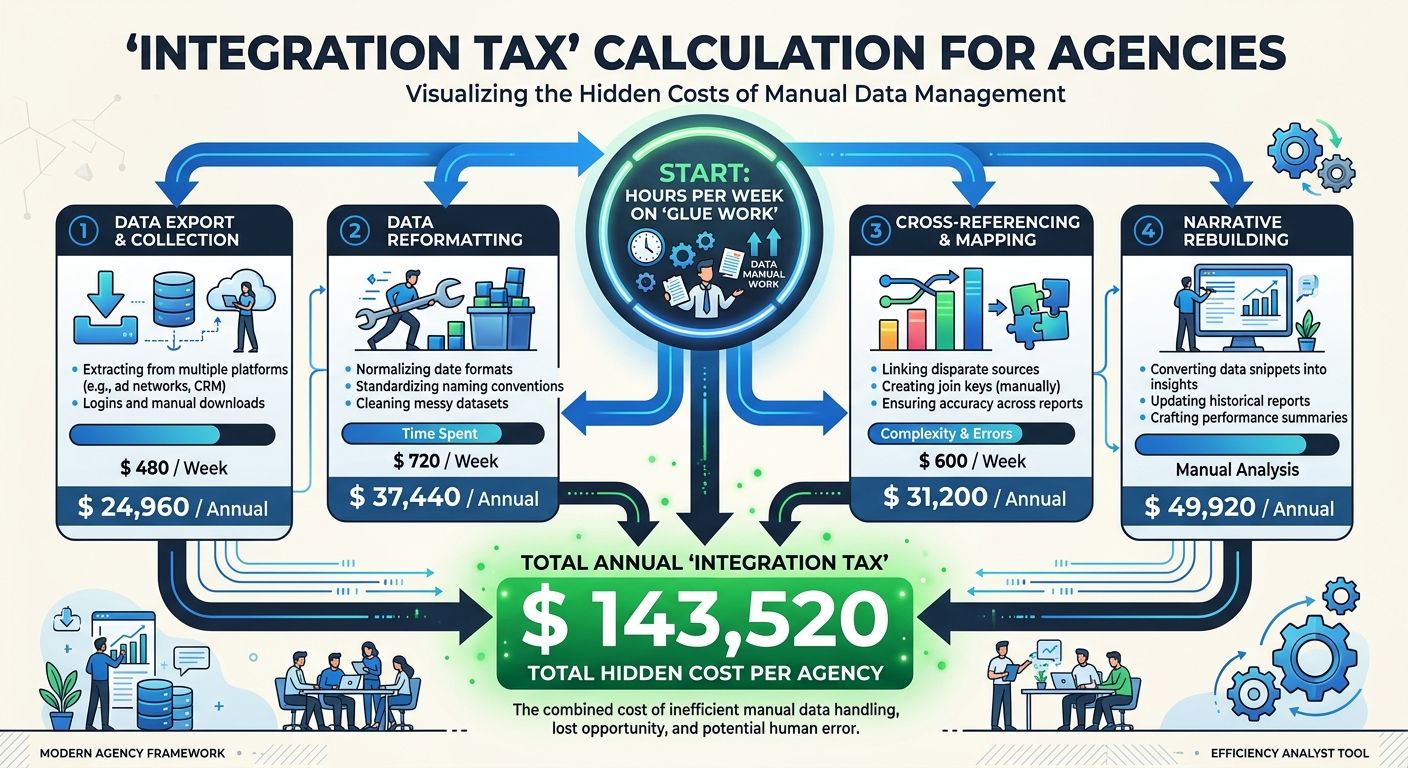
ALM Corp's 2026 agency tech stack audit framework recommends that every agency exit a stack review with three lists: tools to keep (clear usage, reliable integrations, measurable value), tools to cut (weak adoption, overlapping functionality, poor ROI), and tools to consolidate (partial overlap that creates administrative drag without justifying separate licenses). The problem I see constantly is that agencies running white-label SEO tools alongside their own CRM, project management platform, and separate analytics suite never actually do this exercise. They accumulate tools reactively, and the integration tax compounds invisibly because nobody tracks the hours spent manually reconciling data across systems.
I'll put a number on it. The average mid-size agency I've audited spends between 8 and 14 hours per week on what I call "glue work" when operating a fragmented stack. That's someone exporting data from the white-label provider's dashboard, reformatting it for the agency's internal reporting cadence, cross-referencing it against Google Analytics and Search Console, and then rebuilding the narrative for the client-facing deck. At a blended rate of $50 per hour, that's $400 to $700 per week in hidden labor, or roughly $20,000 to $36,000 annually, spent on work that produces zero client-facing value. Platforms like DashClicks attempt to solve this by bundling CRM, fulfillment, and reporting into a single interface, and for agencies under 25 clients, that consolidation genuinely reduces administrative overhead. But the tradeoff is flexibility: integrated platforms impose their workflow on you, and if your agency's methodology differs from the platform's assumptions about how campaigns should be structured, you spend just as much time working around the system as you would have spent on the glue work.
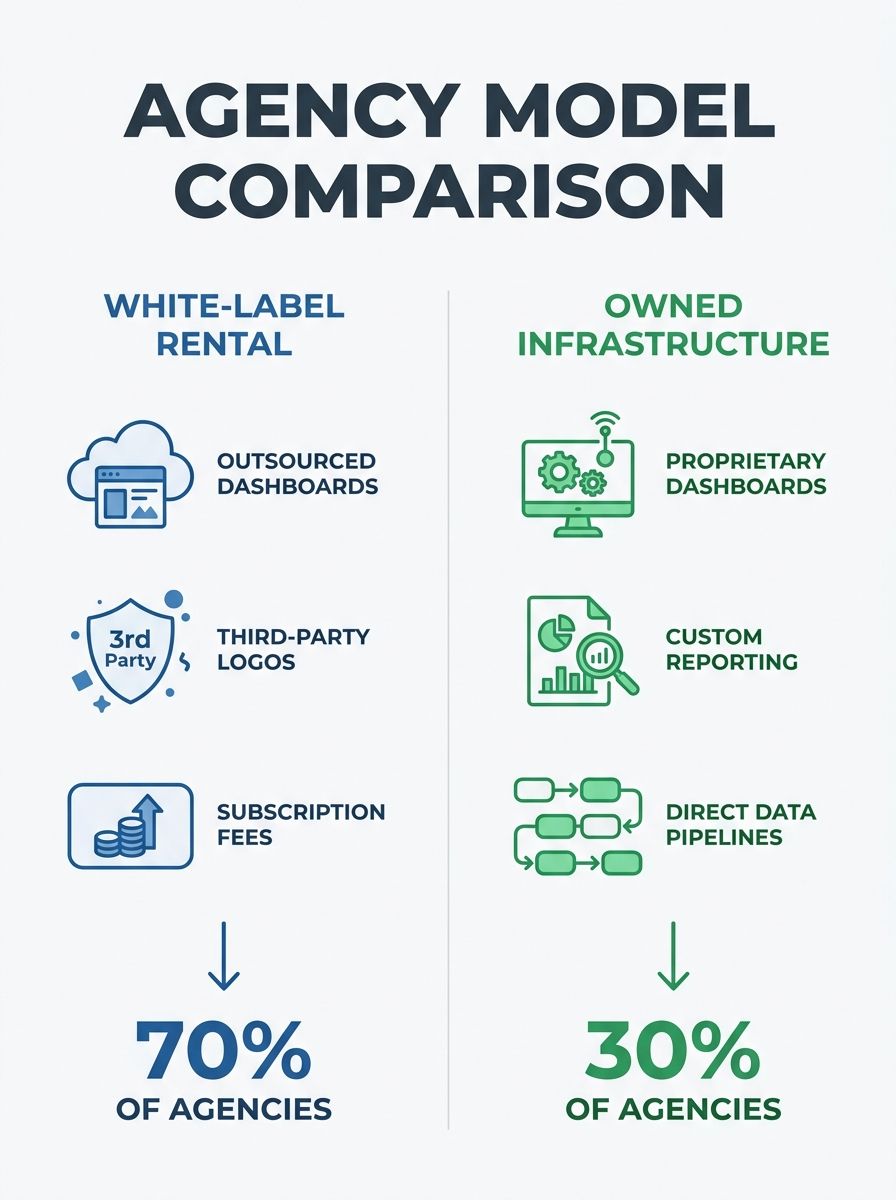
The decision about where to sit on the spectrum between fully rented white-label infrastructure and fully owned tools depends on an honest assessment of what your agency actually does versus what it outsources. If your differentiation lives in strategy and client relationships, renting fulfillment while owning the reporting layer is the highest-margin configuration for agencies in the $500,000 to $1.5 million revenue range. If your differentiation lives in execution quality, owning the fulfillment pipeline and using white-label tools only for peripheral functions like citation building or content production makes more sense. Comparing how different agency models deliver ROI at various scales can sharpen this assessment, because the right answer depends on your agency's position in the market and which capabilities you can credibly claim as proprietary. There are dozens of white-label SEO companies competing on price and turnaround speed, which means the fulfillment layer is increasingly commoditized while the strategy and reporting layers are where defensible margin lives.
The AI visibility shift adds another dimension to this calculus. With AI search engines now driving a meaningful share of queries, agencies that ignore tracking across both traditional rankings and AI-generated results are delivering an incomplete picture. Agencies using unified dashboards that track AI visibility alongside organic performance report a 62% ROI boost on their reporting investment, because the dashboard itself becomes a retention mechanism: the client sees data they can't get anywhere else, and the perceived cost of switching agencies rises accordingly. The agency that can show a client their brand's citation rate inside AI Overviews, Perplexity answers, and traditional blue links on a single screen has a structural advantage over an agency handing over a generic ranking report.
Where This Argument Gets Uncomfortable
The honest version of this analysis acknowledges that most agencies don't have the capital, discipline, or technical talent to build a proprietary reporting layer that actually works better than what established white-label providers offer out of the box. I've watched agencies spend $40,000 on custom dashboard development only to end up with a brittle system that breaks every time Google changes an API endpoint, and then quietly go back to the white-label provider they left, having burned through both money and credibility with their clients during the transition. The build-versus-buy narrative in agency circles tends to romanticize ownership without honestly accounting for the maintenance burden that comes with it.
There's also a question of whether the retention advantage of proprietary dashboards persists as clients become more sophisticated. Five years ago, a branded dashboard with custom KPIs felt like a genuine differentiator. Today, clients have seen enough dashboards that the novelty has worn off, and the clients who stay because of your reporting interface aren't necessarily the same clients who stay because of your results. I've had candid conversations with agency owners who admitted their dashboard investment was primarily a switching-cost strategy rather than a value-delivery strategy, and they were uncomfortable with the distinction. Agency tech stack ROI, measured honestly, should separate the revenue attributable to genuinely better data presentation from the revenue attributable to making it annoying for a client to leave. Both drive the same retention number, but they carry very different long-term risks if a competitor offers to migrate the client's data for free.
The answer I keep landing on, after 12 years in this industry and more stack audits than I can count, is that the optimal configuration for most agencies in the $750,000 to $2 million revenue range is a hybrid: rent fulfillment from a white-label partner whose execution quality you've verified through at least three months of pilot campaigns, own your reporting and client communication layer outright even if that ownership is just a well-configured instance of an existing platform with deep customization, and build proprietary intellectual property around your strategic methodology rather than your tooling. The agencies that thrive over five-year horizons are the ones where the client's loyalty attaches to the thinking, not the interface. Whether that thinking gets delivered through a $200-per-month white-label dashboard or a $2,000-per-month custom build matters less than most agency owners want to admit, and the sooner you make peace with that, the clearer your investment priorities become.
Marcus Webb
Digital marketing consultant and agency review specialist. With 12 years in the SEO industry, Marcus has worked with agencies of all sizes and brings an insider perspective to agency evaluations and selection strategies.
Related Articles
SEO Tool Stack Consolidation: Building Your 2026 Agency Tech Stack Without Bloat
Agencies carrying 5 to 7 overlapping SEO subscriptions at $300–$450 per month can consolidate to a unified platform for roughly $100, recapturing $3,600–$5,400 annually per agency.

How to Build a Transparent SEO Reporting Dashboard Your Clients Will Actually Trust in 2026
Sixty-eight percent of customers leave a company because they believe the company doesn't care about them, according to Vendasta's client reporting research. In agency SEO, that perception of indifference almost always traces back to one artifact: the monthly report.
The Complete SEO Tool Stack Audit Checklist: How to Evaluate, Consolidate, and Right-Size Your Agency's Technology Budget in 2026
Google searches that end without a click now account for 58% of all queries, and over half of Google results pages display an AI Overview — yet the median agency's SEO tool stack still concentrates its budget on tracking traditional blue-link positions.
Explore more topics