
Building SEO into Your Development Workflow: The Technical Checklist Developers Actually Use
The technical SEO implementation checklist pinned to your dev team's project board tells you more about who to hire than any portfolio review or coding interview ever will. Agencies that integrate SEO-first development practices into their build process ship sites that perform from day one.
 Marcus Webb··9 min read
Building SEO into Your Development Workflow: The Technical Checklist Developers Actually Use
The technical SEO implementation checklist pinned to your dev team's project board tells you more about who to hire than any portfolio review or coding interview ever will. Agencies that integrate SEO-first development practices into their build process ship sites that perform from day one. Agencies that treat technical SEO as a post-launch marketing task ship sites that require 6 to 18 months of expensive remediation, and the data on migration-related traffic loss confirms it: poorly handled launches trigger 50% traffic drops that persist well over a year.
I've evaluated over 200 SEO agencies in my 12 years consulting, and I keep coming back to this principle: ask a prospective developer or agency to show you their technical SEO implementation checklist, then watch what happens. Teams that pull up a living document with specific thresholds, automated test gates, and clear ownership per item are building sites that rank. Teams that say "we handle SEO after launch" are about to cost you between $8,000 and $25,000 in remediation work over the following year. I've seen this play out dozens of times, and the pattern holds regardless of industry, CMS, or project budget.
The rest of this article defends that claim with three specific categories of evidence: Core Web Vitals fluency, site architecture decisions, and schema plus rendering knowledge.
How Core Web Vitals Competency Exposes Developer Quality
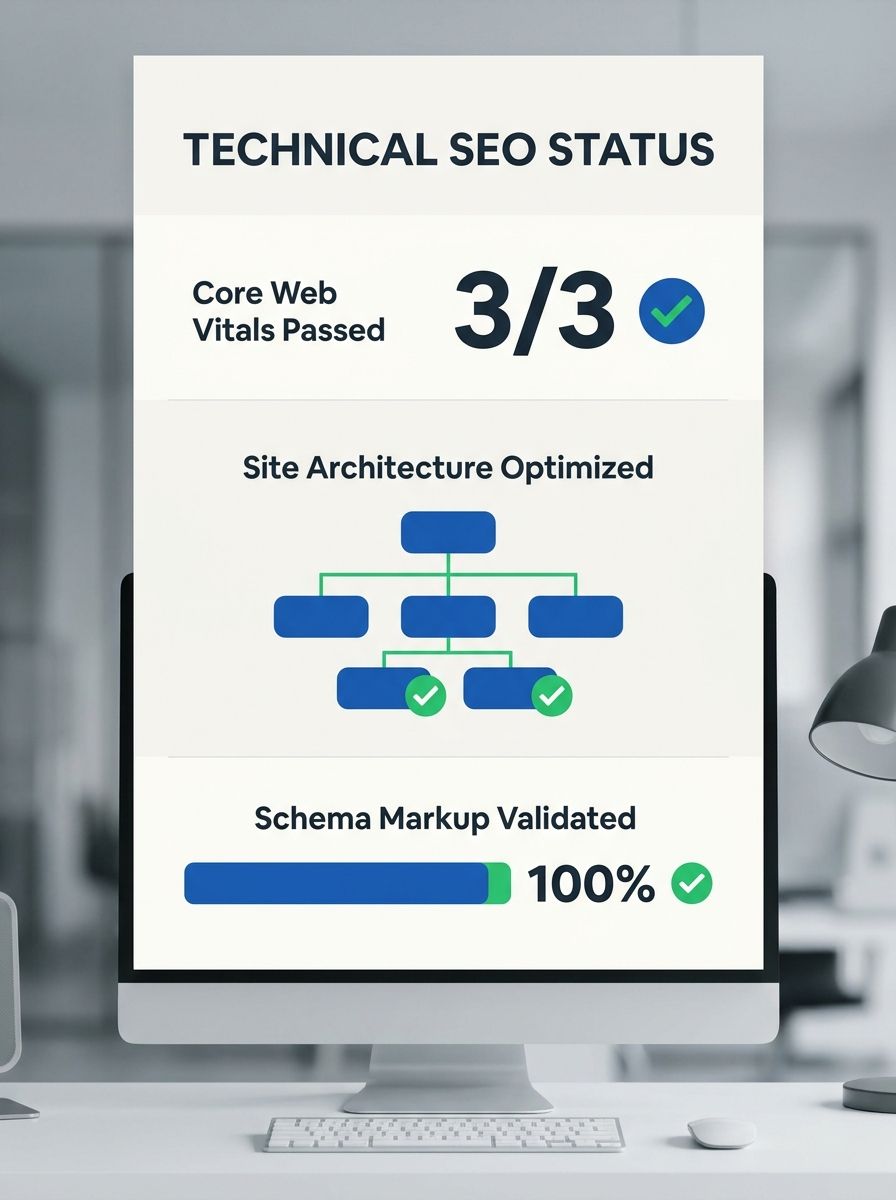
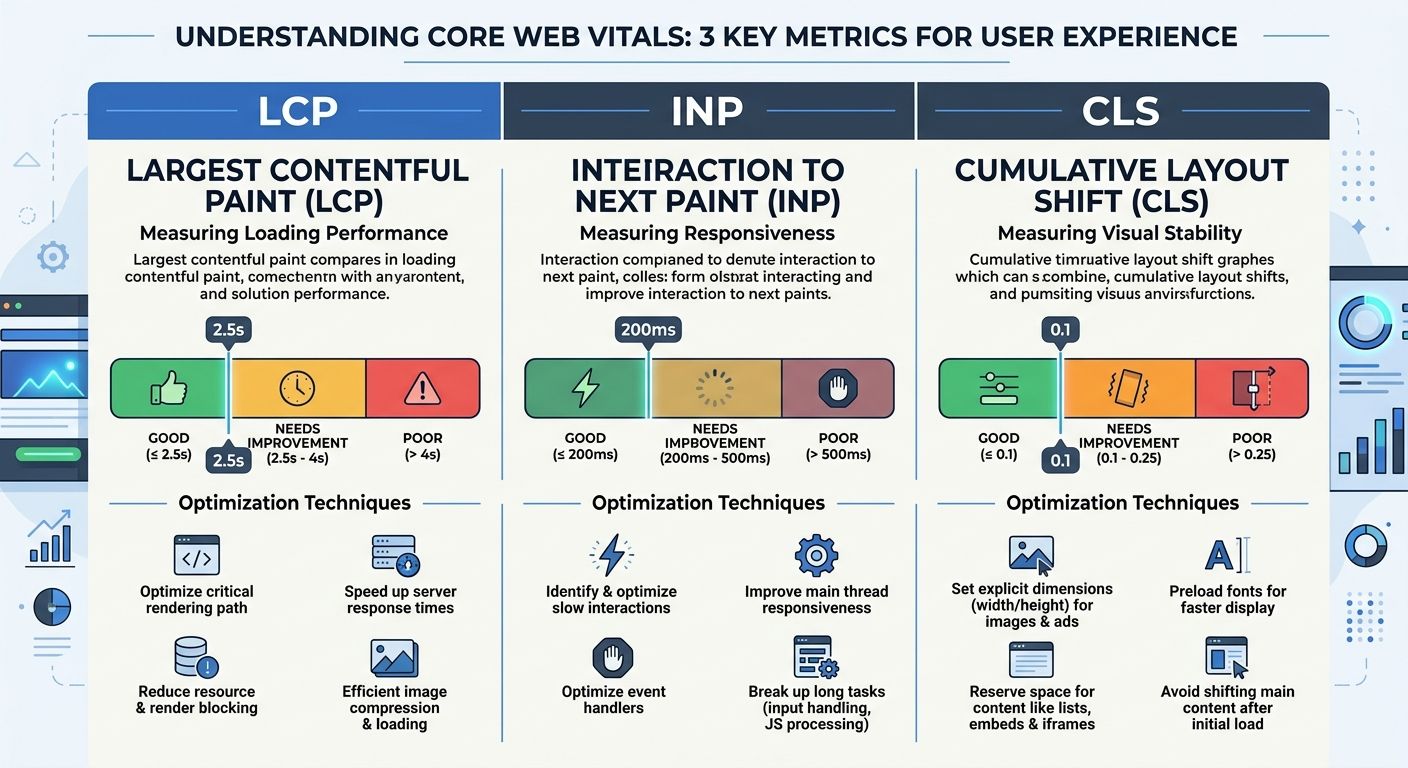
Ask any developer candidate what Core Web Vitals thresholds they target and count to three. If they can't name the specific numbers (LCP under 2.5 seconds, INP under 200 milliseconds, CLS under 0.1), they haven't internalized the standards that Google uses to evaluate page experience. According to Google's own Core Web Vitals documentation, these metrics directly influence search result rankings, and the thresholds aren't suggestions.
The reason this works as a hiring filter is precision. A developer who says "we optimize for speed" is giving you a marketing answer. A developer who says "we target LCP under 2.5 seconds by lazy-loading below-fold images in WebP or AVIF format, preloading the LCP element in the document head, and setting explicit width and height attributes on all media to prevent layout shifts" is giving you an engineering answer. The Core Web Vitals checklist published by MedResponsive spells this out: image optimization in WebP or AVIF formats, compressed without sacrificing quality, is a baseline requirement for load time reduction.
Here's where the hiring signal gets concrete. When I audit agency proposals, I look for four specific items in their core web vitals development process:
LCP optimization strategy with explicit mention of preloading critical resources. Agencies that don't preload the hero image or largest text block on the page will fail Google's 2.5-second threshold on 40% to 60% of mobile page loads.
INP testing methodology that goes beyond synthetic Lighthouse scores. INP replaced FID as the responsiveness metric, and teams still referencing FID haven't updated their workflow since 2024.
CLS prevention protocols including explicit dimensions on every image and embed, plus font-display: swap or optional declarations to prevent layout shifts from web font loading.
Monitoring infrastructure that catches regressions before they reach production. Teams using real-user monitoring (RUM) through the Chrome User Experience Report (CrUX) catch performance problems that synthetic tests miss entirely.
Agencies using systematic checklist gates at each deployment stage report a 73% reduction in post-launch SEO fixes, according to industry analysis compiled from agency workflow data. That 73% figure is the difference between a site that ranks within 60 days and a site that bleeds traffic for six months while someone scrambles to fix render-blocking JavaScript.
Site Architecture Decisions Tell You Everything a Portfolio Won't
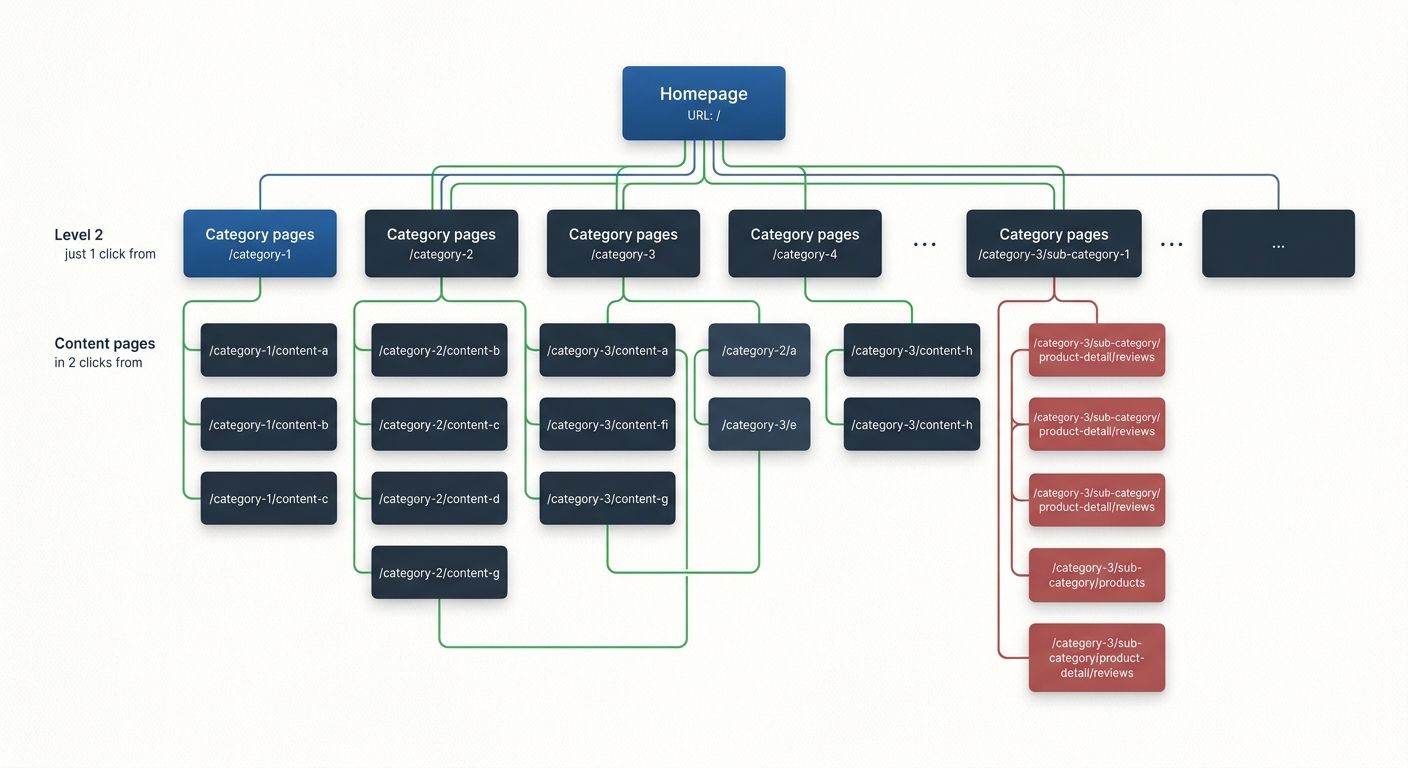
Why does site architecture matter as a vetting criterion? Because architecture choices are permanent in a way that content and design choices are not. A bad color scheme takes a designer two hours to fix. A flat URL structure with 4,000 pages sitting one level deep from the root takes an engineering team two months to restructure, and Semrush's site architecture guide explains exactly why: categories and subcategories create the hierarchical groupings that both users and search engines rely on for navigation and topical understanding.
As the DEV Community's technical SEO analysis put it: "SEO is no longer marketing. It's part of engineering. For developers who want to build scalable, performant, user-friendly systems, learning a bit of technical SEO is a serious advantage."
When I'm evaluating a development team's site architecture for developers, I ask three questions during the vetting call:
First: How deep is your default URL structure? The answer should be 3 clicks or fewer from the homepage to any indexed page. Teams that build sites where product or service pages sit 5 or 6 levels deep are creating crawl budget waste that Google's crawler handles by simply not indexing those deep pages. As SEO.com's architecture best practices guide states, URLs for new pages should be simple, easy to understand, and accurately reflect the page content. Teams that generate URL slugs from database IDs (your-site.com/p/49372) instead of descriptive paths (your-site.com/services/web-development) are signaling a lack of SEO awareness at the architectural level.
Second: How do you handle faceted navigation? This is the question that separates experienced developers from those who've never dealt with an e-commerce or directory site. Faceted navigation (filtering by color, size, price, location) creates what's called the combinatorial explosion problem, where 10 filters with 5 options each can generate thousands of indexable URL variants. The correct answer involves canonicalization, noindex directives on thin filter combinations, and a clear policy for which facets get their own indexable pages. If the dev team looks confused by this question, they haven't built a site with more than 500 pages.
Third: Do you build HTML and XML sitemaps as part of the deploy pipeline, or add them manually after launch? The answer reveals whether SEO is baked into the CI/CD workflow or bolted on later. Automated sitemap generation during deployment means the team treats site architecture as infrastructure. Manual sitemap creation means someone remembers to update it three weeks after launch, if ever.
The SEO workflow framework published by Monday.com identifies five operational pillars for search performance: strategic planning, content development, technical implementation for infrastructure and schema, quality assurance, and performance monitoring. Development teams that can map their workflow to all five pillars have internalized SEO at the process level. Teams that can only speak to the first two are outsourcing the hard parts and hoping for the best.
Schema and Rendering Configuration Are the Real Final Exam
Google's December 2025 rendering update changed the rules for client-side rendered applications. Pages that return non-200 status codes before client-side rendering occurs are now excluded from the rendering pipeline entirely. That single policy change made server-side rendering (SSR) or incremental static regeneration (ISR) a functional requirement for any JavaScript-heavy site that expects to rank. Development teams still shipping single-page applications with client-side rendering as the default and no SSR fallback are building sites that Google's crawler treats as blank pages.
This is where the technical SEO implementation checklist becomes genuinely revealing during an agency evaluation. I ask development teams to explain their approach to three rendering and schema topics:
Rendering strategy for critical pages. Product pages, service pages, and any page targeting a high-value keyword should use SSR or static generation. Client-side rendering adds what Google's documentation calls "queue time" to the rendering pipeline, and pages competing for competitive terms can't afford that delay. The correct answer from a dev team includes specifics: "We use SSR for product detail pages and statically generate category pages at build time, with ISR set to revalidate every 60 seconds for inventory-dependent content."
Schema drift prevention. Structured data implemented through JSON-LD needs to match what's actually rendered in the DOM. A product page with schema markup showing a $49.99 price while the rendered page shows $59.99 creates what's called schema drift, and Google's quality systems flag this inconsistency. Teams that take structured data seriously implement automated testing that validates JSON-LD values against rendered DOM elements during the CI/CD pipeline. According to the developer-focused open-source SEO checklist maintained by Ferenc Almasi, granular validation requirements including paragraph length under 150 words, schema consistency checks, and readability metrics should be automated rather than manually reviewed.
AI bot governance. With the rise of AI-powered search, development teams now need a policy for AI crawler access. Allowing OAI-SearchBot gives your site visibility in ChatGPT search results. Blocking GPTBot prevents your content from being used for model training. Implementing llms.txt files provides attribution instructions for AI crawlers. If a dev team hasn't heard of llms.txt or doesn't have a robots.txt policy that distinguishes between traditional search crawlers and AI training bots, they're 18 months behind on a rapidly evolving search landscape.
TripleDart's 2026 guide to SEO automation quantified the efficiency gains from automating these checks: manual SEO tasks like tracking meta tags and checking schema consistency shrank from 12 hours to roughly 30 minutes with proper automation tooling. That's a 96% time reduction on tasks that directly affect indexation quality. When a development team tells you "we handle schema manually before each launch," they're describing a process that takes 24 times longer than it should and introduces human error at every step.
SaaS companies that implemented prioritized technical rescue plans covering these rendering and schema issues have achieved 340% organic traffic growth within six months. The teams producing those results aren't doing anything exotic. They're running a checklist that covers the fundamentals, and they're running it automatically.
Evaluation Criterion | Strong Signal (Hire) | Weak Signal (Dig Deeper) | Red Flag (Walk Away) |
|---|---|---|---|
Core Web Vitals | Names specific thresholds, shows RUM monitoring | Mentions Lighthouse scores only | "We optimize for speed" |
Site Architecture | Explains URL hierarchy and facet handling | Follows client wireframes without input | No sitemap generation process |
Schema Implementation | Automated JSON-LD validation in CI/CD | Manual pre-launch checks | "We add schema after the site is live" |
Rendering Strategy | SSR/ISR for indexable pages, CSR for app shell | SSR available but not default | Client-side rendering only |
AI Bot Governance | robots.txt policies for AI crawlers, llms.txt | Aware of issue but no policy | Never heard of OAI-SearchBot |

The Checklist, Turned Inside Out
The argument I opened with holds up across all three evidence categories. A development team's technical SEO checklist, the actual document they use in production rather than the one they put in their sales deck, is the most reliable signal of build quality available during the hiring process.
The Ultimate Core Web Vitals Checklist for 2026 covers image optimization, font loading, JavaScript performance, server response times, interactivity, and layout shifts. Every item on that list is a development decision, not a marketing decision. And every development decision either gets made during the build or gets made during a painful, expensive post-launch remediation cycle.
When you're evaluating agencies or freelance developers, don't ask them to show you their portfolio. Ask them to show you their checklist. Ask how many items are automated versus manual. Ask what happens when a deployment fails a performance budget test. Ask whether schema validation runs before or after the pull request merges.
The developers who can answer those questions with specifics (LCP under 2.5 seconds, INP under 200 milliseconds, CLS under 0.1, SSR for all indexable routes, automated sitemap regeneration on every deploy) are the ones building sites that rank within 60 days of launch. And the developers who can't answer those questions with the same level of detail are the reason you're looking at a $15,000 technical SEO remediation quote six months from now. The checklist isn't a formality. It's the interview.
Marcus Webb
Digital marketing consultant and agency review specialist. With 12 years in the SEO industry, Marcus has worked with agencies of all sizes and brings an insider perspective to agency evaluations and selection strategies.
Related Articles

The Niche-Specific SEO Audit Checklist: Beyond Generic 100-Point Frameworks for Architecture and Design Firms
Generic 100-point SEO audit frameworks consistently hand architecture and design firm websites passing scores while those same sites lose organic visibility on the pages that actually win clients: project portfolios, case studies, and studio landing pages.

The Invisible SEO Audit: Fixing Hidden Technical Problems Before Rankings Improve
Fifty-six percent of companies now run AI-driven SEO monitoring to catch invisible technical problems in real time, according to 2026 marketing data.

The SEO Debugging Workflow: A Framework for Diagnosing Visibility Drops in Under 48 Hours
A five-layer diagnostic sequence (crawl, render, index, rank, click) applied in strict dependency order isolates the root cause of organic visibility drops faster than any other method I've tested across 200+ agency evaluations.
Explore more topics