
Netlz Publishes Cost Comparison Framework for SEO Agency vs. In-House Hiring Decisions
A Parsippany-based SEO firm published a decision framework on June 19, 2026, detailing the budget, speed, and control trade-offs between hiring an SEO agency versus building an in-house team, with mid-level SEO specialist salaries in the New Jersey and New York metro region ranging from $65,000 to $
 Marcus Webb··4 min read
Netlz Publishes Cost Comparison Framework for SEO Agency vs. In-House Hiring Decisions
A Parsippany-based SEO firm published a decision framework on June 19, 2026, detailing the budget, speed, and control trade-offs between hiring an SEO agency versus building an in-house team, with mid-level SEO specialist salaries in the New Jersey and New York metro region ranging from $65,000 to $110,000 annually before benefits and tooling costs, according to Netlz.com.
Published Framework Breaks Down Three Core Decision Factors
The published comparison, written by Moshe Zchut of Netlz, identifies budget constraints, implementation speed, and day-to-day control as the three primary variables that determine whether a business should contract an agency or hire internally. The framework positions the decision as stage-dependent rather than universally prescriptive, according to the published analysis.
Agencies deliver immediate access to specialized teams across technical SEO, content production, and link acquisition without the lag time of recruiting multiple full-time employees, the framework states. Monthly retainer costs replace the combined expense of salaries, benefits, payroll taxes, and software subscriptions required to staff equivalent in-house capabilities.
In-house hires provide exclusive focus on a single business, deeper brand and customer knowledge developed over time, and direct coordination with internal sales and development teams, according to the comparison. The framework notes that this arrangement eliminates the attention-sharing inherent in agency client portfolios but introduces hiring timelines that can extend several months for qualified candidates.
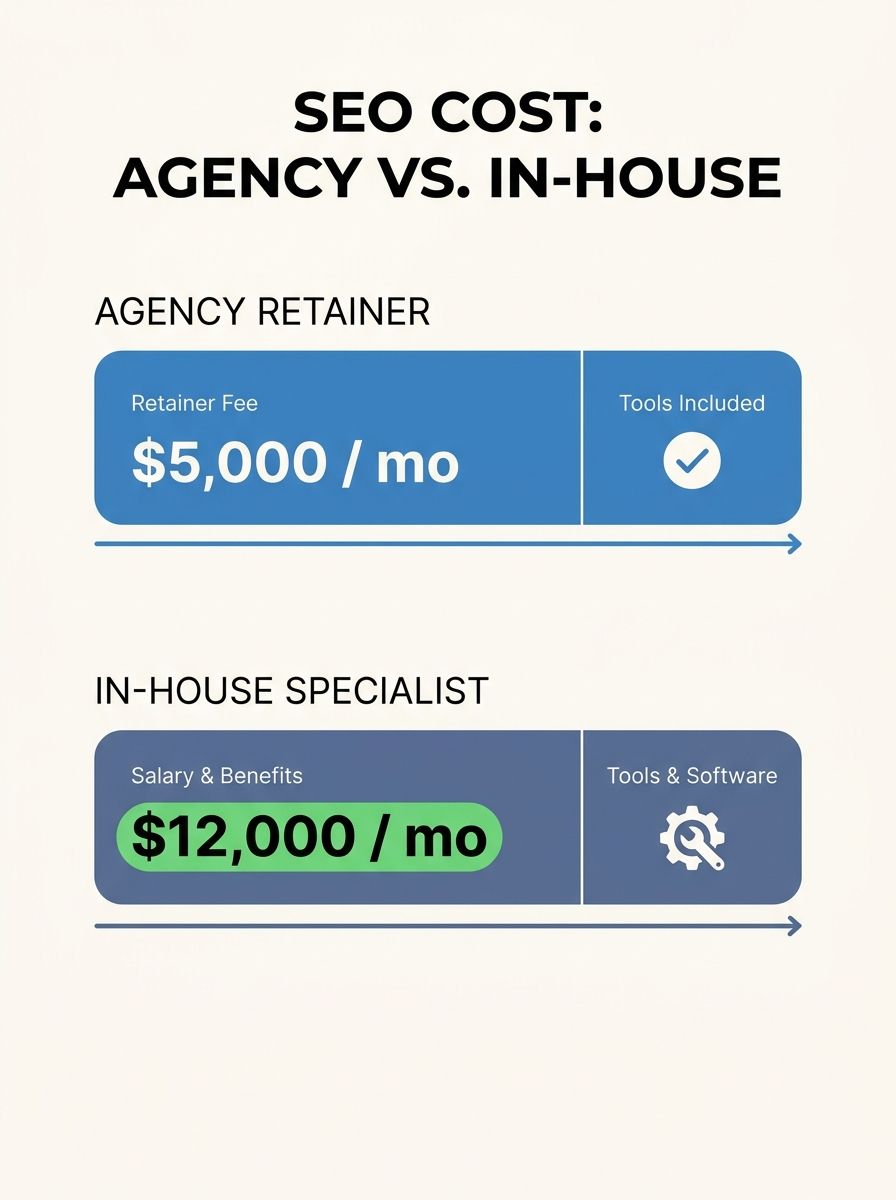
Salary and Tooling Costs Quantified for New Jersey Market
Mid-level SEO specialists in the New Jersey and New York City metro region command annual salaries between $65,000 and $110,000, with senior-level roles exceeding $120,000, the framework reports. These figures precede benefits, payroll taxes, and operational overhead.
A functional SEO technology stack including keyword research platforms, rank tracking software, site crawlers, and analytics tools costs between $3,000 and $10,000 annually per user, according to the published estimates. The combined first-year cost for a single mid-level hire with full tooling access reaches $80,000 to $130,000 before producing ranking improvements.
The framework contrasts this expenditure against agency retainers that bundle team access, established processes, and pre-licensed software into fixed monthly costs, typically ranging lower than the all-in expense of a salaried employee with equivalent capabilities.
Hybrid Model Emerges as Dominant Structure
Many New Jersey businesses operate a hybrid arrangement that assigns brand ownership and internal coordination to one in-house marketer while outsourcing technical audits, content production, and link building to contracted agencies, the framework states. This configuration preserves institutional knowledge and messaging consistency while accessing specialized execution capacity without carrying multiple full-time salaries.
The framework positions SEO consultants as a third option suited to companies with existing marketing staff who require strategic direction rather than hands-on implementation. Consultants deliver audits and planning by the hour or on retainer but do not execute the resulting work, according to the comparison.
Businesses with tight budgets requiring immediate lead generation benefit from agencies or consultants handling local marketing without hire delays, while larger organizations with established teams can justify dedicated in-house specialists, the framework concludes. The analysis frames the decision as dependent on current operational stage rather than prescriptive best practice.
Cost-Control Strategies Vary by Model Selection
The framework identifies differing cost structures across the three models. Agency relationships scale monthly spend against shifting priorities without long-term employment commitments, while in-house hires create fixed overhead independent of project volume. Consultants charge hourly or project-based fees that fluctuate with engagement scope but require client teams to complete recommended implementations.
"A contractor trying to rank for 'emergency plumber Newark' has a different problem than a law firm with forty service pages," Zchut wrote in the published framework, illustrating the variability in appropriate model selection. The comparison notes that businesses frequently change models as revenue and complexity grow.
The framework does not advocate for universal adoption of any single model, instead positioning the choice as contingent on immediate budget availability, acceptable timelines for ranking improvements, and internal capacity to manage either contractors or employees. Companies experiencing SEO agency accountability gaps may reconsider in-house options, while firms lacking technical depth often prefer agency teams, according to the analysis.
What This Means for Business Owners
The published cost framework provides quantified benchmarks for evaluating whether your search budget supports an in-house hire or contracts better with an agency retainer. If your current marketing spend falls below $80,000 annually, agency partnerships or consultant engagements deliver specialized capabilities without the fixed overhead of a salaried employee plus tooling subscriptions. Businesses already carrying marketing headcount should calculate whether reallocating one salary toward contracted SEO execution yields faster ranking improvements than recruiting a specialist.
The hybrid model described in the framework addresses the control concerns many business owners cite when evaluating agencies. Keeping one internal marketer who owns brand messaging while outsourcing technical implementation preserves strategic oversight without staffing every SEO discipline. This structure works particularly well for companies experiencing growth transitions where full-time hires lag behind immediate ranking needs.
Review your last twelve months of search visibility metrics against your total marketing payroll. If organic traffic remains flat despite internal SEO efforts, the framework's agency comparison may justify reallocating budget toward contracted specialists who deliver documented ranking improvements within defined retainer periods.
Marcus Webb
Digital marketing consultant and agency review specialist. With 12 years in the SEO industry, Marcus has worked with agencies of all sizes and brings an insider perspective to agency evaluations and selection strategies.
Related Articles

DIY SEO Tools vs. Agency Services: The Real Cost-Benefit Analysis for Mid-Market Businesses in 2026
The standard "in-house vs agency SEO" debate gives mid-market companies a false binary that leads to overspending in both directions — paying agencies $5,000–$10,000 per month for tasks a $200 tool handles, while skipping the strategic work where professional firms actually earn their fee.

Boutique SEO Agency vs. Enterprise SEO Firm: Which Model Delivers Better ROI for Mid-Market Companies in 2026
Mid-market companies ($10M–$500M revenue) get squeezed in SEO vendor selection because they're too big for freelancers and too small to justify $25,000 monthly retainers.

The SEO Agency Accountability Gap: Why Most Retainer Models Are Structurally Designed Against Client Results
The typical mid-market SEO retainer runs $3,000 to $10,000 per month, locks the client into a 12-month contract, and contains no binding performance benchmarks. That combination of guaranteed revenue and zero required outcomes is the structural core of the agency accountability gap.
Explore more topics