
The SEO Agency Red Flag Audit: How to Spot Track Record Manipulation in Monthly Reports
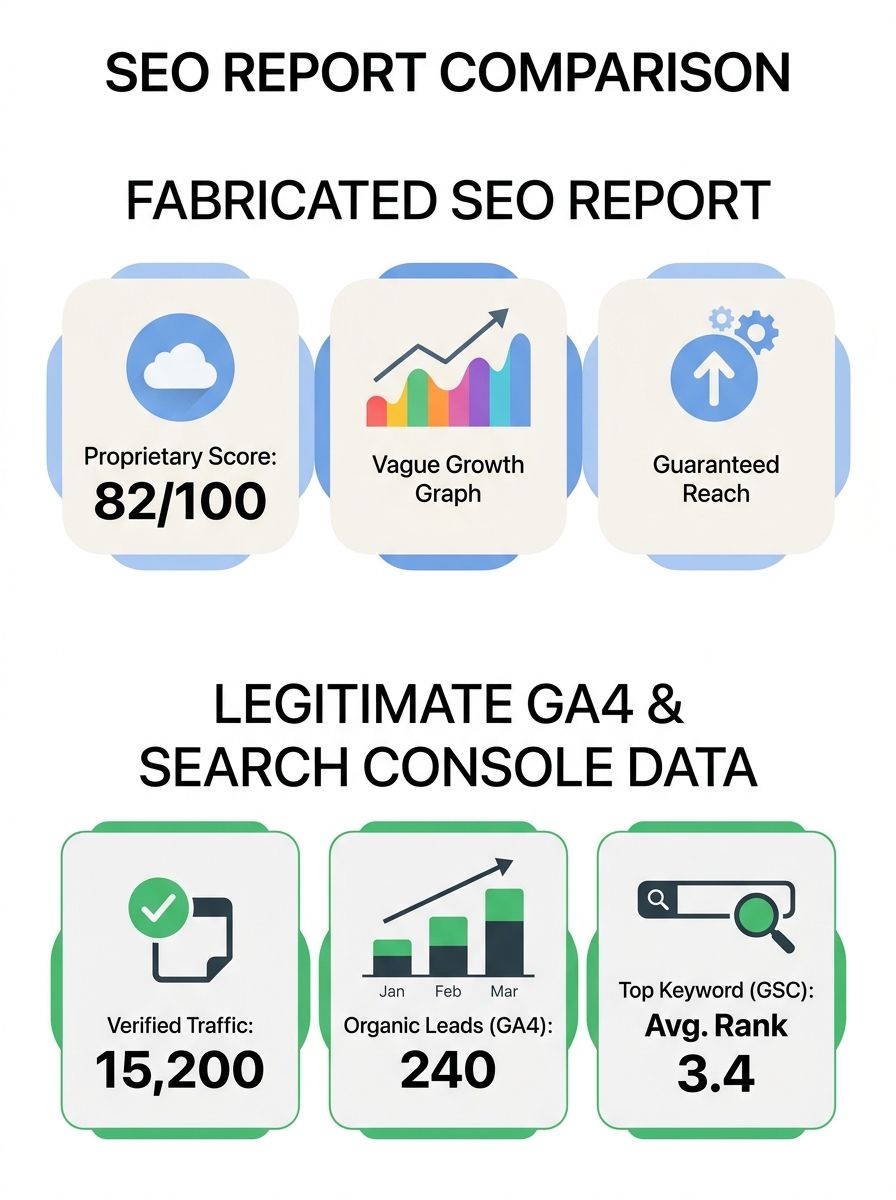
Fake SEO metrics appear in monthly reports as proprietary-sounding graphs labeled "link velocity index," "domain trust trajectory," or "semantic authority score" that can't be verified in Google Analytics or Search Console.
 Marcus Webb··9 min read
The SEO Agency Red Flag Audit: How to Spot Track Record Manipulation in Monthly Reports
Fake SEO metrics appear in monthly reports as proprietary-sounding graphs labeled "link velocity index," "domain trust trajectory," or "semantic authority score" that can't be verified in Google Analytics or Search Console. A proper SEO agency performance audit compares every reported number against your own first-party data and at least one independent third-party tool.
One case documented on Reddit captures the pattern perfectly. A digital marketer reviewing a new client's history found that the previous agency had sent "fancy reports every month with graphs showing 'link velocity' and other made-up metrics." The client had paid $5,000. Actual traffic was down 40% since the engagement started. Worse, the agency had disavowed roughly half the client's legitimate backlinks from real industry publications because their automated tool flagged them as "toxic."
That $5,000 story is extreme, but the underlying pattern plays out at every price point. I've reviewed reports from agencies charging $1,500/month and $15,000/month that used identical obfuscation techniques. These six rules are what I now run through whenever a business asks me to evaluate an existing agency relationship or audit reports from a past engagement.
Cross-Reference Every Metric Against Your Own Analytics
The single fastest way to detect monthly report red flags is to open the agency's report in one browser tab and your GA4 account in another. Navigate to Reports > Engagement > Pages and screens in GA4, as Semrush's measurement guide outlines, and compare session counts, engagement time, and traffic sources for the same date range the agency is reporting on.
A legitimate agency's numbers should land within 5-10% of what your own analytics show. Small discrepancies happen because of filtering differences, timezone settings, or bot traffic exclusion. But if the agency reports 12,000 organic sessions for April and your GA4 shows 7,200, that 40% gap needs an explanation in writing.
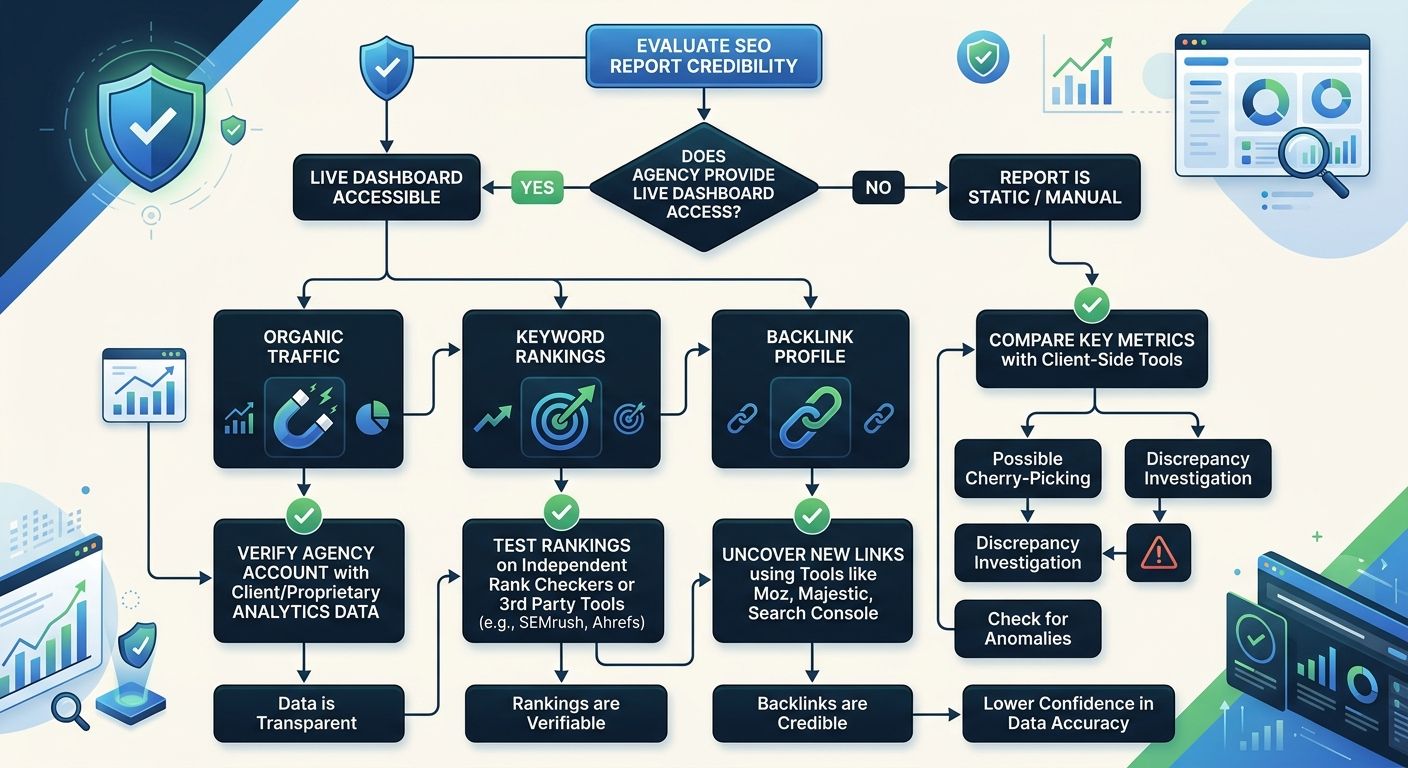
This is where the Three-Source Verification Framework becomes your primary track record verification tool. For any metric the agency reports, check it against three independent sources:
Source 1: GA4. Your own Google Analytics property, which the agency should have set up or connected during onboarding.
Source 2: Google Search Console. Clicks, impressions, average position, and CTR for the specific queries the agency claims to be targeting.
Source 3: A third-party tool you control. Ahrefs, Semrush, Moz, or Sistrix. Run your own domain audit and compare visibility trends to the agency's reported trends.
When all three sources tell roughly the same story, the data is almost certainly clean. When the agency's report diverges from two or all three of your independent checks, you've found manipulation or, at minimum, careless reporting that serves the same function.
As Embarque.io's guide on spotting fake reports notes, "if an agency provides a report but hesitates to give you direct access to view Google Analytics or Google Search Console data, that's a red flag." Full data access is the baseline expectation for any agency engagement.
Demand Live Dashboard Access Instead of Exported PDFs
Static PDFs are the preferred delivery format for agencies that manipulate data. A PDF can be edited in Adobe Acrobat in under three minutes. Charts can be regenerated from modified spreadsheets. Screenshots can be cropped to exclude unflattering date ranges.
Insist on one of these two alternatives:
Direct login access to Google Analytics, Search Console, and any rank tracking tool the agency uses. Not viewer access to a dashboard the agency built. Login credentials to the actual platforms.
A live reporting dashboard in a tool like Looker Studio connected directly to your GA4 and Search Console properties. These connections pull data in real time and can't be edited without leaving a visible modification trail.
The cost difference for the agency is negligible. Setting up a Looker Studio dashboard takes 2-4 hours for a competent SEO team. Agencies charging $3,000-$10,000/month on retainer absorb that setup cost easily. If they push back or claim their "proprietary reporting platform" provides better insights, ask what data sources feed that platform. If the answer involves anything other than your GA4 and Search Console properties connected via API, you should worry.
I've written before about how retainer models are structurally designed against client results. Report format is one of the structural levers agencies use to control the narrative. An agency that owns the reporting medium owns the story of what's working and what isn't.
Ignore Rankings That Don't Connect to Revenue
Why do ranking reports dominate agency decks even when traffic and conversions are flat? Because rankings are the easiest metric to show movement on. An agency might present 200 keywords with improving positions, but 180 of those keywords carry monthly search volumes under 20 with zero commercial intent.
Stridec's 2026 guide on SEO agency red flags identifies vanity metric reporting as one of the most persistent manipulation tactics in the industry, alongside guaranteed rankings and secretive processes.
Here's the test: For every keyword the agency highlights as a "win," look up three numbers:
Monthly search volume in your third-party tool
Click-through rate in Search Console for that specific query
Conversion rate for the landing page that keyword points to
If a keyword has 30 monthly searches, a 2% CTR, and a 1% conversion rate, the agency's "win" produces roughly 0.006 conversions per month from that term. When the agency dedicates a full report page to that keyword and buries the ones where you lost ground, you're looking at selective reporting designed to obscure poor performance.
And the search environment keeps shrinking the pool of keywords that actually deliver clicks. As a16z data showed, search traffic to websites fell approximately 25% over the past year as AI Overviews absorbed clicks that used to reach publisher sites. An agency still reporting keyword rankings without accounting for the CTR collapse on informational queries is reporting on a game that has already changed.
Verify Backlink Claims with an Independent Tool
Backlink building is the section of agency reports where fabrication runs highest because link data is genuinely harder for clients to verify. The agency might report 45 new backlinks acquired in a month. Your job is determining whether those 45 links exist, whether they're from real websites with real traffic, and whether they'll survive beyond the next quarter.
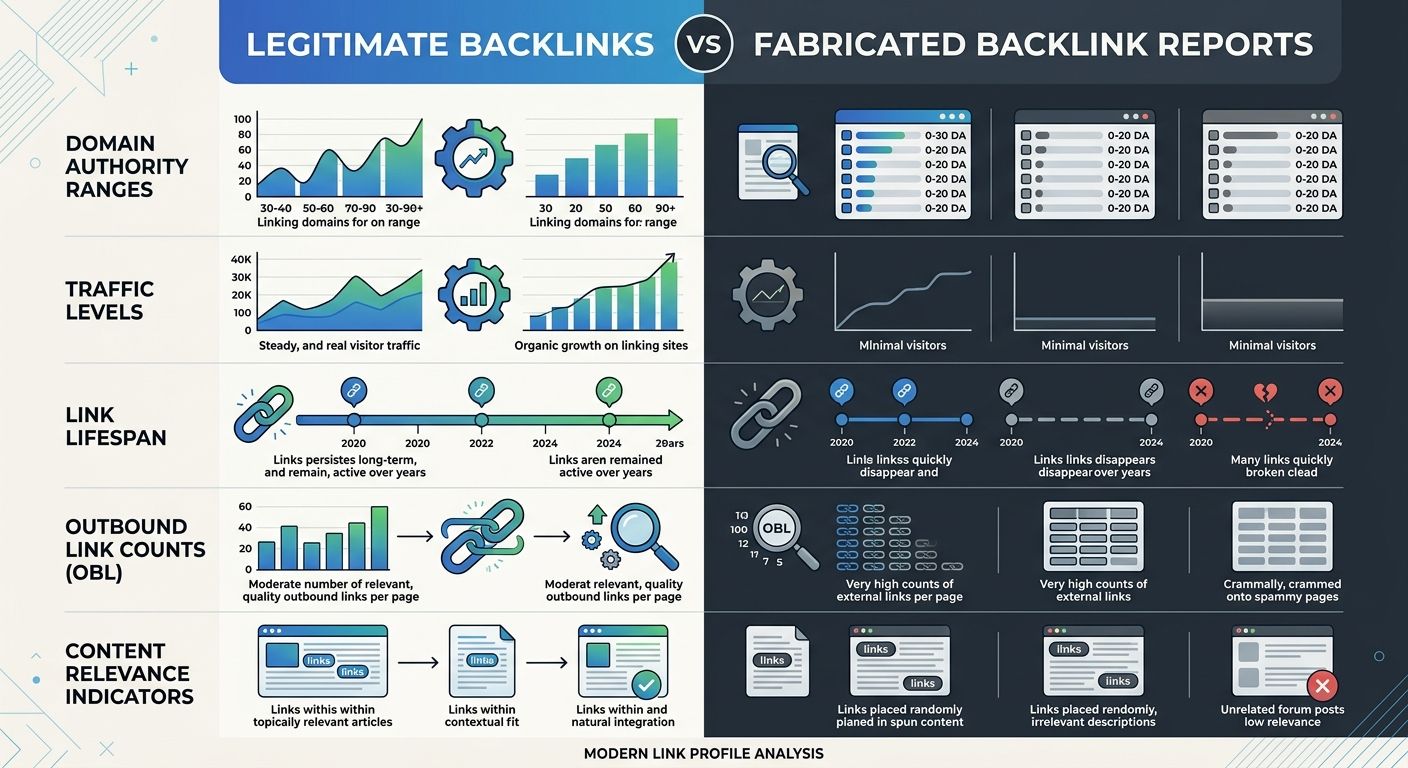
Open Ahrefs or Semrush's backlink analysis tool. Filter for new referring domains over the same period the agency covers. Compare the count. Then evaluate the quality of those linking domains:
Quality Signal | Legitimate Links | Suspicious Links |
|---|---|---|
Domain Rating | DR 30+ with organic traffic | DR below 10, zero traffic |
Outbound links on page | Under 15 external links | 50+ outbound links |
Link lifespan | Still live after 90+ days | Disappears within 30-60 days |
Content relevance | Topically related to your industry | Generic "guest post" sites |
Traffic to linking page | Some organic visitors | Zero organic visitors |
The Reddit case I mentioned earlier illustrates the worst outcome: the agency disavowed half the client's legitimate backlinks from actual industry publications, then replaced those strong editorial links with weaker ones and reported the new links as progress. The net effect was a loss of link equity disguised as link building activity.
If your agency charges separately for link building (typical range: $500-$3,000/month on top of the base retainer), you should be auditing every reported link monthly. The 15 minutes this takes per month can prevent thousands in wasted spend and avoid the kind of damage that triggers months-long traffic recovery projects.
Ask for a Six-Month Revenue Prediction
One of the sharpest tests shared in the SEO community comes from a practitioner on Reddit's DigitalMarketing forum: "Ask the agency to predict specific revenue impact from their SEO work over 6 months. Good agencies can estimate this based on keyword volume and conversion data."
This test works because making a revenue prediction requires the agency to show their math. They need to specify which keywords they're targeting, what search volumes those keywords carry, what CTR they expect at projected rankings, and what conversion rate your site historically achieves. If any of those inputs are fabricated, the prediction falls apart within 90 days.
An agency that refuses to make any projection is telling you something about their confidence in their own work. The refusal usually sounds like "SEO is too unpredictable" or "Google changes too much to forecast." Both statements contain a grain of truth, but an experienced team working with reliable data can still produce a defensible range. "We expect organic traffic to increase 15-25% over six months based on your current keyword positions and the competitive gaps we've identified" is a verifiable, accountable claim.
Compare this approach against agencies that report backward-looking vanity metrics without ever committing to forward-looking outcomes. If your own debugging workflow for ranking drops reveals problems the agency never flagged, their reporting was designed to avoid accountability rather than surface real insight.
Contact References from Recently Completed Projects
HigherVisibility's credibility guide emphasizes that you should "request recently concluded projects" so you can verify the agency's knowledge of current SEO practices. The word "recently" matters here. An agency showing case studies from 2022 is showing work done in a fundamentally different search environment, before AI Overviews reshaped click-through patterns and before Google's March 2026 core update overhauled ranking signals.
Hashmeta's evaluation framework goes further: "Request direct references you can contact rather than relying solely on website testimonials." Speaking with current or former clients allows candid feedback about communication, actual results versus reported results, and how the agency handled setbacks.
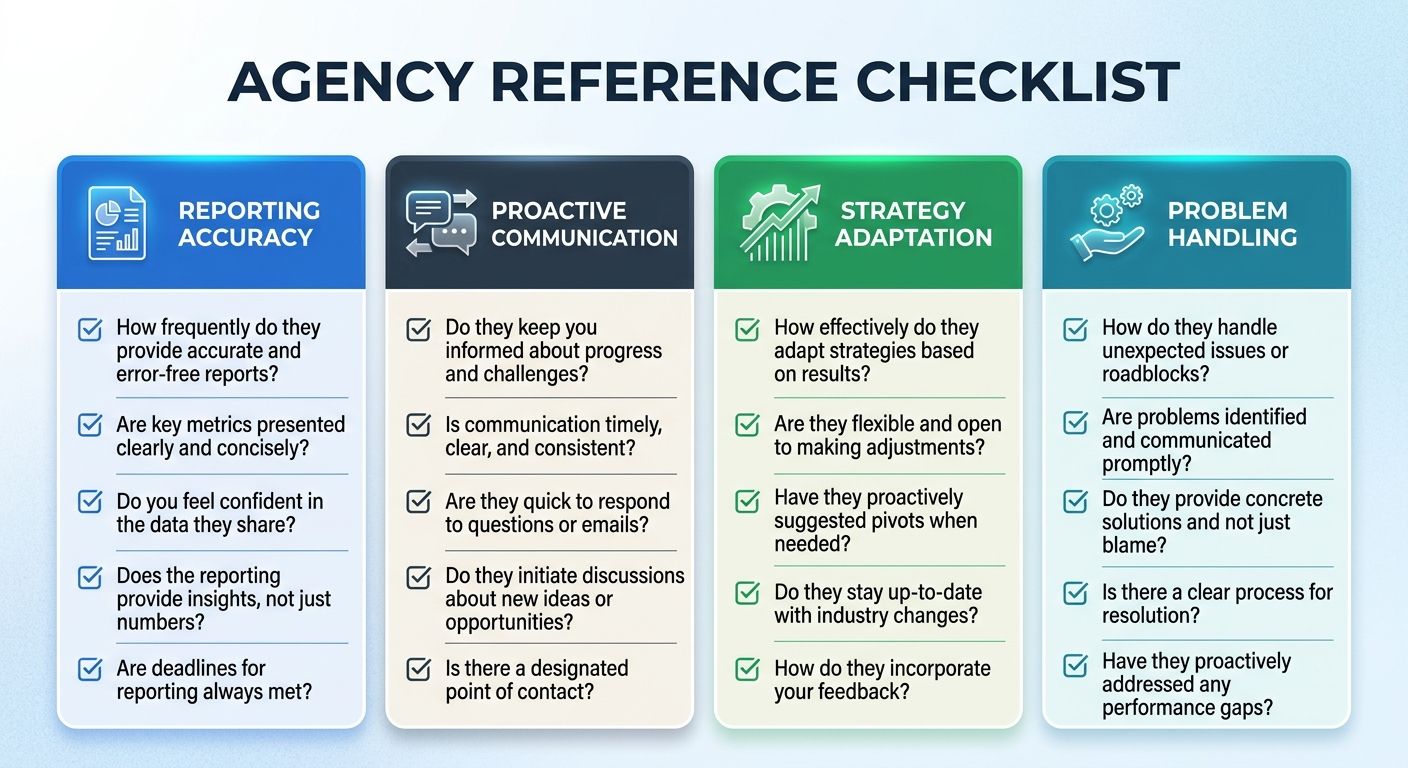
When you reach those references, ask specific questions:
Did the agency's monthly reports match what you saw in your own analytics?
Were there months where the report painted a rosier picture than your dashboards showed?
Did the agency proactively flag problems, or did you discover issues independently?
What happened to your reporting and strategy after a Google core update hit?
That last question is especially revealing. Your Core Web Vitals should be in the "Good" range for key landing pages and your Search Console coverage report should show no critical errors. An agency that didn't address either of these in its monthly reporting during a period of known algorithmic volatility wasn't paying attention.
I typically ask for 3 references and call all 3. You'd be surprised how differently a client's experience sounds from the case study the agency published about that same engagement.
When These Rules Break Down
These six rules assume a baseline of good faith on both sides. They catch incompetence disguised as expertise, selective reporting designed to justify retainer renewals, and outright data fabrication in static reports. They cover the majority of the cases I encounter during an SEO agency performance audit.
But they don't catch everything. Sophisticated agencies can produce reports that pass every verification check above while still delivering poor strategic value. The numbers might be accurate. The dashboards might be transparent. And the strategy itself might still be optimizing for the wrong outcomes entirely. Traffic rises, but conversions stay flat. Rankings improve on keywords that attract browsers, not buyers. Technical SEO scores hit green across the board while actual business performance stagnates.
For those situations, you need a different kind of review. You need to evaluate whether the strategy makes sense for your business model, your competitive position, and the actual search behaviors of your customers. That's a strategic audit, and it usually requires an outside perspective from someone other than your current agency.
If you're paying $4,000-$12,000/month and can't point to a clear revenue connection after 6-9 months of engagement, the problem might live in the reports or it might live in the strategy behind them. Run these six rules first. They'll tell you whether the data is trustworthy. What the data means for your business is the harder question, and it's the one that deserves the most time.
Marcus Webb
Digital marketing consultant and agency review specialist. With 12 years in the SEO industry, Marcus has worked with agencies of all sizes and brings an insider perspective to agency evaluations and selection strategies.
Related Articles

The SEO Agency Trust Verification Framework: Auditing Real Results Beyond Monthly Reports
Verifying an SEO agency's real performance requires auditing three things their monthly reports rarely show: revenue attribution from organic search, ranking movement on terms that actually convert, and independent third-party traffic validation.

Beyond Fake Reviews: How to Audit an SEO Agency's Real Track Record Using Benchmarks and Client Data
Of the 200-plus SEO agencies I've evaluated over 12 years, fewer than 30 provided prospective clients with baseline performance data tied to actual business outcomes before signing a contract.
How SEO Agencies Hide Mediocre Results: The Client Review Audit Framework That Exposes the Truth
Fifty to one hundred fake five-star Google reviews, planted within days on a fabricated Google Business Profile using a stolen brand name, is the specific pattern digital marketing consultant Eric Warncke documented in a widely-shared LinkedIn post.
Explore more topics