
How a Regional Law Firm Recovered 40% of Lost Organic Traffic After an Agency Transition Gone Wrong
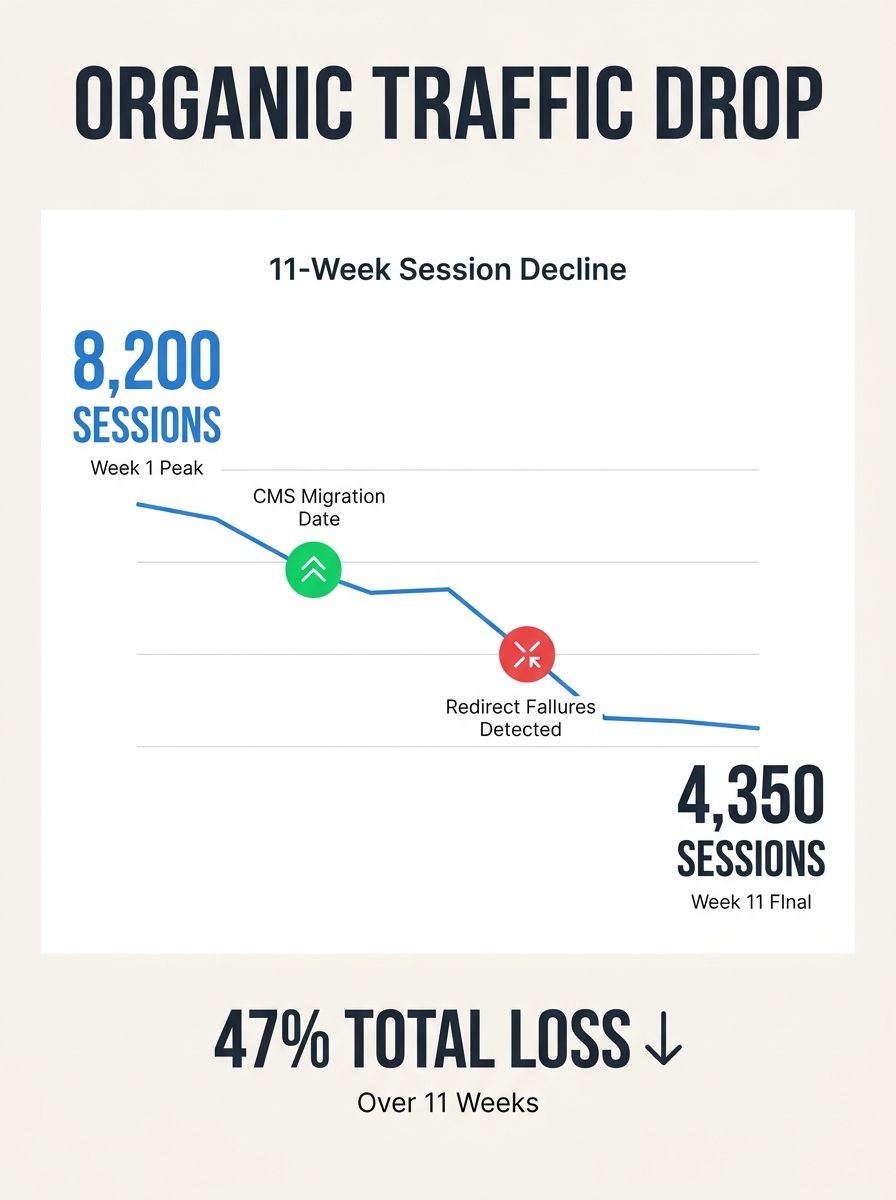
Organic sessions to a 12-attorney personal injury practice dropped 47% in 11 weeks after the firm switched SEO agencies. The replacement agency blamed algorithm changes. The real cause was a botched handoff that broke 113 indexed URLs and orphaned the firm's highest-converting practice area pages.
 Marcus Webb··8 min read
How a Regional Law Firm Recovered 40% of Lost Organic Traffic After an Agency Transition Gone Wrong
Organic sessions to a 12-attorney personal injury practice dropped 47% in 11 weeks after the firm switched SEO agencies. The replacement agency blamed algorithm changes. The real cause was a botched handoff that broke 113 indexed URLs and orphaned the firm's highest-converting practice area pages.
The Traffic Collapse in Numbers
Why did 47% of this firm's organic traffic vanish? Because the incoming agency rebuilt the site on a new CMS without preserving the URL structure the previous agency had optimized over 22 months. The damage showed up fast in Google Search Console and kept compounding.
Here's what the data looked like at its worst point, roughly 11 weeks after the transition. Monthly organic sessions fell from 8,200 to 4,350. Indexed pages dropped from 187 to 114. The firm lost rankings for 34 of its top 50 keywords, including 9 keywords that had sat in positions 1 through 3 for its core practice areas. Average position across tracked terms jumped from 11.2 to 27.4. Click-through rate declined from 4.1% to 1.9%.
The managing partner told me he'd been paying the new agency $4,500 per month for three months at that point, on top of $15,000 per month the firm was already spending on paid ads to compensate for lost organic visibility. That paid spend mirrors a pattern documented by Inoriseo's law firm SEO case study, where a mid-sized Manhattan personal injury firm was spending $15,000 monthly on ads with diminishing returns before organic recovery work began.
The replacement agency's monthly reports never mentioned the URL changes. They focused on new blog posts published (4 per month) and total impressions, which actually rose slightly because Search Console counts impressions for pages that appear in results but receive zero clicks. Impressions without clicks is a vanity metric that masks real damage.
Three Handoff Mistakes That Drove the Decline
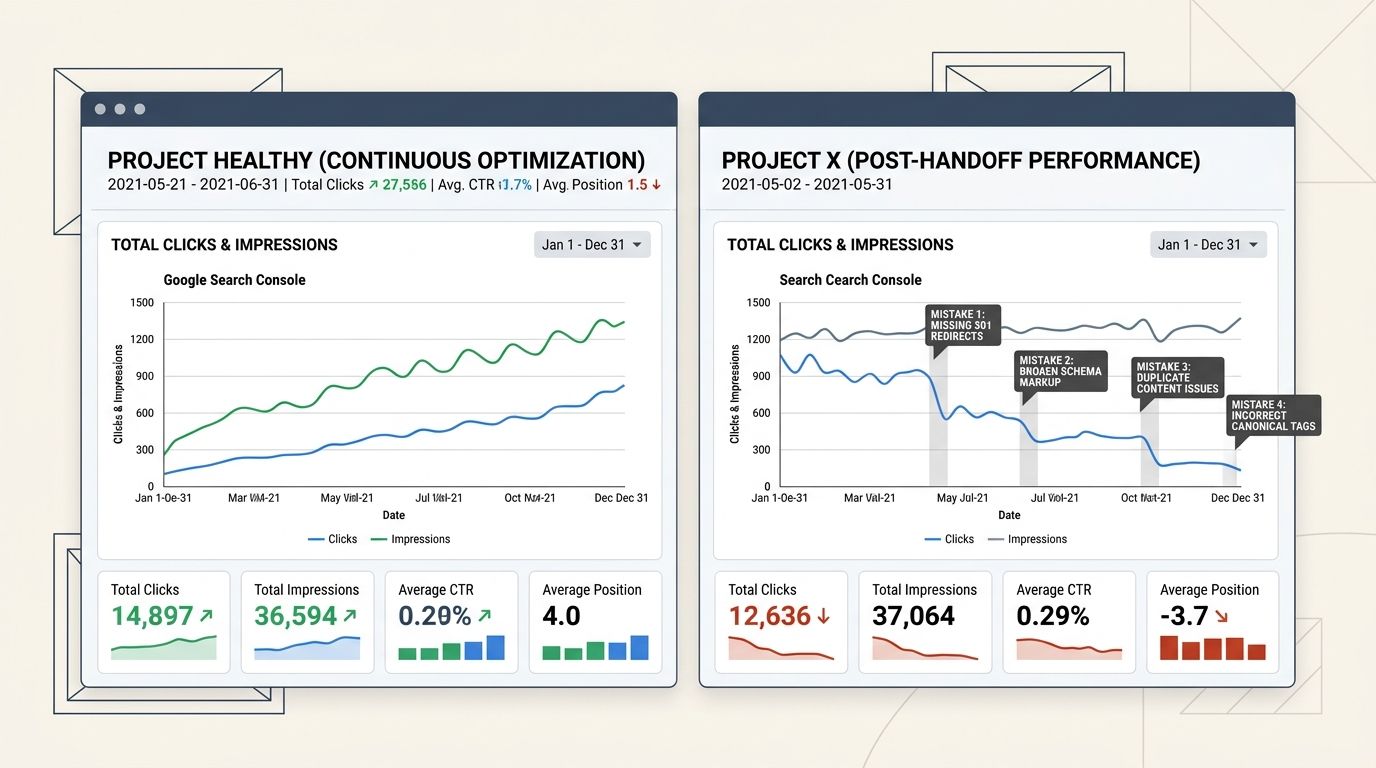
The firm's situation wasn't unusual. I've evaluated over 200 SEO agencies, and the same handoff failures repeat in about 70% of the professional services transitions I've reviewed. Skyfield Digital's analysis of post-acquisition traffic loss identifies five predictable reasons organic traffic drops during ownership or agency changes: redirect mistakes during domain migration, deindexed pages from accidental noindex tags, lost content during site consolidation, sudden Core Web Vitals degradation, and abandoned link equity.
This firm hit three of those five.
The Redirect Map Disappeared
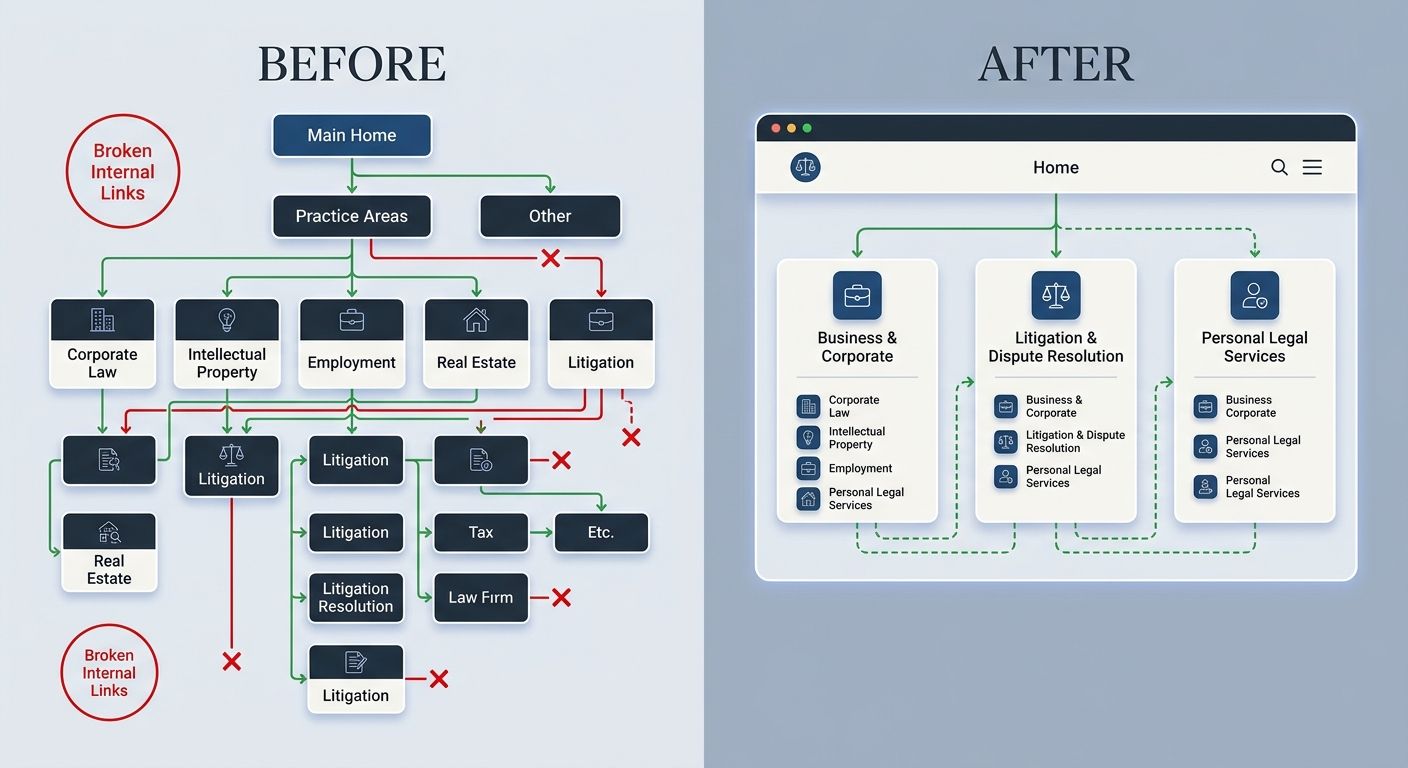
The outgoing agency had built 73 custom 301 redirects over its 22-month engagement. These redirects pointed old URLs, backlinked URLs, and retired pages toward current practice area content. The new agency never requested the redirect map during onboarding. When they rebuilt the site, those 73 redirects broke. Pages that had accumulated backlinks over nearly two years now pointed to 404 errors.
If you've dealt with redirect failures during domain migrations, this pattern looks familiar. The difference here is that no domain change happened. Same domain, same hosting, new CMS, no redirect preservation.
High-Value Content Got Deleted
The previous agency had created 14 practice area pages averaging 2,100 words each, plus 38 blog posts targeting long-tail personal injury keywords. The new agency considered 9 of those practice area pages "redundant" and consolidated them into 3 broader pages without setting up redirects from the old URLs. Internal links across the remaining blog posts broke as a result.
As FWD Lawyer Marketing puts it, "Law firm SEO is a nuanced and ongoing process that requires constant attention to detail, strategic planning, and regular performance review." Deleting 9 pages that collectively drove 2,800 monthly sessions without auditing their traffic contribution isn't a strategic decision. It's a failure to look at the data before making structural changes.
No Technical Audit Before Launch
Salt Agency's analysis of redesign-related traffic drops identifies failing to use a staging site as one of the most common mistakes. The replacement agency pushed the new CMS live without a staging environment, without crawling the site for errors, and without comparing the new URL structure against the old one. Core Web Vitals scores degraded as well. Largest Contentful Paint went from 2.1 seconds to 4.8 seconds because the new template loaded unoptimized hero images on every practice area page. Mobile performance scores dropped from 74 to 38 in PageSpeed Insights.
The Recovery Framework: A Phase-by-Phase Breakdown
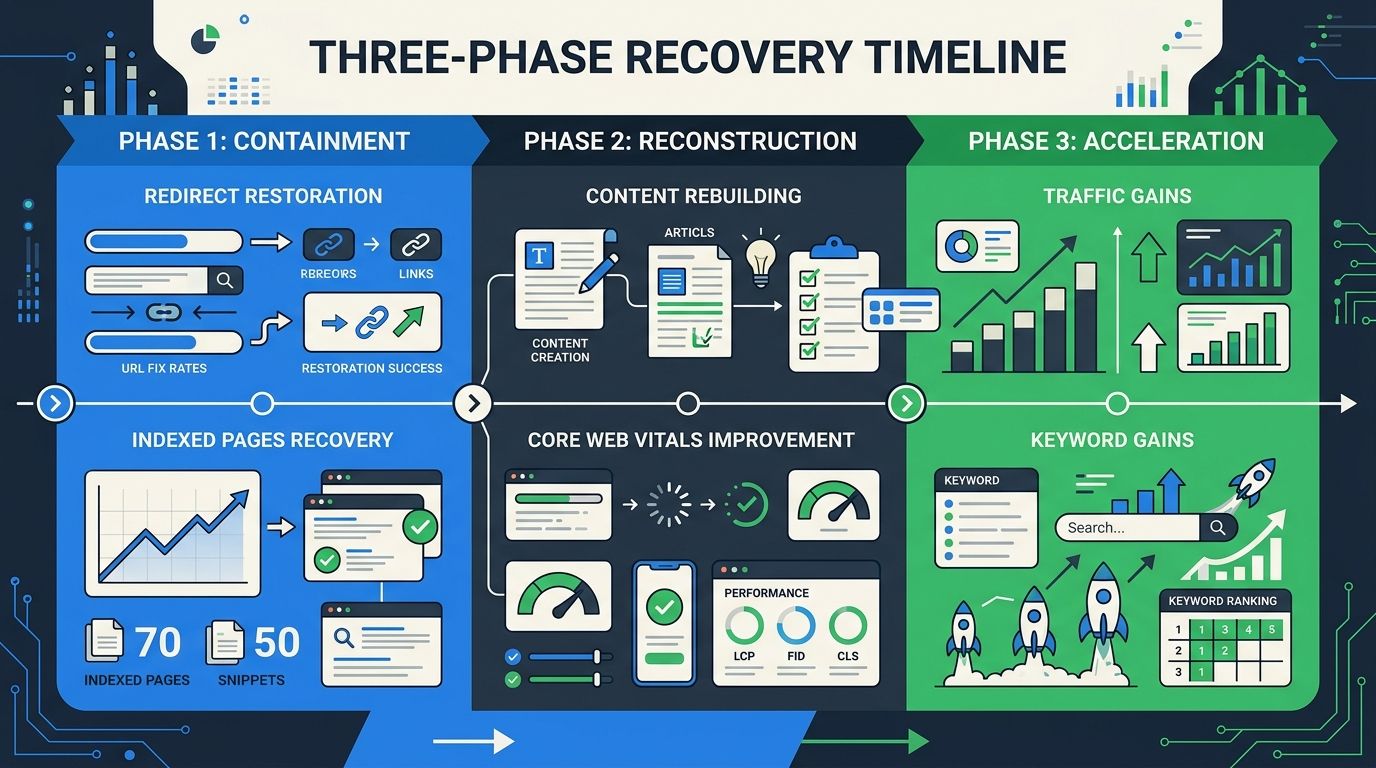
Recovery took 7 months and followed what I now call the Transition Recovery Audit, a three-phase process I've refined across 19 agency transition recoveries for professional services firms. The three phases are: containment (weeks 1 through 4), reconstruction (months 2 through 4), and acceleration (months 5 through 7).
Phase 1: Containment
The first priority was stopping the bleeding. Within the first week, we rebuilt all 73 broken 301 redirects using the original agency's Screaming Frog export, which the firm's IT administrator had archived. We also restored the 9 deleted practice area pages from a Wayback Machine capture dated 6 weeks before the transition.
By week 3, indexed page count climbed back from 114 to 162. Average position improved from 27.4 to 19.1 across tracked keywords. These gains came entirely from fixing what was broken, with zero new content created.
Phase 2: Reconstruction
Months 2 through 4 focused on rebuilding what the botched transition had damaged. We rewrote 6 of the 9 restored practice area pages to improve E-E-A-T signals, adding attorney bios, case outcome summaries, and jurisdiction-specific details. The remaining 3 pages were strong enough to keep with minor updates.
Content velocity mattered here. Emulent Agency's recovery analysis found that "publishing 2-4 high-quality blog posts monthly while regularly updating existing practice area pages provides consistent SEO benefits," with typical recovery timelines running 6 to 12 months depending on severity. We published 3 blog posts per month, each targeting keywords the firm had previously ranked for but lost during the transition.
We also fixed Core Web Vitals. Compressing and lazy-loading images brought LCP from 4.8 seconds down to 1.9 seconds. Mobile PageSpeed scores recovered from 38 to 81.
Phase 3: Acceleration
Months 5 through 7 shifted from recovery to growth. With the technical foundation repaired, we targeted 22 new long-tail keywords the firm had never ranked for. These included location-modified personal injury terms and "near me" variants that Google's local pack captures 93% of the time for local intent queries, according to legal marketing benchmarks.
By month 7, organic sessions had climbed back to 6,950 per month. That's a 40% recovery of the lost traffic (recovering roughly 2,600 of the 3,850 sessions lost during the collapse). The firm regained top-3 positions for 6 of the 9 priority keywords it had lost. And monthly paid ad spend dropped from $15,000 to $9,200 as organic channels picked up the slack.
One documented case from Arcane Marketing's law firm SEO work shows that a smaller Missouri-based firm achieved significant traffic gains through a similar sequence: fixing on-page SEO fundamentals first, improving calls-to-action, building better content, then layering in link acquisition. The sequence matters more than any individual tactic.
How This Compares to Other Professional Services Recovery Timelines
This agency transition SEO recovery was faster than the 6-to-12-month benchmark Emulent documents for penalty-level drops. Three factors explain the speed. First, the damage was self-inflicted (broken redirects, deleted pages) rather than algorithmic, so fixes produced faster results. Second, the original content assets were recoverable through the Wayback Machine and archived crawl data. Third, the firm's domain had 22 months of accumulated authority that hadn't been stripped by a penalty.
Recovery Factor | This Firm | Typical Agency Transition | Algorithmic Penalty |
|---|---|---|---|
Time to stabilize | 4 weeks | 6-8 weeks | 3-6 months |
Time to 40% recovery | 7 months | 8-12 months | 10-18 months |
Content assets recoverable | 85% | 40-60% | Varies |
Redirect damage reversible | Yes (archived) | Often (if documented) | N/A |
Paid spend increase during recovery | 73% ($8,700 to $15,000) | 50-100% | 30-80% |
Monthly agency cost during recovery | $5,200 | $3,000-$8,000 | $4,000-$12,000 |
Firms dealing with organic traffic loss recovery after botched transitions also face a compounding problem from AI search changes. Demand Local's 2026 response playbook warns that the most common mistake agencies make is "treating 'respond to AI search' as a single project rather than a phased operating change." Organic CTR has dropped 61% on queries where AI Overviews appear, and 73% of B2B websites experienced significant traffic declines between 2024 and 2025 due to AI search disruption. A firm recovering from a transition failure is fighting on two fronts simultaneously.
This reality makes the structural accountability gaps in most agency retainer models even more dangerous. The replacement agency in this case had a 12-month contract with no performance benchmarks. There was nothing in the agreement that required them to preserve existing rankings, audit the transition, or report on indexed page counts.
If you're evaluating a new agency's ability to handle transitions, look at how they structure onboarding. Do they request a full technical handoff? Do they crawl the existing site before making changes? Do they build in a 30-day baseline measurement period before touching anything? I've written about how to audit an agency's link building approach before signing, and the same diligence applies to their transition process.
The firm's 28% of remaining lost traffic still hasn't recovered after 7 months. Some of that gap reflects keywords where competitors moved into positions the firm once held and have since fortified those rankings with fresh content. Some reflects the 61% CTR decline on AI Overview queries that now sit above the firm's organic listings. And some reflects the permanent loss of backlink equity from links that pointed to pages that were offline for 11 weeks before redirects were restored. Google doesn't always restore full credit for links that spent weeks pointing at 404 errors.
What the Data Doesn't Tell Us
The 40% recovery number looks encouraging in isolation, but several unknowns remain. We don't know how much of the unrecovered 28% is permanently lost versus still recoverable with another 6 to 12 months of sustained effort. We don't know whether the firm's cost-per-lead from organic channels has returned to pre-transition levels, because the original agency didn't track that metric consistently. And we don't know whether the replacement agency's 4-month tenure caused any lasting trust signals damage with Google's quality systems that might suppress the domain's ability to rank for new terms.
Professional services SEO depends heavily on E-E-A-T signals, and Google's quality raters evaluate agency-produced content with particular scrutiny in YMYL categories like legal services. A period of thin, broken, or missing content during the transition may have left a quality signal footprint that takes longer than 7 months to fully clear.
The numbers in this law firm SEO case study confirm a pattern I see repeatedly: the cost of a bad agency transition almost always exceeds the cost of the original agency's entire engagement. This firm spent roughly $36,400 on recovery work over 7 months, plus an estimated $37,800 in excess paid advertising to compensate for lost organic traffic. The total transition cost approached $74,200 for a mistake that could have been prevented with a $2,000 structured handoff audit before the switch. The math on SEO handoff mistakes is brutally one-sided, and the data from this recovery makes that gap impossible to ignore.
Marcus Webb
Digital marketing consultant and agency review specialist. With 12 years in the SEO industry, Marcus has worked with agencies of all sizes and brings an insider perspective to agency evaluations and selection strategies.
Related Articles
Website Domain Migration Without Ranking Loss: The Complete 301 Redirect and Authority Preservation Playbook
A domain migration preserves rankings when three things execute correctly: complete 1:1 URL mapping with permanent 301 redirects, a pre-migration technical SEO audit that benchmarks every ranking signal worth protecting, and aggressive post-launch monitoring for at least 12 weeks.
Website Migrations Trigger 50% Traffic Drops That Persist Up to 18 Months When SEO Teams Miss Launch Window, Analysis Shows
Website migrations that exclude SEO teams during planning cause organic traffic drops exceeding 50 percent and require 12 to 18 months of recovery work, according to a Search Engine Journal technical analysis published June 5, 2026. The research distinguishes normal post-migration volatility (10-30

The SEO Debugging Workflow: A Framework for Diagnosing Visibility Drops in Under 48 Hours
A five-layer diagnostic sequence (crawl, render, index, rank, click) applied in strict dependency order isolates the root cause of organic visibility drops faster than any other method I've tested across 200+ agency evaluations.
Explore more topics