
Inside Google's E-E-A-T Signals: How Search Quality Raters Evaluate Agency-Produced Content in 2026
Google's search quality raters evaluate agency-produced content against a 175-page scoring document that weighs four factors: Experience, Expertise, Authoritativeness, and Trustworthiness. The March 2026 Core Update, which produced 79.
 Marcus Webb··8 min read
Inside Google's E-E-A-T Signals: How Search Quality Raters Evaluate Agency-Produced Content in 2026
Google's search quality raters evaluate agency-produced content against a 175-page scoring document that weighs four factors: Experience, Expertise, Authoritativeness, and Trustworthiness. The March 2026 Core Update, which produced 79.5% movement in Top-3 results, revealed exactly what happens when agencies treat those E-E-A-T signals as optional reading.
The 175-Page Rulebook Most Agencies Skim
The Search Quality Rater Guidelines sit on Google's public servers as a freely downloadable PDF. Anyone can read them. The full document tells thousands of contracted evaluators worldwide how to score pages on a detailed quality scale, and their collective assessments train Google's ranking algorithms at scale. Yet in twelve years of evaluating agencies, I've found that fewer than one in five SEO teams has read the document past its table of contents.
That gap between what raters actually score and what agencies assume matters became painfully visible after March 2026. The update was, by measured volatility, the largest ranking disruption Google has produced. Sites publishing original data gained 22% visibility. AI-paraphrased content, the kind produced at scale by agencies charging $500/month for 20 blog posts, lost 71% of its organic traffic.
The guidelines themselves haven't changed in radical ways. Google's Search Central Blog noted in a recent update to the rater documentation that changes involved "simplified 'Needs Met' scale definitions, added more guidance for different kinds of web pages and modern examples including newer content formats such as short form video." No foundational shifts. The scoring criteria were already there. Agencies were already being graded on them. The March 2026 update simply raised the consequences of failing.
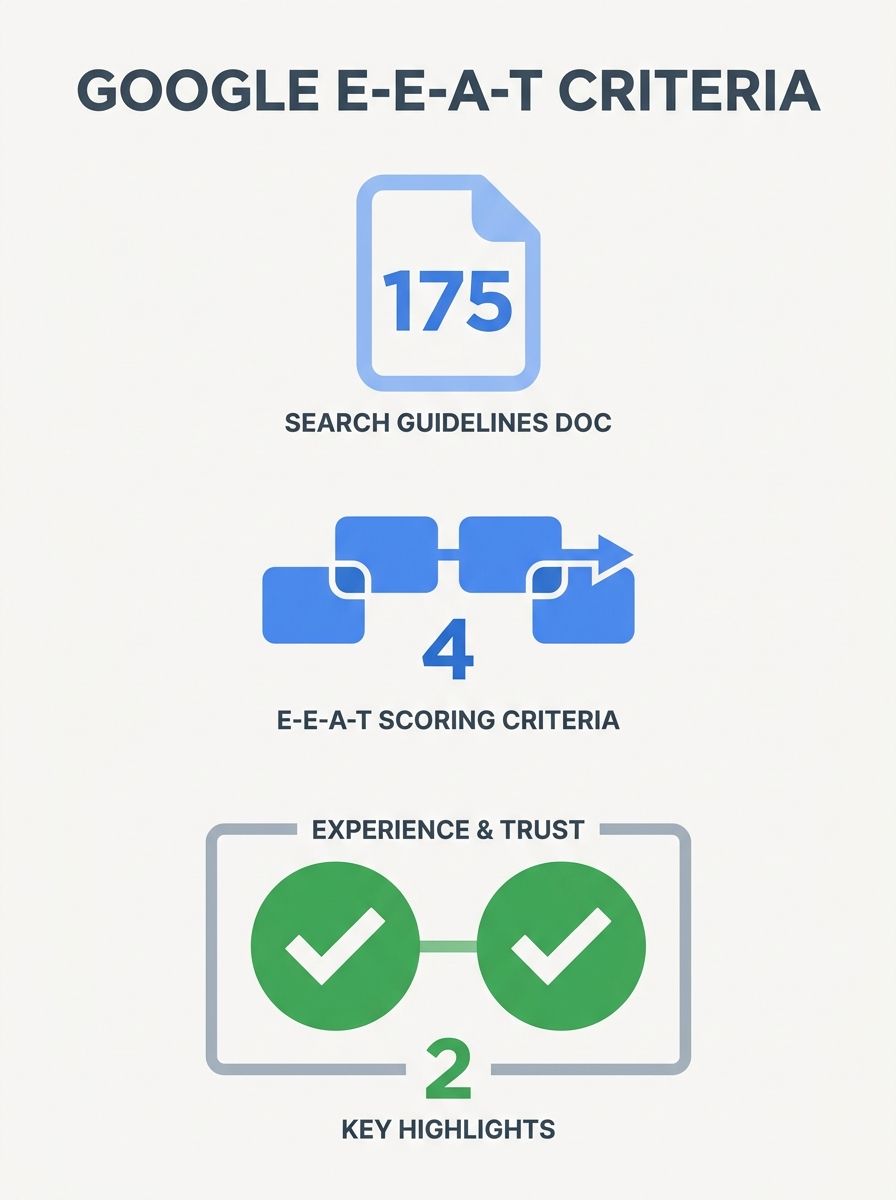
Understanding how this scoring works at the rater level is essential context. Search quality rater guidelines define four pillars that raters use to assess every page they review. E-E-A-T, as Semrush's framework overview explains, assesses content quality across Experience, Expertise, Authoritativeness, and Trust. Those four letters determine whether your page gets a "Highest" quality rating or a "Lowest" one. And the difference between those ratings, aggregated across thousands of evaluations, feeds directly into how Google's algorithms learn to rank content for billions of queries.
March 2026 Sorted Agency Content Into Winners and Losers
The March 2026 Core Update didn't introduce new E-E-A-T signals. It amplified existing ones. The weight of Experience, the newest addition to the framework (added in December 2022), increased significantly. Pages demonstrating genuine first-hand involvement with their subject matter climbed. Pages offering repackaged advice without evidence of actual execution dropped.
E-E-A-T-related signals correlate with approximately 8% of ranking weight across all queries, according to analysis of the update's impact. For YMYL (Your Money or Your Life) topics, that figure jumps to roughly 24%. This is where the damage concentrated. Agencies producing content for healthcare SEO companies and finance SEO agencies saw the sharpest drops when their articles lacked verifiable author credentials or cited no primary sources.
Google's John Mueller stated directly that "E-E-A-T is not a score you can 'add' to a page; it is a quality framework that must be inherent in the content's creation and presentation." That quote should be taped to every agency content strategist's monitor. You can't bolt on E-E-A-T after the fact. You can't add an author bio to a generic 800-word article about retirement planning and expect the rater to check the "Expertise" box. The content itself has to reflect how it was made and who made it.
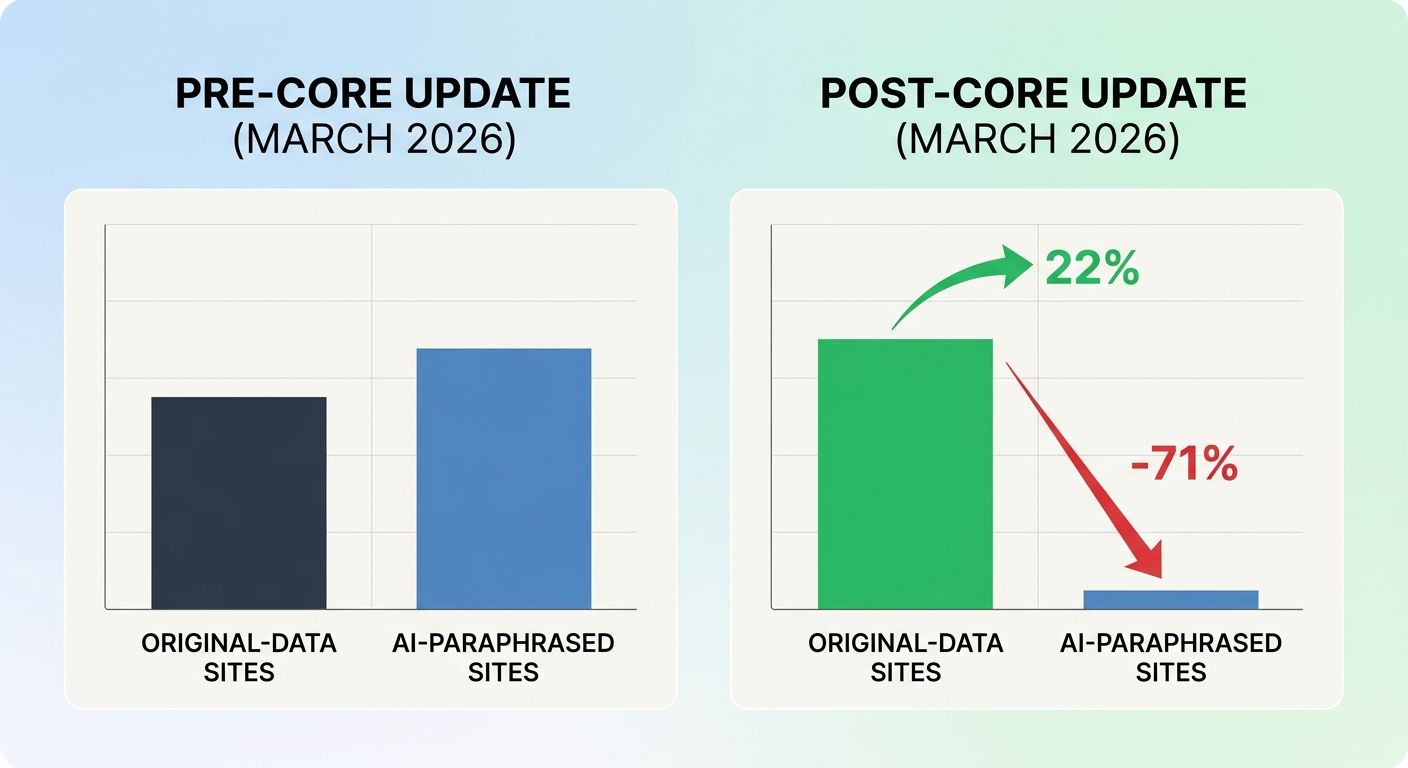
What agencies saw in their dashboards told a clear story. If you've built reporting around the principles we covered in our guide to transparent SEO reporting dashboards, you could see the split in real time. Content with named authors, original screenshots, specific implementation details, and cited data sources held steady or gained. Content that read like a summary of other summaries cratered.
The pattern repeated across verticals. B2B technical content survived when it included proprietary benchmarks or named client outcomes. E-commerce product guides survived when they showed original photography and testing methodology. Agency blog posts about "10 Tips for Better SEO" written by unnamed staff writers and published across four different client sites? Those pages lost their rankings and, in many cases, their index status entirely. Google's ongoing enforcement against topic-cluster strategies built on thin content accelerated during this window.
Four Letters and the Rater's Actual Scoring Process
When a quality rater opens their evaluation interface and pulls up an agency-produced blog post, they don't score each E-E-A-T letter independently on a numeric scale. The process is more contextual than that. According to Google's own content guidelines, content should demonstrate expertise, clear sourcing, and trustworthiness. Raters apply these standards holistically, assessing the overall impression a page creates.
Here's what raters look for across each letter, and what agency content typically gets wrong:
Experience is the newest pillar and the one the March 2026 update weighted most heavily. Raters ask: does this content show that the author has actually done the thing they're writing about? For agency content, this is where experience signals SEO performance lives or dies. A post about migrating a website from HTTP to HTTPS should include screenshots of the actual migration console, specific redirect counts, traffic recovery timelines with dates. An agency writing about Google Ads performance should show real campaign data (anonymized is fine, fabricated is not). The Keywords Everywhere 2026 E-E-A-T playbook confirms that quality raters assess content through this experiential lens, and their feedback trains Google's systems at scale.
Expertise is topic-specific competence. For general topics, life experience counts. For YMYL topics, formal credentials matter enormously. Raters apply "very high" Page Quality standards to pages touching health, financial stability, or safety, as Section 4.0 of the guidelines specifies. An agency writing medical content needs a named MD reviewing or authoring each piece, with that credential displayed prominently. An agency writing tax advice needs a CPA or EA attached to the byline. Raters check.
Authoritativeness is the external validation signal. Google uses a bucket of signals to determine authority on a page-by-page basis, including earned backlinks, brand mentions in established publications, and whether other authoritative sources reference the content creator. Agency content authority builds over time through consistent, attributed publishing. An agency that puts out 50 unattributed posts per month builds zero authority, regardless of volume. An agency that publishes 8 deeply sourced, author-attributed articles per month, each earning natural citations, builds compounding authority with every piece.
Trust is the foundation. Google's guidelines state explicitly that a page with weak Trust signals cannot be rescued by strong scores on the other three letters. Trust encompasses transparency about who owns the site, who wrote the content, how the business operates, and whether contact information is accessible. For agencies, this means every client page needs visible editorial policies, clear author attribution, accessible contact details, and honest handling of affiliate relationships or sponsored content.
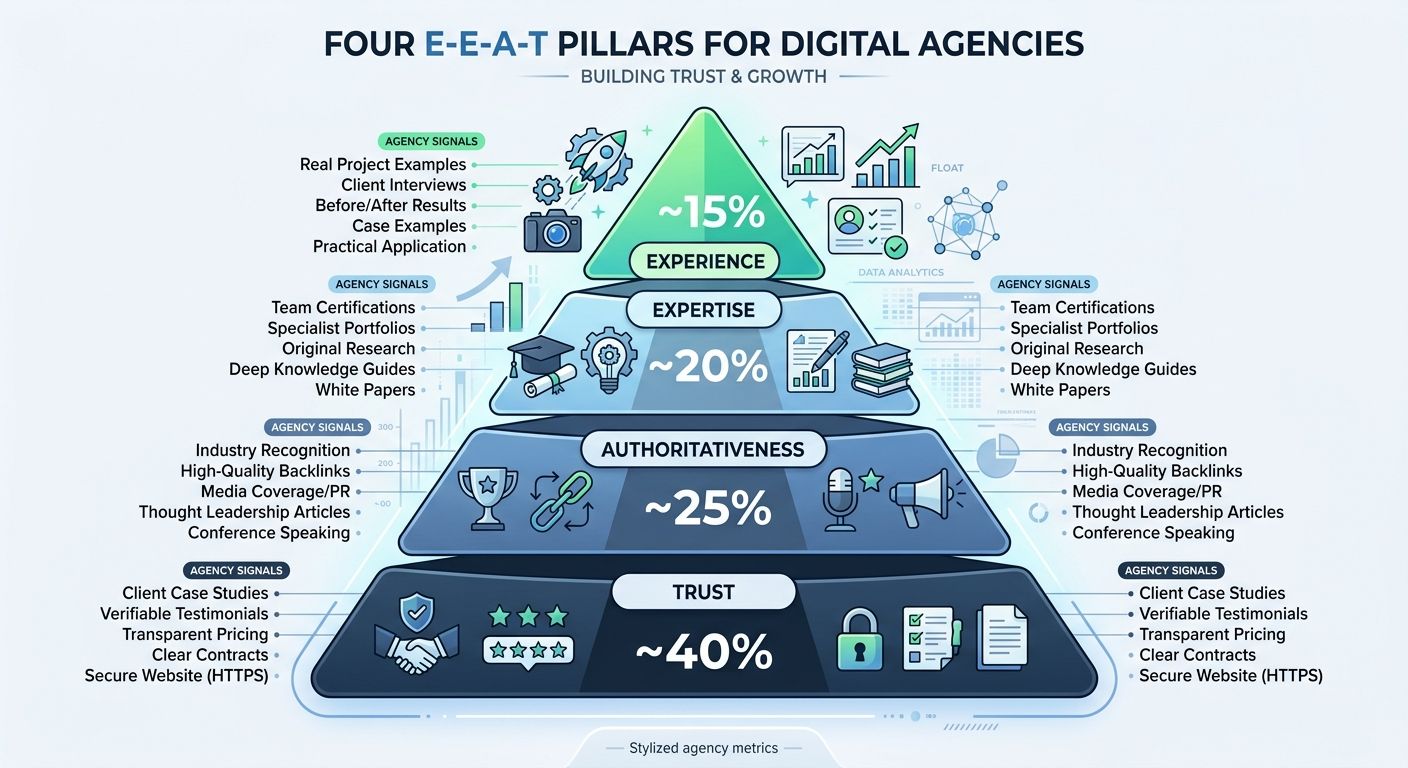
The practical implication for Google content evaluation is that raters aren't running a checklist. They're forming a judgment about whether the page was created by someone who knows what they're talking about, has done what they're describing, is recognized by others in the field, and can be trusted to present information honestly. That judgment, aggregated across thousands of raters and millions of evaluations, trains the algorithms that decide your client's organic visibility.
Trust as the Kill Switch
Why did Trust earn its position as the foundational pillar? Because without it, expertise means nothing. A brilliantly written financial planning article authored by a credentialed CFP loses its value the moment the rater notices the site has no privacy policy, no physical address, no editorial disclosure, and a domain registered three months ago under a privacy proxy.
The imark Infotech E-E-A-T breakdown documents what separates ranking content from invisible content, and Trust failures are the most common disqualifier. In the agency context, the Trust problem often manifests in three specific ways.
First, content attribution gaps. Agencies that publish under generic bylines ("Staff Writer," "Admin," "The Team") signal to raters that nobody is willing to stake their professional reputation on the content's accuracy. Every article without a named, verifiable author is a Trust deficit.
Second, YMYL topic overreach. Agencies taking on clients in regulated industries (health, finance, legal, insurance) without sourcing appropriate expert authors are producing content that raters flag as potentially harmful. The guidelines are unambiguous here: raters apply very high standards to YMYL pages because "low quality pages could potentially negatively impact the health, financial stability, or safety of people, or the welfare or well-being of society."
Third, AI content disclosure failures. AI-generated content is acceptable to Google if it adds genuine value, undergoes expert review, and carries transparent attribution. But agencies mass-producing AI articles without disclosure, without expert review, and without named accountability are producing exactly the kind of content the March 2026 update targeted. Scaled content abuse, defined as mass-producing low-value AI content, falls under Google's spam detection policies. A 2026 trust signals analysis confirms that original data, genuine expertise, and transparent authorship are now non-negotiable for ranking or getting cited in AI Overviews.
The agencies that audit their link building practices before signing contracts, as we've detailed in our guide to vetting agency link strategies, should apply the same rigor to auditing E-E-A-T compliance. A backlink profile review and an E-E-A-T content audit belong in the same pre-engagement checklist.
What the March 2026 Survivors Had in Common
The agency-produced content that held its rankings through the March 2026 update shared a consistent set of characteristics. None of these are surprising if you've read the search quality rater guidelines. All of them are surprisingly rare in actual agency output.
Every surviving page had a named author with a verifiable professional history. Not a stock photo and a made-up bio. A real person whose LinkedIn profile, conference appearances, or publication history confirmed their expertise in the topic. Raters check. They Google the author's name. They look for corroboration.
Every surviving page included proprietary evidence. Original data, client-anonymized case studies with specific numbers, screenshots of actual dashboards, before-and-after metrics from real campaigns. The experience signals SEO teams need to demonstrate aren't abstract. They're concrete artifacts of work actually performed.
Every surviving page cited its sources. Not vague references to "studies show" or "experts say," but named studies, linked sources, and specific data points. Search Engine Journal's E-E-A-T guidance notes that Google introduced this framework specifically to evaluate web content's overall quality and credibility. Credibility requires verifiable claims.
And every surviving page operated on a site with clear Trust infrastructure: visible editorial policies, real contact information, transparent business ownership, and honest disclosure of commercial relationships.

The agencies that treated content production as a volume game, where success meant publishing more posts faster at lower cost, lost the most ground. The agencies that treated content production as an expertise documentation exercise, where success meant capturing and publishing genuine knowledge from qualified people, gained ground they're unlikely to surrender.
I've evaluated over 200 SEO agencies in my career, and the pattern holds: the agencies that can show you exactly who wrote each piece, what qualified that person to write it, and what original evidence supports the claims will outperform the ones offering you 30 blog posts per month at $0.05 per word. The search quality rater guidelines have been telling us this for years. The March 2026 update just made the cost of ignoring them impossible to overlook.
Marcus Webb
Digital marketing consultant and agency review specialist. With 12 years in the SEO industry, Marcus has worked with agencies of all sizes and brings an insider perspective to agency evaluations and selection strategies.
Related Articles

Why Google's May 2026 Algorithm Update Is Breaking Enterprise SEO Playbooks (And How Agencies Should Respond)
SE Ranking's volatility index for the March 2026 core update showed 79.5% of top-3 positions shifting — the most disruptive reshuffle ever recorded.

SEO Agency Excell Industries Publishes 2026 Trends Framework Emphasizing AI-Powered Search and Core Web Vitals
Digital marketing agency Excell Industries published an SEO trends framework on August 21 identifying AI-powered search optimization, user intent alignment, and Core Web Vitals performance as dominant ranking factors heading into the second half of 2026, according to a guide posted to the firm's web

Google's Expanded Ranking Pool Could Reshape Enterprise SEO Priorities: What Agencies Need to Prepare Now
The domain authority moat that enterprise sites have relied on for a decade is eroding faster than any agency retainer report will tell you.
Explore more topics