
Google's June 2026 Spam Update Targets AI Citation Manipulation as Violation of Core Search Policies
Google's June 2026 spam update, which began rolling out on June 24, explicitly treats efforts to manipulate AI-generated search responses—including buying citations or altering AI Overviews—as violations of the company's spam policies, according to Search Engine Journal. The update expands Google's
 Marcus Webb··4 min read
Google's June 2026 Spam Update Targets AI Citation Manipulation as Violation of Core Search Policies
Google's June 2026 spam update, which began rolling out on June 24, explicitly treats efforts to manipulate AI-generated search responses—including buying citations or altering AI Overviews—as violations of the company's spam policies, according to Search Engine Journal. The update expands Google's spam enforcement to cover tactics designed to game generative AI surfaces, applying the same policy framework previously reserved for traditional webspam techniques.
What the Update Targets
The update addresses deliberate attempts to manipulate how websites appear in AI Overviews and AI Mode results. Google clarified in May 2026 that its spam policies now cover efforts to buy citations within AI-generated answers or alter how content surfaces in generative search experiences. Tactics built specifically to game AI-powered search features now carry enforcement risk under the same policy structure that governs link schemes, keyword stuffing, and cloaking.
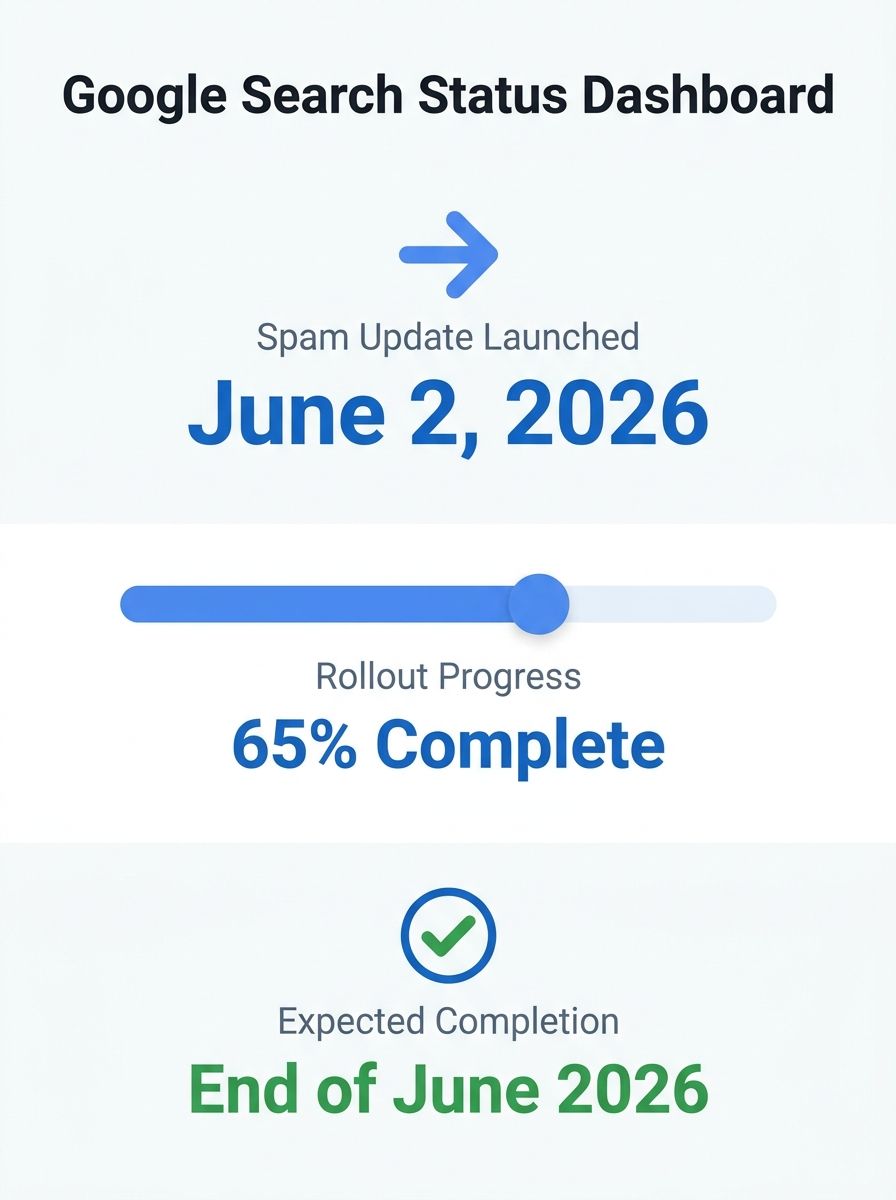
The rollout began on June 24 and may take several days to complete, according to Google's Search Status Dashboard. Ranking volatility during this period is expected as the algorithm processes sites across Google's index.
How AI Impressions Are Counted in Search Console
John Mueller, Google Search Advocate, clarified during the rollout that impressions in Search Console's generative AI report count only when links to a site appear in AI Overviews or AI Mode. Links hidden behind expandable sections are counted only after a user clicks to reveal them, Mueller explained to Nicola Agius, Director of SEO and Discover at Reach PLC. The report does not currently provide click data for AI surfaces.
This measurement approach means sites with content frequently cited but placed behind expansion elements may see lower impression counts than their actual inclusion rate suggests. Mueller's clarification addresses confusion over whether impressions reflect content usage in answer generation or visible link placement—Google counts the latter.
Industry Response and Measurement Challenges
Shushrita M., a freelance SEO consultant, cautioned against immediate reactions to ranking shifts during the update's rollout. "A sudden decline does not automatically mean your content is 'bad,'" she said in a statement. "The right response is to identify which page types, queries and directories were affected, then look for a consistent pattern. SEO recovery starts with diagnosis, not panic."
Separate data from Similarweb showed that 55.9% of downstream traffic following ChatGPT recommendations arrives via branded search rather than direct clicks, based on a U.S. desktop panel covering finance, travel, and beauty sectors. Aleyda Solís, SEO and AI search consultant and founder of Orainti, highlighted the attribution gap: "AI influence can happen without a click, and this is why measuring AI Search impact only through 'AI referral traffic' is not enough." She noted that current attribution models miss AI-influenced demand that arrives through organic search and direct traffic.
Advanced Web Ranking's Q1 2026 click-through benchmark data revealed a 2.2 percentage point decline in mobile CTR at the top position, while desktop CTR increased primarily below the third position. The device-level divergence suggests platform-specific shifts rather than a uniform recovery in organic click behavior.
Google Confirms No Third-Party Tool Access to Internal Metrics
Brendon Kraham, Google's VP of Search and Commerce for Global Ads Solutions, stated that Google does not evaluate third-party SEO tools or vendors and that external tools have no access to Google's internal ranking metrics. Kraham added that effective SEO aligns with strong generative engine optimization (GEO), rejecting the premise that separate strategies are required for AI surfaces versus traditional search.
Cyrus Shepard, founder of Zyppy SEO, agreed with the broad principle but noted limits to the equivalence: "Google says, 'good SEO is good GEO.' I don't disagree. But the same advice doesn't always work in reverse. There are a whole lot of things AI-savvy SEOs do right now that they likely would never do if AI had never existed."
The statement follows ongoing industry discussion about vendor claims regarding proprietary access to Google's AI ranking signals—a capability Google explicitly denies exists. Agencies evaluating tool vendors should treat access claims with skepticism, as Google confirmed no such integration is available to third parties.
The Takeaway
The June 2026 spam update marks the first time Google has publicly positioned AI citation manipulation as a core spam policy violation, applying enforcement mechanisms historically reserved for link schemes and content farms. For agencies managing client portfolios, this shifts AI visibility work from experimental tactics into established policy territory—buying citations or engineering AI placements now carries the same risk profile as traditional black-hat methods. The update also clarifies measurement boundaries: AI impressions track visible link placements, not content influence, creating a gap between citation impact and reported metrics. Agencies should audit any AI-focused tactics for policy compliance and shift branded search monitoring into standard reporting flows, as Similarweb's 55.9% branded-search share suggests AI recommendations drive demand through channels that standard attribution models don't capture. The rollout timeline—several days from June 24—means ranking volatility should stabilize by early July, making it premature to conclude site performance based on mid-rollout snapshots.
Marcus Webb
Digital marketing consultant and agency review specialist. With 12 years in the SEO industry, Marcus has worked with agencies of all sizes and brings an insider perspective to agency evaluations and selection strategies.
Related Articles
Google Launches June 2026 Spam Update Targeting Low-Quality Content Across All Languages
Google deployed a global spam-focused algorithm update on June 24, 2026, designed to reduce the visibility of websites violating the company's spam policies, according to an announcement from Advait Technology Labs. The June 2026 Spam Update applies across all languages and regions and is expected t
Google Updates Search Spam Policy to Classify AI Manipulation as Violation, Targets "Recommendation Poisoning" Tactics
Google updated its search spam policy on May 17, 2026, explicitly classifying attempts to manipulate AI-powered search features—including AI Overviews and AI Mode—as spam violations, according to Search Engine Land. The policy revision directly targets "recommendation poisoning," a technique where m

Google Classifies AI Overview Manipulation as Search Spam, Targets "Recommendation Poisoning" Tactics
Manipulation tactics designed to influence Google's AI Overview and AI Mode results are now formally classified as spam violations under Google's updated search spam policy, effective May 17, 2026, according to Times of India. The policy update explicitly names "recommendation poisoning"—a technique
Explore more topics