
Agentic SEO in Production: Building AI-Powered Automation Into Your Agency Workflow
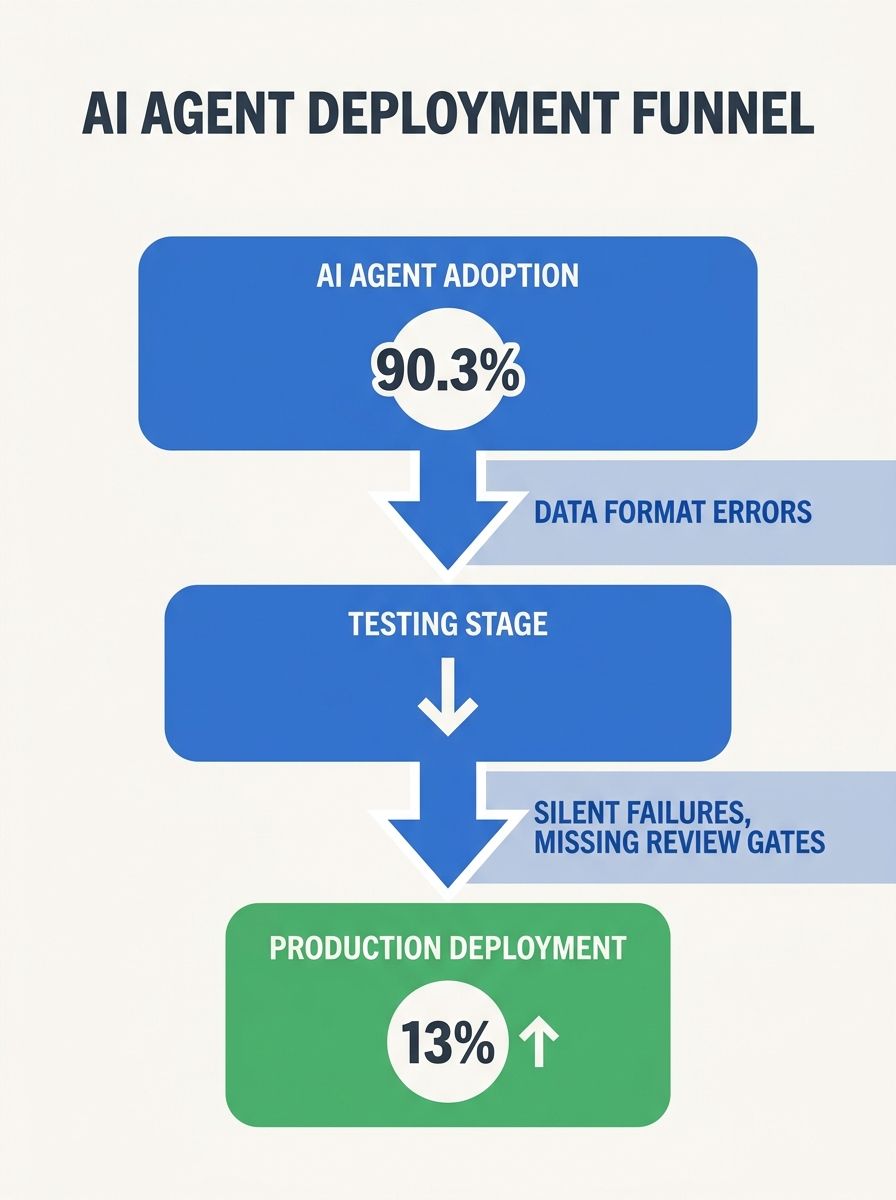
Only 13% of marketing organizations have moved AI agents from their tech stack into active production workflows, despite 90.3% reporting adoption.
 Marcus Webb··9 min read
Agentic SEO in Production: Building AI-Powered Automation Into Your Agency Workflow
Only 13% of marketing organizations have moved AI agents from their tech stack into active production workflows, despite 90.3% reporting adoption. That 77-point gap defines the central problem of agentic SEO implementation: getting autonomous systems past the demo stage and into reliable daily operation.
The 77-Point Production Gap
Why do 90.3% of organizations buy the tools while only 13% run them in production? The answer surfaces in how agencies actually attempt agentic SEO implementation. According to a practical workflow walkthrough published by Search Engine Land, agents built on platforms like n8n can automate scraping, structuring, and delivery of SEO data. But the walkthrough is equally candid about where these agents break down: error handling on dynamic pages, inconsistent data formats from different sources, and the absence of quality checks before output reaches clients.
The gap has nothing to do with technology availability. Agencies install agents, run a few test workflows, and then discover that production reliability requires monitoring, fallback logic, and human review that the initial setup didn't include. Search Engine Journal's playbook for technology leaders recommends that organizations "deploy automation in high-impact workflows" and "formalize model governance and feedback loops" before scaling. That advice implicitly acknowledges how few teams do either.
I've seen this pattern across agencies I consult with. The demo looks magical. The first 20 runs work fine. Run 21 hits an edge case (a SERP layout change, a client site with unusual schema, a rate-limited API), and the entire workflow silently fails. The output still gets delivered. The client gets garbage data dressed up in a clean report. And nobody notices for weeks.
The Six-Stage Pipeline and Where Tools Actually Deliver
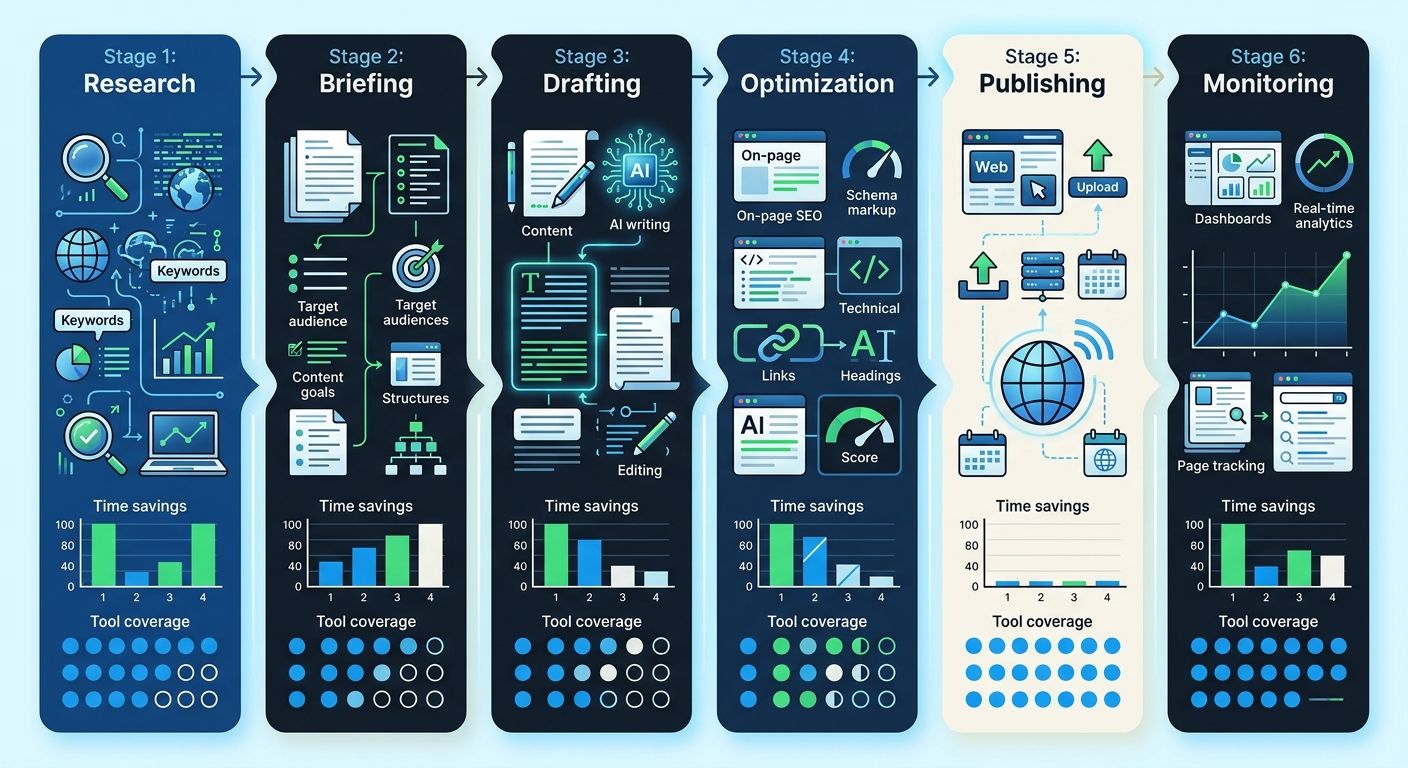
A complete agentic SEO workflow covers six distinct stages: research, briefing, drafting, optimization, publishing, and monitoring. Frase's 2026 guide to agentic content automation offers a revealing self-assessment of the market: "Most tools handle one or two." Frase claims coverage across all six, analyzing the top 20 SERP results per target keyword, identifying content gaps, clustering related terms, and mapping entities from ranking content.
The speed gains are measurable. Competitive landscape analysis that takes 2 to 3 hours of manual SERP review completes in under 5 minutes. Full content production cycles that agencies typically bill at 9 to 14 hours per article compress to 30 to 60 minutes. When you're running 40 or 50 content pieces per month across multiple clients, those numbers translate directly into margin improvement.
But here's the part the vendor pitches leave out: coverage across all six stages doesn't mean equal quality across all six stages. Research and briefing stages benefit enormously from AI automation for SEO agencies because the inputs (SERP data, keyword volumes, competitor content) are structured and verifiable. Drafting and optimization stages introduce subjective quality judgments where agent output varies wildly. Publishing and monitoring stages require integration with CMS platforms and analytics tools that often lack the API depth agents need.
If you're consolidating your agency tech stack, the practical move is to evaluate each stage independently. A tool that excels at automated briefing might produce mediocre drafts. An agent that monitors ranking changes well might miss the content quality signals that caused them.
Evaluating Pipeline Coverage with the Agent Production Score
I propose evaluating any production-ready SEO agent on three axes, a framework I'm calling the Agent Production Score:
Input reliability: Can the agent consistently pull accurate data from its sources without manual intervention? Score this based on error rate over 100 consecutive runs.
Output verifiability: Can a human reviewer confirm the agent's output against source data in under 3 minutes? If verification takes longer than that, the time savings disappear.
Failure transparency: When the agent encounters an error, does it stop and alert, or does it produce degraded output silently? Silent failures are the most dangerous characteristic of any SEO agent in production.
Run 100 tasks through any agent you're evaluating. Track failures across all three axes. Anything below 95% on input reliability or above 2% on silent failure rate isn't production-ready, regardless of what the marketing page promises.
MCP Protocol Changes the Integration Economics
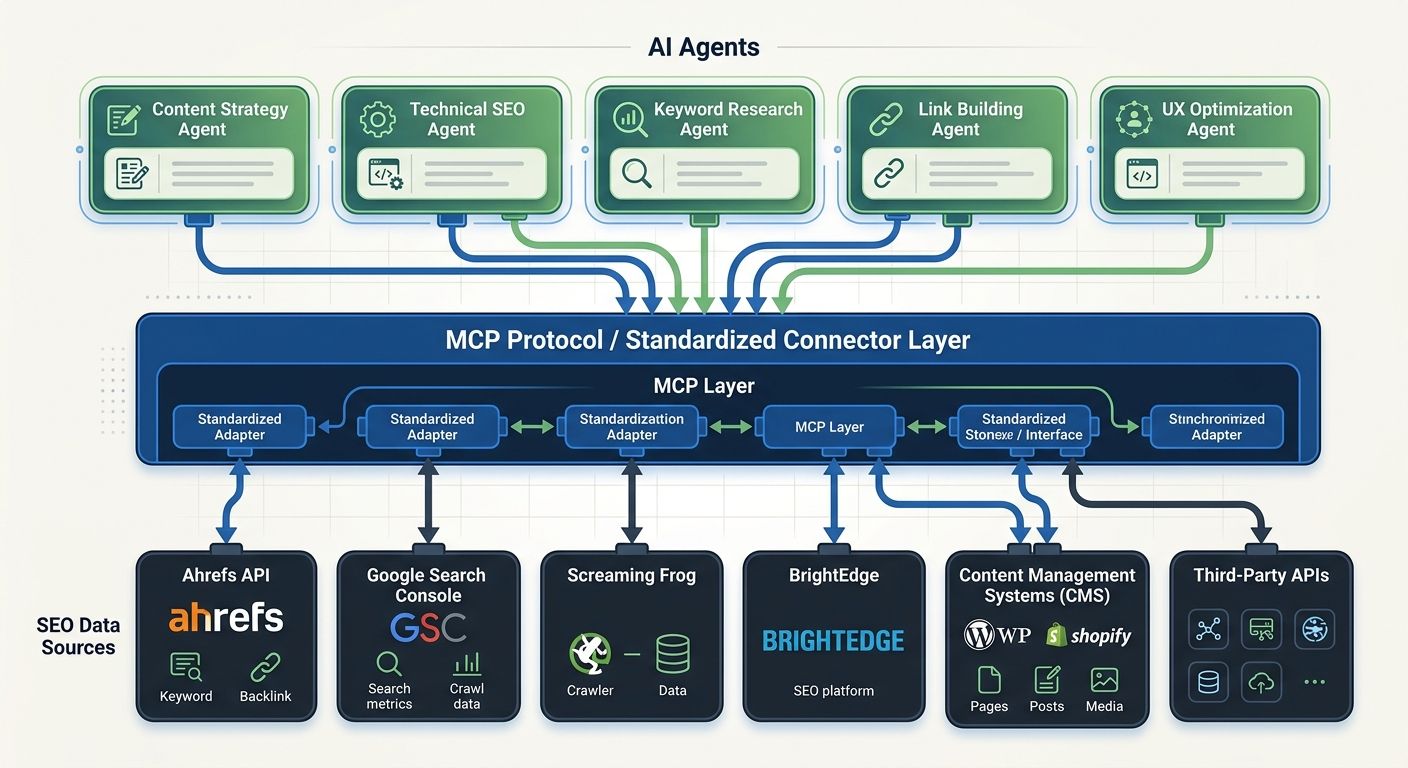
The Model Context Protocol (MCP) has emerged as the standardization layer that makes multi-agent SEO architectures practical. Nightwatch's SEO AI Agent is built on MCP and integrates with multiple AI platforms, giving agencies flexibility in deploying AI-powered SEO automation. Coupler.io's guide identifies 5 essential MCP servers for SEO analysis, with setups covering DataForSEO and similar data providers.
Why do MCP protocol SEO tools matter? Before MCP, connecting an AI agent to Ahrefs data, Google Search Console, and your CMS required three separate custom integrations. Each integration needed its own authentication flow, error handling, and data normalization. Open-source MCP implementations on GitHub demonstrate the approach: they provide an API layer that retrieves SEO data from sources like Ahrefs, handles authentication and CAPTCHA solving, and caches results to reduce API costs.
The 66.4% of the agentic AI market focused on multi-agent coordinated architectures depends on this connector infrastructure. Without a standardized protocol, each agent in a multi-agent system needs custom connectors to every data source. MCP collapses that complexity into one protocol, multiple sources, and a consistent data format.
For agencies evaluating MCP-based tools, the critical question is data freshness. Cached results improve performance and reduce costs (a real concern when you're making thousands of API calls per day across client portfolios), but stale data produces stale recommendations. The best implementations let you configure cache duration per data type: keyword rankings might cache for 24 hours, while backlink data can safely cache for 72 hours.
Multi-Agent vs. Single-Agent Architectures
The 66.4% market concentration on multi-agent architectures reflects a practical reality that single agents handle poorly: SEO requires different types of reasoning for different tasks. A research agent pulling SERP data needs pattern recognition and data extraction capabilities. A content optimization agent needs language understanding and E-E-A-T awareness. A technical audit agent needs rendering capabilities for JavaScript frameworks like React, Angular, and Vue, plus structural analysis of HTML.
According to Sight AI's analysis of the enterprise SEO automation market, their platform "bridges a gap traditional SEO platforms don't address: monitoring how AI models mention your brand and automating content that improves those mentions." This points to an entirely new agent category, AI visibility monitoring, that didn't exist 18 months ago and sits outside the traditional six-stage pipeline entirely.
Search Engine Land's guide to agentic AI in SEO frames the shift this way: "Instead of being an AI prompt engineer, you become a strategist who guides autonomous systems toward business outcomes."
That role redefinition matters for agency staffing. The SEO analyst who spent 3 hours per client on keyword research now spends 20 minutes reviewing agent output and 40 minutes on strategic interpretation. Total time drops, but the skill requirements change. You need people who can spot when an agent's clustering logic grouped unrelated terms, or when a technical audit missed a rendering issue specific to a client's framework.
Governance Guardrails for Production Agents
Running agents in production without governance creates the exact kind of risk that Google's recent enforcement actions target. If your agents are generating content or building link recommendations without human review gates, you're one bad output away from a manual action. The connection to Google's enforcement against AI citation manipulation is direct: automated systems that produce or distribute content at scale face increasing scrutiny.
Search Engine Journal's playbook recommends specific governance structures: organizations should "create evaluation benchmarks for AI accuracy and brand safety" and "build dashboards for AI visibility, trust, and conversion." These aren't optional add-ons for agencies that want to scale. They're the infrastructure that separates agencies running production-ready SEO agents from agencies running unmonitored automation that will eventually cause client damage.
Governance Layer | What It Checks | Review Frequency | Failure Response |
|---|---|---|---|
Brief Approval Gate | Keyword targeting, search intent alignment, content angle | Every brief before drafting begins | Block agent, require human revision |
Draft Quality Gate | Factual accuracy, E-E-A-T signals, brand voice consistency | Every draft before publishing | Return to drafting agent with feedback |
Technical Audit Gate | Rendering accuracy, schema validity, crawl efficiency | Weekly per client site | Alert + auto-generated fix recommendation |
Performance Monitor | Ranking changes, traffic anomalies, citation tracking | Daily, automated threshold checks | Threshold-based alerts to account manager |
The table above reflects what I've seen work at agencies running 15 or more client accounts with automated workflows. Fewer gates than this and errors slip through. More gates and you've rebuilt the manual process with extra steps.
If you've already gone through the process of identifying hidden blockers in your agency operations, you'll recognize the pattern: the biggest risks in automated systems are the silent ones. An agent that confidently produces wrong output is worse than an agent that crashes, because at least a crash gets noticed.
What Production Deployment Actually Costs
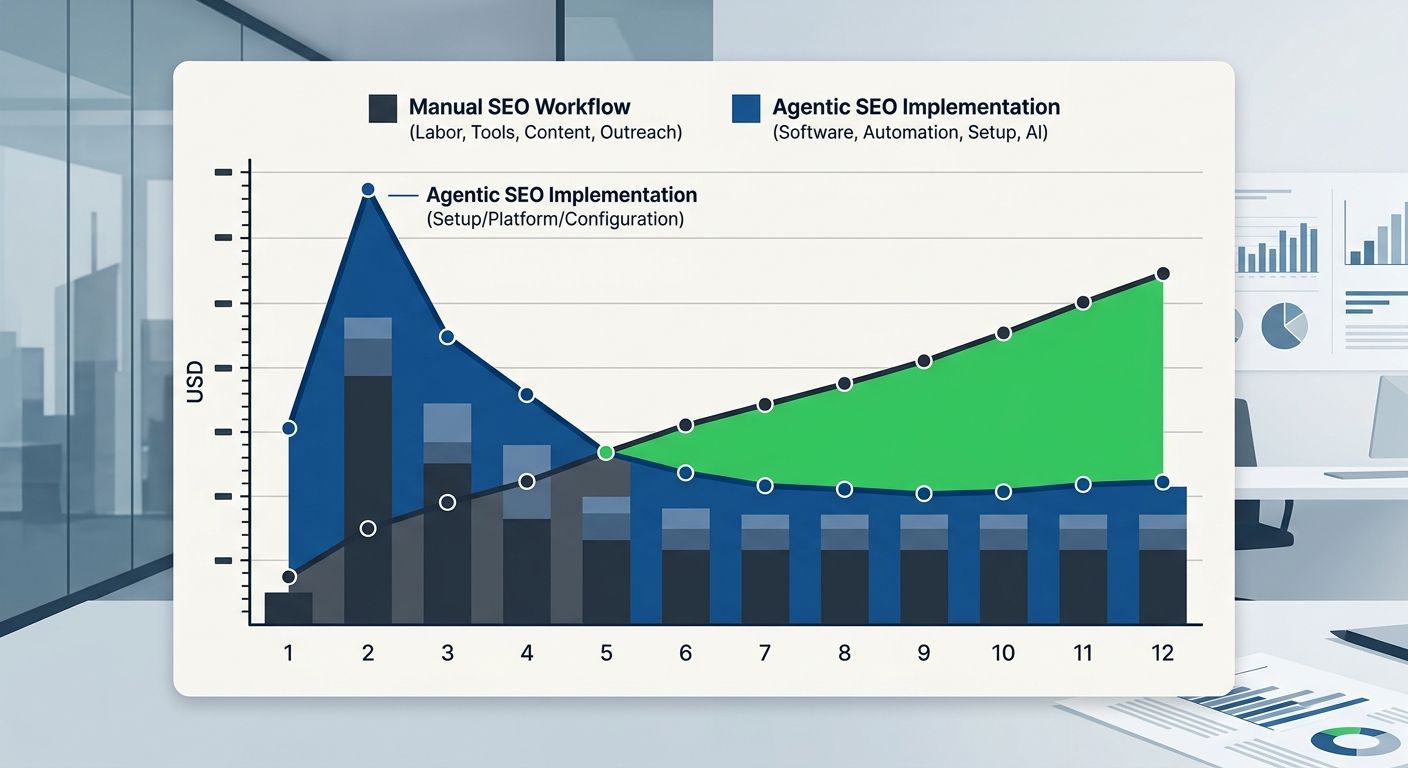
Agencies considering agentic SEO implementation need realistic cost projections beyond tool licensing. Based on current pricing for the platforms discussed above, a mid-size agency (10 to 25 clients) should budget between $2,000 and $5,000 per month for agent platform licensing, MCP server access, and API call volumes. That's the smallest line item.
The larger costs are structural. You'll need 40 to 80 hours of setup time per workflow (research, briefing, and drafting pipelines are separate builds). Ongoing maintenance runs 10 to 15 hours per month as data sources change APIs, agent models update, and client requirements shift. Training existing staff to review agent output instead of producing work from scratch takes 2 to 4 weeks per team member.
Those numbers explain the 13% production rate. Getting to production requires sustained investment beyond the initial tool purchase. Agencies that treat agent deployment like installing a new plugin will end up in the 87% that bought tools they don't actually use. Building this kind of technical infrastructure into your deployment pipeline requires the same rigor you'd apply to any production system: staging environments, rollback procedures, and monitoring dashboards.
What the Data Doesn't Tell Us
The 90.3% adoption figure and 13% production figure tell us where the market stands, but several open questions will determine whether agentic SEO implementation becomes standard agency practice or remains a competitive advantage for early movers.
The quality ceiling is still unknown. Agents produce content faster and research keywords more efficiently, but no published dataset compares the long-term ranking performance of agent-assisted content against manually produced content at scale. Agencies are running these experiments in real time with client sites, and the results won't be clear for another 6 to 12 months.
The MCP protocol ecosystem is young. Five essential MCP servers exist for SEO today, according to Coupler.io's assessment. Whether that number grows to 50 (creating a mature ecosystem) or stalls around 12 (creating integration gaps) depends on adoption patterns that are still forming.
And the governance question remains the hardest of all. The same speed that makes agents valuable makes them dangerous when they produce confident, wrong output. Google's enforcement direction, specifically targeting automated content manipulation, means the stakes of getting governance wrong are climbing. Agencies that solve the governance problem while maintaining the speed advantage of multi-agent architectures will own the next phase of this market. But the data to validate that thesis doesn't exist yet. The 77-point gap between adoption and production is where the opportunity sits for agencies willing to do the engineering work that most competitors skip, and it's where the next round of meaningful benchmarks will come from.
Marcus Webb
Digital marketing consultant and agency review specialist. With 12 years in the SEO industry, Marcus has worked with agencies of all sizes and brings an insider perspective to agency evaluations and selection strategies.
Related Articles
Why Enterprise SEO Agencies Are Expanding Into AI-Driven Markets: What the San Francisco Shift Reveals About 2026 Competition
SEO.co announced its physical expansion into San Francisco on May 7, targeting venture-backed startups and enterprise brands with GEO consulting, AI-driven search strategies, and technical audits designed for generative platforms.
From Google Search to AI Assistants: How B2B Agencies Must Rebuild SEO Strategy Beyond Traditional SERP Rankings
Three of the five B2B agency contracts sitting on my desk right now define success exclusively as Google organic ranking improvements and click-through traffic growth. The agencies that wrote those contracts aren't incompetent.
AI Search Visibility Gaps Are Reshaping Agency Skill Requirements: Why Your Team Needs These New Competencies Now
Five authority gaps keep professional service businesses invisible to ChatGPT, Gemini, and Perplexity, and the first one—absent entity recognition—is a competency that virtually no one on a typical SEO team was trained to address.
Explore more topics