
SEO Intelligence Framework Separates Seven Measurement Layers as Eight-Product Comparison Shows Industry Vocabulary Fragmentation
A comparative field guide published September 22 positions website intelligence, AI visibility, and traditional SEO as distinct measurement layers after analyzing eight products serving overlapping markets, according to a 2026 analysis on dev.
 Marcus Webb··3 min read
SEO Intelligence Framework Separates Seven Measurement Layers as Eight-Product Comparison Shows Industry Vocabulary Fragmentation
A comparative field guide published September 22 positions website intelligence, AI visibility, and traditional SEO as distinct measurement layers after analyzing eight products serving overlapping markets, according to a 2026 analysis on dev.to comparing AuditMe, Beamtrace, WildSEO, Foudroyer, KatLinks, MagicSpace, Captflow, and Trackboxx. The framework addresses what the author calls a "strange problem" in which platforms use identical vocabulary—AI visibility, GEO, SEO intelligence, citations—while measuring fundamentally different signals.
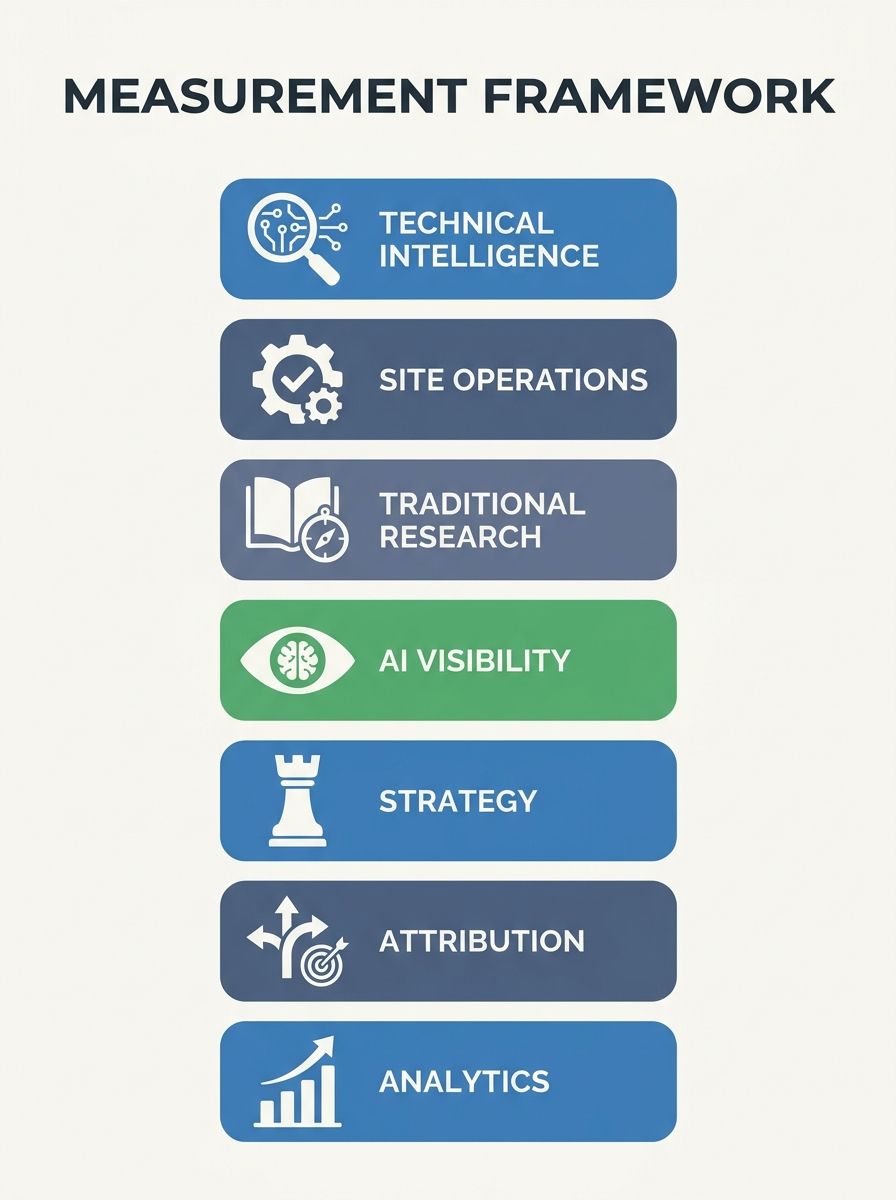
The 12-section guide defines seven operational layers: technical website intelligence (what is present or broken), site-wide SEO operations (whole-site patterns), traditional SEO research (keywords and rankings), AI answer visibility (brand mentions in generative results), human strategy execution, marketing attribution, and privacy-first analytics. Each layer corresponds to different products in the comparison, with the framework arguing against treating every platform as a generic "SEO tool."
Nine Diagnostic Questions Replace Single Ranking Metric
Modern growth teams must answer nine distinct questions rather than the legacy "does my website rank" query, the guide states. The required diagnostics include whether search engines can crawl and understand the site, whether pages are technically healthy, whether humans grasp the proposition quickly, whether machines extract facts accurately, whether information appears consistently across HTML and structured data, whether AI systems mention the brand for relevant prompts, whether agents can discover pricing and APIs, whether developers see actionable evidence when issues arise, and whether verification confirms improvements after fixes.
The shift reflects search's evolution from blue-link lists toward mixed-format results incorporating AI-generated answers, recommendations, citations, browser-based research, and agentic interactions, according to the framework.
Product Comparison Establishes Distinct Market Positions
The guide positions AuditMe in the technical website intelligence layer, emphasizing evidence provenance and diagnostic workflows. Foudroyer addresses site-wide SEO operations. KatLinks focuses on traditional keyword, ranking, and backlink research. Beamtrace and WildSEO measure AI answer visibility across generative platforms. MagicSpace provides human strategy and execution services. Captflow handles marketing attribution. Trackboxx delivers privacy-first web analytics.
The comparison explicitly avoids declaring a universal "winner," instead mapping each product to specific operational needs. Product capabilities were verified against public pages checked around September 21, 2026, the guide notes, acknowledging positioning changes occur frequently in the category.
Related infrastructure challenges include backlink checker discrepancies reaching 100 percent across platforms and AI models collapsing regional authority signals into single global representations.
Evidence Provenance Concept Differentiates Technical Layer
AuditMe's core workflow follows a six-stage chain: URL → evidence → signals → diagnosis → priority → fix → verify. The guide introduces "evidence provenance" as a differentiator, emphasizing traceable observation chains from raw data to recommended action rather than aggregated scores.
"The score was convenient. The investigation was not," the author wrote, explaining AuditMe's origin in frustration over fragmented evidence across HTML, headers, performance tools, Search Console, structured data, and AI systems. The product targets developers and technical teams requiring actionable diagnostic details rather than summary dashboards.
The framework argues against "feature-shopping contests" in which platforms chase every neighboring category simultaneously. "The useful differentiator is not the number of boxes on the dashboard. It is the quality of the chain from observation to action," the guide states.
AI Readiness Requires Agent-Specific Optimization
The guide distinguishes AI visibility (brand mentions in generative answers) from agent readiness (whether automated systems can discover pricing, documentation, products, actions, and APIs). The latter requires structured exposure of actionable data points beyond text-based retrievability, the framework notes.
This distinction addresses growing confusion around answer engine optimization frameworks and the broader shift toward AI-mediated discovery replacing traditional rankings.
The technical intelligence layer AuditMe occupies necessarily overlaps with AI and GEO concerns because machine-readable structure affects both traditional search and generative platform extraction, according to the analysis.
Why This Matters Now
CMOs evaluating SEO agencies and platform vendors face legitimate confusion when multiple products claim identical capabilities using the same marketing vocabulary. The seven-layer framework provides a sorting mechanism: technical teams need evidence chains and diagnostic workflows; content strategists need AI visibility tracking; growth operators need attribution and analytics; agencies managing multiple clients need site-wide operational dashboards.
The framework's utility lies not in recommending specific products but in clarifying which operational questions each category answers. An agency claiming to "optimize for AI search" may deliver technical structured-data implementation, AI answer monitoring, content strategy, or all three—CMOs lacking a mental model for those distinctions cannot effectively evaluate proposals or compare vendor capabilities. The September 22 guide establishes that model with product-specific examples rather than theoretical abstractions.
Buyers should verify which measurement layer a vendor actually operates in before comparing pricing or feature counts across fundamentally different product categories.
Marcus Webb
Digital marketing consultant and agency review specialist. With 12 years in the SEO industry, Marcus has worked with agencies of all sizes and brings an insider perspective to agency evaluations and selection strategies.
Related Articles

TrySight.ai Publishes Step-by-Step Framework for Optimizing Content Visibility in AI Search Platforms
TrySight.ai released a three-stage content optimization framework on August 2 designed to position brand content for citation in AI-powered search platforms including ChatGPT, Claude, and Perplexity, according to a guide published on the company's website.
HubSpot Publishes Six-Field Audit Framework for Measuring Brand Visibility Across AI Search Platforms
HubSpot published a six-field audit methodology September 4 that quantifies brand visibility across ChatGPT, Claude, Gemini, and Perplexity by distinguishing between passive mentions and active recommendations, according to a sponsored framework published on Search Engine Journal.

TrySight.ai Publishes 6-Tool Evaluation of LLM Search Optimization Platforms as AI Visibility Category Matures
TrySight.ai published a comparative evaluation of six large language model search optimization platforms on July 12, 2026, covering tools that track brand mentions across AI assistants, generate content optimized for AI citations, and automate indexing for AI crawlers, according to the guide.
Explore more topics