
AI Models Collapse Regional SEO Authority Signals Into Single Global Representation
Large language models trained on multi-market content fail to preserve local authority signals that international SEO teams build site-by-site, instead collapsing 40 regional websites into a single composite brand impression that erases market-specific expertise demonstrations, according to an analy
 Marcus Webb··4 min read
AI Models Collapse Regional SEO Authority Signals Into Single Global Representation
Large language models trained on multi-market content fail to preserve local authority signals that international SEO teams build site-by-site, instead collapsing 40 regional websites into a single composite brand impression that erases market-specific expertise demonstrations, according to an analysis published August 25 by Search Engine Journal.
The pattern mirrors link-building dynamics from earlier SEO eras, the analysis found. A page ranking in Mexico required links from local-market sites carrying local trust; U.S. link authority did not transfer automatically. AI-mediated search exhibits the same constraint for experience and expertise signals. "A brand doesn't get credit for authority it holds elsewhere; it must be evidenced in a form the model can recognize as belonging to that market," the analysis stated.
The phenomenon affects organizations operating localized websites across multiple regions, each staffed with local writers, reviewed by local experts, and published in market-specific language. Human evaluators recognize 40 distinct credible sources with separate demonstrations of local expertise. AI models trained on overlapping content from those domains can instead derive a single flattened representation.
Market Aggregation Bias Overwhelms Regional Expertise Signals
The 40-regional-website scenario illustrates the technical challenge. Each domain publishes content localized into the market's language, incorporates market-specific examples and terminology, and adheres to traditional international SEO standards. AI models processing near-identical content structures across those 40 domains tend to derive one composite impression rather than preserving 40 distinct market authorities, according to the Search Engine Journal analysis.
The August 25 article described a pattern tracked across multiple projects: "Localized authority signals, regional terminology, market-specific examples, named local experts, local citations and references are frequently overwhelmed by their own similarity." Content consistency across markets—a traditional branding strength—makes it easier for models to treat multiple sites as a single entity.
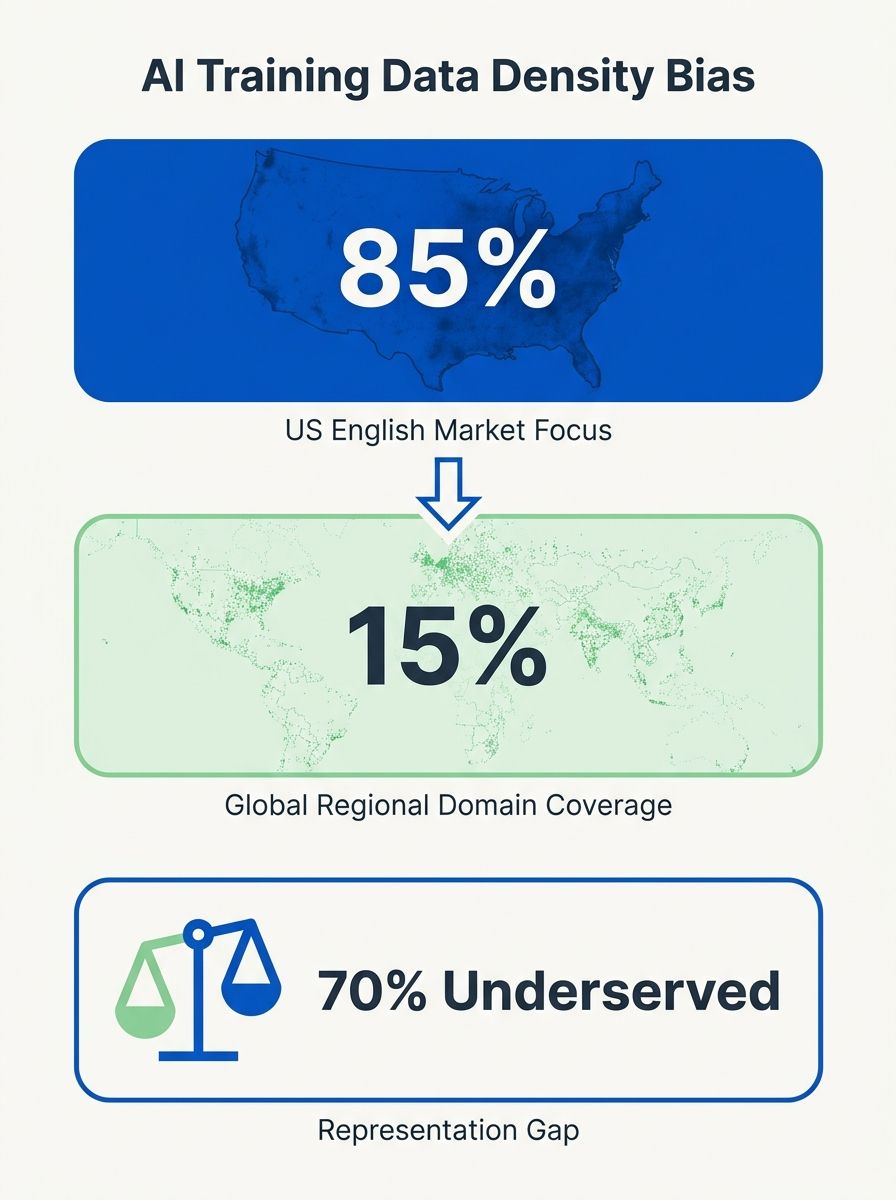
The analysis linked the pattern to a previously documented "geo-identification failure" where AI models favor whichever market has the strongest representation in training data while folding similar regional content into broader brand understanding. The terminology introduced: market aggregation bias and canonical amplification.
Organizations approaching AI search optimization face a prerequisite that traditional E-E-A-T frameworks never required: making expertise legible to machines before models can evaluate it. A brand holding source-of-truth status—the canonical answer to "what does this company say about itself"—does not automatically register as an authority on the domain it operates in, the analysis noted.
Professional Credentials Fail Machine Recognition Test
Professional titles, certifications, and local qualifications represent a specific failure point. Google's quality raters understand local credentials through contextual knowledge. Large language models trained predominantly on English-language content from U.S. sources cannot assume equivalent understanding of credentials from 39 other markets, according to the Search Engine Journal framework.
The credential gap affects how models weight expertise claims. A professional designation recognized immediately by human readers in a regional market may carry no signal weight if the model's training corpus lacked sufficient examples of that credential type connected to authoritative content.
The analysis recommended improving "geo-legibility by making market boundaries more explicit and machine-readable" and separately ensuring credentials appear in forms models learned to interpret during training. The dual requirement: demonstrate expertise for human readers while encoding that expertise in machine-recognizable formats.
The pattern extends beyond credentials to citations, references, and first-hand experience demonstrations that traditional E-E-A-T relied upon. "Expertise that is obvious to people may remain invisible to machines if it isn't expressed in forms the model has learned to interpret," the analysis stated.
Link-building precedent from earlier SEO cycles established that authority accrued market by market through local evidence rather than inheriting from headquarters. The same dynamic now governs how AI-powered search platforms attribute expertise signals. Organizations building content for both traditional search and AI-mediated discovery need localized signals encoded in standardized formats that training processes can associate with regional authority.
The Takeaway
Enterprise organizations operating multi-market digital properties face a structural challenge distinct from traditional international SEO. Building genuinely localized content with market-specific expertise no longer guarantees that AI models will preserve those regional authority distinctions during training or subsequent recommendation generation. The August 25 Search Engine Journal analysis documents a collapse pattern where 40 regional demonstrations of expertise can reduce to a single global representation, erasing the very local signals international SEO teams spent years establishing.
Marketing managers evaluating SEO agency capabilities should add machine-recognizable E-E-A-T implementation to vendor assessment criteria. Agencies claiming international SEO competency need demonstrated approaches for encoding local credentials, citations, and expertise markers in formats LLM training processes can reliably associate with specific geographic markets—not merely translating U.S. content into local languages while preserving identical structure.
The credential gap and market aggregation bias suggest that traditional localization strategies optimized for human readers require a parallel machine-legibility layer. Organizations that built regional authority through conventional means now face technical debt: retrofitting years of localized content to make existing expertise visible to AI systems that learned predominantly from English-language training data. The link-building parallel holds: local authority requires local evidence in forms the evaluating system actually recognizes.
Marcus Webb
Digital marketing consultant and agency review specialist. With 12 years in the SEO industry, Marcus has worked with agencies of all sizes and brings an insider perspective to agency evaluations and selection strategies.
Related Articles

From Google Search to AI Assistants: How B2B Agencies Must Rebuild SEO Strategy Beyond Traditional SERP Rankings
Three of the five B2B agency contracts sitting on my desk right now define success exclusively as Google organic ranking improvements and click-through traffic growth. The agencies that wrote those contracts aren't incompetent.

Multi-Local Market SEO Framework Shows 50% Traffic Gains in Retail Case Study, ACAI Analysis Reports
ACAI published a multi-local market SEO framework June 13 documenting how localized content strategies delivered a 50% increase in local traffic and 30% conversion rate improvement for a global retail brand, according to analysis posted on the platform. A separate tech startup case study showed 40%

Google Publishes Official AI Search Guidance, Rejects Industry's GEO and AEO Optimization Frameworks
Google has published official documentation clarifying how its AI Overviews and AI Mode function, explicitly stating that "Generative Engine Optimization" and "Answer Engine Optimization" are not distinct practices from traditional SEO, according to guidance published on Cyber Kendra analyzing the 2
Explore more topics