
AI Search Platforms Layer Atop Google Rather Than Replace It, Similarweb Tracking Shows
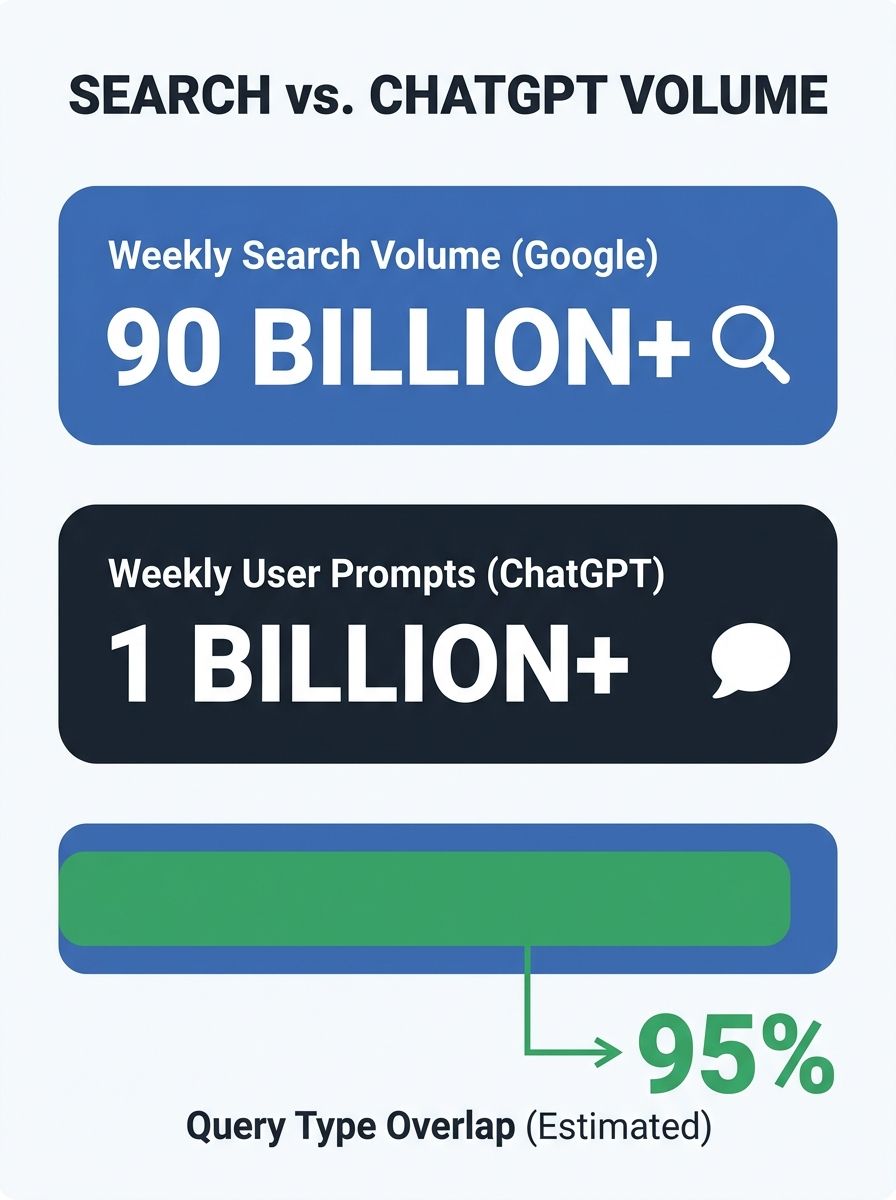
Ninety-five percent of ChatGPT's 494 million users also used Google during the March-May 2026 tracking period, according to Similarweb's "2026 Generative AI Landscape" report released July 24.
 Marcus Webb··4 min read
AI Search Platforms Layer Atop Google Rather Than Replace It, Similarweb Tracking Shows
Ninety-five percent of ChatGPT's 494 million users also used Google during the March-May 2026 tracking period, according to Similarweb's "2026 Generative AI Landscape" report released July 24. The overlap data indicates AI chatbot adoption represents a behavioral addition rather than a search engine replacement, contradicting industry assumptions that generative platforms would cannibalize traditional search traffic.
Search Audience Remains Five Times Larger Than Combined AI Chatbot Category
Traditional search engines delivered 3.3 billion average monthly unique visitors worldwide between March and May 2026, while AI chatbot platforms collectively reached 655 million monthly users despite 57% year-over-year growth, the Similarweb analysis found. The five-to-one ratio persists even as generative AI platforms recorded 9.5 billion average monthly web visits in the 12 months ending May 2026, up 70% from the prior year.
Rand Fishkin, SparkToro CEO, noted on LinkedIn July 24 that the report would "probably infuriate" both AI advocates expecting rapid search displacement and skeptics dismissing chatbot relevance entirely. App downloads for generative AI platforms reached 2.7 billion worldwide in the measured period, up 134% year over year, according to the Similarweb dataset.
Meta AI monthly active users tripled from 384 million in September 2024 to 1.2 billion by March 2026, the report showed, achieved through distribution inside Instagram, Facebook, WhatsApp, and Messenger rather than standalone app adoption. Michael Horrocks of Miro stated in the report that "growth spreading into older generations is often what durable, mainstream adoption looks like," citing demographic data showing half of all generative AI users now aged 35 or older compared to 61% under 34 two years prior.
Citation Patterns Diverge From Click Destination Data
Only 6.8% of ChatGPT answers in the United States included external source links as of May 2026, up from approximately 1% one year earlier but leaving 93% of responses without referral traffic, Similarweb tracking found. The citation-to-click disconnect emerges more sharply in folder-depth analysis: 65% of cited URLs sit two or three folders deep within site structures, while 58.8% of actual referral traffic lands on homepages rather than the cited page itself, according to Aleyda Solis of Orainti.
ChatGPT advertising penetration jumped from 14% of desktop chat sessions in May 2026 to 26% in June 2026, a single-month increase the report characterized as indicating advertiser confidence in platform maturity. Ethan Smith of Graphite noted in the analysis that users are "folding prompting habits back into Google itself," with average search query length climbing steadily since AI Mode launched.
The structural gap between citation credit and traffic delivery has direct implications for agencies building dual-engine visibility strategies for 2026. Cited pages performing evidentiary work for AI answers rarely receive the corresponding click volume, while homepages absorb referral traffic from users who elected to follow through after consuming the AI-generated summary.
Strategic Measurement Requires Separated Metrics
The Similarweb data demonstrates AI search visibility cannot be tracked as a unified metric without obscuring both citation performance and conversion pathway effectiveness. Citation rate and folder depth measure whether AI systems trust content enough to use it as evidence. Referral landing page distribution and downstream conversion track what occurs after a human user clicks through. Conflating the two in unified dashboards causes brands to miss both problems simultaneously, according to SparkToro's Fishkin.
Traditional search's persistent dominance alongside AI chatbot growth creates what the report characterizes as a "stacked" ecosystem rather than a transitional replacement cycle. Google executives have previously stated that AI search and traditional SEO follow the same optimization principles, reinforcing the layered approach agencies must now operationalize in client strategy.
Demographics spreading beyond early-adopter cohorts combined with major platform integration—Meta AI's distribution through existing social apps being the clearest example—indicate generative search has crossed from experimental to infrastructural adoption. Yet the 95% overlap figure shows this infrastructure addition has not displaced the prior layer it was predicted to replace.
The Takeaway
SEO agencies advising clients in 2026 face a measurement and resource allocation challenge the Similarweb data brings into sharp focus: AI search visibility delivers citation credit to deep content while sending referral clicks to different pages entirely, creating two separate performance zones that require independent tracking systems. The 461 million users employing both ChatGPT and Google aren't splitting time between platforms—they're using AI chatbots for certain query types while maintaining traditional search habits for others, a pattern that makes "AI versus SEO" budget debates structurally incorrect.
The strategic implication is operational rather than philosophical. Agencies must split AI performance reporting into citation tracking for deep content that gets referenced and conversion pathway optimization for homepage and landing pages that receive the actual traffic, treating each as its own KPI with separate benchmarks. Clients questioning AI investment face a 70% year-over-year visit growth number that can't be dismissed, while those pushing to reallocate traditional SEO budgets face a persistent five-to-one audience gap favoring conventional search. The data supports neither replacement nor dismissal—it supports doubled measurement infrastructure tracking both layers of a stacked ecosystem that now defines search visibility through 2026.
Marcus Webb
Digital marketing consultant and agency review specialist. With 12 years in the SEO industry, Marcus has worked with agencies of all sizes and brings an insider perspective to agency evaluations and selection strategies.
Related Articles
Google Marketing Live 2026 Confirms End of Traditional Search as Agency Study Shows Top-Ranked Brands Invisible to AI 69% of Time
Google announced at Marketing Live 2026 that traditional search has ended and all search on the platform now operates through AI-based systems, according to NP Digital's APAC managing director Dan Kalinski writing in Marketing-Interactive. The announcement validates what an NP Digital experiment mea
Ranking #1 on Google Now Delivers 58% Fewer Clicks Than It Used To, Gravitate Analysis Finds
A first-position Google ranking now delivers 58% fewer clicks than the same ranking delivered before AI Overviews began appearing in search results, according to an analysis released July 9, 2026 by Gravitate, a Vancouver-based digital marketing agency.
AI Mode Queries Now Triple Traditional Search Length as Non-Text Inputs Reach 16% of Volume
AI Mode queries average three times the length of traditional search inputs and incorporate non-text elements in more than 16% of searches, according to a May 19, 2026 analysis published by Shivani Mohan, Google's vice president of Data Science and UXR.
Explore more topics