
Google's AI Overview Opt-Out Control May Block Publisher Access to Top Stories Placements
Google rolled out a Search Console setting in July 2026 allowing website owners to exclude their content from AI Overviews, AI Mode, and Discover's AI features, according to Search Engine Journal reporting published August 1.
 Marcus Webb··4 min read
Google's AI Overview Opt-Out Control May Block Publisher Access to Top Stories Placements
Google rolled out a Search Console setting in July 2026 allowing website owners to exclude their content from AI Overviews, AI Mode, and Discover's AI features, according to Search Engine Journal reporting published August 1. The control, which Google began respecting on June 17, emerged from a UK regulatory mandate but carries an unintended consequence: publishers using the opt-out may lose visibility in Top Stories carousels that render inside AI Overviews, tracking data released this week indicates.
The UK's Competition and Markets Authority imposed a conduct requirement in June 2026 mandating Google provide websites more granular control over generative AI usage, the Search Engine Journal report states. Google began testing the toggle with UK properties the same week as the regulatory requirement and expanded availability to U.S. accounts in July. Jamie Indigo, Director of Technical SEO at Cox Automotive, flagged the setting appearing in a U.S. Search Console account on LinkedIn in July, confirming the international rollout.
The control's technical scope creates a visibility measurement challenge similar to issues enterprises face when AI Search Overviews reduce organic click-through rates while delivering attributed impressions.
What the Control Excludes
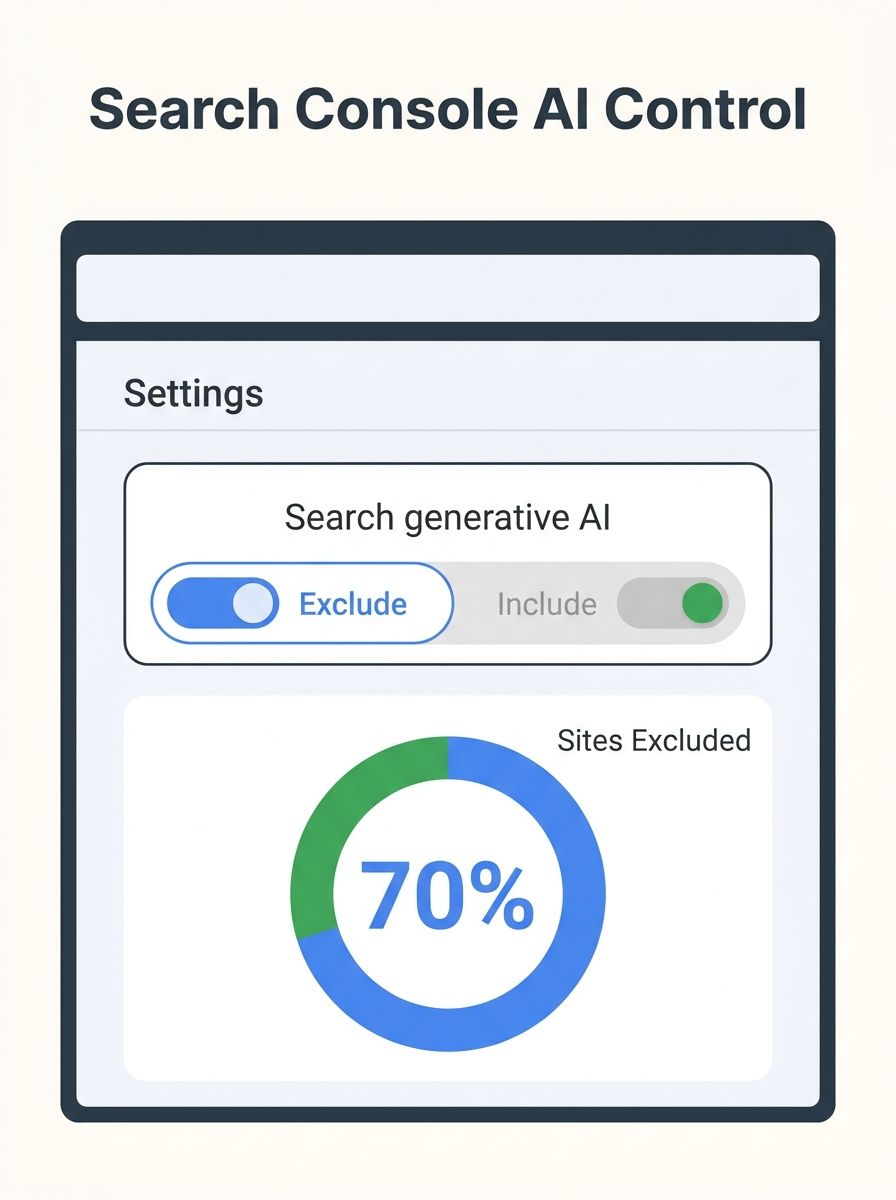
The Search generative AI control appears under Settings in Search Console for accounts where Google has completed rollout. The default "Include" option allows content to appear as cited links inside AI Overviews, AI Mode, and Discover's generative AI features. The "Exclude" setting removes the site from those features entirely, including all link citations, according to Google's help documentation.
Google documentation states the setting carries no ranking or inclusion impact on regular organic search results. The control operates independently from Merchant Center and Google Ads settings, leaving Shopping campaign participation unaffected. The toggle also does not govern AI training—website owners must use the separate Google-Extended robots.txt token to control whether content trains future Gemini models.
Changes to the setting typically process within a few days, with content removal from AI features occurring one to two days after processing completes, though caching can extend the timeline, Google's documentation notes.
Top Stories Appear Inside AI Overviews at 15.5% Rate
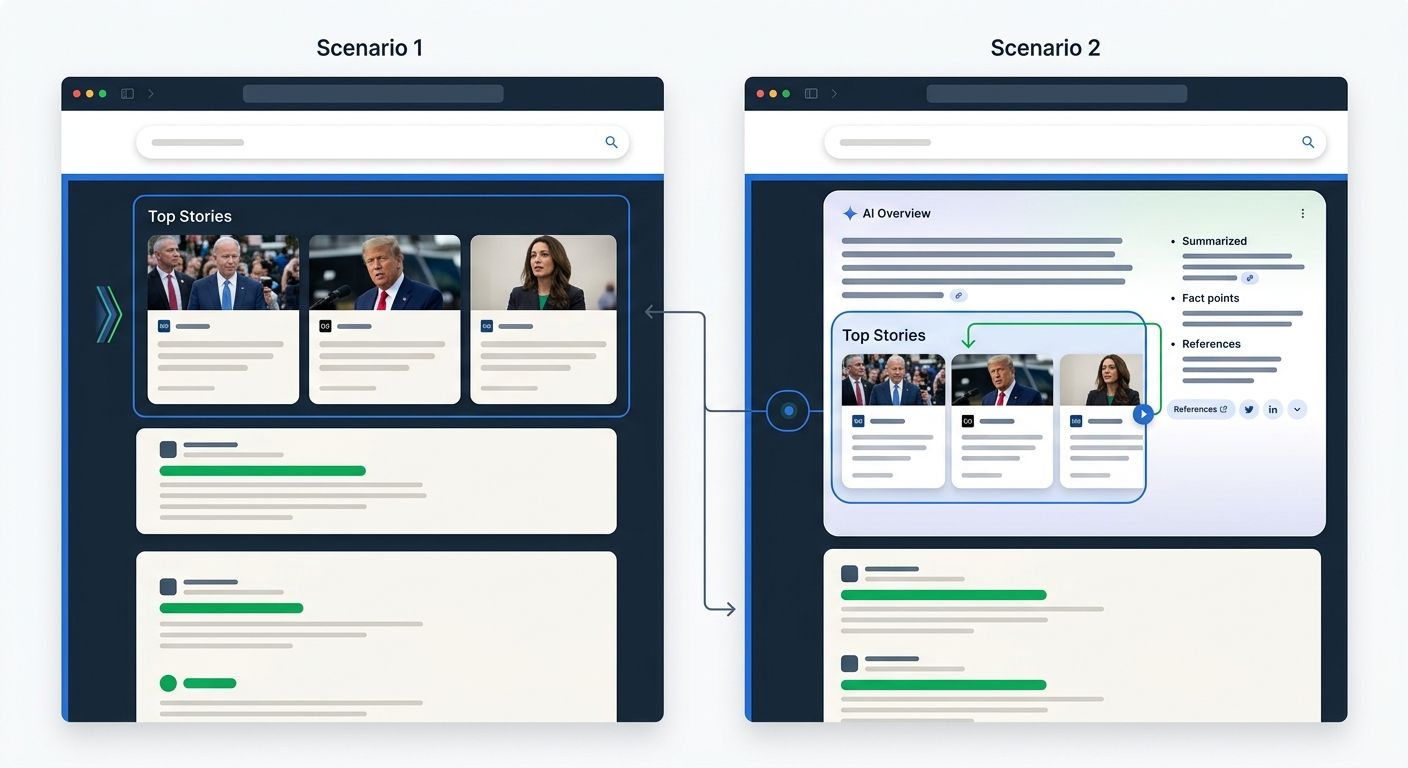
NewzDash, a news-visibility tracking provider, released data this week showing 15.5% of U.S. trending news queries that displayed Top Stories carousels placed those carousels inside AI Overviews rather than as standalone organic features. The UK rate reached 17.46%, according to John Shehata, CEO and founder of NewzDash and GDdash.
"Nearly 1 in 6 U.S. trending news queries now place Top Stories inside AI Overviews," Shehata stated in reporting the figures. NewzDash's data shows the embedded carousel and standalone Top Stories version do not appear simultaneously on the same query result. The company has not published sample sizes or specific collection dates for the tracked data.
Kyle Sutton, Head of SEO and AI Discovery at The Washington Post, confirmed the pattern in a comment on Shehata's LinkedIn post: "Anecdotally, seems we're all seeing it a lot more often." His comment does not verify NewzDash's specific percentage figures or methodology.
Opt-Out May Remove Traditional Organic Features
Shehata interprets Google's control as blocking access to Top Stories carousels when those carousels render inside AI Overviews. "Using Google's newer Search Console generative AI opt-out is different, and will likely remove publishers from Top Stories inside AI Overviews," Shehata stated.
Google's help documentation states sites that exclude themselves "won't show up" in AI features but does not specify how the control handles traditional organic features—such as Top Stories—when Google displays those features within an AI Overview container. Google has not confirmed Shehata's interpretation publicly.
The architectural question mirrors broader challenges in AI search optimization frameworks where hybrid result layouts blur distinctions between generative and organic placements. If Shehata's reading proves correct, publishers opting out to preserve organic traffic could inadvertently block visibility in news carousels they still consider core distribution channels.
Historical Context: The All-or-Nothing Problem
Before the Search Console control launched in June 2026, website owners lacked any method to exclude content from Google's AI features without removing it from Search entirely. Robots.txt directives, noindex tags, and snippet controls predated AI Overviews and carried no AI-specific granularity.
The nosnippet meta tag removes content from AI Overviews but simultaneously blocks traditional featured snippets, creating an all-or-nothing tradeoff Google acknowledged in January 2026 when the company stated it was exploring separate opt-out mechanisms. Google-Extended, the robots.txt token Google introduced for AI training control, governs whether content trains Gemini models and grounds results in Gemini Apps and Vertex AI but explicitly does not control AI Overviews or AI Mode inclusion, Google's crawler documentation states.
The Search Console setting emerged from parallel development: Google made a January 2026 statement on AI opt-outs the same day the UK Competition and Markets Authority opened a public consultation on requiring such controls. The CMA's June conduct requirement made the control legally mandatory for Google in the UK market, with compliance deadlines extending into 2027.
The Takeaway
SEO teams evaluating the new opt-out face a three-part decision framework: measure current AI Overview citation volume and traffic contribution, determine whether Top Stories placements inside AI Overviews represent material visibility, and assess the regulatory or brand risk of AI association. Publishers heavily dependent on news carousel traffic should audit their current AI Overview citation rate before activating the exclusion—NewzDash's 15.5% figure suggests a meaningful portion of news visibility now routes through hybrid AI placements where opting out removes both generative and traditional features simultaneously.
For marketing managers and CMOs evaluating AI search performance measurement, the control creates a testing opportunity: exclude a subset of content through the Search Console setting and track whether organic news carousel impressions decline alongside AI Overview citations. That data gap would confirm whether Google treats embedded Top Stories as an AI feature subject to the opt-out. Until Google clarifies the setting's handling of hybrid placements in documentation, publishers making the exclusion choice operate without complete information on what they're actually excluding from.
Marcus Webb
Digital marketing consultant and agency review specialist. With 12 years in the SEO industry, Marcus has worked with agencies of all sizes and brings an insider perspective to agency evaluations and selection strategies.
Related Articles
Google Adds Further Exploration Links to AI Overviews as Publisher Traffic Decline Reaches 58 Percent
Google deployed five updates to AI Overviews and AI Mode on May 6, 2026, designed to direct more traffic to publisher websites, according to The Next Web. The rollout arrives as the search giant faces antitrust lawsuits from Penske Media and a European Commission investigation into whether AI-genera
Google Introduces Further Exploration Links to AI Overviews as Publishers File Antitrust Suits Over 58 Percent Traffic Decline
Publishers filed antitrust lawsuits and European Commission complaints against Google as AI Overviews correlated with a 58 per cent click-through rate decline, prompting the search giant to introduce five traffic-restoration features on May 6, 2026, according to The Next Web.
Google Automatically Expands AI Overviews, Pushing Organic Results Further Down Search Pages
Google now automatically expands AI Overviews at the top of search results pages for certain queries, eliminating the "Show more" button and pushing traditional organic link listings significantly lower on the page, according to a report published August 28 by Search Engine Roundtable.
Explore more topics