
TrySight.ai Publishes Step-by-Step Framework for Optimizing Content Visibility in AI Search Platforms
TrySight.ai released a three-stage content optimization framework on August 2 designed to position brand content for citation in AI-powered search platforms including ChatGPT, Claude, and Perplexity, according to a guide published on the company's website.
 Marcus Webb··3 min read
TrySight.ai Publishes Step-by-Step Framework for Optimizing Content Visibility in AI Search Platforms
TrySight.ai released a three-stage content optimization framework on August 2 designed to position brand content for citation in AI-powered search platforms including ChatGPT, Claude, and Perplexity, according to a guide published on the company's website.
The framework addresses what the company characterizes as an "AI visibility problem" distinct from traditional search engine optimization, where AI assistants answering product or service queries cite a curated set of sources while excluding brands without optimized content structures.
The methodology positions Generative Engine Optimization (GEO) as a complementary discipline to traditional SEO, with the framework stating that "understanding both is what separates brands that show up in AI answers from those that don't." The approach follows growing industry recognition that AI search platforms layer atop Google rather than replace it, requiring parallel optimization strategies.
Framework Stage One: AI Visibility Baseline Assessment
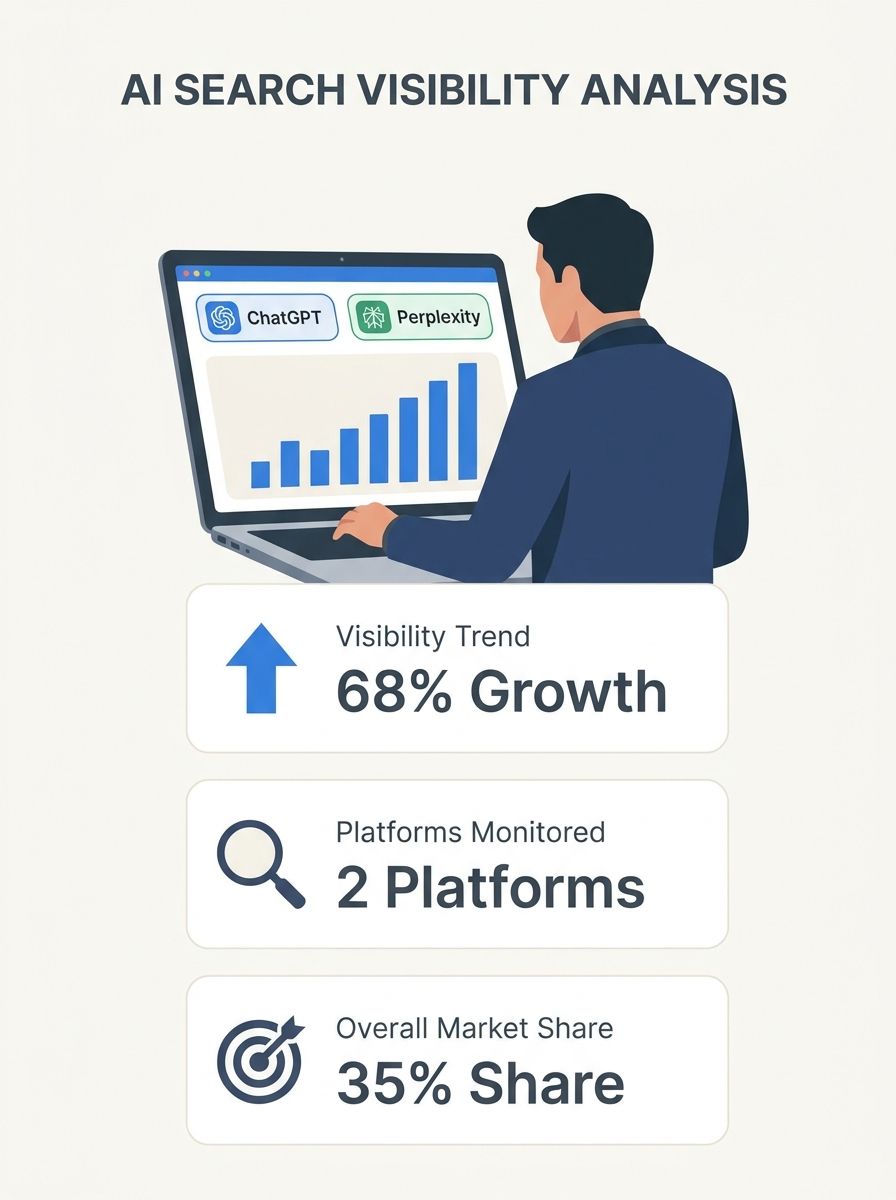
The framework's first stage directs marketers to run prompt-based queries mirroring target audience questions across multiple AI platforms, documenting which brands appear in responses. TrySight.ai positions its proprietary AI Visibility Score tool as a mechanism to convert manual prompt testing into structured benchmarking.
The methodology requires sentiment analysis of existing brand mentions. The guide specifies that AI responses framing a brand as viable "though it has a steeper learning curve than alternatives" represent technically accurate citations that work against competitive positioning. Organizations must flag these characterizations during baseline assessment.
The framework addresses inaccurate AI mentions—outdated information, incorrect pricing, or wrong feature descriptions—by positioning targeted authoritative content as the correction mechanism rather than direct outreach to AI platform operators.
Content Gap Identification for AI Citation Patterns
Stage two maps topics where AI models cite competitor content in responses, expanding traditional content gap analysis beyond Google rankings to include AI-generated answer patterns. The framework directs teams to identify specific prompts where competitor guides earn citations while the analyzing organization's content receives no mention.
The methodology prioritizes informational query types. The guide states that "how to" guides, comparison articles, and explainers perform particularly well "because they match the way AI models parse and summarize information." Topics where AI models currently cite no clear authority represent optimal opportunities according to the framework.
TrySight.ai recommends building a ranked content calendar of 10-20 topics, each mapped to specific AI query patterns identified during auditing. The framework ties each content item to a documented gap where competitor content currently earns citation.
Dual SEO-GEO Optimization Structure
The framework's third stage addresses content structuring for both traditional search engines and AI model citation. While the published guide truncates before completing this section's specifics, the methodology positions simultaneous optimization for Google crawlers and AI language models as the core technical requirement.
The approach aligns with enterprise SEO differentiation increasingly dependent on AI-answer optimization as tracked across multiple 2026 industry frameworks. Organizations implementing structured AI visibility measurement have reported competitive advantages in sectors where software companies' SEO listicles lose 69% of AI search recommendations to competitors despite earning citations.
The TrySight.ai framework follows Google's June 2026 guidance that AI search and traditional SEO follow the same optimization principles, while acknowledging format and structural differences between content optimized for crawler indexing versus language model extraction.
What This Means for Business Owners
Business owners evaluating SEO agencies in 2026 face a bifurcated visibility landscape where traditional Google rankings no longer guarantee comprehensive market coverage. Agencies demonstrating competency in both traditional SEO and Generative Engine Optimization now deliver measurably broader reach than those optimizing exclusively for crawler-based search.
The TrySight.ai framework provides a testable evaluation criterion: request that prospective agencies conduct an AI visibility audit across ChatGPT, Claude, and Perplexity for your specific product category, documenting where competitor brands appear in AI-generated answers and mapping content gaps driving those citations. Agencies unable to execute this analysis lack operational capacity in a channel that Similarweb data shows reaches 494 million monthly users.
Organizations should prioritize content calendar development that explicitly addresses both search engine result pages and AI answer inclusion, with measurable baselines and quarterly reassessment. The framework's emphasis on sentiment analysis—tracking not just whether AI models mention your brand but how they frame it relative to alternatives—offers a practical lens for ongoing performance evaluation that most traditional SEO reporting omits entirely.
Marcus Webb
Digital marketing consultant and agency review specialist. With 12 years in the SEO industry, Marcus has worked with agencies of all sizes and brings an insider perspective to agency evaluations and selection strategies.
Related Articles
Cloviana Publishes Comprehensive AI Search Optimization Framework as B2B Buyer Research Shifts to ChatGPT and AI Platforms
Cloviana published a comprehensive guide to AI search optimization on June 25, 2026, outlining how B2B brands can optimize for visibility in AI-generated answers across ChatGPT, Claude, Perplexity, Google AI Overviews, and Gemini as 71% of B2B buyers now rely on AI chatbots for software research, ac
TrySight.ai Publishes 6-Tool Evaluation of LLM Search Optimization Platforms as AI Visibility Category Matures
TrySight.ai published a comparative evaluation of six large language model search optimization platforms on July 12, 2026, covering tools that track brand mentions across AI assistants, generate content optimized for AI citations, and automate indexing for AI crawlers, according to the guide.
HubSpot Publishes Six-Field Audit Framework for Measuring Brand Visibility Across AI Search Platforms
HubSpot published a six-field audit methodology September 4 that quantifies brand visibility across ChatGPT, Claude, Gemini, and Perplexity by distinguishing between passive mentions and active recommendations, according to a sponsored framework published on Search Engine Journal.
Explore more topics