
European Commission Orders Google to Share Search Data With Rivals Starting January 2027
The European Commission adopted a binding decision on July 16, 2026 under the Digital Markets Act requiring Google to share anonymized ranking, query, click, and view data with rival search engines and AI chatbot providers beginning January 2027, according to Search Engine Journal.
 Marcus Webb··4 min read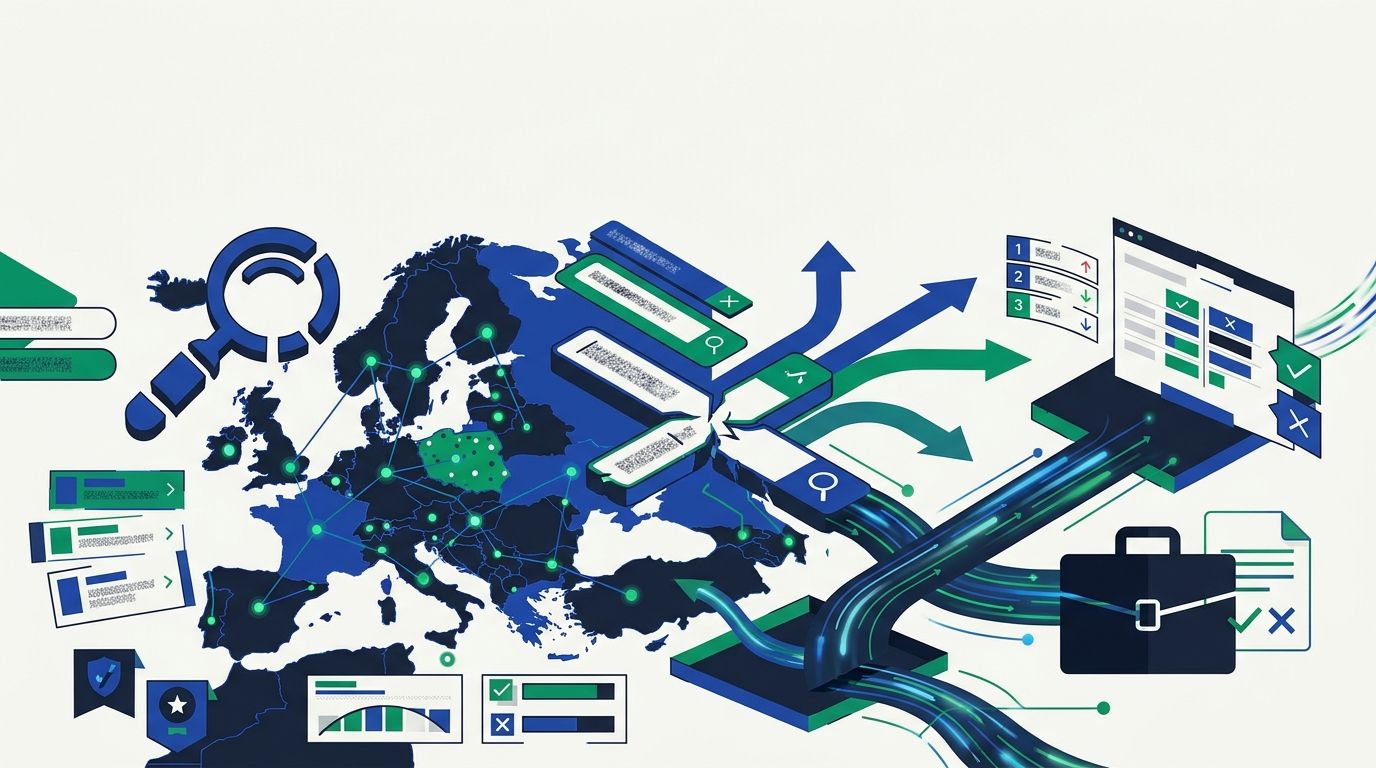
European Commission Orders Google to Share Search Data With Rivals Starting January 2027
The European Commission adopted a binding decision on July 16, 2026 under the Digital Markets Act requiring Google to share anonymized ranking, query, click, and view data with rival search engines and AI chatbot providers beginning January 2027, according to Search Engine Journal. The order, issued under Article 6(11) of the DMA, represents the first regulatory mandate forcing a dominant search platform to provide competitors with dataset access at this scale, reshaping competitive dynamics across European search markets where local engines and marketplaces already command meaningful share in Germany, Czech Republic, and the UK.
Regional Search Fragmentation Already Underway
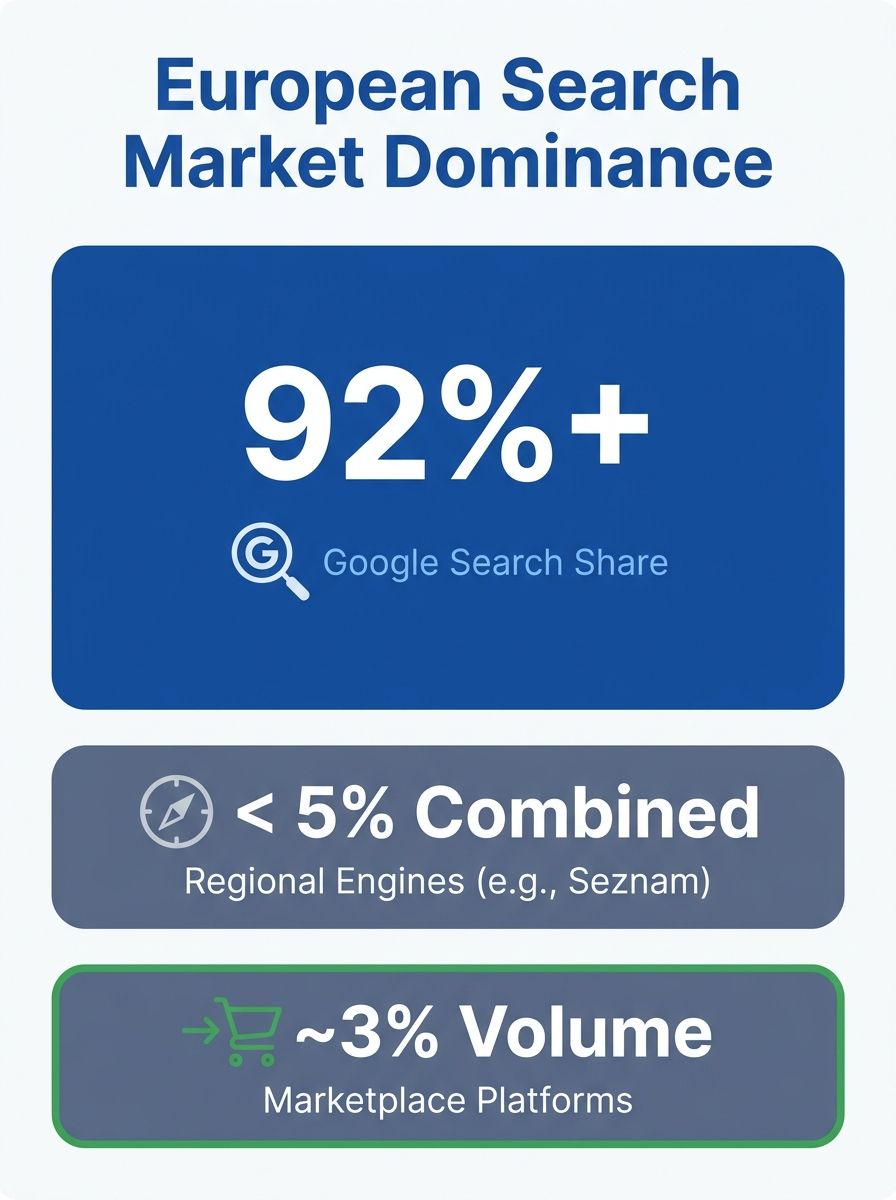
Google maintains approximately 80% market share in Germany's search market, but Bing has reached a genuine 10% share with Yahoo, DuckDuckGo, and Ecosia dividing the remainder, according to the analysis. Ecosia posted its best-ever home-market performance in recent quarters, tracking with German consumer preferences for privacy and sustainability as purchasing criteria.
In the Czech Republic, domestic search engine Seznam.cz holds roughly 12% market share compared with Google's 81%, making it the only EU country with a local search engine reaching double-digit share. Bing's desktop-only market share climbs to several times its combined mobile-desktop figure in enterprise environments where Windows installations and Edge defaults dominate, according to the report.
The regional fragmentation extends beyond traditional search engines. Product searches increasingly bypass Google entirely as consumers open marketplace platforms directly—Zalando, Otto, and Allegro handle query understanding within their own search systems, with marketplace search bars now processing product discovery that previously flowed through Google.
Regulatory Actions Reshape Answer Visibility
The UK Competition and Markets Authority's Strategic Market Status designation on Google in October 2025 produced requirements enabling local publishers to opt out of AI Overviews without losing organic search visibility, provide clear attribution and engagement metrics, and allow users to port search data to authorized third parties, according to the framework.
A Munich Regional Court ruling in May 2026 found Google directly liable for false AI Overview claims that wrongly linked two publishers to scams, treating the generative summaries as Google's own authored speech rather than neutral search results. The court's reasoning plausibly extends to any answer engine synthesizing claims about real businesses, creating legal exposure that did not previously exist under traditional search liability frameworks. Google has appealed the ruling.
The AI Act's transparency rules for user-facing artificial intelligence systems take effect August 2, 2026. Combined with GDPR enforcement mechanisms, the regulatory environment creates liability for incorrect or defamatory generative answers that U.S. and APAC markets do not impose.
The legal exposure incentivizes answer engines to avoid citing sources they cannot verify, according to the analysis. Brands maintaining detailed, consistent, and machine-readable identity data gain a structural visibility advantage as AI Overviews, ChatGPT, Perplexity, and Mistral's Le Chat expand usage across EU markets.
AI Answer Systems Deploy on Delayed Timeline
AI Overviews launched in most EU markets well after U.S. and 200-plus-country deployments, with features announced at Google I/O routinely carrying unstated "not available in Europe" restrictions tied to DMA and AI Act review processes. The deployment lag remains real but closing as ChatGPT, Perplexity, and Le Chat see meaningful EU adoption ahead of regulatory approval, according to the report.
Bing continues expanding its desktop advantage by integrating Copilot further into Edge and Windows 11, pushing the gap between desktop and mobile market share wider in enterprise environments. Microsoft's Windows install base creates default search placement that regulatory scrutiny has not yet addressed at the same scale as Google's Android agreements.
The data-sharing requirement under the July 16 Commission decision hands competitors dataset advantages no regulator has enforced elsewhere. Rival engines and AI platforms will receive anonymized but detailed performance data covering how Google ranks results, which queries trigger specific features, and how users interact with search result types—information previously unavailable outside Google's systems.
Marketplace Search Absorbs Discovery Intent
Comparison sites including Idealo and Kelkoo attract consumers directly from Google for product research, while Amazon's local European versions, Zalando, and country-specific platforms handle initial discovery queries that once began on search engines. AI-powered shopping assistants now pull product data directly from marketplace listings and feeds rather than brand-owned websites, according to the analysis.
Structured product attributes, titles, and review counts within marketplace listings function as discoverability signals similar to traditional SEO, but most brands delegate marketplace optimization to e-commerce teams without connecting it to broader search visibility strategy. As AI systems prioritize structured data feeds over website crawling for product information, the disconnect creates visibility gaps brands may not recognize until traffic patterns shift, according to the framework.
Why This Matters Now
The January 2027 data-sharing mandate fundamentally changes competitive positioning for agencies managing multi-market European campaigns. Search strategies treating Europe as a single Google-dominated market miss both the existing fragmentation (double-digit local engine share in Czech markets, Bing's enterprise desktop strength, marketplace query absorption) and the regulatory forces accelerating that fragmentation. The Commission's binding decision hands rivals dataset access that could compress Google's advantages in ranking quality and query understanding within 12-18 months of implementation.
The Munich liability ruling—if upheld on appeal—makes AI answer accuracy a legal requirement rather than a quality preference, creating citation advantages for brands with verifiable, structured identity data. Marketing managers evaluating SEO agencies should verify whether providers track visibility across local engines (Seznam, Ecosia), marketplace platforms (Zalando, Otto, Allegro), and emerging AI answer engines (Le Chat, Perplexity), not just Google rankings. The August 2 AI Act transparency deadline compounds urgency for structured data implementation supporting AI answer visibility.
CMOs allocating 2027 budgets face a question the source data makes explicit: whether current agency partnerships monitor regulatory actions as search strategy inputs. The DMA data-sharing requirement, CMA publisher opt-out provisions, and potential liability exposure for defamatory AI summaries all change what "ranking well" means in European markets within the next six months. Agencies positioning these shifts as compliance overhead rather than competitive opportunities are answering the wrong question.
Marcus Webb
Digital marketing consultant and agency review specialist. With 12 years in the SEO industry, Marcus has worked with agencies of all sizes and brings an insider perspective to agency evaluations and selection strategies.
Related Articles
How UK Search Fairness Rules Are Changing SEO Strategy for US Agencies in 2026
Every organic search result served in the UK, including AI Overviews, must now satisfy an "objective and non-discriminatory" ranking standard.
Google Marketing Live 2026 Confirms End of Traditional Search as Agency Study Shows Top-Ranked Brands Invisible to AI 69% of Time
Google announced at Marketing Live 2026 that traditional search has ended and all search on the platform now operates through AI-based systems, according to NP Digital's APAC managing director Dan Kalinski writing in Marketing-Interactive. The announcement validates what an NP Digital experiment mea
Google Adds Further Exploration Links to AI Overviews as Publisher Traffic Decline Reaches 58 Percent
Google deployed five updates to AI Overviews and AI Mode on May 6, 2026, designed to direct more traffic to publisher websites, according to The Next Web. The rollout arrives as the search giant faces antitrust lawsuits from Penske Media and a European Commission investigation into whether AI-genera
Explore more topics