
Chicago SEO Agency Reports Client Visibility Gains From Combined Traditional and AI Search Optimization Strategy
Simple SEO Group has integrated generative engine optimization alongside traditional search engine optimization for clients across both AI-generated answers and organic rankings, according to founder and CEO Brendan Egan, who described the combined approach in a Newsweek article published July 17, 2
 Marcus Webb··3 min read
Chicago SEO Agency Reports Client Visibility Gains From Combined Traditional and AI Search Optimization Strategy
Simple SEO Group has integrated generative engine optimization alongside traditional search engine optimization for clients across both AI-generated answers and organic rankings, according to founder and CEO Brendan Egan, who described the combined approach in a Newsweek article published July 17, 2026. The Chicago-based agency, which has served more than 500 brands over two decades, reported that clients applying the dual strategy now appear inside AI-generated answers while maintaining traditional search visibility.
Egan told USA Today that the agency's approach centers on creating content structured to answer customer questions clearly enough for both search engines and AI systems to extract direct answers, while continuing to build quality backlinks and third-party citations. "Ignoring AI's role in search is giving competitors an opportunity to establish authority before you do," Egan said in the Newsweek piece.
How the Dual-Optimization Strategy Works in Practice
The agency structures pages around questions customers ask, backs claims with specific data rather than generalities, and documents brand expertise clearly enough for AI systems to cite it, according to the article. Simple SEO Group's 40-person team adapts link-building and citation practices developed over decades of SEO work for AI-era visibility requirements.
AI search systems often benefit from corroborating references across credible sources, the article noted. A brand with consistent documentation across multiple credible sources gives AI systems more reason to trust claims than a brand making assertions only on its own site. The practice mirrors principles Google executives stated earlier in 2026 regarding AI search and traditional SEO following the same optimization fundamentals.
AI-Generated Answers Draw From Same Authority Signals as Organic Rankings
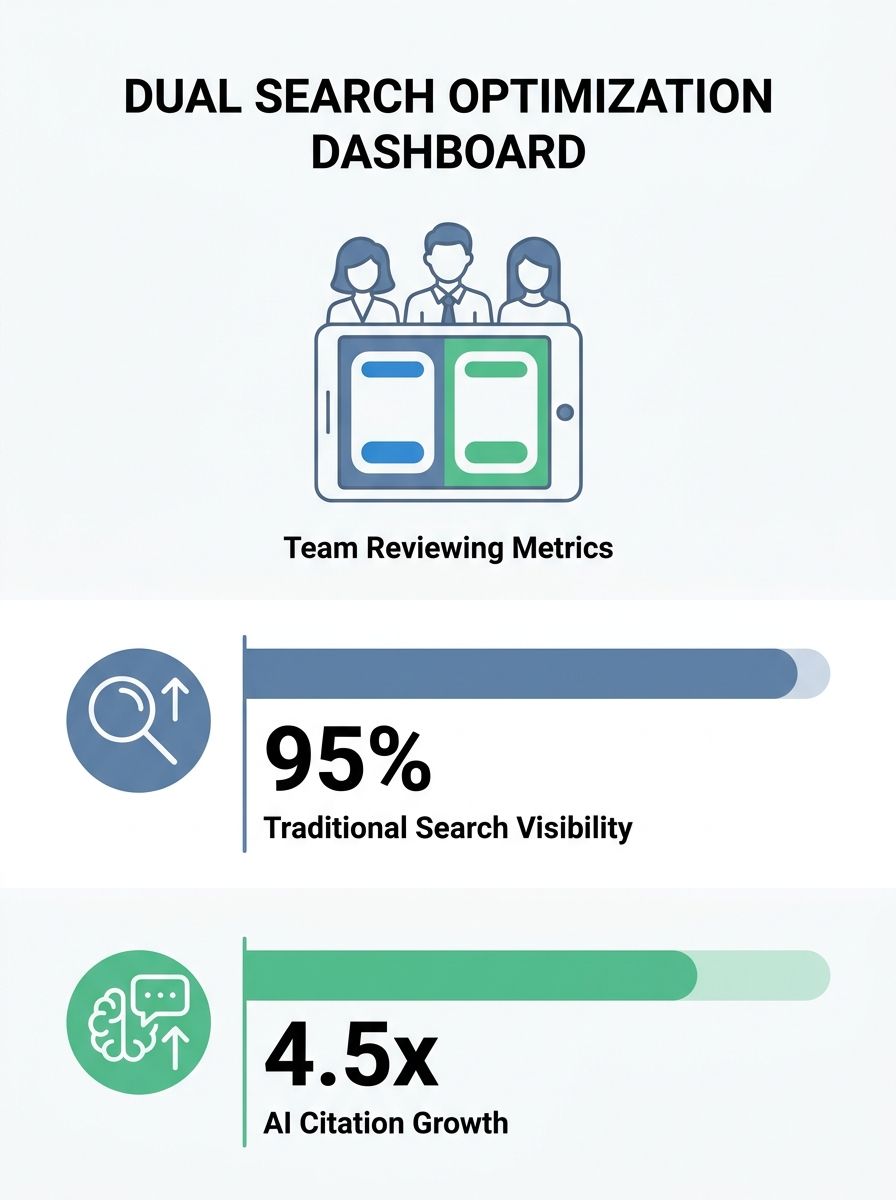
Pages that rank well organically tend to be well structured, answer questions directly, and demonstrate authority, qualities that also make content likely to surface in AI-generated responses, according to the Newsweek analysis. AI systems favor content providing clear answers in opening sentences without requiring readers to scroll through multiple introductory paragraphs, the article stated.
The shift affects brands relying on traditional rankings as the foundation of visibility strategy. A growing share of searches now conclude with an AI answer, Google AI Overview, or ChatGPT response before users click any link, according to the article. The change parallels findings in a recent analysis showing ranking number one on Google delivers 58% fewer clicks than historical benchmarks.
Early Movers May Gain Positioning Advantage in AI Citation Patterns
Brands establishing strong topical authority and third-party corroboration early may be better positioned to appear repeatedly across AI-generated results, according to Egan's assessment in the article. If ChatGPT or Google AI Overviews cite a brand consistently today, that brand may have a head start over competitors beginning the same work a year later.
AI-driven search represents a smaller share of overall search activity today but is expected to grow substantially, the article noted. The observation aligns with broader industry shifts toward AI-answer optimization and governance systems now differentiating enterprise SEO teams.
Why This Matters Now
Marketing leaders evaluating SEO agencies face a strategic decision point as AI-generated answers claim growing search market share. Agencies demonstrating integrated traditional-plus-AI optimization capabilities may deliver broader visibility coverage than firms treating generative engine optimization as a future consideration rather than a current practice requirement.
The risk for brands delaying AI search optimization work extends beyond missed citation opportunities to competitive positioning disadvantage. Competitors establishing consistent AI citation patterns today build authority signals that may compound over time as AI systems reference the same sources repeatedly across answer generation.
CMOs and marketing managers should ask current or prospective SEO agencies specific questions about AI citation tracking, content structure for answer extraction, and third-party authority-building adapted for AI systems. Agencies unable to demonstrate active client work in this area may lack the operational capability to deliver visibility across the search landscape's evolving dual-engine reality.
Marcus Webb
Digital marketing consultant and agency review specialist. With 12 years in the SEO industry, Marcus has worked with agencies of all sizes and brings an insider perspective to agency evaluations and selection strategies.
Related Articles
Cloviana Publishes Comprehensive AI Search Optimization Framework as B2B Buyer Research Shifts to ChatGPT and AI Platforms
Cloviana published a comprehensive guide to AI search optimization on June 25, 2026, outlining how B2B brands can optimize for visibility in AI-generated answers across ChatGPT, Claude, Perplexity, Google AI Overviews, and Gemini as 71% of B2B buyers now rely on AI chatbots for software research, ac

Google Executives State AI Search and Traditional SEO Follow Same Optimization Principles
Google CEO Sundar Pichai and Search SVP Nick Fox both confirmed in spring 2026 interviews that optimizing for AI-powered search requires the same approach as traditional search engine optimization, according to statements published by Search Engine Journal. The alignment between the two executives'

AI Search Platforms Layer Atop Google Rather Than Replace It, Similarweb Tracking Shows
Ninety-five percent of ChatGPT's 494 million users also used Google during the March-May 2026 tracking period, according to Similarweb's "2026 Generative AI Landscape" report released July 24.
Explore more topics