
Website Speed Analysis Shows 100-Millisecond Delays Cost 1% of Conversions
Website performance analysis published August 24 by Mean CEO blog quantified the revenue impact of page-speed delays, reporting that every 100-millisecond loading lag correlates with approximately 1% conversion loss and 53% of mobile users abandon pages exceeding three-second load times, according t
 Marcus Webb··4 min read
Website Speed Analysis Shows 100-Millisecond Delays Cost 1% of Conversions
Website performance analysis published August 24 by Mean CEO blog quantified the revenue impact of page-speed delays, reporting that every 100-millisecond loading lag correlates with approximately 1% conversion loss and 53% of mobile users abandon pages exceeding three-second load times, according to aggregated 2026 industry data.
The statistics compilation by Violetta Bonenkamp, founder of Mean CEO, drew from industry case studies, platform benchmarks, and Chrome User Experience Report data to establish speed-to-conversion correlations across ecommerce, service, and lead-generation verticals. The report emphasizes that technical performance affects commercial outcomes directly, not just user-experience metrics.
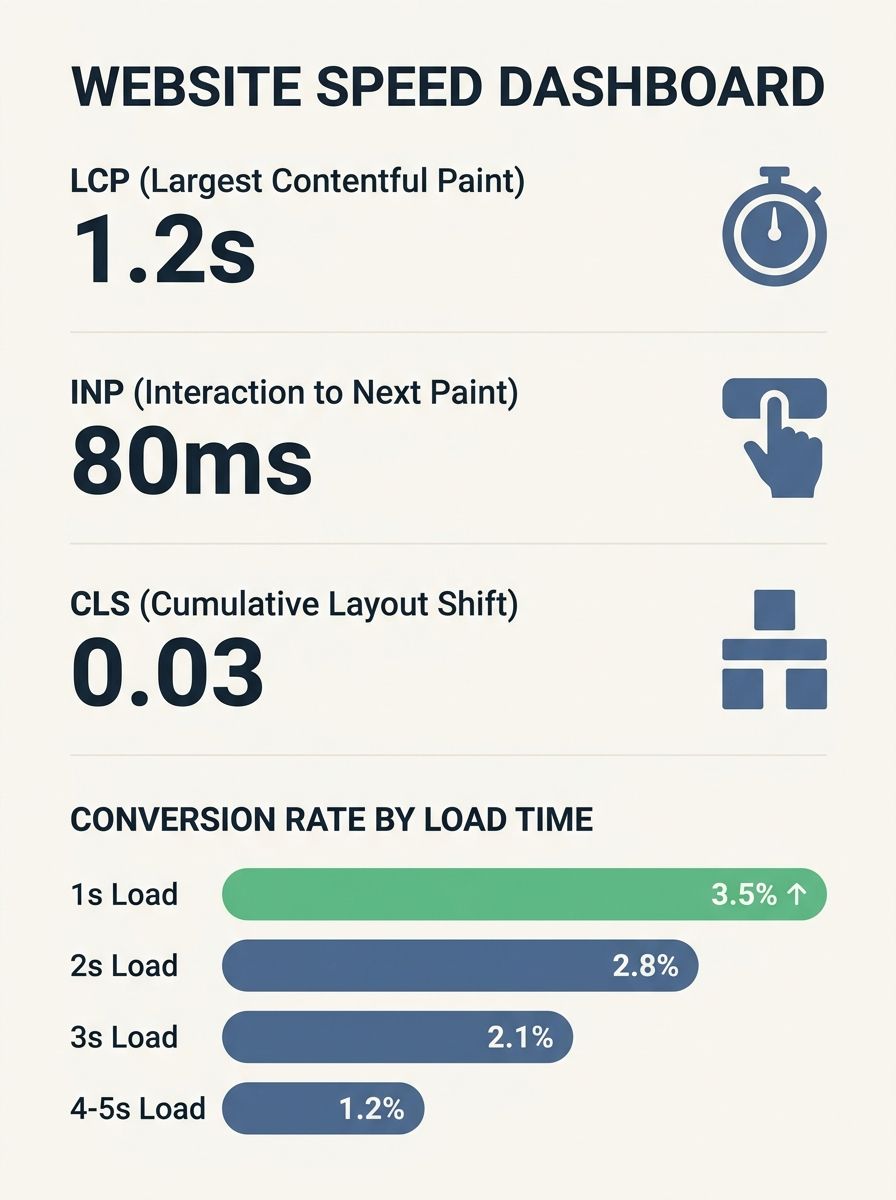
Core Web Vitals—Google's trio of page-experience signals measuring loading speed (Largest Contentful Paint), interactivity (Interaction to Next Paint), and visual stability (Cumulative Layout Shift)—became ranking factors in 2021 and remain components of Google's algorithmic assessments in 2026. The Mean CEO analysis positions these metrics as diagnostic tools for identifying revenue leakage rather than purely technical compliance checkboxes.
Core Web Vitals Pass Rates Remain Below 50% on Mobile
Approximately 49.1% of mobile web pages passed Core Web Vitals assessment thresholds in 2026, according to PageSpeed Matters tracking cited in the report. The sub-50% pass rate indicates that half of mobile pages fail at least one of the three Core Web Vitals signals—Largest Contentful Paint, Interaction to Next Paint, or Cumulative Layout Shift—creating structural conversion disadvantages relative to faster competitors.
The mobile web lags desktop performance across all three metrics, the analysis notes. Mobile devices face slower network conditions, less processing power, and higher image-weight burdens, compounding the impact of unoptimized resources.
The gap between passing and failing pages represents what the report characterizes as a competitive opening: sites that fix Core Web Vitals issues gain relative advantage in both search rankings and visitor retention when most pages in a category remain slow.
E-Commerce Platforms Document Revenue Impact
Shopify merchants experience approximately 3.5% lower conversion rates for every 100 milliseconds of added load time, according to platform data referenced in the compilation. The e-commerce platform's internal analysis links speed directly to checkout completion and average order value across millions of storefronts.
Rakuten documented 33.13% higher conversion rates and 53.37% more revenue per visitor following Core Web Vitals optimization work focused on layout stability and image loading, the report states. The Japanese e-commerce conglomerate's case demonstrates that fixing visual shift and perceived speed affects not only bounce rates but also transaction completion.
Vodafone Italy improved Largest Contentful Paint scores by 31% and saw 8% sales increases, while travel platform RedBus reported 7% sales growth after optimizing Interaction to Next Paint responsiveness. Both cases tie Core Web Vitals improvements to measurable commercial outcomes rather than abstract performance scores.
Service and Lead-Generation Sites See Conversion Lifts
Yelp reduced mobile First Contentful Paint from 4.4 seconds to 1.8 seconds on business listing pages and measured 15% more conversions on lead-capture contact forms, the analysis notes. The local-business directory's data shows that speed affects lead-generation verticals as significantly as transactional e-commerce flows.
Google's internal testing found that reducing load time from three seconds to one second can lift conversions by up to 27%, according to benchmarks cited in the report. The search company's analysis spans billions of page loads across diverse content types and geographies.
Research firm Portent documented conversion rate decline from 3.05% at one-second load times to 0.41% at five-second load times in an e-commerce study. The nearly sevenfold conversion spread between fast and slow pages suggests that speed delays eliminate interested visitors before messaging, pricing, or product selection enter consideration.
Three-Second Mobile Threshold Drives Half of Abandonment
Mobile users abandon 53% of page visits that exceed three-second load times, a threshold the report identifies as a practical optimization target for mobile-first indexing strategies. The three-second window represents the point at which waiting costs outweigh curiosity for more than half of mobile traffic.
The mobile-abandonment data aligns with Google's mobile-first indexing framework, which prioritizes mobile page performance in ranking assessments. Sites serving slow mobile experiences face dual penalties: both reduced rankings from algorithmic signals and higher bounce rates from visitor behavior.
The report positions the 100-millisecond-to-1%-conversion correlation as a budgeting tool for agencies evaluating technical SEO projects. A site generating 10,000 monthly visitors at 2% conversion and $100 average order value would theoretically recover $2,000 monthly revenue for every second of load-time reduction, making performance work a calculable return-on-investment decision rather than a discretionary enhancement.
The Takeaway
The Mean CEO analysis frames Core Web Vitals optimization as a revenue-recovery strategy for SEO agencies advising enterprise clients on technical infrastructure priorities. With half the mobile web failing Core Web Vitals thresholds and documented conversion spreads exceeding 7:1 between one-second and five-second load times, agencies can position speed audits as margin-protection work that compounds across every site visit rather than one-time ranking boosts.
The data supports treating website speed as a continuous cost center: every 100 milliseconds of delay functions as a hidden tax on paid search, content marketing, and organic traffic investments. For agencies managing portfolios of enterprise clients, the statistics provide a benchmark framework for diagnosing where technical debt is eroding acquisition spend and where performance fixes can recapture lost conversions without increasing traffic volume.
Technical SEO teams evaluating which sites in a client portfolio require immediate intervention can prioritize mobile pages serving high-value conversion flows, using the three-second abandonment threshold and Core Web Vitals assessments as triage criteria.
Marcus Webb
Digital marketing consultant and agency review specialist. With 12 years in the SEO industry, Marcus has worked with agencies of all sizes and brings an insider perspective to agency evaluations and selection strategies.
Related Articles

The Mobile-First SEO Audit: Why Agencies Miss Screen Optimization Before Ranking Recovery
A desktop page carrying 1,500 words and rich schema markup that renders as a 400-word stripped-down version on mobile will rank based on the thin mobile version, because Google indexes mobile, not desktop.

Organic Traffic Declines Persist Despite SEO Improvements, LeadRaft Marketing Framework Shows
Organic traffic can decline even when SEO metrics improve, according to a diagnostic framework published September 19 by LeadRaft Marketing that identifies seven distinct factors causing visitor drops independent of optimization quality.

Website Migrations Trigger 50% Traffic Drops That Persist Up to 18 Months When SEO Teams Miss Launch Window, Analysis Shows
Website migrations that exclude SEO teams during planning cause organic traffic drops exceeding 50 percent and require 12 to 18 months of recovery work, according to a Search Engine Journal technical analysis published June 5, 2026. The research distinguishes normal post-migration volatility (10-30
Explore more topics