
Organic Traffic Declines Persist Despite SEO Improvements, LeadRaft Marketing Framework Shows
Organic traffic can decline even when SEO metrics improve, according to a diagnostic framework published September 19 by LeadRaft Marketing that identifies seven distinct factors causing visitor drops independent of optimization quality.
 Marcus Webb··5 min read
Organic Traffic Declines Persist Despite SEO Improvements, LeadRaft Marketing Framework Shows
Organic traffic can decline even when SEO metrics improve, according to a diagnostic framework published September 19 by LeadRaft Marketing that identifies seven distinct factors causing visitor drops independent of optimization quality. The analysis addresses a measurement gap where businesses report stronger technical SEO, fresh content, and expanded backlink profiles while simultaneously experiencing sustained traffic reductions.
The framework targets a persistent friction point in SEO evaluation: the period when optimization investments appear successful across isolated metrics—improved page speed, expanded keyword coverage, higher domain authority scores—yet aggregate visitor counts decline, according to the analysis published by LeadRaft Marketing. Business owners evaluating agency performance or in-house SEO teams frequently interpret traffic drops as evidence of failed optimization, even when underlying search dynamics rather than execution quality drive the decline.
Search Demand and Algorithm Changes Decouple Traffic From Ranking Position
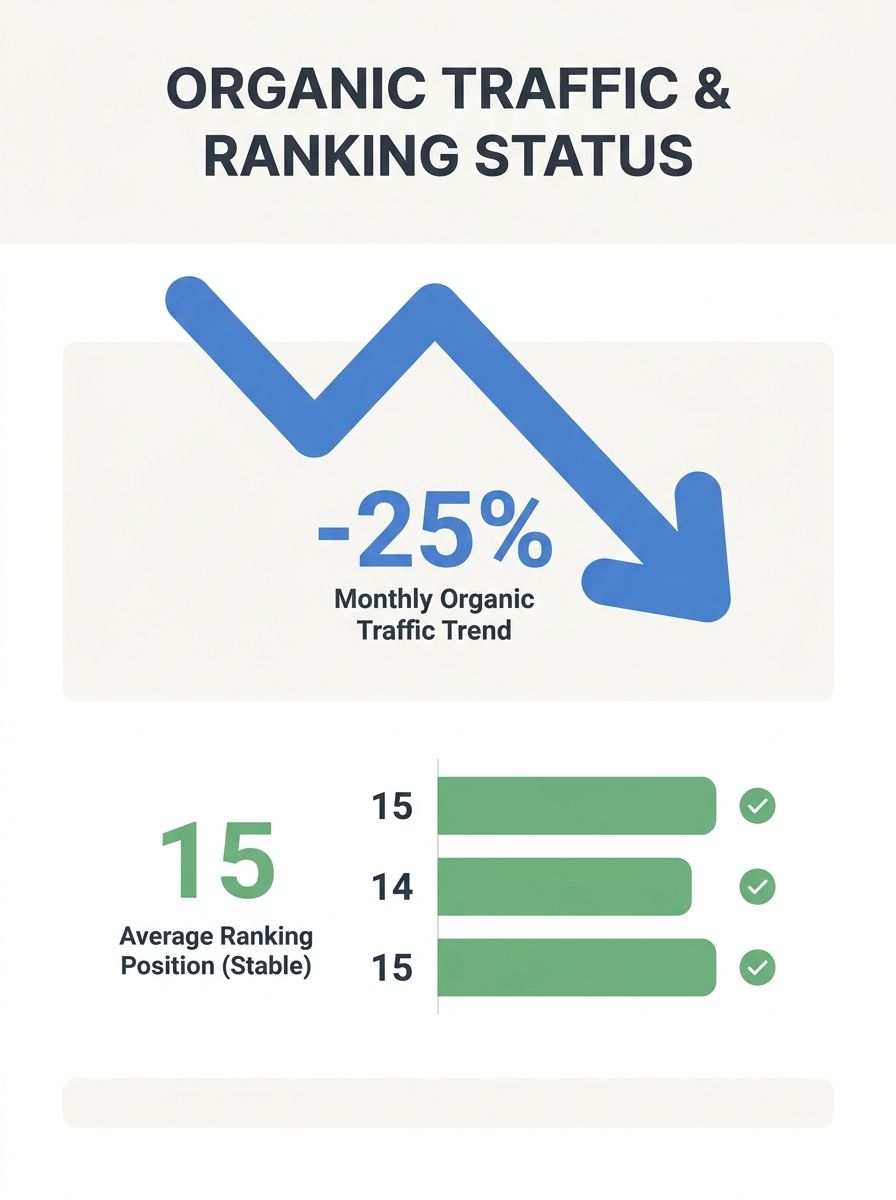
Algorithm updates and fluctuating search demand create traffic volatility unrelated to website improvements, the framework notes. A page maintaining third-position ranking can experience reduced visitors when overall search volume for its target query declines due to seasonality, shifting consumer behavior, or industry trend changes.
Google Search Console's impression data separates these factors, the analysis states. Stable impressions paired with declining clicks indicate ranking or click-through rate problems; declining impressions with stable click-through rate indicate demand contraction. "Search demand can change because of seasonality, consumer behavior, industry trends, economic conditions, or changing interests," the framework states.
Algorithm updates independently affect visibility even when SEO practices remain consistent. Pages ranking well before a core update can lose positions when evaluation criteria shift toward different quality signals, user experience factors, or authority measures. The framework recommends monitoring ranking changes alongside documented algorithm rollouts rather than attributing all traffic drops to optimization errors.
Competitor Velocity and SERP Feature Expansion Dilute Click Share
Competitive acceleration—where rival sites improve faster than a target website—produces relative ranking declines despite absolute optimization gains, according to the framework. A website publishing optimized content can drop from position three to position seven when competitors release more comprehensive topical coverage, stronger internal linking architecture, or superior authority signals during the same period.
"A page ranking in the top three positions can move down several places when competitors publish more comprehensive or relevant content," the analysis states. Even single-position drops within the top three results produce measurable click reductions; movement from position three to position four typically reduces click-through rate by 30 to 40 percent across most commercial queries.
SERP feature proliferation compounds this dilution. Featured snippets, local packs, video carousels, shopping results, and AI-generated overviews now occupy screen real estate formerly dedicated to traditional organic listings. The framework identifies click-through rate monitoring as essential: stable impressions with declining clicks suggest SERP layout changes rather than ranking losses. Google's expansion of AI Overviews accelerated this dynamic in 2026, pushing organic results further down initial viewport positions.
Content-Intent Misalignment and Technical Failures Block Conversion Despite Optimization
Content improvements disconnected from actual search intent reduce effectiveness even when keyword targeting and page structure improve, the framework notes. Pages optimized for informational queries fail to convert users seeking transactional outcomes—pricing, locations, contact options—regardless of content length or keyword density.
"SEO improvements should go beyond keyword placement," according to the analysis. "Content should answer the questions users have at different stages of their search journey and provide clear, useful information." A service-focused query matched to a lengthy blog article produces high bounce rates and low engagement signals despite technically sound optimization.
Technical problems introduced during redesigns, migrations, or plugin updates create visibility gaps independent of content quality. The framework lists incorrect canonical tags, accidental noindex directives, broken internal links, redirect errors, duplicate pages, slow loading times, and crawl budget issues as common post-update failures. "A website can have strong content and backlinks but still lose organic visibility if important pages cannot be crawled or indexed properly," the analysis states.
URL changes, title modifications, and navigation restructuring—common components of SEO improvement projects—can temporarily disrupt rankings even when the changes ultimately prove beneficial. The framework recommends documenting all structural changes and comparing performance before and after implementation to isolate which modifications correspond with traffic fluctuations.
Backlink Portfolio Quality Determines Authority Despite Volume Growth
Backlink quantity increases do not guarantee authority gains when new links lack relevance, industry alignment, or source credibility, according to the framework. Websites reporting expanded backlink profiles—measured in raw link counts—can simultaneously experience declining authority signals when those links originate from unrelated industries, low-trust domains, or link farm networks.
"SEO strategies should focus on earning relevant references from trustworthy websites rather than simply increasing the number of links," the analysis states. Digital PR campaigns, original research publication, and resource development produce authority gains; automated directory submissions and reciprocal link exchanges typically do not. Backlink checker discrepancies across measurement platforms further complicate this assessment, with tools disagreeing by up to 100 percent on referring domain counts for identical websites.
The framework positions competitor authority analysis as a diagnostic requirement. Businesses should compare their backlink profiles, topical coverage, internal linking structures, and domain authority scores against current top-ranking pages for target queries to identify relative authority gaps independent of absolute improvement metrics.
Reading Between the Lines
The LeadRaft Marketing framework isolates a measurement problem that predates AI search but intensifies under current conditions: SEO improvements operate within competitive and algorithmic contexts that can reverse their impact. For business owners evaluating agency performance or justifying internal SEO budgets, the framework provides diagnostic separation between execution quality and external market dynamics. Traffic declines accompanied by improved technical scores, expanded content, and growing backlink counts do not necessarily indicate failed optimization—they may indicate demand contraction, competitive acceleration, or SERP feature displacement that optimization cannot overcome.
The framework's emphasis on Google Search Console impression data as a demand diagnostic addresses a common misattribution error. Marketing managers attributing traffic drops to ranking losses when impression volumes simultaneously declined misidentify the problem; optimization cannot restore traffic lost to reduced search demand. Conversely, stable impressions with declining clicks correctly identify ranking erosion or SERP feature competition as the remediation target. The distinction determines whether businesses should expand topical coverage to capture adjacent demand or improve content quality and authority signals to reclaim lost click share within existing search volume.
For CMOs evaluating SEO agency reporting, the framework highlights click-through rate and impression trends as priority metrics alongside ranking positions. Agencies reporting ranking improvements without addressing CTR declines or impression volume shifts provide incomplete visibility into traffic drivers. The framework's seven-factor diagnostic model establishes a structured approach to traffic decline analysis that extends beyond simplified "rankings up equals traffic up" assumptions increasingly misaligned with 2026 SERP dynamics.
Marcus Webb
Digital marketing consultant and agency review specialist. With 12 years in the SEO industry, Marcus has worked with agencies of all sizes and brings an insider perspective to agency evaluations and selection strategies.
Related Articles

The SEO Debugging Pyramid: A Structured Framework for Diagnosing Traffic Drops Before They Become Crises
The SEO Debugging Pyramid is a five-layer diagnostic hierarchy (server infrastructure, crawl access, rendering and indexation, content signals, and authority/competitive visibility) that forces teams to troubleshoot organic traffic drops from the bottom up, preventing wasted effort on content rewrit

Ranking #1 on Google Now Delivers 58% Fewer Clicks Than It Used To, Gravitate Analysis Finds
A first-position Google ranking now delivers 58% fewer clicks than the same ranking delivered before AI Overviews began appearing in search results, according to an analysis released July 9, 2026 by Gravitate, a Vancouver-based digital marketing agency.

SEO Team Laid Off After Submitting 1,400 Unimplemented Recommendations Over 18 Months
An entire SEO department lost their positions in early 2026 after leadership determined the team failed to reverse organic traffic declines, despite documenting 1,400 improvement tickets across 18 months, according to a case study published in Search Engine Journal on May 13. The disconnect reveals
Explore more topics