
Backlink Checker Discrepancies Reach 100 Percent Across Platforms for Identical Sites, Analysis Shows
Backlink analysis tools routinely miss one-third of indexed links, display authority scores Google has confirmed it does not use, and can disagree by up to 100 percent on referring domain counts for identical sites checked simultaneously, according to a September 7 analysis published by marketing co
 Marcus Webb··4 min read
Backlink Checker Discrepancies Reach 100 Percent Across Platforms for Identical Sites, Analysis Shows
Backlink analysis tools routinely miss one-third of indexed links, display authority scores Google has confirmed it does not use, and can disagree by up to 100 percent on referring domain counts for identical sites checked simultaneously, according to a September 7 analysis published by marketing consultant Lilach Bullock. The discrepancies stem from each platform crawling different web segments on independent schedules while calculating proprietary metrics that bear no direct relationship to Google's ranking algorithm.
What Backlink Checkers Actually Measure
Each backlink checker operates its own crawler that indexes a distinct subset of the web rather than querying Google's proprietary link data. Ahrefs processes approximately 8 billion pages daily according to the company's published statistics, while Semrush and Moz maintain smaller crawl footprints weighted toward different site categories. When a user enters a domain into any checker, the tool returns only the links its specific crawler has discovered and logged in its internal database, not a comprehensive view of all links across the internet.
The referring domains metric counts unique websites linking to a target domain regardless of total link volume from each source. Bullock noted that a site showing 40,000 total backlinks from 12 referring domains carries less ranking potential than a site with 400 backlinks distributed across 300 separate referring domains, yet businesses frequently misinterpret raw backlink counts as competitive advantages without examining domain diversity.
Why Three Tools Show Three Different Numbers
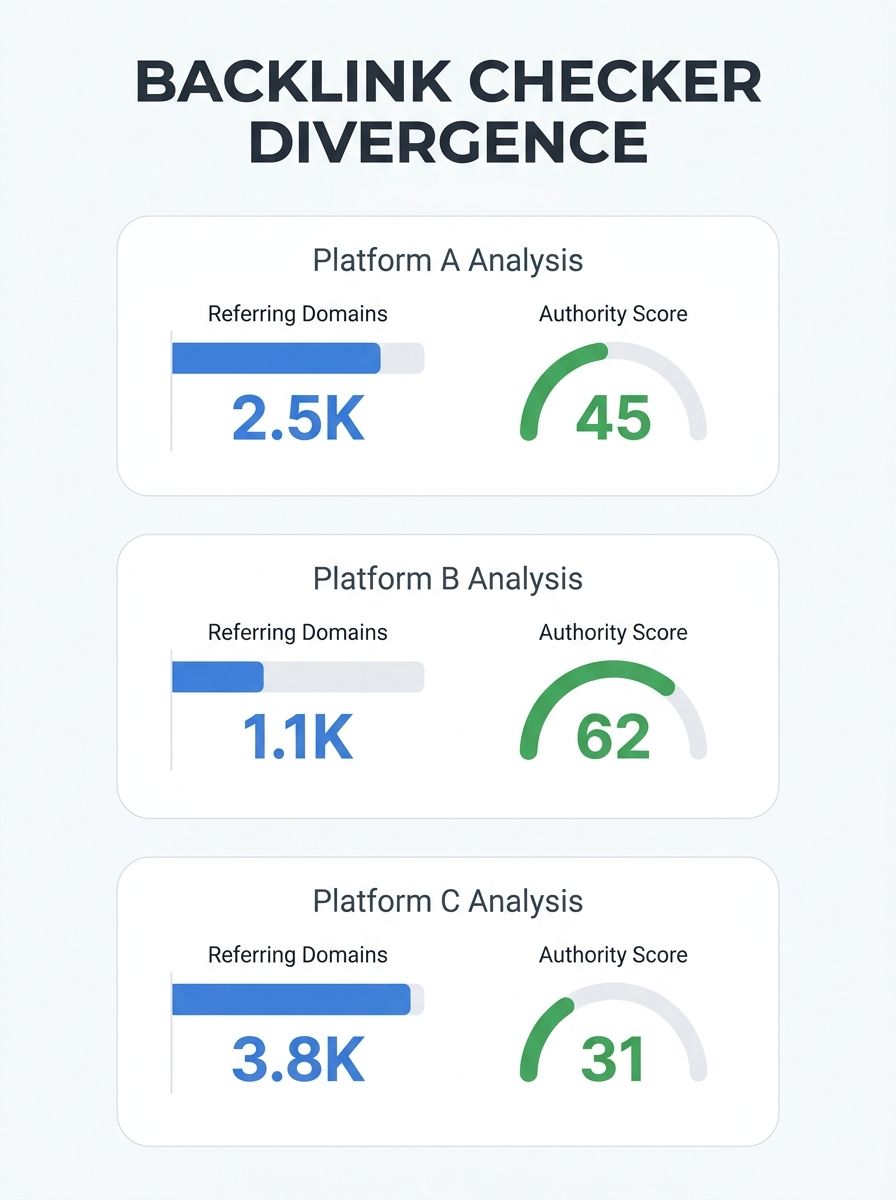
Running a single domain through Ahrefs, Semrush, and Moz on the same date produced referring domain counts of 1,240, 980, and 640 respectively for Bullock's own website during a 2025 site rebuild, representing a 93.8 percent variance between the highest and lowest reported figures. The tools disagreed not due to technical errors but because each platform's crawler had indexed different link sets at different refresh intervals.
Approximately one-third of the 1,240 domains Ahrefs reported consisted of guest posts and interviews published between 2014 and 2017 that had since been deleted, moved to new domains, or taken offline entirely. The links remained visible in Ahrefs' index because the crawler had not re-verified those specific pages in subsequent months. Similar patterns affect competitive SEO platform comparisons, where database size claims mask significant differences in link freshness and validation frequency.
"The crawler simply hadn't found the same set of pages," Bullock wrote in the analysis, explaining why identical domains produce non-overlapping backlink profiles across platforms.
The Authority Score Problem
Domain Rating (Ahrefs), Domain Authority (Moz), and Authority Score (Semrush) represent proprietary estimates of ranking likelihood calculated through formulas loosely modeled on Google's original PageRank algorithm, yet Google Search Advocate John Mueller has confirmed multiple times that Google's ranking systems do not incorporate any of these third-party scores. The metrics correlate with strong rankings in aggregate because sites with numerous quality links from diverse domains often perform well in search results, but optimizing specifically to raise a tool's authority number does not directly improve Google visibility.
One client documented in the analysis spent £3,000 across four months purchasing links exclusively to increase Domain Rating from 18 to 30. The campaign successfully raised the score to 27 through links from low-traffic directories and article farms created solely to sell links, yet organic traffic remained flat throughout the initiative. The score increased while no business outcome improved.
CMOs evaluating link building proposals should distinguish between metrics that predict ranking potential (referring domain diversity, topical relevance of linking sites, organic traffic to linking pages) and metrics that exist primarily within the SEO tools ecosystem. Link building frameworks increasingly emphasize editorial placement criteria over score manipulation to align vendor activity with actual ranking signals.
Why This Matters Now
The 100 percent variance documented across major backlink checkers creates immediate problems for agencies presenting competitive benchmarking reports and for marketing teams allocating link building budgets based on gap analyses. When three industry-standard tools report referring domain counts that vary by double-digit percentages for the same target, the baseline for competitive positioning becomes unreliable. CMOs who approve link acquisition spending tied to closing a "referring domain gap" identified by a single tool may be funding campaigns built on incomplete data.
The dead-link retention problem compounds these accuracy issues. With one-third of detected links pointing to deleted pages that remain cached in checker databases for months, businesses risk basing outreach strategies on link profiles that substantially overstate current live link counts. Before committing budget to guest posting, sponsored content, or directory submissions aimed at specific authority score targets, marketing managers should verify that the score itself correlates with their actual traffic and conversion outcomes rather than accepting it as a self-evident KPI.
Organizations transitioning to AI-mediated search visibility strategies face an additional complication: the proprietary authority scores built for traditional search have no established correlation to citation rates in ChatGPT, Perplexity, or Google AI Overviews. Backlink checkers remain useful for discovering link acquisition opportunities and monitoring competitive activity, but treating their output as objective ground truth rather than one vendor's incomplete snapshot leads to misallocated resources and misaligned performance expectations.
Marcus Webb
Digital marketing consultant and agency review specialist. With 12 years in the SEO industry, Marcus has worked with agencies of all sizes and brings an insider perspective to agency evaluations and selection strategies.
Related Articles
Link Building Package Industry Challenged as Analysis Labels Most Services "Waste of Money" for Small Businesses
Digital marketing firm Ingenious Netsoft published an industry analysis on June 16, 2026, arguing that most pre-packaged link building services sold to small businesses deliver minimal search ranking value because they prioritize link quantity over the relevance and trust signals Google's algorithms
SEO Tool Traffic Estimates Run 7 to 9 Times Higher Than Google Search Console Data in Side-by-Side Testing
Ahrefs and Semrush traffic estimates exceeded actual Google Search Console clicks by 7.1 and 9.2 times respectively when tested on the same domain during the same measurement period, according to a six-test analysis published September 25 by Arfadia, an Indonesian SEO agency.
Organic Traffic Declines Persist Despite SEO Improvements, LeadRaft Marketing Framework Shows
Organic traffic can decline even when SEO metrics improve, according to a diagnostic framework published September 19 by LeadRaft Marketing that identifies seven distinct factors causing visitor drops independent of optimization quality.
Explore more topics